
The castle at 7am when the morning mist is still in the river valley below and the city is entirely yours, the Dragon Bridge and its four corner dragons that have been watching the Ljubljanica since 1901, the Central Market designed by Jože Plečnik — the architect who built a city in his own image — the wine bars of the Stara Ljubljana that pour the orange wines of the Vipava Valley, and why Ljubljana is the most liveable capital in Europe that nobody has quite caught up with yet.
Reading time: 7 minutes | Last updated: 2026
Ljubljana has approximately 295,000 residents and is the smallest capital city in the European Union. It has a medieval castle on a forested hill above a Baroque old town bisected by an emerald-green river, a covered market designed by the architect Jože Plečnik (who spent the period between 1921 and his death in 1957 redesigning the city as a continuous personal project), a pedestrianised centre so complete that the entire old town is walkable end to end in 20 minutes, and a proportion of cafes, restaurants, and wine bars to permanent population that is perhaps the highest in Europe.
It receives approximately 600,000 visitors per year — compared to Dubrovnik’s 4 million, Bruges’ 8 million, or Prague’s 7 million. The absence of overtourism is not a marketing phrase. It is a current fact about a city that is, by most liveable-city metrics, the finest small capital in Europe.
These 48 hours are the case for going before the crowds figure it out.
Hour-by-Hour
Day 1
7:00am — Ljubljana Castle
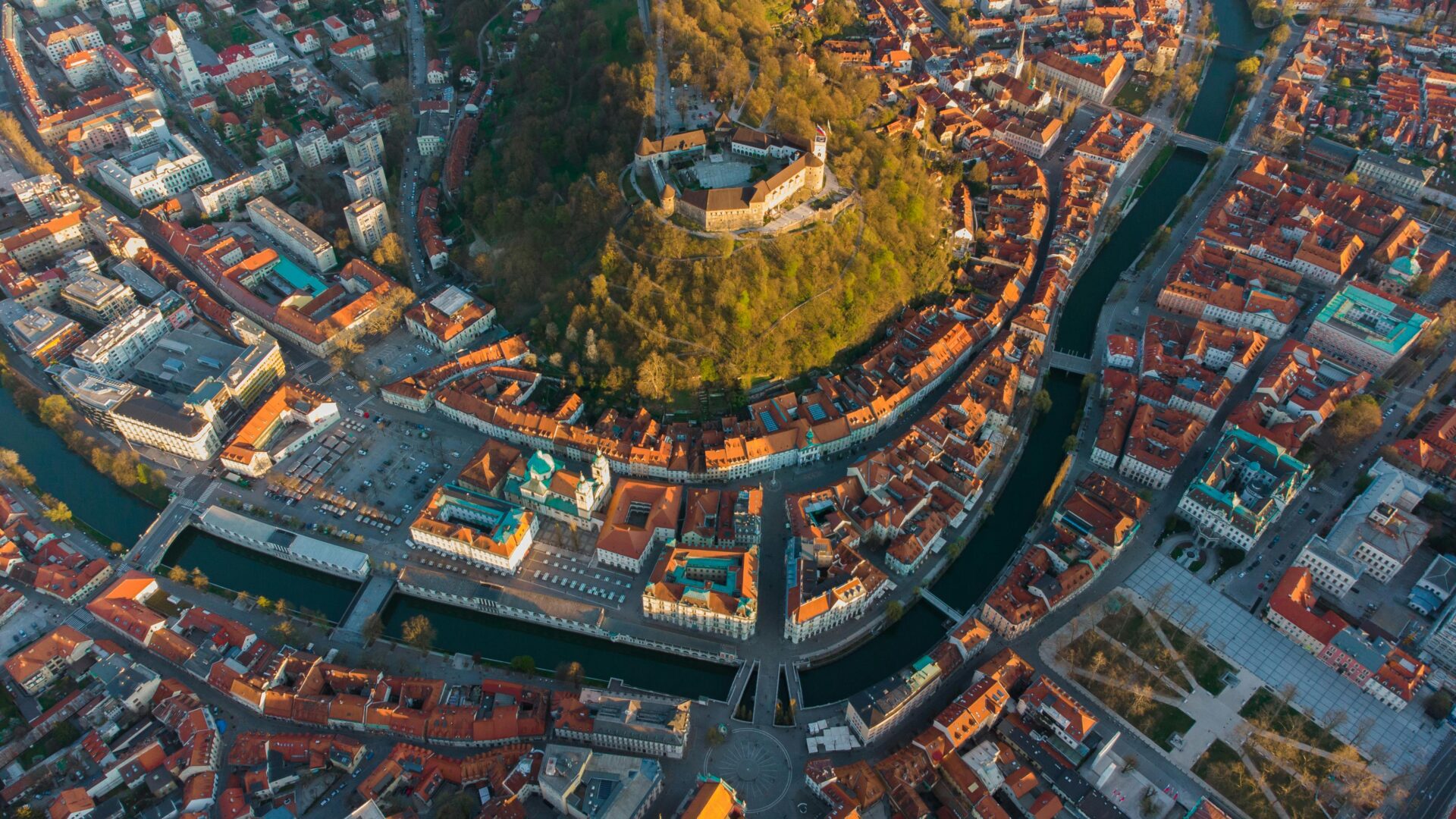
The Ljubljana Castle (Ljubljanski Grad) sits on a forested hill 375 metres above the old town — 5 minutes on foot from the Stara Ljubljana by funicular (€3 / £2.58 return, operates from 9am) or 15 minutes on foot from the Reber Street staircase (the old stone staircase up the south face of the hill, lit by lanterns, the city visible through the trees as you climb).
At 7am, on foot: the staircase is empty. The castle courtyard is open without a ticket before the visitor centre opens at 9am. The view from the castle ramparts: the Ljubljanica River below, the old town’s Baroque rooftops, the Ljubljana Basin extending to the Kamnik-Savinja Alps visible to the north on clear mornings. The Alps — genuinely snowcapped for much of the year — appear directly behind the castle hill, giving Ljubljana the specific urban Alpine quality that few European capitals have.
The castle in the morning fog (October-November): the valley below white, the castle above it. One of the finest early morning urban views in Central Europe.
9:00am — The Central Market (Plečnikov trg)
The market designed by Jože Plečnik along the Ljubljanica river embankment — completed in 1944, the long colonnaded halls running parallel to the river, the specific architectural vocabulary of Plečnik’s Ljubljana (the classical column repurposed in a modernist frame, the human scale maintained at every point).
The market at 9am: the Slovenian smallholders and the organic producers from the Ljubljana basin selling their produce. The specific Slovenian market products: the forest honey (the lime blossom honey of the Slovenian beekeeping tradition — Slovenia is the only country in the world to have bred an indigenous bee subspecies, the Carniolan bee, which produces the honey without winter feeding), the štruklji (the rolled pasta dumpling filled with cottage cheese, the classic Slovenian food served at the market stalls from 9am), and the fresh goat’s cheese from the Karst plateau.
The fish section (the Plečnik covered fish market, a separate structure at the market’s east end): the trout from the Soča River and the Sava River tributaries — the Soča marble trout (an endemic subspecies found only in the Soča system, wild-caught, available from licensed vendors) is the finest freshwater fish available in Ljubljana.
Free to enter. Budget €5-15 / £4.30-12.91 for market purchases.
10:30am — The Old Town: Plečnik’s Ljubljana
The Stara Ljubljana (Old Town) on both banks of the Ljubljanica — the Baroque facades on the east bank (the Ljubljana that existed before Plečnik), the Plečnik interventions visible at every turn.
The Plečnik inventory:
Triple Bridge (Tromostovje): Three bridges crossing the Ljubljanica from the Prešeren Square — the central stone bridge is original (1842), the two flanking bridges added by Plečnik in 1932, the ensemble creating a pedestrian crossing of unusual width and grace.
Shoemaker’s Bridge (Čevljarski most): A pedestrian bridge with a pergola of columns and flower boxes — the summer version of the bridge covered in flowering plants.
The National and University Library (NUK): Plečnik’s masterpiece — completed 1941, the red brick and stone exterior giving way to a black marble entrance staircase (the specific instruction: you enter from the light of the street into the darkness of the staircase into the light of the main reading room — the transition from darkness to light representing the transition from ignorance to knowledge). The reading room is accessible to visitors; the library is still operational. Free entry during opening hours.
1:00pm — Lunch: Odprta Kuhna (Open Kitchen Market, if Friday)
On Friday midday (11am-4pm) from March through October: the Odprta Kuhna (Open Kitchen) operates in the Central Market square — 60+ Slovenian restaurants and food producers serving their dishes at market stalls, the finest weekly street food market in Central Europe. Everything from Slovenian forest mushroom risotto to the potica (the rolled nut pastry that is the Slovenian national dessert) to the štruklji to the Primorska wine served in glasses at the standing tables.
Cost: €5-15 / £4.30-12.91 per dish.
If not Friday: the Fala restaurant (Gornji trg, Old Town) for the finest traditional Slovenian lunch — the jota (the bean and sauerkraut soup of the Karst region), the žganci (buckwheat groats with bacon and sour milk), and the potica to close.
3:00pm — The Ljubljanica by Kayak
The Ljubljanica River through the old town is navigable by kayak — hire from Kayak Ljubljana at the embankment (€12 / £10.33/hour). The river at the level of the water: the Plečnik embankments visible from below, the castle reflected in the surface, the dragon heads of the Dragon Bridge visible from the water at eye level. The most specific Ljubljana perspective.
Alternatively: the horse-drawn carriage tour of the old town (€16 / £13.77/person, 30 minutes, departs from Prešeren Square) gives the same streets at a pace that walking doesn’t enforce.
5:00pm — Tivoli Park and the Promenada
The Tivoli Park (the main city park, 5 minutes west of the old town): 510 hectares of forest and formal garden in the Ljubljana Basin, the Jakopič Promenade (the wide gravel avenue lined with photographic exhibitions mounted on the trees — a continuous outdoor gallery that changes annually) leading from the park entrance toward the castle hill.
The park at 5pm on a weekday: the Ljubljana residents in their post-work mode — the runners, the dog walkers, the parents with children, the chess players at the permanent stone tables. The specific quality of a city park that functions for its residents rather than primarily for visitors.
Free access.
7:00pm — Metelkova
Metelkova Mesto — the former military barracks complex converted by squatters in 1993 (the day after the Slovenian army moved out) into the finest alternative cultural centre in Central Europe. The squatter community painted the entire complex in murals, installed art installations in every courtyard, and established the music venues, the Hostel Celica (an art hotel in the former prison cells, each cell decorated by a different artist), and the bars that have operated continuously since 1993.
At 7pm: the outdoor bars opening, the murals visible in the evening light, the Hostel Celica visible through the courtyard gate. The evening programme — jazz, electronic, folk, and everything between — begins at 9pm.
Free access to the exterior. Bar drinks: €3-6 / £2.58-5.17.
Day 2
8:00am — Lake Bled (55km northwest)
Ljubljana’s most famous day trip — Lake Bled (the Alpine lake with the island church and the cliff castle) is 1 hour by car or 1.5 hours by train (GoOpti shuttle or regular train from Ljubljana Station: €10-15 / £8.61-12.91 one way).
The lake circuit (6km, 1.5 hours on foot): the Vintgar Gorge (4km from the lake, the Radovna River through a narrow limestone gorge with wooden walkways above the water — the finest gorge walk in Slovenia). The traditional pletna boat (a flat-bottomed wooden boat rowed standing by a single oarsman using a specific Bled rowing technique — the oarsmen’s families have held the monopoly on the pletna service since the 18th century) to the island church.
The Bled cream cake (kremna rezina): the Bled-specific custard and cream slice, created at the Park Hotel in 1953 and now protected as a Bled trademark. At the Slaščičarna Simon café on the lake promenade: €4.50 / £3.87.
1:00pm — Return to Ljubljana: Afternoon at Leisure
Return to the city. The afternoon options:
The Slovenian Ethnographic Museum (covering the material culture of Slovenian rural life — the beehive panels, the Slovenian beekeeping tradition, the folk costumes of the different Slovenian regions): entry €5 / £4.30.
The wine bars of the old town: Dvorni Bar (Dvorni trg, the wine bar with the finest Slovenian wine list — the orange wines of the Vipava Valley, the Malvasia of the Kras, the Refošk) or Vino Boutique for the smallest-producer natural wines. Wine by the glass: €4-8 / £3.44-6.89.
5:00pm — Departure
Essentials
Getting there: Ljubljana Jože Pučnik Airport (LJU), 26km north of the city. Wizz Air from London Luton and Stansted direct (2.5 hours, return from £40-120). The Flixbus also connects Ljubljana to Vienna (6 hours), Venice (3.5 hours), and Trieste (3 hours) for overland combinations.
City transport: Ljubljana’s old town is walkable. The Kavalir (the free electric courtesy car operating in the pedestrian zone) serves those who can’t walk the distances. Taxi and Uber available for the Metelkova and Tivoli distances.
When: May-June (the lake circuit at peak green, the Friday market open, the outdoor café culture beginning) or September-October (the Bled lake reflection finest in autumn light, the market still running, the crowds significantly reduced from August).
Currency: Euro. Ljubljana is among the cheaper Western European capitals — dinner at a good restaurant: €20-35 / £17.22-30.13 per person with wine.
The Closing Moment
I was on the castle ramparts at 7:20am. The fog was in the valley — the Ljubljanica invisible, the old town rooftops emerging from the white, the Alps behind it all with their tops in the clear air above the fog line.
A city of 295,000 people. The entire old town walkable in 20 minutes. The market on the river. The Plečnik bridges. The wine bars that open at 5pm and close when the last person leaves.
Ljubljana is the European city that answers the question most travellers are not quite asking: what does a city look like when it hasn’t been consumed by its own tourism? The answer is a castle in the morning fog and a market on the river and wine in the afternoon and Metelkova at night.
Go before the crowds arrive. They will.