
The Queen Victoria Market at 7am when the vegetable and meat vendors are supplying the Melbourne restaurants and the city is visible in its working state before the Saturday morning crowd transforms it into something more performative, the Hosier Lane street art that is repainted weekly by the Melbourne graffiti community and that documents the city’s specific relationship with public expression, the rooftop bar at dusk that gives the city grid from above, and why Melbourne — the city whose airport arrivals signs famously declare “you’re in the right city” — earns that confidence in 48 hours if you know where to look.
Reading time: 9 minutes | Last updated: 2026
Melbourne is Australia’s second city — 5.1 million people in the greater metropolitan area, the city on the Yarra River that lost the competition to be Australia’s capital (Canberra was built between Melbourne and Sydney as the compromise) and has spent the subsequent century establishing a cultural superiority that the Australian national debate has never fully resolved.
The Melbourne proposition: the best coffee in Australia (the city that invented the flat white — the competing claim from Auckland notwithstanding — and that has built a café culture around the espresso bar that the rest of the world’s specialty coffee scene has spent 20 years trying to replicate), the best food scene in Australia (the multicultural kitchen — the Vietnamese, the Lebanese, the Greek, the Italian, the indigenous bush food — that reflects the specific immigration waves that built the city), and the best street art in the southern hemisphere (the laneway culture that has turned the city’s back alleys into the most significant outdoor art gallery in Australia).
The 48 Hours
DAY ONE
7:00am — The Queen Victoria Market
The Queen Victoria Market (Victoria Street — the 1878 market building, the largest open-air market in the southern hemisphere, operating Tuesday, Thursday, Saturday, and Sunday): at 7am on a Saturday, the market’s working state visible before the recreational shopping crowd arrives at 9:30am.
The Queen Vic at 7am: the Deli Hall (the covered hall running the length of the market — the Greek feta from the Delphi Greek Foods stall that has been here for 40 years, the Italian charcuterie from the continental delis, the smoked fish from the seafood vendors, the Melbourne market culture that reflects the Mediterranean immigration wave of the 1950s-70s visible in the vendors whose families established here). The Meat Hall (the butchers supplying the Melbourne restaurants). The organic produce section (the Victorian farmers who drive to the market before dawn with the seasonal vegetables — the broad beans in spring, the artichokes in summer, the Jerusalem artichokes in winter).
The market breakfast: the corn on the cob roasted at the market entrance stall (AUD $4 / £2.03), the Dutch stroopwafel from the Stroopies stall (AUD $3.50 / £1.78), and the coffee from the Beppe & Roberto Italian coffee stand (the flat white, AUD $5 / £2.54).
9:30am — The Laneways
The Melbourne laneway circuit (the specific network of back alleys — Hosier Lane, Caledonian Lane, AC/DC Lane, Duckboard Place — that constitutes the most concentrated street art precinct in Australia):
Hosier Lane: The most famous Melbourne laneway, the walls repainted weekly by a rotating community of Melbourne street artists (the works accumulate in layers — the layer visible today will be covered by next week’s work, the laneway a palimpsest of the city’s creative conversation). The bins, the doorways, the entire cobbled surface covered. Free access.
Degraves Street: The espresso bar laneway — the café terraces at street level, the apartment windows above, the specific Melbourne laneway café atmosphere that influenced the global specialty coffee shop aesthetic.
The Melbourne laneways at 9:30am: the artists sometimes visible applying work in the morning, the photography crowd building but manageable before 11am.
11:00am — The National Gallery of Victoria
The NGV International (180 St Kilda Road — the largest art museum in Australia, the collection spanning from the ancient world to the contemporary): the specific rooms:
The Great Hall: The stained glass ceiling (the ceiling of 50,000 hand-fitted pieces of glass, the largest stained glass ceiling in the world, the light filtering into the hall below) — the most architecturally specific room in any Australian museum.
The Rembrandt collection: The Self Portrait (1659-60, one of six Rembrandt self-portraits in Australia — the late period, the specific Rembrandt vulnerability of the ageing face).
The contemporary Australian collection: The work of John Brack, Sidney Nolan, Arthur Boyd — the mid-20th century Australian painting that established the country’s visual arts identity.
Entry: free for the permanent collection.
1:30pm — Lunch: Flinders Lane
Flinders Lane (the restaurant corridor parallel to Flinders Street — the concentrated restaurant strip that gave Melbourne its food reputation before the suburban food scene developed): the Cumulus Inc. (45 Flinders Lane — the Andrew McConnell restaurant that has been the reference for the Melbourne casual fine dining approach for 15 years, the 12-hour slow-roasted lamb shoulder, the raw fish with the finger lime): AUD $30-55 / £15.24-27.94 per main.
The accessible alternative: the Movida (1 Hosier Lane — the Spanish tapas at the laneway entrance, the pintxos and the croquetas and the tortilla): AUD $6-12 / £3.05-6.10 per tapa.
3:00pm — Federation Square and the Yarra
The Federation Square (the 2002 public space at the corner of Flinders and Swanston — the zinc and glass façade buildings, the ACMI (the Australian Centre for the Moving Image — the museum of screen culture, the collection covering Australian film and television history: entry free), and the Ian Potter Centre: NGV Australia (the collection of Australian art including the largest collection of Aboriginal and Torres Strait Islander art in Australia: entry free).
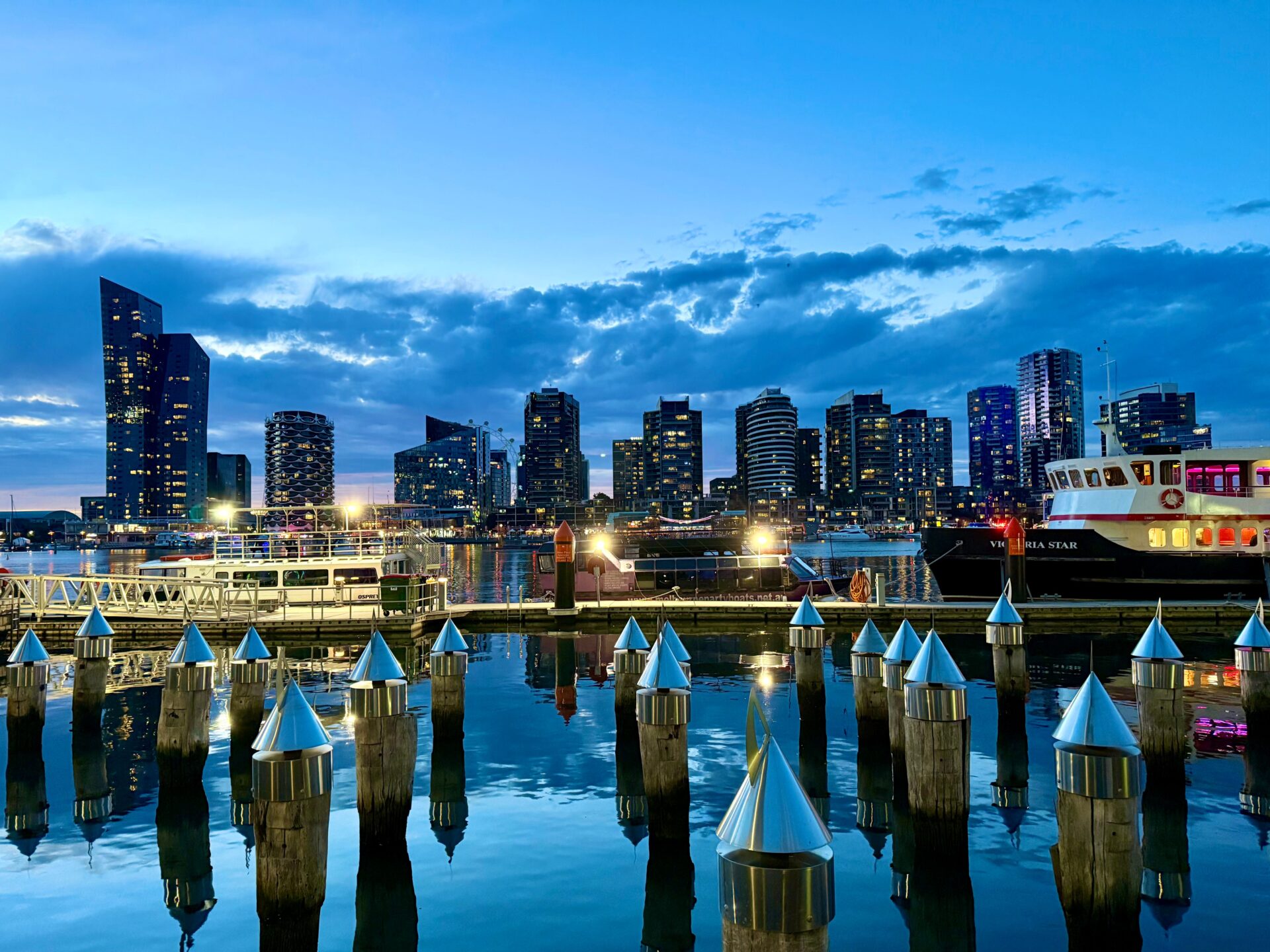
The Yarra River walk (the path along the north bank from Federation Square west to Docklands — the street art visible on the south bank walls, the rowers on the river, the specific Melbourne river quality of a working waterway used as a recreational axis): 30 minutes.
5:30pm — The Rooftop Bar
The Rooftop Bar at the Curtin House (252 Swanston Street — the bar on the 6th floor of the Curtin building, the open-air rooftop with the city grid visible in all directions, the Melbourne CBD grid at dusk): the flat white replaced by the local craft beer, the skyline in the evening light. Entry: free. Drinks: AUD $10-18 / £5.08-9.14.
The Naked for Satan (285 Brunswick Street, Fitzroy — the rooftop bar alternative in the Fitzroy neighbourhood for the visitor who wants the Brunswick Street evening rather than the CBD): AUD $10-16 / £5.08-8.12 per drink.
8:00pm — Dinner: Fitzroy or Carlton
The two neighbourhoods that give the most concentrated Melbourne food experience outside the CBD:
Carlton: The Italian heart of Melbourne — Lygon Street (the restaurant strip, the Italian immigrants who established here from the 1950s, the pizza and the pasta that predate the wood-fired fashion): the Tiamo (303 Lygon Street — the Italian restaurant that has been open since 1978, the bolognaise, the parmigiana, the specific Carlton Italian that is not fashionable but is correct): AUD $25-40 / £12.70-20.32 per main.
Fitzroy: The more contemporary food neighbourhood — Smith Street (the Vietnamese pho from the Hanoi Hannah, the Sri Lankan curry from the Lankan Tucker, the Turkish pide from the local bakery): AUD $15-30 / £7.62-15.24 per main.
10:00pm — Brunswick Street
Brunswick Street (Fitzroy — the Melbourne alternative culture street, the bars, the record shops, the late-night food): the Builders Arms Hotel (211 Gertrude Street — the Melbourne pub that defines the neighbourhood pub at its most Melbourne: the local craft beer, the wooden floors, the specific Melbourne pub that is neither a sports bar nor a hotel): AUD $10-16 / £5.08-8.12 per pint.
DAY TWO
8:00am — The Collingwood Farmers Market (Sunday) or the St. Kilda Market (Sunday)
The Collingwood Farmers Market (Sunday, second and fourth): The Abbotsford Convent (Johnston Street — the market in the grounds of the former convent, the Victorian farmers directly to the public, the free-range eggs at the correct price, the heritage tomatoes from the Yarra Valley, the raw milk cheese from the Gippsland farms): AUD $10-20 / £5.08-10.16 for the full market breakfast circuit.
The St. Kilda Esplanade Market (Sunday): The Sunday art and craft market on the St. Kilda foreshore — the watercolour seascapes of Port Phillip Bay, the photography, the ceramics. Less food, more art. The correct alternative for the visitor who has done the Queen Vic on Saturday.
10:30am — The Melbourne Museum
The Melbourne Museum (Carlton Gardens — the Museum Victoria science and natural history museum, the Phar Lap section (the stuffed hide of the New Zealand-bred Australian racehorse that won 37 of 51 starts in the early 1930s and that is as culturally significant in Australia as Red Rum in the UK — perhaps more so), the Forest Gallery (the indoor temperate rainforest, the living plants, the specific museum architecture that integrates the natural world into the building): entry AUD $15 / £7.62.
1:00pm — Lunch: South Melbourne Market
The South Melbourne Market (Corner Cecil and Coventry Streets, South Melbourne — the neighbourhood market serving the South Melbourne residential population since 1867, the specific Melbourne market that is least oriented toward the tourist and most oriented toward the resident): the dim sim (the South Melbourne Dim Sim, the large steam or fried dumpling that is the specific South Melbourne market specialty, invented here in the 1940s and served from the original stall: AUD $3.50 / £1.78 each steamed, $4 / £2.03 fried), the gozleme (the Turkish stuffed flatbread from the market stall): AUD $10-14 / £5.08-7.11.
3:00pm — St. Kilda
The St. Kilda foreshore (the beachside suburb 6km south of the CBD — the Acland Street cake shops (the Jewish-European confectionery tradition that established in St. Kilda in the post-war period, the Monarch Cake Shop the reference: the flourless chocolate cake, the apple strudel, the babka): AUD $4-8 / £2.03-4.06 per slice), the Luna Park (the 1912 amusement park at the foreshore, the Scenic Railway — the oldest continually operating roller coaster in the world), and the St. Kilda Pier penguins (the little penguin colony that nests under the pier, visible at dusk when the birds return from the daily fishing — free viewing from the pier, the volunteer guides available at the breakwater from sunset).
6:00pm — Final Dinner: Chinatown
The Melbourne Chinatown (Little Bourke Street — the oldest continuously operating Chinatown in the western world, established 1854, the dim sum restaurants operating from 11am and the yum cha tradition functioning as the Melbourne Sunday lunch institution):
The Flower Drum (17 Market Lane — the Cantonese fine dining restaurant that has been Melbourne’s most celebrated Chinese restaurant since 1975, the roast Peking duck, the king prawns with XO sauce): AUD $50-100 / £25.40-50.79 per person. Book at flowerdrum.com.au.
The accessible Chinatown: the Shanghai Street Dumpling (noodles and dumplings at the communal table, the xlb — xiaolongbao, the soup dumpling — at AUD $12-18 / £6.10-9.14 for 8 pieces).
The Essentials
Getting to Melbourne: Qantas direct from Heathrow (21 hours). Singapore Airlines via Singapore. Emirates via Dubai. Return: £700-1,200.
Getting around: The Myki card (the Melbourne transit card, covering the tram, the train, and the bus network: AUD $6 / £3.05 card fee, top up at any 7-Eleven or station). The tram is free in the CBD zone (the free tram zone covering the city grid — the CBD tram travel with no Myki required within the zone boundaries).
The coffee instruction: Melbourne’s coffee culture has a specific vocabulary. The flat white (the double shot in a smaller cup with the milk microfoam) is the standard Melbourne coffee. The long black (the Americano equivalent, the espresso poured over hot water) is the correct black coffee. The “latte” in Melbourne is a single shot in a large cup — specify “double shot latte” if required. Never order a “regular coffee” — this triggers mild professional concern.
Where to stay: The QT Melbourne (133 Russell Street — the design hotel: AUD $200-350 / £101.52-177.66/night), the Ovolo Laneways (19 Little Bourke Street: AUD $180-300 / £91.37-152.28/night), the Space Hotel (380 Russell Street, the design hostel: private rooms from AUD $80-130 / £40.61-66.00/night).
The Closing Moment
I was at the Queen Victoria Market at 7:12am. The Deli Hall was in the first 20 minutes of opening — the vendors arranging the displays, the fluorescent lights on the marble counters, the Greek feta being unwrapped from its brine container.
The owner of the Delphi Foods stall had been here, his family told me, since 1968. He arrived from Thessaloniki with enough capital for one week’s rent. He has been in the same location for 56 years.
Melbourne’s food culture is built on this continuity — the Greek delicatessen that has been in the Queen Vic since 1968, the Italian espresso bar in the laneway since 1978, the Chinese restaurant since 1975. The multi-cultural kitchen that the city celebrates as its contemporary identity is not a recent invention. It is the accumulated result of the specific immigration waves that each generation of Melburnians brought with them.
The feta was good. The flat white at 8am was better.