
The Baščaršija at 7am when the copper hammers are not yet audible and the Gazi Husrev-bey Mosque is in the morning light and the Ottoman market quarter that the Ottomans built in 1462 is visible in its pre-tourist version, the Tunnel of Hope at 11am where the 800-metre passage under the Sarajevo airport runway was the city’s only connection to the outside world for 1,425 days, the ćevapi at Ćevabdžinica Hodžić at noon where the minced beef sausages have been grilled in the same wood-fired mangal since 1884, and why Sarajevo — the city that hosted the 1984 Winter Olympics and then survived the longest siege of any capital city in the history of modern warfare — is the most historically consequential 48-hour destination in the Balkans.
Reading time: 9 minutes | Last updated: 2026
Sarajevo sits in a river valley surrounded by mountains — the valley that gave the city its strategic position as the Ottoman administrative capital of Bosnia and Herzegovina and the same mountains that the Serbian Army used as artillery positions during the 1992-1996 siege. The city of 420,000 has been occupied by the Ottomans, the Habsburgs, and then itself — the independent Bosnian state that declared independence in 1992 and was immediately besieged by the Serbian Army and Bosnian Serb forces.
The siege (April 5, 1992 to February 29, 1996 — 1,425 days) is the specific historical event that shapes every experience in modern Sarajevo. The bullet holes in the building facades. The rose-shaped shrapnel marks in the pavements (the Sarajevo Roses — the mortar blast marks that volunteers filled with red resin as memorials). The absence of the mixed Sarajevo that existed before 1992, replaced by a more ethnically segregated city. And the Tunnel of Hope — the 800-metre hand-dug passage under the airport that kept the city alive.
This guide visits Sarajevo as both the Ottoman city it was and the siege city it became. Both are inseparable from what the city is now.
The 48 Hours
DAY ONE
7:00am — The Baščaršija at Dawn
The Baščaršija (the Ottoman bazaar quarter — the market established by Isa-Beg Ishaković in 1462, the oldest continuously operating market in Bosnia): at 7am, the quarter before the tourist economy begins.
The Sebilj fountain (the 19th-century wooden fountain at the centre of the Pigeon Square — the pigeons that the Sarajevo residents feed each morning, the fountain that has been the gathering point of the Baščaršija since its construction in 1753): the specific Sarajevo morning around the Sebilj — the residents walking to the mosque, the early café opening, the coppersmiths beginning to set up on the Kazandžiluk Street (the Coppersmith Street).
The Kazandžiluk (the street of the coppersmith workshops — the hand-hammered copper trays, the džezva (the long-handled coffee pot for the Bosnian coffee), the copper plates): at 7am, the first workshops opening, the hammers beginning. The specific sound of the Baščaršija — the rhythmic copper hammering that is the aural signature of the market — is not audible before 8am.
The Bosnian coffee at the Baščaršija café: the coffee served in the džezva alongside the glass of water and the rahat lokum (the Turkish delight), the coffee poured into the small cup and drunk slowly. The distinction from the Turkish coffee: the Bosnian coffee is served with the grounds in the džezva, the drinker pouring their own cup and allowing the grounds to settle — the grounds never touch the cup. The Turkish coffee has the grounds already in the cup. €1-2 / £0.86-1.72.
9:00am — The Gazi Husrev-bey Mosque
The Gazi Husrev-beg Džamija (the 1531 mosque — the most beautiful Ottoman mosque in the Balkans outside Turkey, the interior space, the painted muqarnas in the dome, the courtyard with the saat-kula — the clock tower that shows Islamic prayer time rather than the 24-hour clock): the mosque at 9am, before the midday prayer crowd.
The adjacent Kurşumli Han (the 16th-century lead-roofed caravanserai — the former travellers’ inn, the courtyard visible through the gate): the most complete surviving Ottoman caravanserai in Bosnia.
10:30am — The Yellow Fortress
The Žuta Tabija (the Yellow Fortress — the 16th-century Ottoman fortification above the Baščaršija on the Jekovac hill): the 15-minute walk from the market, the view over the entire Sarajevo valley — the minarets and the church spires and the synagogue dome visible simultaneously from the fortress wall, the specific Sarajevo skyline that the four religious communities (Muslim, Orthodox Christian, Catholic, Jewish) built in the same valley.
Free access.
12:30pm — The ćevapi
The Ćevabdžinica Hodžić (Bravadžiluk 30 — the ćevapi restaurant operating since 1884, the original mangal, the family recipe):
The Sarajevo ćevapi (the dish that defines the city — the minced beef sausages grilled over the charcoal fire, served 10 per plate in the somun bread, the ajvar on the side, the kajmak (the dairy spread), the raw onion): the specific Sarajevo version of the ćevapi is different from the Belgrade or the Zagreb version — the Sarajevo ćevapi is thinner, the beef higher quality, the somun bread specific (the pita-style bread made fresh through the day at the Baščaršija bakeries).
BAM 8-12 / £3.49-5.24 per portion.
2:30pm — The History Museum
The History Museum of Bosnia and Herzegovina (Zmaja od Bosne 5 — the museum in the building that survived the siege, the interior still showing the damage from the shelling, the exhibition of the siege preserved in the space that experienced it): the most important museum in Sarajevo for the 1992-1996 period.
The siege exhibition: the specific daily life of the siege — the water collection, the food rationing, the burning of books and furniture for heat, the children’s artwork from the bunkers, the radio that kept the city connected to the world — presented in the building that was itself a target of the artillery on the hills above.
Entry: BAM 5 / £2.18.
4:00pm — The Sarajevo Roses Walk
The Sarajevo Roses (the mortar blast marks in the city pavement filled with red resin — the memorials to the mortar attacks on the civilian population): the walk through the old city identifying the roses in the pavement (the specific concentration at the Markale market — the site of the two massacres, February 5, 1994 and August 28, 1995, where the mortar shells killed 68 and 43 civilians respectively on the open market, the events that finally triggered NATO intervention).
The roses are in the pavement throughout the old city — the specific instruction is to look down rather than at the facades. The roses are the pavement-level history.
7:00pm — Dinner: the Inat Kuća
The Inat Kuća (the “Spite House” — the restaurant across the Miljacka River from the Vijećnica, the building moved stone by stone across the river in 1896 when the Austro-Hungarians wanted the site for the city hall and the owner refused to sell, agreeing only when the Habsburgs agreed to move the entire house to the new location): the Bosnian lamb stew (bosanski lonac), the stuffed peppers (punjene paprike), and the Bosnian wine (the Blatina from the Herzegovina vineyards): €25-40 / £21.55-34.48 per person.
DAY TWO
10:00am — The Tunnel of Hope
The Tunnel of Hope (Tunel spase — the full guide in 7 Days in the Balkans): the museum at the Kolar family house, the preserved 25-metre section of the original tunnel, and the film (the documentary covering the tunnel’s construction and operation — the most important single documentary available in Sarajevo for understanding the siege logistics): BAM 10 / £4.36.
The airport taxi (the taxi from the old city to the Butmir suburb takes 20-25 minutes — the route passing the airport fence that the tunnel passes under): BAM 20-30 / £8.73-13.10 each way.
12:00pm — The War Childhood Museum
The War Childhood Museum (Logavina 32 — the full guide in 7 Days in the Balkans): the personal objects and the testimonies of 60 individuals who were children during the siege. Entry: BAM 10 / £4.36.
2:00pm — The Latin Bridge and the Assassination Site
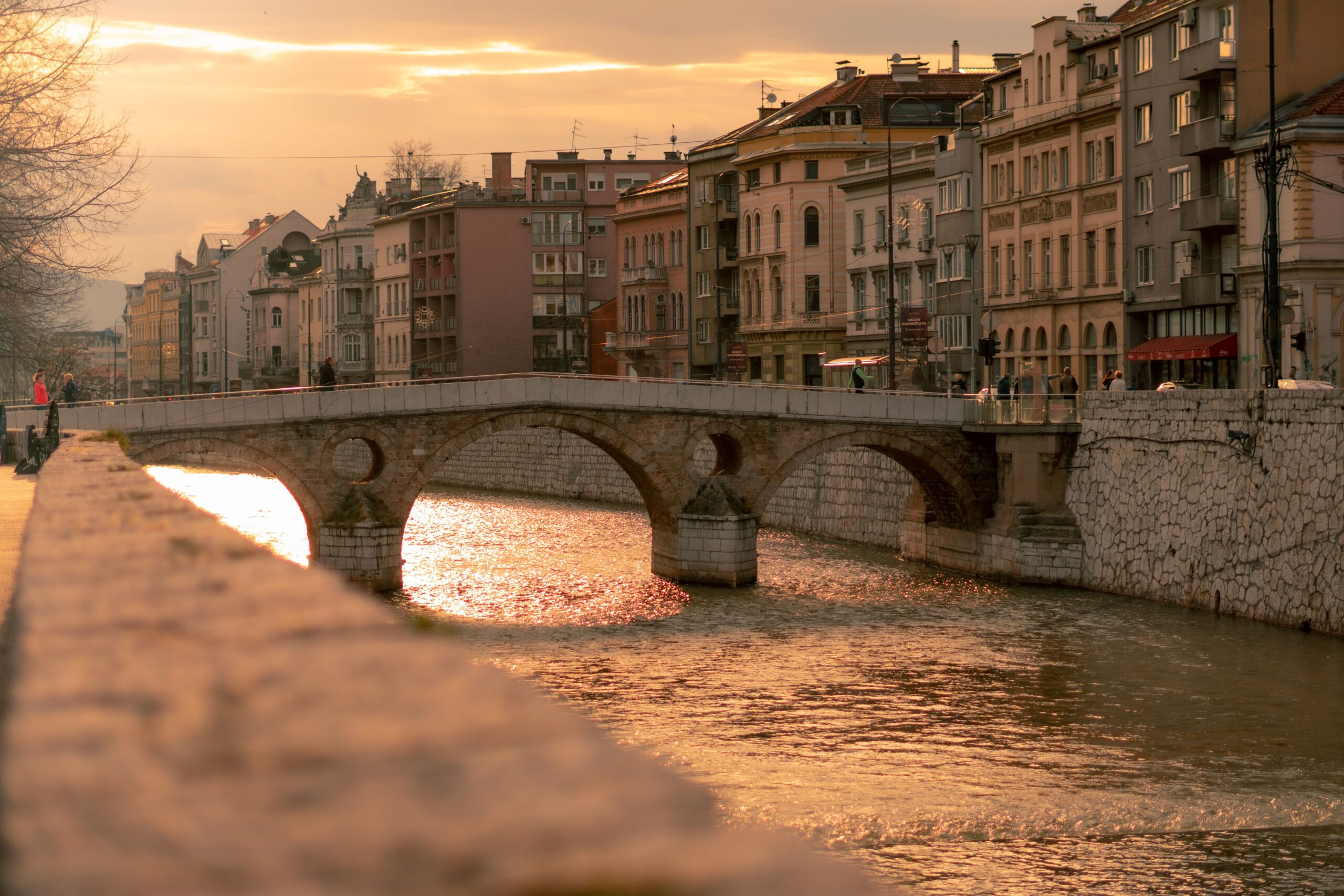
The Latin Bridge (the Latinska Ćuprija — the 16th-century Ottoman bridge over the Miljacka, the site of the June 28, 1914 assassination of Archduke Franz Ferdinand and his wife Sophie by Gavrilo Princip, the event that triggered the First World War):
The assassination is among the most consequential single acts of the 20th century — the specific geography (the car route, the incorrect turn that brought the Archduke’s vehicle back past Princip’s position, the second opportunity that changed the century) is comprehensible at the human scale of the city. The bridge is 200 metres from the corner where it happened.
The Sarajevo Museum 1878-1918 (adjacent to the Latin Bridge — the exhibition covering the Habsburg period and the assassination): entry BAM 7 / £3.06.
5:00pm — The Trebević Cable Car
The Trebević Cable Car (the cable car from the Bistrik neighbourhood to the Trebević mountain — the 1959 cable car destroyed during the siege and rebuilt in 2018, the ascent to the 1,163-metre summit visible above the city): entry BAM 10 / £4.36 return.
The Trebević summit: the bobsled track from the 1984 Winter Olympics visible from the cable car — the track that the Serbian Army used as an artillery position during the siege, the Olympic facility converted to a weapon against the city that celebrated it. The track is now a site of contested memory — the graffiti artists have covered it with murals, the structure decays in the forest above the city.
The view from the summit: the Sarajevo valley in the late afternoon light — the city below, the mosques and the churches visible, the mountains on the other side of the valley where the artillery was positioned.
The Essentials
Getting to Sarajevo: Ryanair direct from London Stansted. Austrian Airlines via Vienna. Wizz Air via various hubs. 2.5-3 hours from London. Return: £80-200.
Getting around: Walking for the old city (compact, the Baščaršija to the Latin Bridge is 800 metres). The taxi for the Tunnel of Hope and the cable car base. Bolt (the taxi app operates in Sarajevo).
The currency: Bosnia-Herzegovina uses the Convertible Mark (BAM). £1 ≈ 2.30 BAM. Cash is the primary transaction method in the Baščaršija.
Where to stay: The Hotel Europe (the Austro-Hungarian grand hotel, the most historically significant accommodation in Sarajevo: €80-150 / £68.97-129.31/night), the Hotel Kovači (the boutique hotel in the old city: €55-100 / £47.41-86.21/night), the Hostel Goli + Bosi (private rooms from €25-45 / £21.55-38.79/night).
The Closing Moment
I was at the Tunnel of Hope at 11:42am. The 25-metre preserved section of the tunnel. 800 metres wide at the shoulders. 1.6 metres tall — the crouch required to walk it.
The film showed the tunnel in operation: the food, the weapons, the civilians moving through. The 800 metres took 20-25 minutes to traverse if carrying a heavy load. The civilians often waited hours for the right moment to cross — the airport above was under United Nations control, and the UN knew about the tunnel and chose not to interfere, understanding that the tunnel was keeping the city alive.
Sarajevo is the city that survived by digging. The 800 metres of hand-dug passage under a functioning airport, the city above surviving for 1,425 days on what could be carried through — this is the specific Sarajevo story that the copper hammers and the ćevapi and the baroque beauty of the Baščaršija surrounds but does not replace.
Both are true. Both are here.