
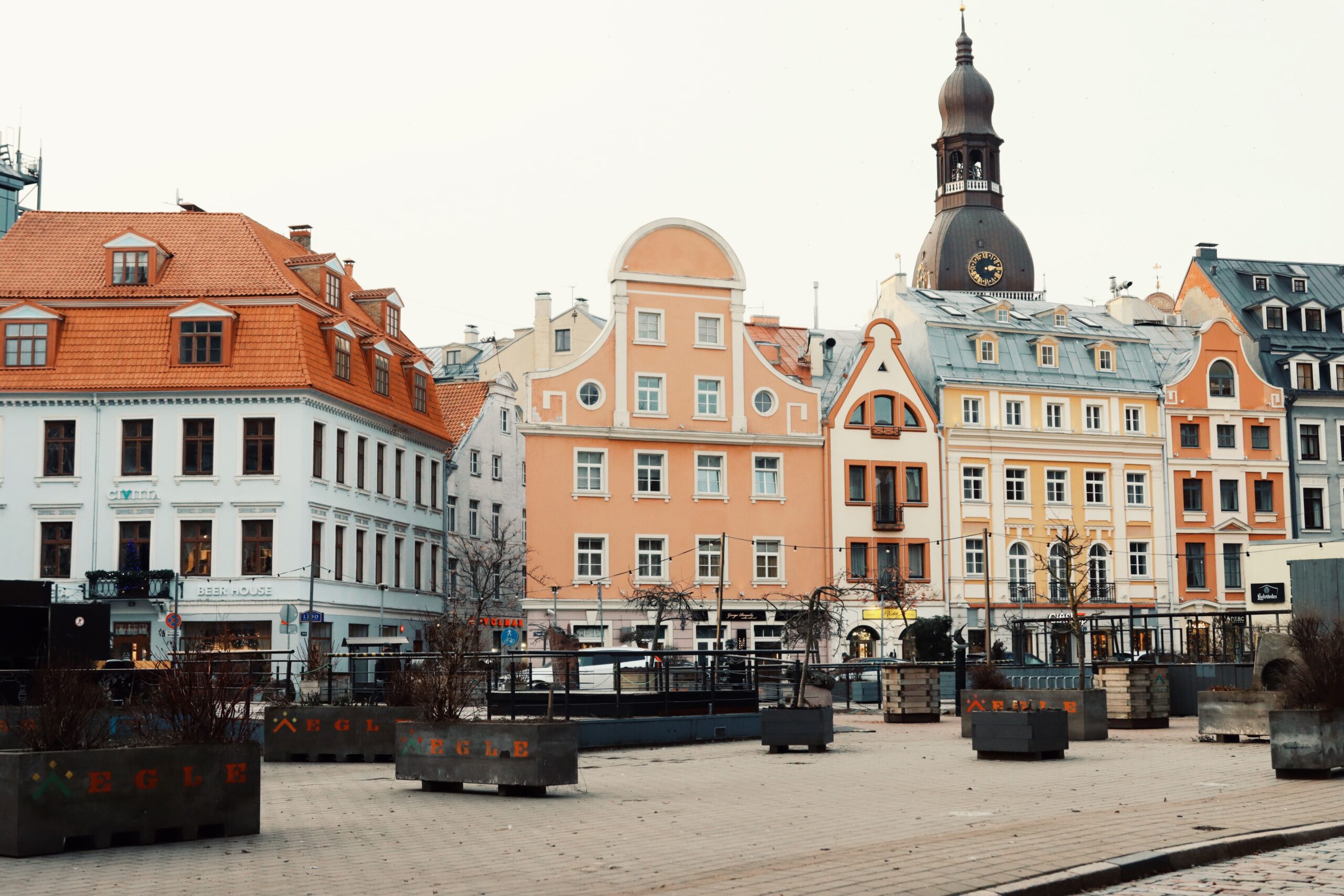
The Art Nouveau district north of the Old Town at 9am when the façades of Elizabetes and Alberta Streets are in the morning light and the specific Riga contribution to European architecture — the largest collection of Art Nouveau buildings in the world, 800 buildings covering a third of the city’s historic fabric — is visible without the distraction of the tour groups, the Riga Central Market at 7am where the Latvian grandmothers are selling the forest mushrooms and the smoked fish from the five German zeppelin hangars repurposed as the market halls, and why Riga — the Baltic capital that the Lonely Planet named the European Capital of Culture and that the UK traveller most often bypasses en route to Tallinn — deserves 48 hours of its own attention.
Reading time: 8 minutes | Last updated: 2026
Riga is the largest of the three Baltic capitals — 650,000 people, the city on the Daugava River estuary, the medieval trading city that the Hanseatic League made the most important commercial port on the eastern Baltic coast in the 13th-18th centuries. The specific Riga architectural heritage: the Old Town (UNESCO-listed, the Gothic and Baroque buildings of the Hanseatic period), the Art Nouveau district (the 800 Art Nouveau buildings from the 1890s-1914 boom period, the most concentrated collection in the world), and the Wooden Architecture district of Maskavas Forštate (the 19th-century wooden houses, the specific Latvia vernacular timber building tradition visible in the streets east of the Central Station).
The food: the Latvian culinary tradition is the least internationally known of the three Baltic kitchens and the most specifically linked to its landscape — the rye bread (the darkest, densest sourdough rye in Northern Europe), the smoked fish from the Gulf of Riga, the grey peas with the smoked lard (the pūpolu zirņi — the Latvian national dish by popular consensus), and the birch sap in spring (the sap collected from the silver birch in March-April, consumed fresh or fermented into a light wine).
The 48 Hours
DAY ONE
7:00am — The Riga Central Market
The Riga Central Market (the five former German Imperial zeppelin hangars repurposed as the covered market halls in 1930 — the largest market in Europe by floor area, the specific Riga market architecture where the industrial scale of the hangars gives the market a quality unavailable in any other European covered market): at 7am, the market in its working state.
The specific halls:
The Meat Hall: The Latvian smoked sausages (the ķirbis — the pumpkin-stuffed sausage, the specific Latvian preparation that is unavailable outside Latvia), the grey peas with the smoked lard (available as a prepared dish at the hall’s hot food counters): €3-5 / £2.59-4.31 per portion.
The Fish Hall: The smoked sprats from the Gulf of Riga (the brētliņas, the Baltic sprat, the fish that has been smoked over alder wood on the Latvian coast for 500 years — the specific Baltic smoked fish that the whole of Northern Europe has borrowed from the Latvian and Estonian coastal tradition): €4-8 / £3.45-6.90 per 200g.
The Vegetable Hall: The forest mushrooms in autumn (the boletus, the chanterelle, the penny bun — the Latvian forest mushroom tradition, the mushroom picking a civic activity in Latvia where the Latvians go to the forest to collect mushrooms the way the English go to the pub), the Latvian honey (the buckwheat honey — the dark, strongly flavoured honey specific to the buckwheat fields of Vidzeme).
9:00am — The Art Nouveau District
The Art Nouveau district (the streets north of the Old Town, particularly Elizabetes Street, Alberta Street, and the surrounding blocks): the most concentrated Art Nouveau in the world, 800 buildings in a coherent district.
The key facades:
Alberta 4: The Mikhail Eisenstein building (the father of film director Sergei Eisenstein was the architect responsible for the most elaborate of the Riga Art Nouveau façades — the four-storey building with the giant screaming masks, the female figures with the raised arms, the decorative excess that makes this the most theatrical single façade in the district): free to view from the street.
Alberta 13: The Jānis Alksnis building (the more restrained geometric Art Nouveau — the specific Latvian National Romantic addition to the international Art Nouveau vocabulary, the Latvian folk motifs visible in the ornament): free.
Elizabetes 10a: Another Eisenstein building — the female faces framed in the window surrounds, the floral decoration covering every available surface between the windows: free.
The Riga Art Nouveau Museum (Alberta 12 — the apartment preserved in its 1903 furnishing, the interior of the Art Nouveau era visible in the specific domestic scale): entry €6 / £5.17.
11:00am — The Latvian History Museum
The Latvian National History Museum (Brīvības boulevard 32 — the history of the Latvian people from the prehistoric Baltic tribes through the Hanseatic period through the Russian Imperial period through the brief independence of 1918-1940 through the Soviet occupation and the renewed independence of 1991):
The national dress collection (the Latvian traditional dress — the most complex regional variation of any national costume in Europe, each district having a specific colour and pattern, the museum collection giving the full geographic range): the most visually extraordinary single collection in Riga.
The Latvian Rifle collection (the Latvian rifle regiments that fought in the First World War as the most decorated units in the Russian Imperial Army, then became the backbone of Lenin’s personal guard in the Russian Revolution — the specific Latvian historical irony that the nation that later suffered most under Soviet rule provided the military force that brought the Soviet state into being): the exhibition that the Riga city guide often omits because the narrative is too complex for the tourist leaflet.
Entry: €5 / £4.31.
1:00pm — Lunch: the Lido Restaurant
The Lido Atpūtas Centrs (55 Krasta iela — the Latvian cafeteria chain, the most popular restaurant in Latvia by annual diner count, the self-service format with the Latvian traditional dishes displayed in the heated trays): the pork schnitzel (the Latvian karbonāde, the thin pork cutlet breaded and fried, the standard Latvian lunch), the grey peas with the smoked lard (pelēkie zirņi ar speķi — the dish of dried grey peas cooked until soft, the smoked pork fat cut over the top, the specific Latvian combination that sounds improbable and is quietly extraordinary), and the birch sap kvass (the fermented birch sap drink in season): €8-14 / £6.90-12.07 for a full lunch.
The Lido is not a tourist restaurant. It is where the Latvians eat lunch on a Tuesday. The prices reflect this.
3:00pm — The Old Town
The Riga Old Town (the UNESCO-listed medieval city — the Blackheads’ House, the Town Hall Square, the St. Peter’s Church):
The Blackheads’ House (Rātslaukums 7 — the 1334 guild house, destroyed in World War II, reconstructed in the 1990s with the Gothic and Renaissance façade restored to the 1625 state — the most architecturally elaborate single building in Riga): entry €9 / £7.76.
The St. Peter’s Church tower (the 123-metre church tower, the viewing platform at 72 metres — the view over the Old Town, the Art Nouveau district visible to the north, the Central Market visible to the southeast): entry €9 / £7.76.
6:00pm — The Jūrmala Beach
Jūrmala (the coastal resort town 25km west of Riga, accessible by suburban train from Riga Central Station in 35 minutes — €1.30 / £1.12 each way): the Baltic Sea beach, the pine forest immediately behind the beach, the specific Jūrmala quality of the sea in the pine forest at the edge of the city — the beach that should not exist at the end of a major capital’s suburban rail and that does.
The Jūrmala beach in September: the Baltic Sea at 17-19°C (the specific Baltic temperature — cool but swimmable for the north European who has acclimated to UK sea temperatures), the pine forest shade behind the beach, the Jūrmala wooden villa architecture visible from the beach road.
Return to Riga by 8pm.
9:00pm — Dinner: the Arsenāls Art Museum Quarter
The Mukusalas street food and restaurant area or the Spīķeri (the warehouse quarter adjacent to the Central Market, the converted 19th-century brick warehouses now housing the restaurant, bar, and gallery complex): the Folkklubs Ala Pagrabs (Peldu 19 — the Latvian folk music restaurant in the vaulted basement, the Latvian beer on tap, the pork knuckle and the grey peas and the rye bread): €20-35 / £17.24-30.17 per person.
DAY TWO
10:00am — The Latvian Ethnographic Open Air Museum
The Latvian Ethnographic Open Air Museum (Brīvības gatve 440 — 10km from the city centre by bus or taxi, the largest open-air museum in the Baltic states): the 118 historic buildings relocated from across Latvia to the lakeside site — the farmsteads, the windmills, the churches, the fishermen’s houses, the specific Latvian traditional architecture visible in the authentic buildings.
The spring and summer programme (the craftspeople demonstrating the traditional crafts in the buildings — the weaving, the blacksmithing, the ceramics): entry €5-8 / £4.31-6.90.
Afternoon: Gauja National Park Day Trip
The Gauja National Park (50km northeast of Riga — the valley of the Gauja River, the sandstone cliffs, the medieval castles, the specific Latvian forest landscape): the Cēsis town (the best-preserved medieval town in Latvia, the ruined Livonian Order castle, the Cēsis History Museum, and the Cēsis beer — the brewery operating since 1878, the Latvian craft beer tradition visible in the current Cēsis portfolio): train from Riga to Cēsis (1.5 hours, €3-5 / £2.59-4.31), the afternoon in the park and the town.
The Essentials
Getting to Riga: Ryanair, airBaltic, easyJet direct from UK airports (Stansted, Luton, Edinburgh, Manchester). 2.5-3 hours. Return: £50-150.
Getting around: Walking for the Old Town, Art Nouveau district, and Central Market. The tram network (the Riga tram, the flat-rate €1.15 / £0.99 per journey) for the outlying areas. Bolt (the Baltic taxi app) for the Jūrmala and the Ethnographic Museum.
The currency: The Latvian Lats was replaced by the Euro in 2014. Riga is the most affordable of the three Baltic capitals — the accommodation 20-30% cheaper than Tallinn, the food 15-25% cheaper.
Where to stay: The Grand Palace Hotel (Pils iela 12, Old Town: £80-150/night), the Naughty Squirrel Hostel (Kalēju 50, Old Town: private rooms from £20-40/night), the Dome Hotel (Miesnieku 4, adjacent to the Dome Cathedral: £65-120/night).
The Closing Moment
I was at the Central Market at 7:18am. The fish hall. The smoked sprat vendor was unwrapping the fish from the paper — the cold-smoked Baltic sprat, the alder wood smoke still visible as a light film on the fish skin.
The fish had been smoked the previous afternoon on the Gulf of Riga coast. The vendor had driven 60km to bring them to the market before dawn. The price: €5 / £4.31 per 200g.
The same smoked sprat in a UK supermarket: unavailable. The closest equivalent (the British smoked sprat): £4-6 per 100g, smoked with liquid smoke rather than alder wood, tasting of the approximation rather than the thing.
Riga gives the Baltic in its working state — the market that feeds the city, the Art Nouveau that the boom built, the beach at the end of the suburban railway. None of it is performing for the visitor. All of it is the city operating as itself.
The fish were correct. The smoke was correct. The price was the price that feeds a city.