
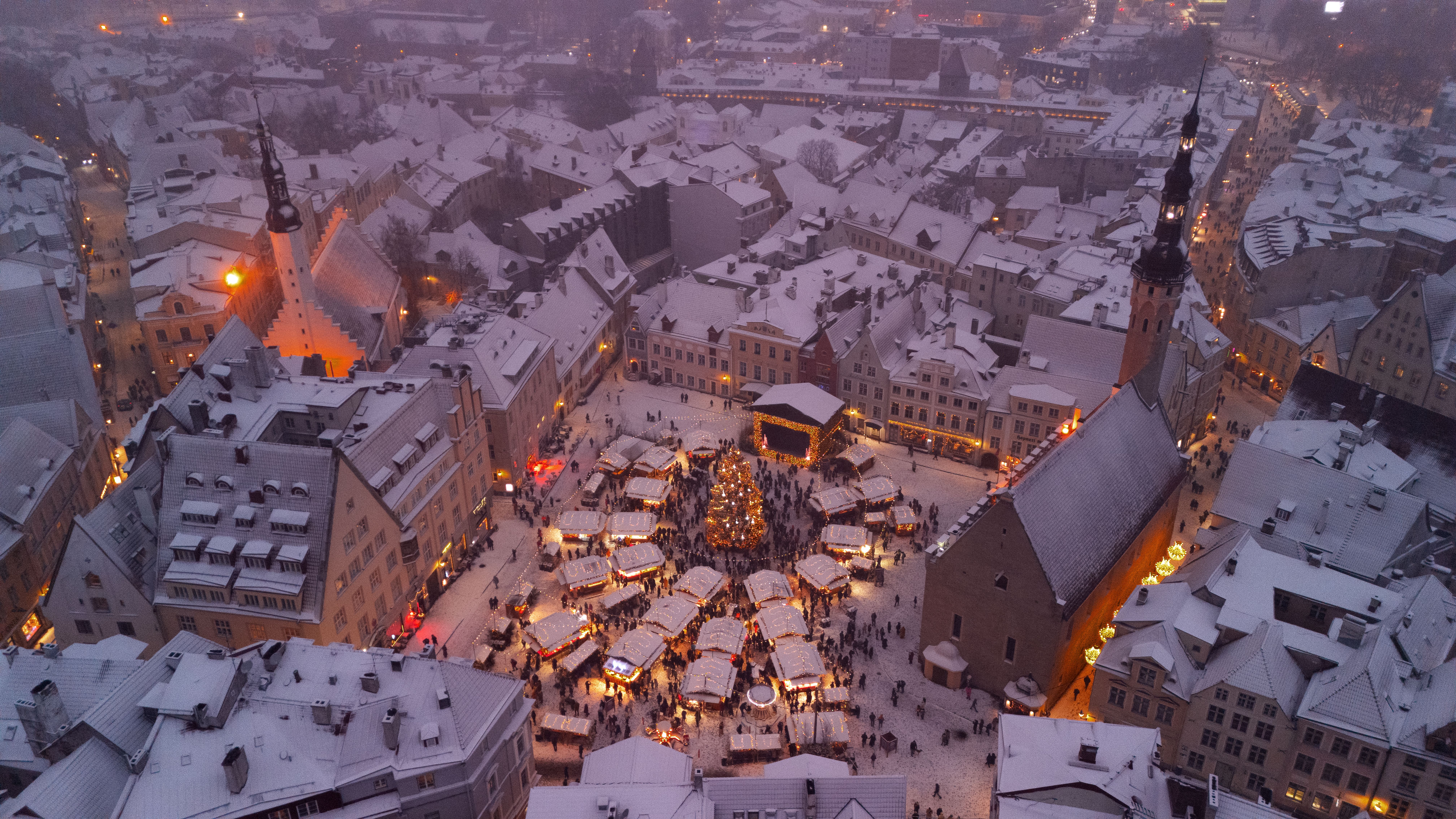
The Tallinn Old Town at 7am when the UNESCO-listed medieval city belongs to the Tallinn residents walking to work and the cobblestones are damp from the overnight rain and the town hall square has nobody in it but the pigeons and one coffee vendor who opens at 6:30am, the Viru Gate in the first morning light before the tour groups arrive from the cruise ships at 10am, and why Tallinn — the medieval city that the Baltic Sea gave to the Hanseatic League and that the 20th century gave to the Soviet Union and that the 21st century has given to the digital nomad and the tech startup — is the most historically layered small capital in Northern Europe.
Reading time: 8 minutes | Last updated: 2026
Tallinn is the capital of Estonia — a country of 1.3 million people on the Baltic Sea, the smallest country in the European Union by population, and the most digitally advanced country in the world per capita (the first country to declare internet access a human right, the country that invented Skype, the country where you can vote in national elections from your phone and file your tax return in 3 minutes). The medieval Old Town (the UNESCO-listed centre that is the most intact medieval city in Northern Europe) and the Kalamaja design district (the wooden house neighbourhood that has become the startup hub of the Baltic) coexist in a city of 450,000 people that takes 25 minutes to walk across.
Tallinn has been occupied by the Danes, the Teutonic Knights, the Swedes, the Russians, the Germans (twice), and the Soviets. Each occupation left an architectural trace. The medieval city is the German Hanseatic layer. The baroque is the Swedish layer. The neoclassical is the Russian imperial layer. The brutalist is the Soviet layer. And the wooden houses of the Kalamaja are the Estonian layer, the houses that the Estonian bourgeoisie built in the early 20th century and that survived because they were too modest for the occupation authorities to want.
The 48 Hours
DAY ONE
7:00am — The Old Town Before the Cruise Ships
Tallinn receives 2 million visitors per year, many of them from the Baltic ferry routes and the Baltic cruise circuit. The cruise ships dock at the D-terminal from approximately 9:30am. The Old Town from 7am-9am belongs to the city.
The Raekoja Plats (the Town Hall Square — the main square of the medieval city, the 14th-century town hall with the Old Thomas weathervane above, the square that has been the commercial and civic centre of Tallinn since the 13th century): at 7am, the square empty except for the coffee cart that opens at 6:30am and the pigeons. The town hall facades are the most complete medieval square in Northern Europe outside Bruges.
The Viru Gate (the medieval gate in the city wall — the two surviving towers of the original 14th-century gate, the entrance to the Old Town from the Viru Street): at 7am, the gates visible without the tourist photography queue that forms by 10am.
The Old Thomas (the weathervane on the town hall tower — the 16th-century warrior figure that has been a symbol of Tallinn since 1530, the figure that the town has maintained and repaired continuously for 500 years): visible from the square below, the original in the Town Hall Museum.
9:00am — The Toompea Hill
The Toompea (the limestone hill at the centre of the Old Town — the upper city, the seat of Estonian power since the Danish occupation in 1219):
The Alexander Nevsky Cathedral (the 1900 Russian Orthodox cathedral built by the Russian Imperial administration — the onion domes deliberately imposing above the Estonian lower city, the political statement in stone that the Estonian people have never entirely forgiven and that the Orthodox congregation continues to use as a working church): free access, dress code required.
The Toompea Castle (the seat of the Estonian Riigikogu — the Parliament of Estonia, the castle that has been the seat of power in Estonia for 800 years, the pink baroque facade of the Stenbock House visible from the Lossi Plats square): the exterior viewable, the Parliament accessible on specific public visit days.
The Patkuli viewing terrace and the Kohtuotsa viewing terrace (the two viewpoints from the Toompea giving the lower city roofscape, the Old Town tiled roofs, and the Baltic Sea visible to the north on clear days): free access.
11:00am — The Kadriorg Palace and Art Museum
The Kadriorg Palace (Weizenbergi 37 — the 1718 baroque palace built by Peter the Great for his wife Catherine I, the most significant baroque building in Estonia, the palace now housing the KUMU Art Museum’s foreign collection and the adjacent Kadriorg Art Museum):
The Kadriorg Art Museum (the collection of Dutch and Flemish 17th-century paintings in the baroque palace rooms — the most specifically incongruous and rewarding museum experience in Tallinn: the Dutch interiors in the specific light of the Baltic summer): entry €8 / £6.90.
The Kadriorg Park (the baroque formal garden surrounding the palace, the park extending to the Baltic coast 10 minutes walk east — the park used daily by the Tallinn residents): free access.
1:00pm — Lunch: the Balti Jaama Turg
The Balti Jaama Turg (the Balti Station Market — the market in the former railway station area, the most characterful food market in Tallinn): the Soviet-era market that has been renovated into a food hall while maintaining the specific Baltic market character (the Estonian pickles, the smoked fish from the Baltic, the black rye bread, the Estonian dairy — the soured milk products that are the foundation of the Estonian traditional diet):
The kiluvõileib (the sprat sandwich — the smoked Baltic sprat on the dark rye bread, the cream cheese, the specific Estonian open sandwich): €2-3 / £1.72-2.59. The kama (the roasted grain flour — the mix of rye, oat, pea, and barley flour, the traditional Estonian breakfast mixed with the kefir): the taste that is specifically Estonian and available in no other food culture.
3:00pm — The Vabamu Museum of Occupations and Freedom
The Vabamu (the Museum of Occupations and Freedom — Toompea 8, the museum covering Estonia’s 20th-century history from the Soviet occupation of 1940 through the Nazi occupation of 1941-1944 through the Soviet re-occupation of 1944 to the independence of 1991):
The most important museum in Tallinn for understanding the city you are walking through. The Soviet period exhibitions (the deportations of 1941 and 1949, the specific Stalinist mechanism of the deportation — the night knock, the 24 hours, the cattle wagon — visible in the documentary evidence), the resistance period, and the Singing Revolution (the mass singing events of 1987-1991 that gave the Estonian independence movement its specific nonviolent character — 300,000 Estonians gathering to sing national songs that had been banned under Soviet occupation).
Entry: €14 / £12.07.
6:00pm — The Kalamaja Neighbourhood
The Kalamaja (the wooden house neighbourhood northwest of the Old Town — the early 20th-century working-class housing, the coloured wooden houses that survived both occupation periods and that have become the design and startup district of 21st-century Tallinn):
The Telliskivi Creative City (the former industrial complex converted to the creative hub — the restaurants, the bars, the design shops, the startup offices, the most concentrated creative economy in the Baltic States in one repurposed factory complex): the afternoon coffee at the F-Hoone café (the food and coffee that the Tallinn creative class uses as its working space).
8:30pm — The Smoke Sauna
The smoke sauna (the traditional Estonian sauna — the suitsusaun, the sauna heated by the fire burning in the sauna room itself rather than in a separate stove, the smoke blackening the walls and the benches, the specific heat quality of the smoke sauna different from the conventional Finnish sauna): the most culturally specific single experience available in Tallinn.
The Iglupark Smoke Sauna (Asula 4 — the Tallinn smoke sauna available for booking by the hour, the authentic suitsusaun experience in the city): from €15-25 / £12.93-21.55 per person per session.
The correct smoke sauna instruction: the heat cycle (the 15-20 minutes in the sauna, the cold plunge or the cold shower, the rest, the repeat), the vihta (the birch branch bundle used to beat the skin — the aromatic birch leaf, the circulation stimulation, the specific smell of the heated birch that is the smell of the Estonian sauna tradition), and the quiet (the smoke sauna is not a social event in the way the Finnish sauna is — the Estonian sauna is for the specific restoration that the heat and the silence give).
DAY TWO
9:00am — The Open-Air Museum
The Estonian Open Air Museum (Vabaõhumuuseum tee 12, Rocca al Mare — 6km from the city centre by Bus 21A): the collection of traditional Estonian rural buildings relocated from across the country, the farmhouses, the windmills, the smoke saunas, the fishing village visible in the original buildings from the 18th-20th century.
The most specific single open-air museum in the Baltic States — the buildings are the actual buildings, not reconstructions, and the collection gives the full Estonian rural architectural tradition from the Swedish period (the 17th century) to the Soviet collective farm period (the 1950s-80s). Entry: €10 / £8.62.
Afternoon: The Day Trip to Lahemaa National Park
The Lahemaa National Park (70km east of Tallinn — the Baltic coast national park, the limestone alvars, the coastal forest, the Palmse Manor): the most accessible Estonian nature experience from the capital.
The Palmse Manor (the 18th-century Baltic German manor house, the most complete manor estate in Estonia, the distillery and the stable and the park visible in the original 18th-century layout): entry €10 / £8.62.
The Viru Bog (the raised bog accessible by the 3.5km wooden boardwalk — the specific Estonian landscape of the raised peat bog, the carnivorous sundew plants, the bog pine, the silence that the bog gives at the end of the boardwalk): free access.
The Essentials
Getting to Tallinn: Wizz Air, Ryanair (via Kaunas connection on some routes), Nordica, Finnair via Helsinki. easyJet via Riga. Return: £80-200.
Getting around: Walking for the Old Town and the Kalamaja. The bus network for the Open Air Museum and the Kadriorg. The taxi app (Bolt — the Estonian taxi app that is the Uber of the Baltics, the correct transport for any journey over 15 minutes walk): €3-8 / £2.59-6.90 for city journeys.
The digital Estonia experience: The e-Estonia showroom (Lasnamäe 4 — the exhibition of Estonia’s digital government services, the e-Residency programme, the digital infrastructure that makes Estonia the most digitally advanced country in the world): free, book a tour at e-estonia.com.
Where to stay: The Hotel Telegraaf (Vene 9, Old Town — the 19th-century telegraph building: £80-150/night), the Ülemiste Hotel (the airport-adjacent design hotel: £60-100/night), the Red Emperor Hostel (Nunne 18, Old Town: private rooms from £30-55/night).
The Closing Moment
I was at the Raekoja Plats at 7:14am. The square was empty except for the pigeons and the coffee vendor at the southeast corner who was arranging the cups. The town hall above was in the morning light — the Old Thomas weathervane catching the first sun.
The medieval square in the morning quiet: the specific Tallinn quality that the cruise ship passenger arriving at 10am does not have and cannot have.
I ordered the coffee. The vendor said “head aega” — good day, in Estonian. The Estonian language is the specific remnant of the nation that survived the occupations: the language that the Soviets tried to replace with Russian and that the Estonian population maintained through the private use and the public singing and the specific stubbornness of the small nation.
The coffee was good. The square was still quiet. The cruise ships were still offshore.