

The Monteverde Cloud Forest at 6am when the spider monkeys are moving through the canopy and the resplendent quetzal is occasionally visible in the cecropia trees and the cloud forest mist is low enough to be in the tree level rather than above it, the Arenal Volcano in the afternoon when the cone emerges from the cloud for the specific daily window between 3pm and 5pm, the zip line over the cloud forest canopy that the 8-year-old asks to do again before the platform catches them, and why Costa Rica — with its pura vida philosophy and its 26% of national territory under protected reserve — is the correct family adventure destination for the family that has done Europe and wants something that requires none of the cultural preparation that Asia or Africa or South America requires.
Reading time: 10 minutes | Last updated: 2026
Costa Rica is the easiest adventure destination in the Americas for UK families — the English spoken at a higher rate than any other Central American country, the tourist infrastructure developed, the national parks accessible by road in a hire car, and the specific wildlife (the sloths, the monkeys, the toucans, the scarlet macaws) visible without the specialist guide that the East African safari requires.
It is not cheap — the Costa Rica tourist economy has positioned itself at the mid-to-upper range of Central American tourism, and the national park entries, the activity costs, and the accommodation prices reflect a country that knows its wildlife is extraordinary and prices accordingly. But the 10-day family circuit (the Monteverde cloud forest, the Arenal volcano, the Osa Peninsula or the Nicoya coast) is manageable at the mid-range family budget without compromising the specific wildlife and adventure that is the point.
When to Go
December-April (the dry season): The correct family Costa Rica window. The Pacific coast is in its driest months, the roads are accessible, and the wildlife is concentrated around the water sources (the dry season animals are more visible because they are more localised). The Christmas and Easter school holidays fall within this window.
July-August (the Caribbean coast dry season): The specific Caribbean coast (the Tortuguero National Park, the Cahuita reef) is dryest in July-August while the Pacific coast is in its rainy season. The family circuit that focuses on the Caribbean turtle nesting (the green turtle season at Tortuguero is June-October) should go in July-August.
The rainy season (May-November on the Pacific): Manageable with preparation — the rain typically falls in the afternoon and the mornings are clear. The rains make the rivers accessible for white water rafting (the highest grade rafting is in the September-October peak of the rainy season). The prices are 20-30% lower.
The Family Circuit
Monteverde (Cloud Forest)
The cloud forest at dawn (Ages 7+):
The Monteverde Cloud Forest Reserve at 6am (the reserve opens at 7am — the Curi-Cancha Reserve adjacent to the main reserve opens at 6am for the serious wildlife visitor): the cloud forest in the first hour before the guided tours begin.
The cloud forest specific wildlife: the resplendent quetzal (the Pharomachrus mocinno — the iridescent green and red bird whose tail feathers reach 65cm, the bird that the Maya and Aztec considered sacred, visible in the cecropia trees during the February-May breeding season), the three-wattled bellbird (whose konk call is audible from 1km through the forest), and the Monteverde forest gecko (the transparent-skinned gecko visible at the bark surface at dawn).
Entry: USD 24 / £18.90 adult, USD 16 / £12.60 child under 12.
The zip line (Ages 7+, minimum weight 20kg):
The Monteverde zip line (the Original Canopy Tour at the SkyTram, the Santa Elena Reserve zip line, or the Extremo Monteverde — the most dramatic): the zip line over the cloud forest canopy, the platform-to-platform transit at tree-canopy height (50-70 metres above the forest floor), the specific perspective on the cloud forest that the walkway path does not give.
The SkyTram and SkyWalk combination (the gondola up to the ridge, the suspension bridge walkway at canopy level, the zip line descent): USD 62 / £48.82 per person.
Where to stay: The Monteverde Lodge (the most atmospherically sited lodge in the cloud forest, the hummingbird feeders, the guided tours): USD 180-280 / £141.73-220.47/night. The Arco Iris Lodge (the more accessible mid-range, the garden with the coatis): USD 80-130 / £63.00-102.36/night.
Arenal (Volcano and Hot Springs)
The Arenal Volcano (Ages 3+):
The Arenal Volcano National Park (the 1,633-metre symmetrical cone, the most active volcano in Costa Rica for most of the 20th century — dormant since 2010 but the cone still visible when the cloud clears): the park entry (USD 18 / £14.17) gives access to the lava fields and the forest trails at the base.
The specific instruction: the volcano is visible from the La Fortuna town side between approximately 3pm and 5pm on clear days, when the afternoon cloud that shrouds the upper cone thins. Every other hour: clouds.
The hike to the Arenal Observatory (the trail through the regenerating forest — the 2010 lava field now covered in pioneer vegetation): 2 hours round trip, appropriate for children of 8+.
The Hot Springs (Ages 3+):
The Arenal hot springs (the geothermal springs heated by the volcanic activity below — the thermal pools accessible from multiple resort facilities around the La Fortuna area):
The Baldi Hot Springs (the most accessible and most affordable — the multiple pool complex at different temperatures, the waterslides for children, the swim-up bar for parents): USD 35-55 / £27.56-43.31 adult, USD 25-35 / £19.68-27.56 child.
The Tabacón Hot Springs (the premium version — the natural riverbank pools, the restaurant, the luxury spa context): USD 60-90 / £47.24-70.87 adult.
The hanging bridges (Ages 5+):
The Arenal hanging bridge circuit (the Mistico Arenal Hanging Bridges Park — the 16 bridges including 6 suspended bridges, the longest 98 metres, the forest visible from above and at the root level simultaneously): USD 28 / £22.05 adult, USD 18 / £14.17 child under 12.
Where to stay: The Arenal Springs Resort (the private hot spring pools in the villa gardens, the volcano view): USD 200-350 / £157.48-275.59/night. The La Pradera Hotel (the mid-range with pool, La Fortuna town): USD 70-120 / £55.12-94.49/night.
The Pacific Coast (Nicoya Peninsula or Osa Peninsula)
Nicoya (Ages 3+):
The Nicoya Peninsula (the northwest Pacific coast — the most accessible beach region from San José, the Playa Tamarindo the most developed, the Playa Santa Teresa the boutique alternative, the Playa Nosara the yoga-and-wildlife combination):
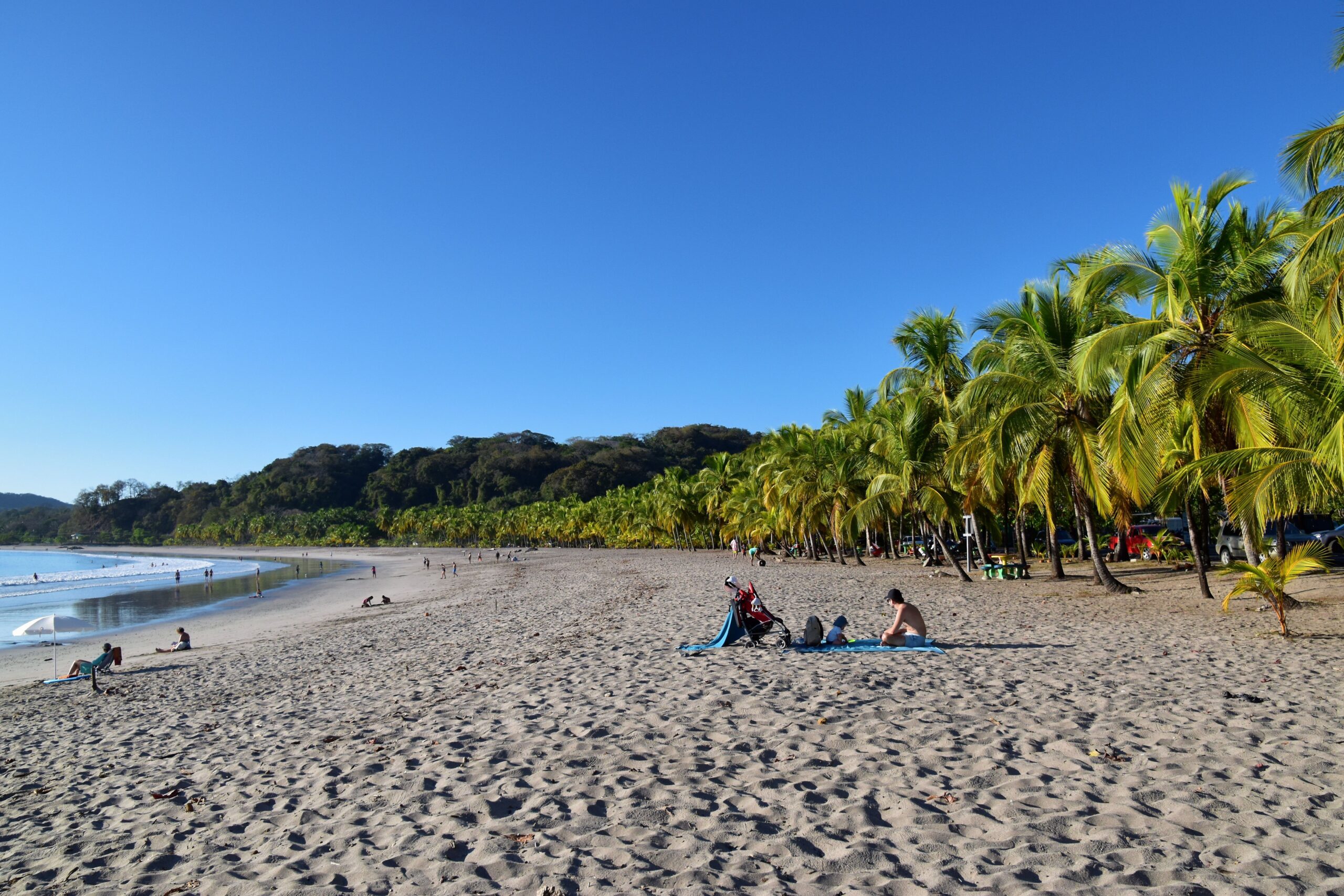
The Playa Sámara (the crescent bay with the calm water — the most family-appropriate beach on the Nicoya coast: the water sheltered from the open Pacific swell by the headlands, the sea turtle nesting on the adjacent Playa Ostional from July-November): the ASVO community turtle project (the organisation that monitors and protects the olive ridley turtle mass nesting — la arribada — where 100,000+ turtles nest simultaneously): turtle guide: USD 15-25 / £11.81-19.69 per person.
Osa Peninsula (Ages 8+):
The Osa Peninsula (the most biodiverse place on Earth per square kilometre according to National Geographic — the 2.5% of Costa Rica’s land area containing 5% of the world’s biodiversity): the Corcovado National Park (the park that requires a guided entry — the self-guided hiking is not permitted within the core zone, the registered naturalist guide required): USD 15 / £11.81 park entry + USD 40-80 / £31.50-63.00 per day for the certified guide.
The Osa wildlife: the Baird’s tapir, the white-lipped peccary, the harpy eagle, and the 13 species of primates that make the Osa the most primate-diverse region in Central America. The family for whom the wildlife is the primary goal should add 2 days on the Osa to the Monteverde-Arenal circuit.
The Age-by-Age Costa Rica Guide
Ages 3-7
What works: The hot springs (universally loved, the waterslides at Baldi), the hanging bridges (the suspension movement is appealing at this age rather than alarming), the sloth sanctuary (the Toucan Rescue Ranch or the Jaguar Rescue Center in the Caribbean zone — the rescued sloth interaction, the specific three-toed sloth hanging from the handler’s arm, the slowest animal in the world at a speed that a 4-year-old can comprehend), and the beach.
The sloth instruction: the two-fingered sloth (Choloepus hoffmanni) is the most reliably found at the rescue centers. The three-fingered sloth (Bradypus variegatus) moves at 0.15 mph and sleeps 20 hours per day. Both are available at the Jaguar Rescue Center in Cahuita.
What needs management: The Corcovado National Park (the distance, the heat, the mandatory guide, the 6+ hours of walking). The sea turtle nesting at midnight (the 11pm-2am tour timing is incompatible with the sleep schedule of under-6s).
Ages 8-12
What works: Everything in the 3-7 list plus: the zip line (the specific Monteverde zip line requiring the minimum 20kg weight — most 7-year-olds meet this threshold), the white water rafting on the Río Sarapiquí (Class III-IV, appropriate for children of 8+ in the guided raft), the surf lesson (the Tamarindo and the Santa Teresa beaches, the learner-friendly breaks, the supervised surf school lessons from USD 50-75 / £39.37-59.06 per 2-hour group lesson).
The white water rafting instruction: the half-day guided raft on the Río Sarapiquí (the Class III-IV rapids appropriate for the 8-12 age group — the guide manages the steering, the child paddles, the specific adrenaline of the rapid without the full technical requirement of solo paddling): USD 60-85 / £47.24-66.93 per person, minimum age 8.
Ages 12-16
The full adventure circuit: The zip line, the white water, the surf, and the overnight in the Osa Peninsula tent camp. The teenager who has been to Costa Rica with the family has the framework for understanding the specific conservation and biodiversity arguments that shape contemporary environmental thinking.
What It Costs — Family of Four
| Category | Budget | Mid-Range |
|---|---|---|
| Return flights (UK-San José, 4 persons) | £3,200-4,800 | £4,000-6,400 |
| Car hire (10 days, 4WD recommended) | £500-800 | £700-1,200 |
| 10 nights accommodation | £700-1,400 | £1,400-2,800 |
| Food (10 days) | £350-600 | £600-1,000 |
| Activities (zip line, hot springs, rafting, parks) | £400-700 | £600-1,000 |
| Total (10 nights) | £5,150-8,300 | £7,300-12,400 |
The flight cost is the primary budget variable — the 12-hour flight to San José on United Airlines via Houston or on British Airways via the US gateway prices four seats at a level that makes Costa Rica a significant investment relative to European destinations. The on-the-ground costs are mid-range by global standards.