
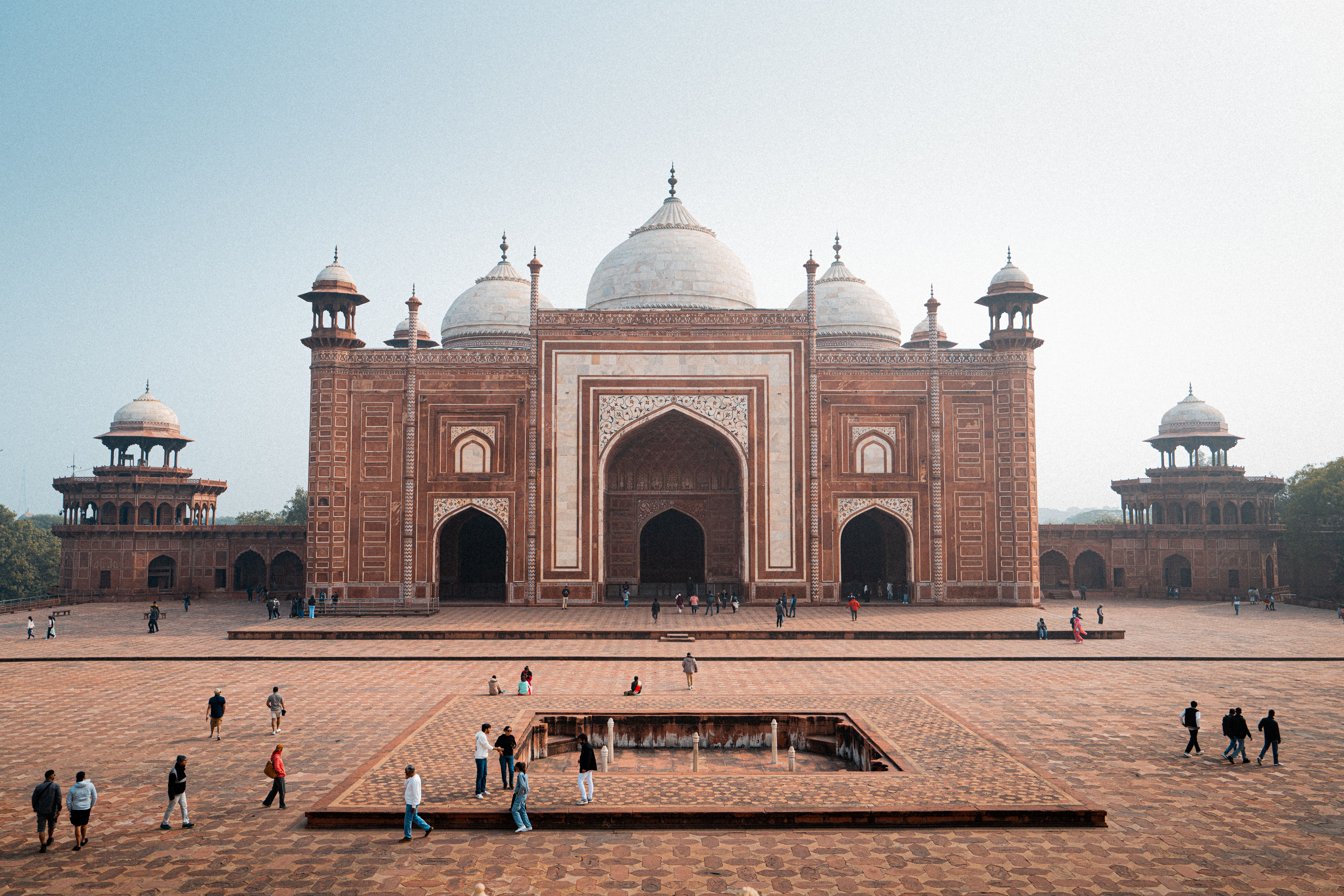
The route that gives India its most concentrated architectural and cultural argument in the most accessible circuit: two days in Delhi for the Red Fort and the Jama Masjid and the Chandni Chowk street food that is the finest in India by specific assessment of the people who have eaten at every other claim, one day in Agra for the Taj Mahal at dawn before the tour buses arrive and the Agra Fort in the afternoon, and three days in Jaipur for the Amber Fort on the hill and the bazaars of the old city and the specific Rajasthani evening when the rose lassi and the sunset and the rooftop together constitute the definitive India photograph — and why this specific circuit, despite being the most visited in India, remains the correct beginning.
Reading time: 11 minutes | Last updated: 2026
The Golden Triangle — Delhi, Agra, Jaipur — is the most visited tourism circuit in India and the one that UK travellers with one week choose most frequently. The reasons are logistical: the three cities are connected by expressway and by the fast train network, the tourist infrastructure is the most developed in India, and the specific combination (the Mughal capital, the Taj Mahal, the Rajput fortress city) gives the country’s two greatest historical empires in a single week.
The case against the Golden Triangle — that it is too visited, too developed, too sanitised — mistakes the infrastructure for the experience. The Taj Mahal at dawn is still the Taj Mahal at dawn. The Chandni Chowk at 7am is still the correct Delhi. The infrastructure makes the circuit possible; it doesn’t make it false.
Before You Leave
The e-Visa: India Tourist e-Visa required for UK citizens. Apply at indianvisaonline.gov.in at least 4 days before departure (the 72-hour processing time is the minimum — apply a week ahead). Cost: USD 25 / £19.69 for 30-day single entry, USD 40 / £31.50 for 1-year multiple entry.
The vaccinations: The Hepatitis A and Typhoid vaccines strongly recommended. Consult a travel clinic 6-8 weeks before departure. Malaria prophylaxis: the Delhi-Agra-Jaipur circuit is a low-risk malaria zone — the risk is present but not at the level of the tropical areas of India. The travel clinic will advise on your specific itinerary.
The heat: The Golden Triangle in May-June reaches 42-45°C. The October-March window is the correct visiting season: October-November for the post-monsoon green, December-February for the cool (10-25°C), March-April before the summer heat builds.
The driver: A driver-guide for the full circuit is the most efficient and comfortable format — the inter-city distances (Delhi to Agra: 230km, Agra to Jaipur: 240km), the city navigation, and the site access are all simplified by a qualified driver. Cost: INR 4,000-7,000 / £36-63 per day for the car and driver. Book through the hotel or through the India Tourism Development Corporation (ITDC) approved operators.
The Route
Delhi (2 nights) → Agra (1 night) → Fatehpur Sikri (day stop) → Jaipur (3 nights)
The 7 Days
DAYS 1-2 — Delhi
Day 1: Old Delhi
7:00am — The Jama Masjid
The Jama Masjid (the Friday Mosque — the largest mosque in India, completed 1656 under Shah Jahan, the prayer hall accommodating 25,000 worshippers, the two 40-metre minarets visible from across the old city): at 7am, the mosque in the morning prayer — non-Muslim visitors admitted between the prayer times (check the current schedule at the entrance, the gates typically open to visitors at 8:30am). Entry: INR 300 / £2.70 camera fee; entry to the mosque itself free with appropriate dress (the robes available for rental at the entrance).
The rooftop view from the southern minaret (the 120-step spiral staircase, the old Delhi roofscape visible, the Red Fort across the road, the Old Delhi below): INR 100 / £0.90.
8:00am — Chandni Chowk
The Chandni Chowk (the main market street of Old Delhi — established 1650 by Shah Jahan’s daughter Jahanara, the 600-metre street that has been the commercial centre of Delhi for 375 years): at 8am, the street in its working morning before the midday congestion.
The specific Chandni Chowk food circuit:
Paranthe Wali Gali (the lane of the fried bread): The lane running north from the main Chandni Chowk street — the paratha restaurants that have been frying the stuffed wheat bread in the same ghee-filled iron karahis since the 19th century. The aloo paratha (the potato-stuffed bread, the clarified butter poured over the top), the paneer paratha (the fresh cheese stuffing), the dal makhani on the side: INR 60-120 / £0.54-1.08.
Khari Baoli (the largest spice market in Asia): The wholesale spice market on the western end of Chandni Chowk — the sacks of coriander and cumin and turmeric and dried chillies visible from the street, the specific compound smell of the Asian spice market at its most concentrated.
Jalebi wala: The jalebi (the fried spiral of the fermented batter, dipped immediately in the sugar syrup, eaten hot — the specific Old Delhi breakfast sweet, the texture between the crispy surface and the syrup-saturated interior): INR 10-20 / £0.09-0.18 per piece from the original Old Famous Jalebi Wala at the Dariba Kalan corner.
10:00am — The Red Fort
The Lal Qila (the Red Fort — the sandstone fortified palace of the Mughal emperors, the seat of the Mughal court from 1648 to 1857, the declaration of Indian independence read from its battlements by Jawaharlal Nehru on August 15, 1947): entry INR 650 / £5.85.
The Diwan-i-Aam (the Hall of Public Audience — the 60-pillar hypostyle hall where the Emperor received petitions), the Diwan-i-Khas (the Hall of Private Audience — the white marble hall where the Peacock Throne stood until the Persian invader Nadir Shah carried it to Tehran in 1739), and the Rang Mahal (the Palace of Colours — the fountain in the white marble pool, the coloured glass in the ceiling panels).
Day 2: New Delhi
Humayun’s Tomb:
The Humayun’s Tomb (Mathura Road, Nizamuddin — the 1565 Mughal mausoleum, the prototype for the Taj Mahal built 80 years later, the double-domed sandstone and white marble structure in the Persian charbagh garden): the finest Mughal funerary monument in Delhi. Entry: INR 650 / £5.85.
The Qutub Minar:
The Qutub Minar (the 12th-century 73-metre minaret — the tallest brick minaret in the world, the Quwwat-ul-Islam Mosque at its base — the first mosque built in India after the Islamic conquest of 1193, the pillars of 27 Hindu and Jain temples visible in its colonnaded construction): entry INR 650 / £5.85.
The India Gate and Lutyens’ Delhi:
The India Gate (the 42-metre war memorial, designed by Edwin Lutyens — the same Lutyens who designed the official New Delhi with Herbert Baker in the 1910s-1930s, the grand processional axis from the Presidential Palace to the India Gate the most architecturally ambitious colonial planning project in history after the construction of Chandigarh): free access.
Where to stay in Delhi: The Oberoi (Dr. Zakir Husain Marg — the finest hotel in India: £200-500/night), the The Manor (Friends Colony West: £80-150/night), the Bloomrooms (Link Road, Jangpura: £25-55/night).
DAY 3 — Agra: The Taj Mahal
5:00am — The Taj Mahal at Dawn
This is the instruction that overrides all others in the Golden Triangle: the Taj Mahal at dawn.
The east gate (the Shilpgram complex entry point, the queue forming before 5:30am when the gate opens at dawn) — arrive at 5:15am. The first entry into the forecourt, the Taj Mahal visible through the great sandstone gateway:
The first sight: the white marble dome above the gateway arch, the perfect geometry of the building framed by the gateway. Mughal design convention places the monument at the end of the axis — the building is revealed rather than visible from the approach.
The Taj Mahal at dawn: the marble in the first light (the marble changes colour through the day — the pre-dawn blue-grey, the sunrise pink-gold, the midday white, the sunset amber — the dawn version is the most contemplated by the tourist guides and the most genuinely different from photographs):
The specific dawn instruction: stand at the centre of the reflecting pool axis (the long pool connecting the entrance to the plinth), look at the reflection. The image — the Taj Mahal and its inverted double in the still water, the reflection in the dawn light — is the correct Taj Mahal. By 9am the pool reflection is disrupted by the crowd movement.
Entry: INR 1,100 / £9.90 including the Agra Development Authority fee.
At 5:30am: perhaps 400 people for a monument that receives 8 million visitors per year. By 9am: 4,000. By noon in peak season: 15,000. The dawn visit is not optional — it is the Taj Mahal.
Morning: the Taj interior and the Mehtab Bagh
The Taj interior (the central cenotaph chamber — the octagonal chamber, the perforated marble screens surrounding the cenotaphs of Mumtaz Mahal and Shah Jahan, the marble inlay of the semi-precious stones in the pietra dura technique, the Quranic inscriptions in the black marble calligraphy): the interior is less visited than the exterior and more specifically accomplished.
The Mehtab Bagh (the Moonlight Garden across the Yamuna River — the garden from which the Taj is visible from the north, across the river, the black marble cenotaph planned but never built visible in the river bed at low water): the least visited view of the Taj available to the public, accessible by the auto-rickshaw from the Taj east gate.
Afternoon: The Agra Fort
The Agra Fort (the 1565 sandstone fort — the prison of Shah Jahan after his son Aurangzeb deposed him in 1658, the specific irony that Shah Jahan spent the last 8 years of his life imprisoned in the Fort that his great-grandfather Akbar built, looking across the Yamuna at the Taj he had built for his wife): the Khas Mahal (the white marble pavilion from which Shah Jahan looked at the Taj), the Musamman Burj (the octagonal tower where Shah Jahan died in 1666): entry INR 650 / £5.85.
Day stop: Fatehpur Sikri
Fatehpur Sikri (40km from Agra on the road to Jaipur — the Mughal capital built by Akbar in 1571 and abandoned 14 years later when the water supply proved insufficient, the entire city preserved as built, the most intact Mughal city in India):
The Buland Darwaza (the Victory Gate — the 54-metre gateway, the largest gateway in the world, built to commemorate Akbar’s conquest of Gujarat): entry INR 650 / £5.85.
DAYS 4-6 — Jaipur
Day 4: The Amber Fort
The Amer Fort (11km from Jaipur on the Jaipur-Delhi road — the 16th-century Rajput fortress of the Kachchwaha Maharajas, the hill-top fort above the Maota Lake): arrive at 8am opening.
The elephant ride (the traditional access to the fort — the elephants walk the paved zigzag path from the lake level to the main gate): controversial on elephant welfare grounds, the current ethical assessment of the Amer elephant programme mixed. The jeep alternative (the jeep shuttle from the base, INR 100-150 / £0.90-1.35 per person) is the correct choice for the visitor who applies the same welfare standards to Indian working elephants as to the Chiang Mai sanctuary.
The Sheesh Mahal (the Hall of Mirrors — the room whose ceiling and walls are covered with small convex mirrors set in the plaster, the candle or the torch reflected across 1,000 surfaces simultaneously, the specific Rajput palace interior technology that was the chandelier before electricity): the most visually extraordinary single room in Rajasthan.
Day 5: The Pink City
Jaipur’s old city (the walled city founded 1727 by Maharaja Sawai Jai Singh II — the planned city, the grid streets, the uniform height of the buildings, the facades painted in the terracotta pink that gives the city its “Pink City” designation):
The Hawa Mahal (the Palace of Winds — the 953-window facade built in 1799 to allow the royal women to observe the street below without being seen — the five-storey facade visible from the Badi Chaupar intersection is not a building but a screen, the rooms behind it one room deep): entry INR 200 / £1.80.
The City Palace (the palace complex at the centre of the old city, the museums within the palace covering the textile collection — the Maharaja’s clothing and the courtly textile traditions — and the armoury): entry INR 700 / £6.30.
The Jantar Mantar (the 18th-century astronomical observatory of Maharaja Jai Singh II — the 19 instruments for measuring celestial time, the giant sundial accurate to 2 seconds, the zodiac arcs the size of buildings, the most accurate pre-telescopic observatory ever built): entry INR 200 / £1.80. UNESCO-listed.
Day 6: The Bazaars and the Rooftop
The Johari Bazaar (the jewellery market — the Jaipur gem and jewellery industry, the largest in India, the semi-precious stones from the Rajasthan mines sold at the trade rather than the tourist prices at the wholesale market interior shops): the amethyst, the garnet, the citrine, the blue sapphire from the Ajmer mines.
The Bapu Bazaar (the fabric market — the block-printed cottons, the Rajasthani tie-dye (bandhani), the embroidered textiles): the block-printing workshops visible from the street at some shops in the lanes behind the main market.
The rooftop at Nahargarh Fort (the 19th-century fort on the Aravalli hills above the city, the sunset view over the Pink City, the Amber Fort visible in the hills to the north): the specific Jaipur evening from above.
What It Costs
| Category | Budget | Mid-Range |
|---|---|---|
| Return flights (UK-Delhi, direct) | £350-600 | £500-800 |
| 7 nights accommodation | £100-210 | £280-560 |
| Driver-guide (7 days) | £250-440 | £300-500 |
| Food (7 days) | £60-120 | £140-280 |
| Site entries (Red Fort, Taj, Amber, etc.) | £40-70 | £40-70 |
| Total | £800-1,440 | £1,260-2,210 |
India is the best-value destination in this guide at the budget level — the food at the street stall and the dhaba (the roadside restaurant) level costs £3-8 per day for three full meals. The site entries are fixed at the quoted prices. The accommodation and the driver are the primary cost variables.