
The route that gives the Yucatán Peninsula its full argument without the Cancún resort that the package market sells and that is a different Mexico entirely: two days in Mérida for the Paseo de Montejo and the Mercat Lucas de Gálvez at 7am and the specific Yucatecan food (cochinita pibil — the slow-roasted pork, the achiote marinade, the banana leaf wrapping, the dish cooked underground in the píib oven and that the Mérida food stall makes correctly and that the Cancún hotel buffet approximates), two days at Chichén Itzá and the surrounding cenotes (the underground freshwater pools that the Maya used for the ritual sacrifice and that the visitor swims in once they have processed the archaeological context), and three days at Tulum for the clifftop Maya ruins above the Caribbean and the Sian Ka’an Biosphere Reserve (the Yucatecan wetland, the manatee, the boat through the Maya canal channels) and the specific Tulum that exists below the Instagram version and that the town-side rather than the hotel zone gives.
Reading time: 10 minutes | Last updated: 2026
The Yucatán Peninsula is the limestone platform that the Gulf of Mexico meets the Caribbean around — the flat landscape whose appearance (scrubby jungle) conceals the specific geological wonder beneath: the world’s longest underground river system, 10,000+ cenotes (the dzonot — the collapsed limestone sinkholes revealing the freshwater cave systems), and the specific Maya civilisation that built Chichén Itzá and Uxmal and the dozen lesser sites visible from the peninsula road.
Before You Leave
Getting there: Fly London-Mérida (via Mexico City, Houston, or Miami — 12-15 hours total) or London-Cancún (direct BA, Virgin, or TUI — 10 hours) and travel west by ADO bus (4 hours to Mérida, 2 hours to Tulum).
The car vs the bus: The ADO bus (the premium Mexican long-distance coach — the reclining seats, the air conditioning, the reliable schedule) covers the Mérida-Chichén Itzá-Tulum route efficiently and cheaply (MXN 100-300 / £4.17-12.50 per leg). The car gives the flexibility to visit the lesser-known cenotes and Maya sites off the ADO network.
The Route
Mérida (2 nights) → Chichén Itzá and the cenotes (2 nights: Valladolid base) → Tulum (3 nights)
DAYS 1-2 — Mérida
Day 1: The Mercado and the Cochinita
7am — The Mercado Lucas de Gálvez:
The Mercado Lucas de Gálvez (the Mérida central market — the Yucatecan produce: the habanero chilli (the Yucatán-specific chilli, the base of the Yucatecan salsas), the achiote (the annatto seed paste, the orange-red marinade base for the cochinita), the fresh tortillas visible at the tortillería stall at 6am):
At 7am: the market in the food-stall configuration for the Mérida breakfast:
The huevos motuleños (the Mérida breakfast plate — the fried eggs on the fried tortilla with the black bean purée, the ham, the peas, the plantain, the salsa, the queso fresco, the specific Yucatecan breakfast that the Oaxacan and the Mexico City visitor discovers as the specific local plate they hadn’t encountered before): MXN 80-130 / £3.33-5.42 at the market stall.
The cochinita pibil:
The cochinita pibil (the slow-roasted pork — the pork shoulder marinated in the achiote paste and the bitter orange, wrapped in the banana leaf and cooked overnight in the píib (the underground oven — the wood fire at the bottom, the stone barrier, the pot above) for 8-10 hours, the meat pulling from the bone at the morning market service):
At the Mercado Lucas de Gálvez by 8am (the cochinita sold out by 10am on weekend mornings): MXN 60-100 / £2.50-4.17 per portion.
The Paseo de Montejo:
The Paseo de Montejo (the 19th-century Parisian-inspired boulevard — the henequen (sisal fibre) wealth of the Yucatán’s 19th-century agricultural export economy visible in the Beaux-Arts mansions along the avenue, the specific Mérida wealth that the hacendado (the estate owner) class built from the Maya population’s labour on the henequen plantation):
The Museo Regional de Antropología e Historia (the mansion converted to the regional museum — the Maya artefacts from the Yucatán sites, the henequen agricultural history, the specific Yucatán context for Chichén Itzá): MXN 85 / £3.54.
DAYS 3-4 — Chichén Itzá and the Cenotes
The Cenote Samula and Dzitnup:
The Dzitnup cenotes (the underground cenote system near Valladolid — the Samula (the cathedral-ceiling cenote, the tree roots descending from the surface aperture into the underground pool, the specific lighting from the ceiling opening giving the specific photograph) and the Xcajum (the smaller cave pool, the crystal-clear freshwater at 26°C, the bat colony visible in the cave roof at dusk)): MXN 80 / £3.33 each.
The specific cenote instruction: the cenote is sacred in Maya cosmology — the dzonot was the Maya’s connection to Xibalbá (the underworld), the place of sacrifice (the offerings including the human sacrifice visible in the archaeological evidence from the Cenote Sagrado at Chichén Itzá), and the freshwater source for the limestone peninsula with no surface rivers. The visitor who enters the cenote after the pre-Columbian context has a different swim.
The Uxmal ruins:
The Uxmal (the Puuc-style Maya city 80km south of Mérida — the Pyramid of the Magician (the elliptical base pyramid — unique in Maya architecture, the rounded corners giving the specific silhouette that the Chichén Itzá square base does not), the Nunnery Quadrangle (the elaborate Puuc-style carved façade, the Chaac rain god mask repeated throughout)):
Entry: MXN 588 / £24.50. The Uxmal light and sound show (the evening illumination): MXN 280 / £11.67 additional.
DAYS 5-7 — Tulum
The Tulum Archaeological Zone:
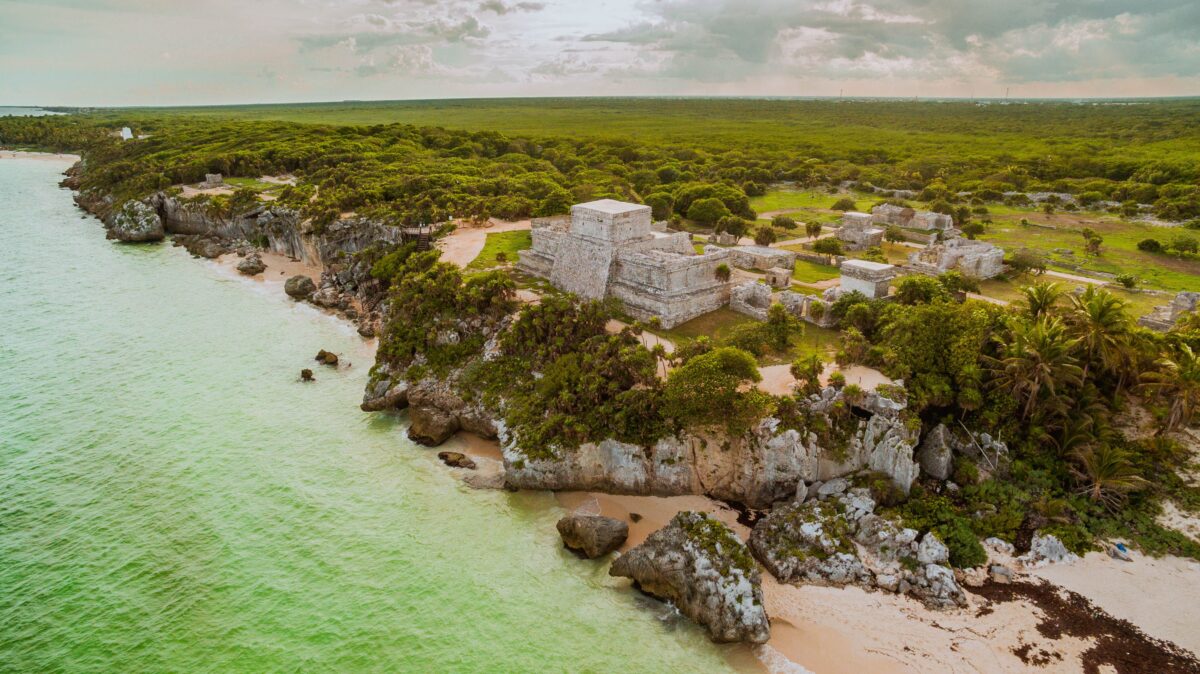
The Tulum ruins (the 13th-15th century Maya walled city on the Caribbean cliff — the Castillo (the main pyramid visible from the sea, the specific Tulum image, the Caribbean visible through the arch below the pyramid)):
At 8am (the site opens at 8am, the cruise ship passengers arriving from Playa del Carmen at 10am): the ruins with the Caribbean visible in every eastward direction, the iguana (Iguana iguana — the large lizard, the specific Tulum site inhabitant visible sunbathing on the stones): MXN 95 / £3.96.
The Sian Ka’an Biosphere Reserve:
The Sian Ka’an (“Where the sky is born” in Mayan — the UNESCO Biosphere Reserve south of Tulum, the 528,000 hectares of tropical forest, mangrove, marine environment, and Maya canal channels):
The canal channel float (the boat tour through the Maya canals — the channels dug by the Maya for the coastal trade route visible as the straight water channels through the mangrove, the current carrying the visitor through the channels without swimming): USD 60-90 / £47.24-70.87 per person for the guided tour.
The manatee (the West Indian manatee (Trichechus manatus — the large marine mammal visible in the Sian Ka’an lagoon in the early morning): the snorkel at the lagoon’s edge gives the manatee at close range in the dawn.
The Tulum town (not the hotel zone):
The Tulum town (the specific instruction: the pueblo — the town on the western side of the highway versus the zona hotelera on the eastern beach — gives the Tulum that is affordable, has the tacos at MXN 20 / £0.83 each, and exists below the Instagram algorithm). The hotel zone gives the Tulum that Instagram built. Both are in the same postcode. Only one has the Mérida-price food.
What It Costs
| Category | Budget | Mid-Range |
|---|---|---|
| Return flights (UK-Cancún or Mérida) | £300-600 | £500-900 |
| 7 nights accommodation | £70-210 | £210-560 |
| ADO bus network (Mérida-Valladolid-Tulum) | £10-25 | £10-25 |
| Food (7 days — Yucatán is affordable) | £25-70 | £70-180 |
| Entries (Chichén Itzá, Uxmal, Tulum, cenotes) | £40-80 | £40-80 |
| Sian Ka’an tour | £47-71 | £47-71 |
| Total | £492-1,056 | £877-1,816 |