
The Botswana argument: the most expensive accessible safari destination in Africa, the most wildlife-dense safari destination in Africa, and the specific Botswana that gives both of these simultaneously because the specific Botswana conservation model (the High Value, Low Volume tourism policy — the deliberate government policy of limiting the visitor number and maximising the conservation revenue per visitor) is the reason the Okavango Delta (the UNESCO World Heritage Site — the world’s largest inland delta, the Okavango River flowing from Angola into the Kalahari and never reaching the sea, the 15,000 square kilometre wetland visible from the mokoro) has the wildlife density it has. The lion that walks past the camp tent at 2am and the elephant that drinks from the lagoon visible from the camp deck at 6am and the African wild dog (Lycaon pictus — the most endangered large carnivore in Africa, the Okavango giving the highest wild dog sighting probability on the continent) are all the direct consequence of the policy that makes Botswana cost what it costs.
Reading time: 10 minutes | Last updated: 2026
Botswana is the conservation success story of post-colonial Africa — the country that went from one of the poorest in the world at independence (1966) to the upper-middle-income economy through the diamond revenue managed with the specific transparency that the Botswana governance record gives. The wildlife conservation (the 38% of the national territory protected) is the specific consequence of the policy that the Botswana government chose.
Before You Leave
Visa: UK citizens enter Botswana visa-free for 90 days.
Getting there: Fly London-Johannesburg (direct, 11 hours) → connect Johannesburg-Maun (the Okavango gateway — 2 hours, South African Airways or Airlink) → Maun airport → light aircraft to the camp (the 30-45 minute Cessna Caravan flight over the delta).
The cost reality: Botswana is not the budget safari. The high-value-low-volume camps (the Mombo Camp, the Nxabega, the Vumbura Plains) cost USD 800-2,000 per person per night all-inclusive. The budget end (the Maun guesthouse + the mokoro day trip) gives the Okavango without the all-inclusive camp at USD 100-200 per person per day total.
The Route
Maun (1 night) → Okavango Delta Camp (3 nights) → Chobe National Park (3 nights)
DAY 1 — Maun
The Maun base:
Maun (the Okavango gateway town — the Riley’s Hotel or the Sedia Riverside Hotel as the comfortable budget base, the Ngami Food and Wine as the Maun dinner, the Maun airport as the morning light aircraft departure):
The light aircraft departure at 7am (the Cessna Caravan or the Islander — the 8-seat aircraft, the Okavango visible from the aircraft window as the approaching green on the Kalahari brown, the delta channels visible from 500 metres as the water system spreading over the floodplain):
DAYS 2-4 — Okavango Delta
The mokoro:
The mokoro (the dugout canoe — the traditional Okavango transport, the poler (the guide standing at the stern, the pole propelling the canoe through the papyrus channels) navigating the delta’s inner waterways):
The mokoro at 6am (the papyrus channels in the first light, the malachite kingfisher (Corythornis cristata) visible at the channel edge, the hippo (Hippopotamus amphibius) audible in the adjacent pool — the mokoro passes within 20 metres, the poler steering around the hippo territory that the poler knows from the accumulated trips through the same channel):
The specific mokoro instruction: the mokoro is 30 centimetres above the water surface and 50 centimetres from the papyrus wall. The hippo is 3 metres underwater and 20 metres to the left. The poler knows exactly where the hippo is. The passenger is invited to trust the poler’s knowledge, which has been developed over more years than the passenger has been traveling.
The wild dog:
The African wild dog (Lycaon pictus — the painted wolf, the 7-cm-long ear, the mottled coat visible at 500 metres on the open floodplain, the pack hunt (the wild dog’s prey success rate at 80% — the highest of any African large predator)):
The wild dog pack hunt (the 6am game drive, the radio call from the camp tracker, the vehicle positioned at the floodplain edge as the pack moves through in the specific ground-covering run that covers 5km in 10 minutes — the speed of the pursuit visible at the vehicle’s driving speed): the most specifically dramatic single wildlife encounter in the Okavango.
The elephant herd:
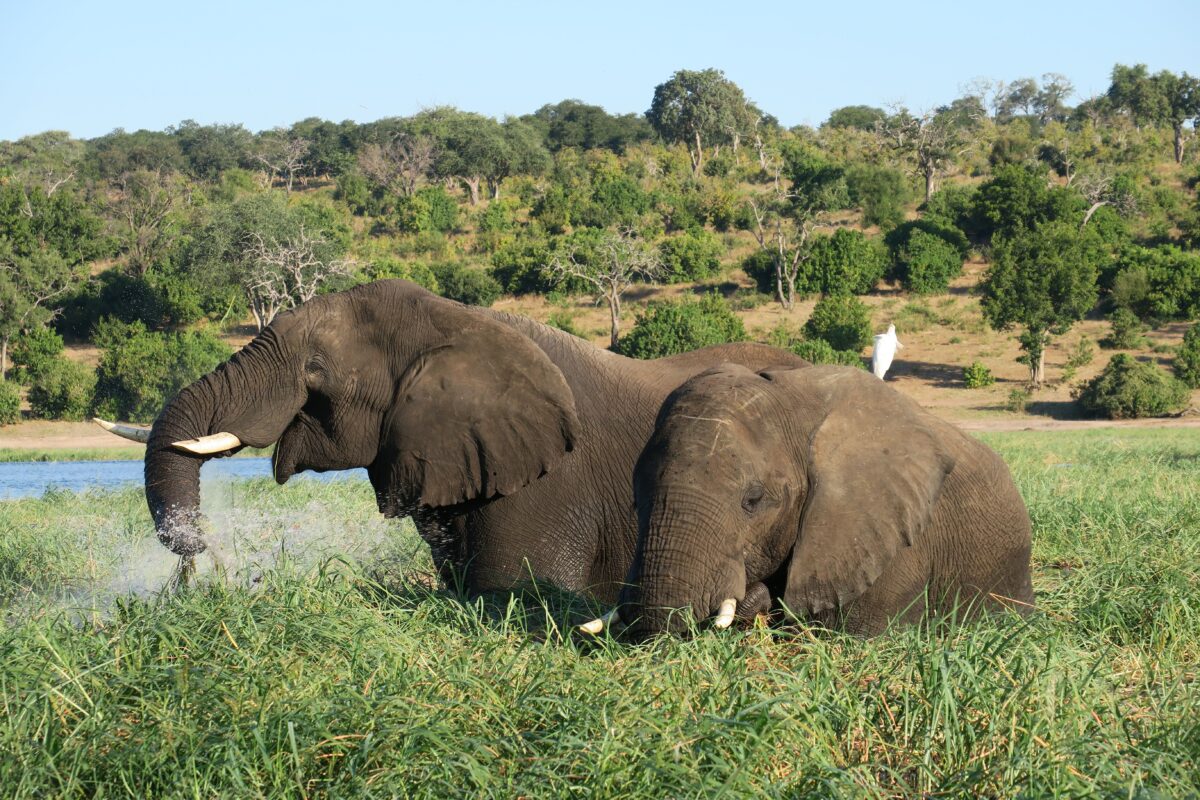
The Okavango elephant herd (the Botswana elephant population — approximately 130,000 individuals, the largest national elephant population on Earth, the herd visible at the delta’s mopane woodland edge at the late afternoon waterhole):
DAYS 5-7 — Chobe National Park
The Chobe riverfront:
The Chobe National Park (the river corridor adjacent to Zimbabwe and Zambia — the Chobe River, the elephant herd visible at the river’s edge in quantities that Botswana alone makes possible (the elephant-to-area density on the Chobe riverfront is the highest of any protected area in the world)):
The Chobe river boat safari (the flat-bottomed boat at 4pm, the elephants swimming across the river visible from the boat, the impala herd on the Namibian bank, the sunset over the Kasane National Park):
The Victoria Falls extension (optional Day 8):
The Victoria Falls (the waterfall on the Zambia-Zimbabwe border, 60km from the Kasane airport — the Mosi-oa-Tunya (the “Smoke That Thunders”), the 1,708-metre wide, 108-metre drop visible from the Zimbabwe side at Livingstone):
The 1-hour flight from Kasane to Victoria Falls Airport, the day at the falls, the overnight, the return flight Vic Falls-Johannesburg-London. The specific southern Africa extension that gives the safari and the world’s most impressive waterfall in the same trip.
What It Costs
| Category | Budget | Mid-Range |
|---|---|---|
| Return flights (UK-Johannesburg-Maun) | £600-1,000 | £850-1,400 |
| Delta light aircraft (Maun to camp) | £200-400 | £200-400 |
| 3 nights Okavango camp (all-incl.) | £600-1,800 | £1,800-4,200 |
| 3 nights Chobe lodge (all-incl.) | £450-1,200 | £1,200-3,000 |
| Total | £1,850-4,400 | £4,050-9,000 |
Botswana is the most expensive single-country safari in this guide. The Botswana Wildlife Conservation levy (BWP 100 / £5.59 per person per day in national parks) goes directly to the conservation fund. The cost is the conservation model; the conservation model is the reason the wildlife exists at the density it does.