
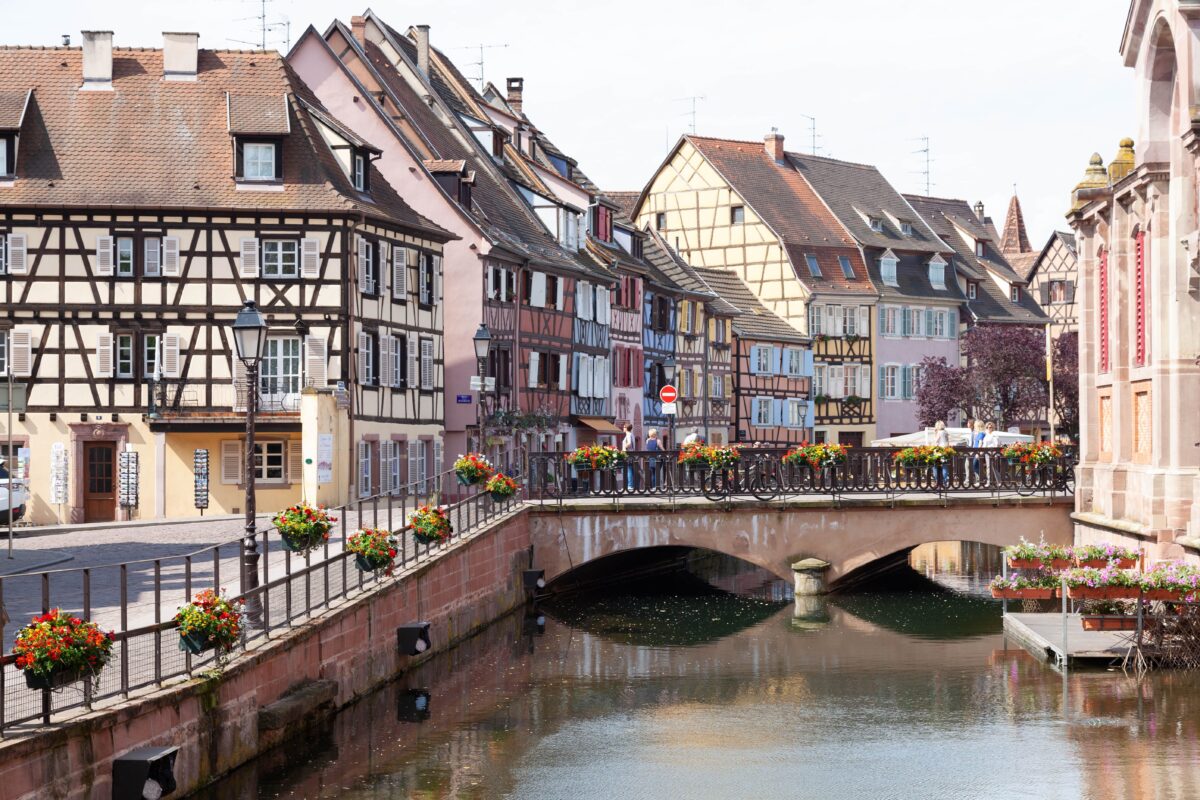
Colmar’s half-timbered old town anchors the Alsace Wine Route, a string of genuinely picture-perfect villages running roughly 170km through the region, close enough to Colmar that a week of day trips covers the entire route without moving accommodation once.
Quick answer: basing in Colmar for 7 days and exploring the Alsace Wine Route costs roughly £420-£520 per person excluding flights, based on a mid-range old-town hotel, three meals a day, and a rental car for the full week. Direct flights are limited from the UK; most travellers fly into Basel-Mulhouse or Strasbourg and take a short onward train or drive.
Why Colmar Works as a Single Base
Colmar sits roughly in the middle of the Alsace Wine Route, meaning villages both north and south (Riquewihr, Eguisheim, Kaysersberg among them) are all within a 20-30 minute drive. The region’s compact geography, unusual for a wine route of this length, means genuinely every major village is reachable as a half-day or shorter trip, making Colmar the natural single base rather than requiring accommodation changes along the route.
Day-by-Day: What to Do From Colmar
Day 1: Colmar Old Town
Colmar’s La Petite Venise district, canals lined with the same colourful half-timbered houses found throughout the wider region, makes the base itself worth a full day before venturing further afield.
- La Petite Venise canal walk: free, with boat tours available for €7.50-€8.50 (£6.40-£7.25) offering a different perspective on the same architecture
- Musée Unterlinden: €13 (£11.10), home to the Isenheim Altarpiece, one of the most significant works of German Renaissance art
- Dinner: a full Alsatian meal (choucroute, the region’s sauerkraut and sausage dish, or tarte flambée, a thin Alsatian flatbread) runs €15-€25 (£12.80-£21.35) per person
Day 2: Eguisheim
A short 10-minute drive from Colmar, Eguisheim is consistently ranked among France’s most beautiful villages, built in a distinctive concentric circular layout around its original medieval fortress.
- Village exploration: free, best experienced by simply wandering the circular streets rather than following a fixed route
- Wine tasting: Eguisheim sits at the heart of Alsace’s Grand Cru vineyard areas, with several family-run wineries offering tastings from €5-€15 (£4.30-£12.80) for a flight of 4-5 wines
- Lunch: a full meal at a village winstub (traditional Alsatian tavern) runs €15-€22 (£12.80-£18.80) per person
Day 3: Riquewihr
Roughly 20 minutes north of Colmar, Riquewihr is arguably the most photographed village on the entire Wine Route, its main street lined with colourful, ornately decorated timber houses largely unchanged since the 16th century.
- Village exploration: free, though genuinely crowded during peak summer and the Christmas market season, both worth timing around if possible
- Dolder Museum (medieval belfry gate): €4 (£3.40), offering a compact but interesting look at the town’s fortification history
- Wine tasting: Riquewihr’s position within the Riesling and Gewürztraminer growing areas makes it a strong stop for tastings, similarly priced to Eguisheim
The 6am principle applies most directly at Riquewihr. Its fame as the most photographed Wine Route village means genuine crowding by mid-morning in peak season, and an early visit delivers a dramatically different, quieter experience.
Day 4: Kaysersberg
A 15-minute drive from Colmar, Kaysersberg (birthplace of Albert Schweitzer) offers a slightly less crowded alternative to Riquewihr with equally strong architectural character.
- Kaysersberg Castle ruins: free to explore, a short uphill walk offering views over the village and surrounding vineyards
- Albert Schweitzer’s birth house (small museum): €5 (£4.30)
- Lunch: a full meal runs €14-€20 (£12-£17.10) per person, generally slightly cheaper than Riquewihr given lower tourist density
Day 5: Strasbourg Day Trip
A longer day trip, roughly 40 minutes from Colmar by train, to Alsace’s regional capital, offering a genuinely different scale and atmosphere from the smaller Wine Route villages.
- Strasbourg Cathedral: free entry, with the platform climb (332 steps) costing €8 (£6.85) for panoramic views over the city
- La Petite France district: free to wander, Strasbourg’s own canal-lined half-timbered quarter, similar in character to Colmar’s but on a larger scale
- Lunch: a full meal runs €15-€25 (£12.80-£21.35) per person
Days 6-7: Vineyard Hiking & Buffer
The final two days work well for hiking sections of the Route des Vins’ walking paths through the vineyards themselves, alongside a buffer for any village that warranted a longer return visit.
- Vineyard hiking trails: free, with well-marked paths connecting several Wine Route villages through the vines themselves rather than along the road
Ribeauvillé and Turckheim: Two More Villages Worth the Detour
Beyond the four main villages covered in the core itinerary, Ribeauvillé (a short drive north of Riquewihr) and Turckheim (just outside Colmar itself) both offer genuinely strong alternatives for anyone wanting to extend the Wine Route exploration during the buffer days. Turckheim in particular, still walled and largely untouched by the crowd volumes affecting Riquewihr, retains a night watchman tradition (a costumed guide leads an evening walk through the streets in summer) that adds a genuinely distinctive local touch most visitors never encounter elsewhere on the route.
What £420-£520 Actually Covers
| Category | Total for 7 Days (GBP, per person) |
|---|---|
| Accommodation (6 nights, split two ways) | £180-£280 |
| Food (three meals daily) | £110-£160 |
| Rental car (full week, split two ways) | £50-£75 |
| Wine tastings/activities | £40-£65 |
| Total | £380-£580 |
Step-by-Step: Booking This Trip
- Fly into Basel-Mulhouse (EuroAirport) rather than a more distant French hub, since it sits closest to Colmar, roughly 45 minutes by car or a combination of train and bus.
- Rent a car for the full week, since the smaller villages (Eguisheim, Riquewihr, Kaysersberg) aren’t comprehensively connected by public transport, unlike the Strasbourg day trip, which works well by train.
- Visit Riquewihr and Eguisheim early in the day, given their status as the most photographed and consequently most crowded villages on the route.
- Book wine tastings in advance for smaller, family-run wineries, since the best-regarded operations are often small enough to require reservation rather than accepting walk-ins.
- Avoid visiting during the Christmas market season if genuine village quiet is the priority, since this period, while beautiful, brings Riquewihr and Colmar’s most significant crowd volumes of the year.
Frequently Asked Questions
Do UK citizens need a visa for this trip?
No. France is part of the Schengen Area, allowing UK passport holders to visit visa-free for stays up to 90 days within any 180-day period.
Is a rental car essential for this base camp approach?
Largely yes, given the smaller Wine Route villages’ limited public transport connections, though Strasbourg specifically works well by train if a car-free day is preferred.
Which Wine Route village is the single best if only visiting one?
Eguisheim is often considered the strongest all-round choice, combining Riquewihr’s architectural beauty with a noticeably calmer atmosphere, given its slightly lower profile in international rankings.
What is the best time of year for this itinerary?
May-June and September-October offer the strongest combination of comfortable weather and (outside the Christmas market period) manageable crowds, with the September-October window also coinciding with the grape harvest season.
Can this route be done without a car, relying on public transport instead?
Partially, since Colmar has a regional train and bus network, but coverage to the smaller villages (Eguisheim, Riquewihr, Kaysersberg specifically) is limited enough that a car genuinely improves both flexibility and the range of villages reachable within the week.
The Bottom Line
Colmar delivers the strongest single-base position for exploring the Alsace Wine Route, close enough to every major village that a full week of day trips works without a single accommodation change. The trade-off is genuine crowding at the most famous villages (Riquewihr specifically) during peak season, worth managing with early starts rather than avoiding the villages entirely.