

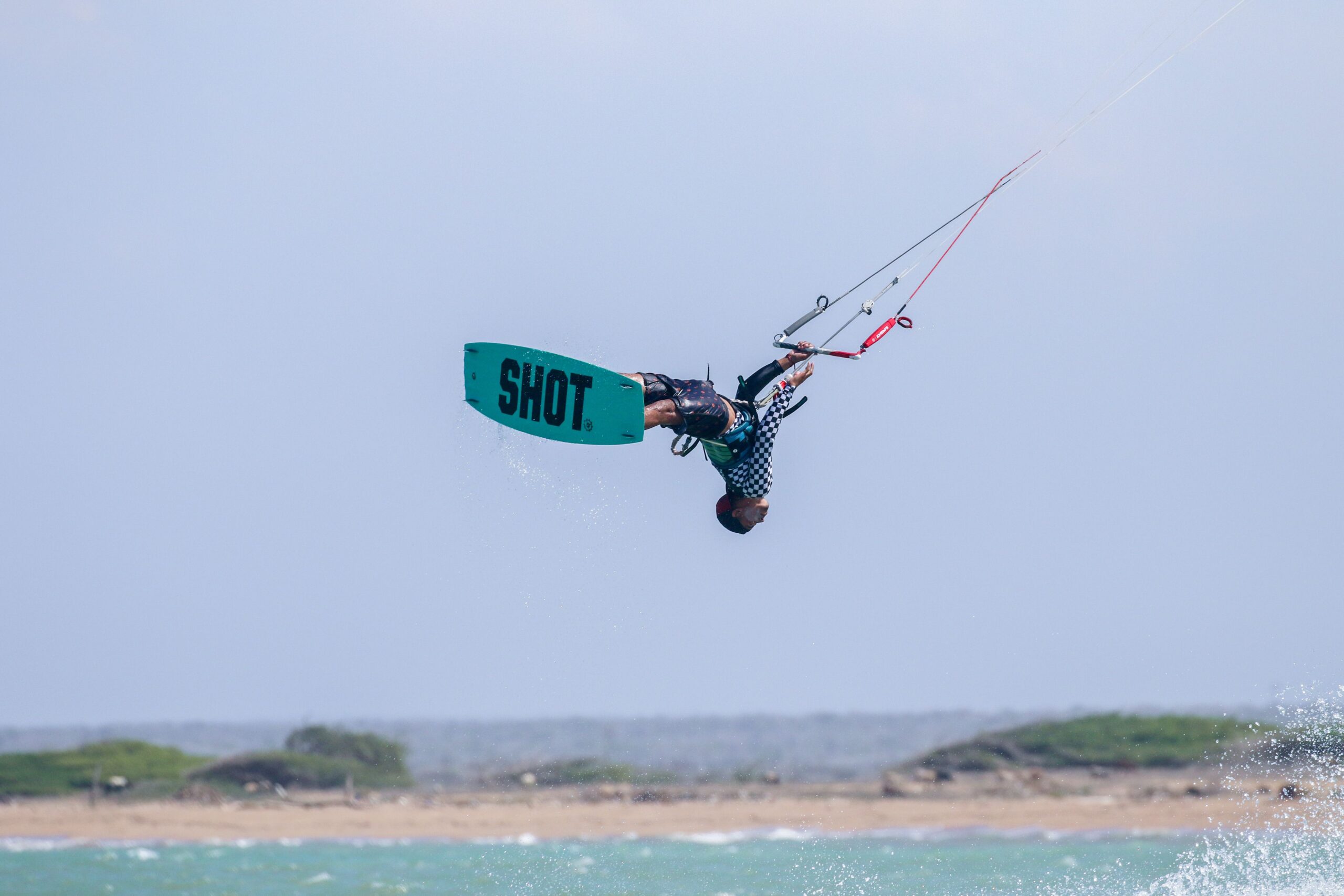
The kitesurfing ranking by what the conditions actually give you: the learner who needs the steady side-onshore wind, the flat water, and the instructor within shouting range rather than the world-class freestyle spot where the 30-knot gusts and the 2-metre chop would end the lesson before it began. Tarifa for the Levante wind that the Strait of Gibraltar tunnels between two continents. Dakhla for the lagoon that gives learning conditions for 10 months of the year. And the specific progression sequence — from the kite on the beach (Day 1) to the waterstart (Day 3) to the first board ride (Day 5) — that every kitesurfing instructor applies and that this guide gives honestly, including the days when the wind drops and you do nothing except watch the kite flyers and reconsider your relationship with patience.
Reading time: 8 minutes | Last updated: 2026
Kitesurfing (the board sport using the power kite to pull the rider across the water surface) has the steepest learning curve of any board sport — the kite control (the bar, the lines, the depower system) is a separate skill from the board riding, and the two must be learned in sequence before they can be combined. The learner who arrives at the beach and expects to be riding upwind by Day 2 is misunderstanding what the sport requires. The learner who accepts the correct timeline (5-12 hours of instruction spread across 3-5 days, the board riding beginning on Day 3-4 if conditions are consistent) has the sport’s specific joy available within a week.
The Destinations
1. Dakhla, Morocco — The Learning Capital
Why it’s first: Dakhla (the Moroccan city on the lagoon in the Western Sahara, 1,700km south of Casablanca) gives the most consistent learning conditions of any kitesurfing destination in the world — the flat lagoon (the 30km × 10km sheltered lagoon, the water depth averaging 60cm in the learning area, the depth giving the specific safety of being able to stand up at any point in the learning zone), the consistent trade wind (the north-northeast trade wind at 15-25 knots for 300+ days per year), and the side-onshore direction (the wind blowing across the beach rather than directly offshore, the direction that keeps the learner within swimming range of the beach if the kite fails).
The learning conditions: The Dakhla lagoon in the mornings (before 11am — the wind builds through the day, the learning conditions at 15-18 knots giving the controllable power for the beginner before the afternoon 25-knot condition that the advanced riders prefer). The flat water giving the specific benefit of no swell to manage while also managing the kite.
The instruction: The IKO (International Kiteboarding Organisation) certified schools in Dakhla (the Dakhla Attitude, the Club Mistral, the Dakhla Kite — the cluster of schools on the lagoon shore): the IKO Level 1 course (12 hours, the kite control on the beach, the body drag without the board, the waterstart and the first board ride): approximately €280-380 / £241.38-327.59 for the 12-hour course.
The cost: Dakhla is the most affordable major kitesurfing destination — the accommodation, the food, and the instruction are all at the Moroccan price rather than the European resort price. Mid-range accommodation with the kite school package: €80-120 / £68.97-103.45 per person per day all-inclusive.
The season: April-October for the best consistent wind. December-March: the wind is lighter and less consistent but the destination is quieter.
Getting there: Fly London to Agadir or Casablanca (Ryanair, easyJet), then Agadir to Dakhla on the RAM domestic service (1.5 hours). Or the 24-hour Supratours overnight bus from Agadir to Dakhla (€30 / £25.87) for the traveller who has time and budget.
2. Tarifa, Spain — The Wind City
Why it’s second: Tarifa (the southernmost city in mainland Europe, the point where the Strait of Gibraltar narrows to 14km and where the Atlantic and the Mediterranean exchange through the gap) gives the most consistent European kitesurfing conditions — the Levante (the east wind funnelled through the Strait at 20-35 knots) and the Poniente (the west wind at 15-25 knots) giving useable wind approximately 300 days per year.
The condition quality: Tarifa gives both the flat water of the lagoon at Los Lances beach (the learning conditions, the shallow water, the sand bottom) and the Atlantic swell at the Valdevaqueros beach (the advanced conditions, the jump height, the specific Tarifa kitesurfing that the progression rider comes for). The two beaches 15 minutes apart by road give the beginner and the intermediate conditions in the same destination.
The instruction: The Tarifa kite school concentration (the largest concentration of IKO-certified kite schools in Europe): the ION Club, the F-One Tarifa, the Kite Obsession — courses from €250-380 / £215.52-327.59 for 12 hours.
The town: Tarifa is a functioning Andalusian town with the kitesurfing economy layered on top — the tapas bars, the flamenco, the specific Spanish town quality that the purpose-built resort lacks. The evening in Tarifa (the Calle Sancho IV El Bravo, the kitesurfers and the surfers and the Spanish families at the same bar, the manzanilla and the albondigas and the wind that the town runs on): the most atmospheric single kitesurfing destination in Europe.
Getting there: Fly London to Malaga (Ryanair, easyJet, BA — from £50 return), the bus from Malaga to Algeciras (2.5 hours, €12 / £10.34), the bus from Algeciras to Tarifa (30 minutes, €3 / £2.59).
3. Cabarete, Dominican Republic — The Caribbean Learning Holiday
Why it’s third: Cabarete (the north coast Dominican Republic town that is the Caribbean’s kitesurfing capital) gives the thermal wind (the consistent 15-25 knot afternoon wind generated by the temperature differential between the land and the Caribbean Sea) in the most accessible tropical setting from the UK — the direct flight to Punta Cana (8 hours) combined with the 4-hour bus to Cabarete.
The conditions: The afternoon thermal at Cabarete Beach (the wide sand beach, the shallow lagoon behind the reef, the reef protecting the learning area from the ocean swell) — the wind arrives at 1pm and holds until 6pm with remarkable consistency from December-August.
The specific Cabarete advantage: The Caribbean in December-January (when the Tarifa and Dakhla conditions are reduced) gives the kitesurfing learning holiday when the UK travel window is most available. The Christmas and New Year break in Cabarete gives the winter sun and the consistent learning conditions simultaneously.
Getting there: BA, Virgin Atlantic, TUI direct London-Punta Cana (8.5 hours). Return: £450-700. The Caribe Tours bus from Punta Cana to Cabarete (4 hours, USD 10 / £7.87).
4. Boa Vista, Cape Verde — The Atlantic Island
Why it’s fourth: Boa Vista (the easternmost island of the Cape Verde archipelago, 700km off the coast of Senegal — the island that the trade winds reach before any land obstruction from the east): the consistent 20-30 knot trade wind from November-July, the 4-hour flight from the UK (the closest consistently excellent kitesurfing destination to the UK), and the flat turquoise lagoon at Santa Mónica beach (the 12km beach on the island’s south coast, the most consistent conditions in the Cape Verde archipelago).
Getting there: TUI, easyJet direct from UK airports to Boa Vista (4 hours). Return: £350-550.
The Learning Sequence
The correct kitesurfing learning progression (the IKO curriculum):
Day 1 (3 hours): The kite on the beach. The four-line bar, the power zones, the bar control, the depower safety system. The trainer kite (the small 3-4m practice kite) flown on the beach for 2 hours before the full-size kite is introduced in the shallows.
Day 2 (3 hours): The body drag. The full-size kite (9-12m depending on the wind strength and the learner’s weight) in the water, the learner dragged by the kite through the water without the board, the kite control practised while managing the water environment. This is the day that separates the learner who will progress from the learner who is misunderstanding what the sport requires — the body drag is not optional and is not abbreviated. The instructor who skips the body drag produces an unsafe kiter.
Day 3-4 (3-4 hours): The waterstart with the board. The board on the feet, the kite powering the ride, the first attempts to stand. Most learners achieve the first stand on Day 3 and the first sustained ride on Day 4-5.
Day 5+: The first upwind ride (the ability to kitesurf upwind rather than simply downwind) — the skill that gives full independence from the instructor.