


The lightweight hiking boot question is the gear question that reveals the difference between the hiker who understands the weight-support trade-off and the hiker who doesn’t: the boot that weighs 400g per pair and gives the day hiker the terrain confidence of the 1kg boot on the Tongariro Alpine Crossing is the correct boot. The boot that weighs 400g per pair and gives no lateral support on the loose scree of the Tour du Mont Blanc is the correct running shoe, incorrectly placed on a mountain. This guide tests the four boots that the long-distance walking community has converged on and names the one that earns the weight saving without the support penalty.
Reading time: 7 minutes | Last updated: 2026
The Weight-Support Trade-Off
The traditional hiking boot (900g-1.2kg per pair): The full-grain leather, the high ankle, the Vibram sole, the steel shank — the boot built for the multi-week alpine trek with the 15kg pack. Still correct for the extended alpine route with the heavy load.
The lightweight hiking boot (400-600g per pair): The synthetic fabric or the lightweight leather, the lower ankle cut, the lighter midsole — the boot built for the day hike, the multi-day trail with the lighter pack, and the traveller who wants hiking capability without the full boot bulk in the hold luggage.
What you sacrifice: The ankle protection (the lighter fabric and the lower cut give less lateral stability on loose terrain), the waterproofing duration (the GTX membrane in the lightweight boot degrades faster than in the full leather boot under prolonged wet conditions), and the pack load capacity (the lightweight boot is not designed for the pack above 12kg for extended periods).
The Four Boots
1. Salomon X Ultra 4 GTX — The BGGD Recommendation
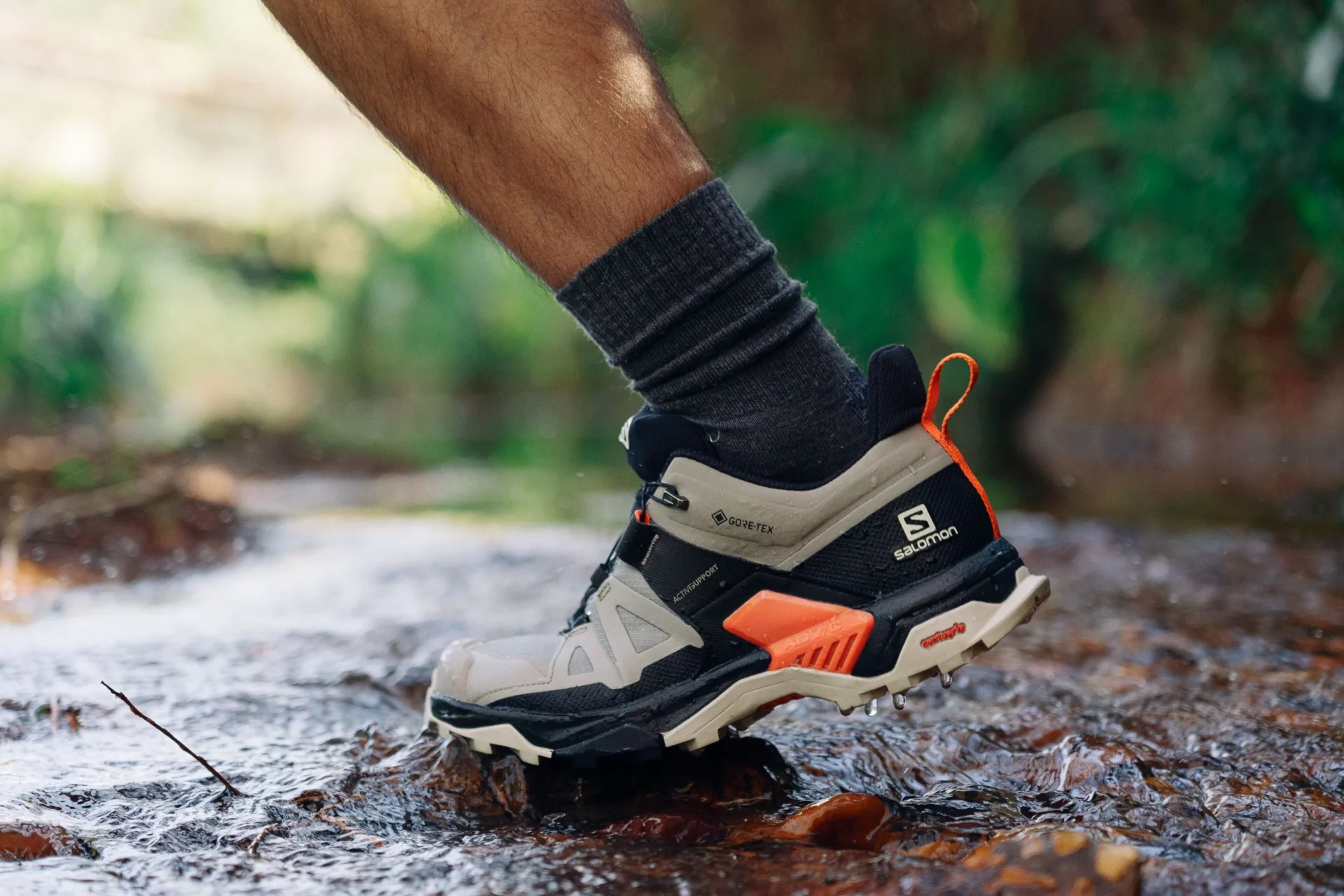
What it is: The most consistently recommended lightweight hiking boot in the UK trail community — the Gore-Tex waterproof lining (the GTX), the Contagrip MA outsole (the multi-directional traction compound, the specific rubber formulation for the mixed terrain), the SensiFit construction (the lacing system that wraps the foot from the sole, giving the specific locked-in feel that reduces the foot movement inside the boot):
The weight: 520g per pair (women’s version: 460g). Significantly lighter than the traditional hiking boot at the comparable support level.
The terrain test: The Tongariro Alpine Crossing (the volcanic rock, the loose scree on the descent from Red Crater, the stream crossings in the lower valley): the X Ultra 4 GTX handles all three terrain types without the slip that the trail shoe produces on the scree. The ankle cut (the mid cut) gives the lateral support for the scree without the full ankle immobilisation of the high-cut boot.
The durability: The Contagrip sole typically gives 800-1,200km before the tread depth reaches the replacement threshold. For the traveller who walks 15-20km per day on a 2-week trip, the boot has approximately 3-4 years of equivalent use.
Price: £130-160 at UK retailers.
BGGD verdict: The correct lightweight hiking boot for the traveller who hikes on mixed terrain (trail, loose rock, river crossings) and wants the GTX waterproofing with the touring weight.
2. Hoka Anacapa Mid GTX — The Cushioned Option
What it is: The Hoka approach to the hiking boot — the maximalist cushioning midsole applied to the hiking boot format, the PROFLY X midsole (the Hoka signature cushioning compound giving the impact absorption that the traditional hiking boot midsole does not), the Gore-Tex lining:
The weight: 620g per pair (heavier than the Salomon X Ultra 4, lighter than the traditional boot).
The specific Hoka advantage: The knee impact reduction. The Hoka midsole absorbs the downhill impact (the descent loading that the traditional hiking boot transmits directly to the knee) in a way that the standard trail shoe does not. For the hiker with existing knee issues or the traveller who hikes extensively on the descent, the Hoka cushioning is the specific biomechanical advantage.
The trade-off: The maximalist cushioning reduces the trail feel — the hiker who wants to feel the terrain through the sole (the specific proprioceptive information that the thinner midsole gives) finds the Hoka more insulating than the Salomon. Not a universal negative; personal preference.
Price: £160-190.
BGGD verdict: The correct boot for the hiker with knee sensitivity or the hiker who covers high daily mileage on descent terrain.
3. Scarpa Zodiac Plus GTX — The Technical Option
What it is: The Scarpa approach to the lightweight boot — the Italian leather and fabric hybrid construction, the Vibram Lite Tech outsole (the Vibram compound specifically formulated for the technical terrain), and the SCARPA Precision Fit last (the Italian footwear tradition giving the specific foot hold that the Salomon and the Hoka use a wider-fit last):
The weight: 700g per pair (heavier than the Salomon, justifiable for the specific technical terrain use).
The specific Scarpa advantage: The crampon compatibility. The Zodiac Plus is compatible with the C1 walking crampons (the basket-style strap crampons for the winter trail or the early-season alpine approach). This gives the specific winter capability that the Salomon X Ultra 4 does not have.
The fit note: The Scarpa Italian last (the narrower toe box, the tighter heel hold) does not suit every foot. Trial in store before purchasing.
Price: £200-240.
BGGD verdict: The correct boot for the traveller who combines summer trail hiking with winter mountain walks or the early-season alpine approach where the crampon compatibility adds value.
4. Merrell Moab 3 Mid GTX — The Value Option
What it is: The Merrell Moab (the Acronym for “Mother Of All Boots” — the marketing claim that the US outdoor community adopted ironically and affectionately) has been the entry-level quality lightweight hiking boot since 2005. The third generation gives the updated M Select DRY waterproof lining (the Merrell proprietary alternative to the Gore-Tex), the Vibram TC5+ outsole:
The weight: 580g per pair.
The honest assessment: The Moab 3 is the correct first lightweight hiking boot — the price point (£100-130, significantly below the Salomon and the Scarpa), the widespread availability in UK outdoor retailers, and the 20-year track record of the Moab platform give the boot’s specific quality argument. It is not the Salomon’s equal in lateral support or the Scarpa’s equal in technical terrain; it is available at 75% of the Salomon’s price and performs at 85% of the Salomon’s level.
Price: £100-130.
BGGD verdict: The correct boot for the hiker who wants quality lightweight hiking footwear without the premium pricing. The correct entry to the category.
The Boot vs Trail Shoe Question
The boot versus trail shoe decision (the Salomon Speedcross or the Hoka Speedgoat trail shoe versus the Salomon X Ultra or the Hoka Anacapa boot):
Choose the boot if: The terrain includes loose rock, scree, or stream crossings (the ankle cut and the sole stiffness give the specific stability that the trail shoe does not); the pack weight exceeds 8kg; or the hike duration exceeds 4 hours per day.
Choose the trail shoe if: The terrain is primarily well-maintained trail (the GR10 in the Pyrenees, the Camino de Santiago, the Lycian Way lower sections); the pack weight is under 8kg; and the daily hike is under 4 hours.