
The route that gives Cambodia its full argument: three days in Siem Reap for the Angkor Archaeological Park at the correct hours and in the correct sequence (Angkor Wat at dawn, the Bayon at 7am before the heat, the Ta Prohm at 3pm when the afternoon light hits the tree roots at the angle the photographs miss), two days in Phnom Penh for the Tuol Sleng Genocide Museum and the Royal Palace and the riverfront that gives the Cambodia evening at its most specifically atmospheric, and two days at Kampot for the pepper plantation and the river kayak and the specific Cambodian provincial town that the backpacker circuit discovered in 2015 and that has not yet been consumed by the discovery.
Reading time: 10 minutes | Last updated: 2026
Cambodia is the country that the Khmer Empire built and the Khmer Rouge dismantled and the Cambodian people are rebuilding. The Angkor Archaeological Park (the 400+ temples of the Khmer Empire capital from the 9th-15th centuries, the most extensive archaeological site in the world by area) and the Tuol Sleng Genocide Museum (the school converted to the Khmer Rouge detention facility where 17,000 people were processed for execution between 1975-1979) are the same country and require the same visit.
Before You Leave
The visa: Cambodia e-Visa for UK citizens. Apply at evisa.gov.kh — USD 36 / £28.34, processed within 3 business days, valid 30 days.
The Angkor pass: The Angkor Archaeological Park entry pass (the Angkor ticket — purchased at the Angkor Ticket Centre on the road from Siem Reap): USD 37 / £29.15 for 1 day, USD 62 / £48.82 for 3 days, USD 72 / £56.69 for 7 days. Buy the 3-day ticket for the first Siem Reap visit.
The tuk-tuk: The tuk-tuk driver hired for the full day is the correct Angkor transport — the driver waits outside each temple, the route managed around the timing and the crowd avoidance. Negotiate the full-day rate before departure: USD 15-25 / £11.81-19.69 for the small circuit.
The Route
Siem Reap (3 nights) → domestic flight or bus to Phnom Penh (45 minutes by air, 6 hours by bus) → Phnom Penh (2 nights) → bus to Kampot (4 hours) → Kampot (2 nights) → return Phnom Penh, fly home
DAYS 1-3 — Siem Reap and Angkor
Day 1: Angkor Wat at Dawn
5:00am — The departure from Siem Reap:
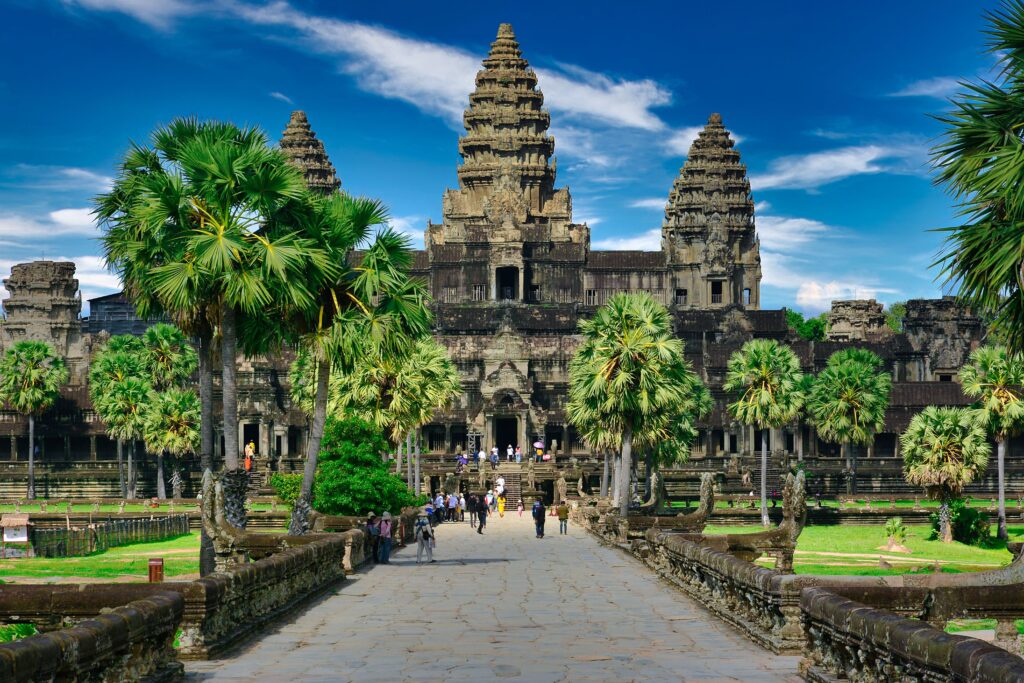
The tuk-tuk at 5am (the 20-minute drive to the Angkor Wat causeway in the dark). The causeway at 5:30am: the silhouette of the five towers visible against the pre-dawn sky, the moat reflecting the first light, the photographers positioned at the reflection point.
The Angkor Wat (the 12th-century temple complex — the world’s largest religious monument by land area, the 5.5-kilometre moat, the 800-metre causeway, the five towers at the centre (the Meru-representing towers, the central tower at 65 metres)): the dawn visit gives the temple in the eastern light, the full tour circuit (2 hours) in the cool of the morning before the 30°C midday.
The Gallery of Bas-Reliefs (the 800-metre narrative carved into the outer gallery walls — the Battle of Kurukshetra (the Hindu epic), the Churning of the Ocean of Milk (the creation myth), the Heaven and Hell narrative): the south gallery at 7am, the specific detail visible in the morning light that the midday glare erases.
Day 2: The Bayon and Ta Prohm
7:00am — The Bayon:
The Bayon (the 12th-century Khmer temple at the centre of Angkor Thom — the 216 stone faces of the bodhisattva Lokesvara looking in the four cardinal directions from 54 towers): at 7am, the faces in the low morning light, the shadow emphasising the carved features.
The specific Bayon instruction: look up. The faces are carved at the height of the tower tops — the standard tourist eye-line misses the perspective from which the faces are most fully visible. Stand at the base of the central tower and look upward to the four faces simultaneously.
3:00pm — The Ta Prohm:
The Ta Prohm (the temple that the Angkor Conservancy has left in the jungle-reclaimed state — the tetrameles nudiflora tree roots visible growing over and through the sandstone walls, the specific Ta Prohm image visible in every Angkor photograph set): at 3pm, the afternoon light filtering through the tree canopy into the courtyard, the shadows giving the roots their maximum photographic drama.
The Ta Prohm at 3pm rather than 10am: the tour group buses leave the park at noon; the afternoon Ta Prohm is 60% less crowded.
Day 3: The Outer Temples
The Bantaey Srei (the 10th-century temple 25km north of Siem Reap — the pink sandstone, the finest decorative carving in Angkor, the temple called “the citadel of women” for the delicacy of the carving (which the 19th-century French archaeologists incorrectly attributed to female hands)): the morning visit, the light on the pink sandstone before 10am.
The Preah Khan (the 12th-century temple — the flat roof corridor, the specific columned passageway visible from every Angkor guide’s camera angle, the tree roots growing through the corridor roof in the Ta Prohm style at 50% of the Ta Prohm crowd): the most photographically coherent of the outer temples.
DAYS 4-5 — Phnom Penh
Day 4: The Tuol Sleng Genocide Museum
Full description in Laos vs Cambodia. The specific instruction repeated: the Tuol Sleng and the Killing Fields together. The audio guide is the mandatory component — the survivor testimony gives the museum its specific register. Entry: USD 8 / £6.30.
The Royal Palace:
The Royal Palace (the Phnom Penh royal palace complex — the Silver Pagoda (the floor of 5,000 silver tiles, the Emerald Buddha and the gold Buddha visible in the temple interior), the Throne Hall, and the pavilion gardens): entry USD 10 / £7.87.
Day 5: The Phnom Penh Riverfront
The Phnom Penh Waterfront (the promenade on the Tonlé Sap River where it meets the Mekong — the Sisowath Quay, the restaurants and the bars visible from the riverside path, the ferry to the Koh Dach silk-weaving island (the island accessible by local ferry at USD 1 / £0.79, the silk weaving visible in the village households)): the Phnom Penh evening on the waterfront, the sunset over the Tonlé Sap.
The Fish Amok (the Cambodian national dish — the freshwater fish steamed in the coconut milk and the kroeung (the lemongrass paste), the presentation in the banana leaf cup, the specific Cambodia flavour that no other Southeast Asia cuisine replicates): at the Kravanh restaurant (41 Sothearos Boulevard — the riverfront restaurant with the consistent Fish Amok): USD 7-12 / £5.51-9.45.
DAYS 6-7 — Kampot
The Kampot pepper plantation:
The Kampot pepper (the UNESCO geographical indication — the pepper grown in the Kampot and Kep provinces of southern Cambodia, the specific Cambodian pepper that the French colonial cuisine adopted in the 19th century and that the international fine dining market has rediscovered): the plantation visit (the pepper vine on the wooden post, the green clusters (the immature fruit), the red (the ripe), the black (the dried ripe)):
The Starling Farm or the La Plantation (the Kampot pepper farm accessible by bicycle from the town — 10km south on the river road): free or USD 5-10 / £3.94-7.87 for the guided circuit.
The Kampot river kayak:
The Kampot River (the mangrove river south of the town — the kayak available from the Kampot riverside operators): USD 10-20 / £7.87-15.75 per half-day solo kayak. The river at dawn (the mangrove visible from the kayak at water level, the kingfisher visible on the mangrove root, the specific Cambodia dawn at the river surface).
The Bokor Mountain:
The Bokor National Park (the plateau above Kampot — the abandoned French colonial hill station (the Casino, the Church of Our Lady of Sorrows, the Post Office visible in the jungle, the specific French Indochina infrastructure abandoned in 1940 and reclaimed by the forest since)): the motorbike hire from Kampot (USD 5-10 / £3.94-7.87 per day), the 37km mountain road.
What It Costs
| Category | Budget | Mid-Range |
|---|---|---|
| Return flights (UK-Siem Reap or Phnom Penh) | £450-750 | £600-1,000 |
| 7 nights accommodation | £35-140 | £140-420 |
| Angkor 3-day pass | £49 | £49 |
| Food (7 days) | £30-70 | £70-170 |
| Transport (tuk-tuks, buses, domestic flight) | £30-70 | £50-100 |
| Activities | £20-50 | £40-90 |
| Total | £614-1,129 | £949-1,829 |