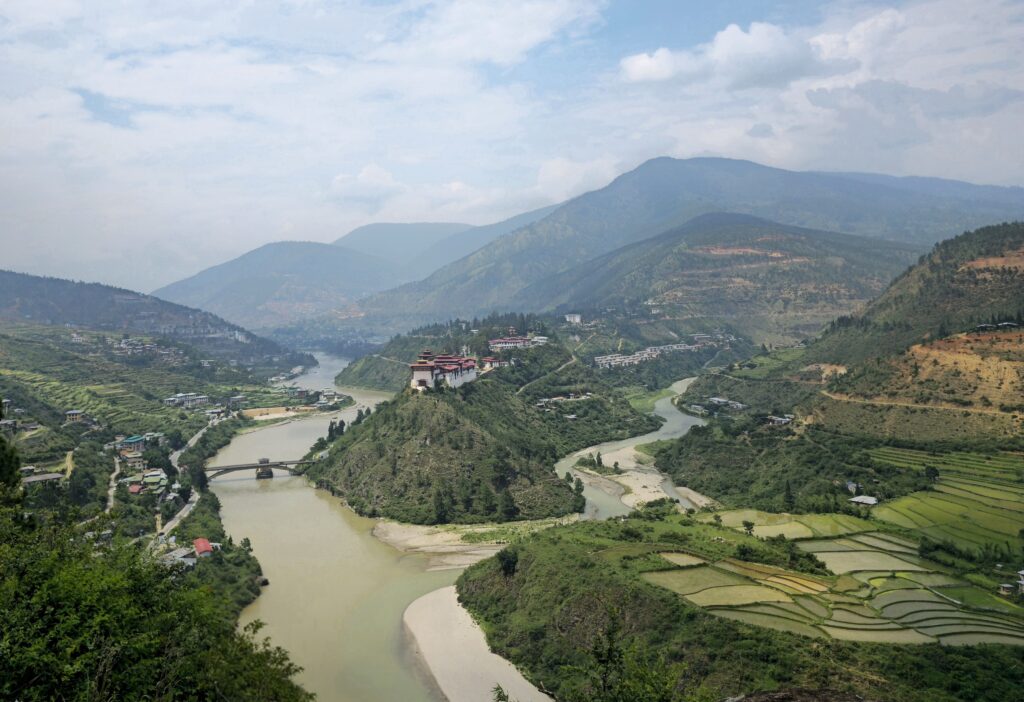

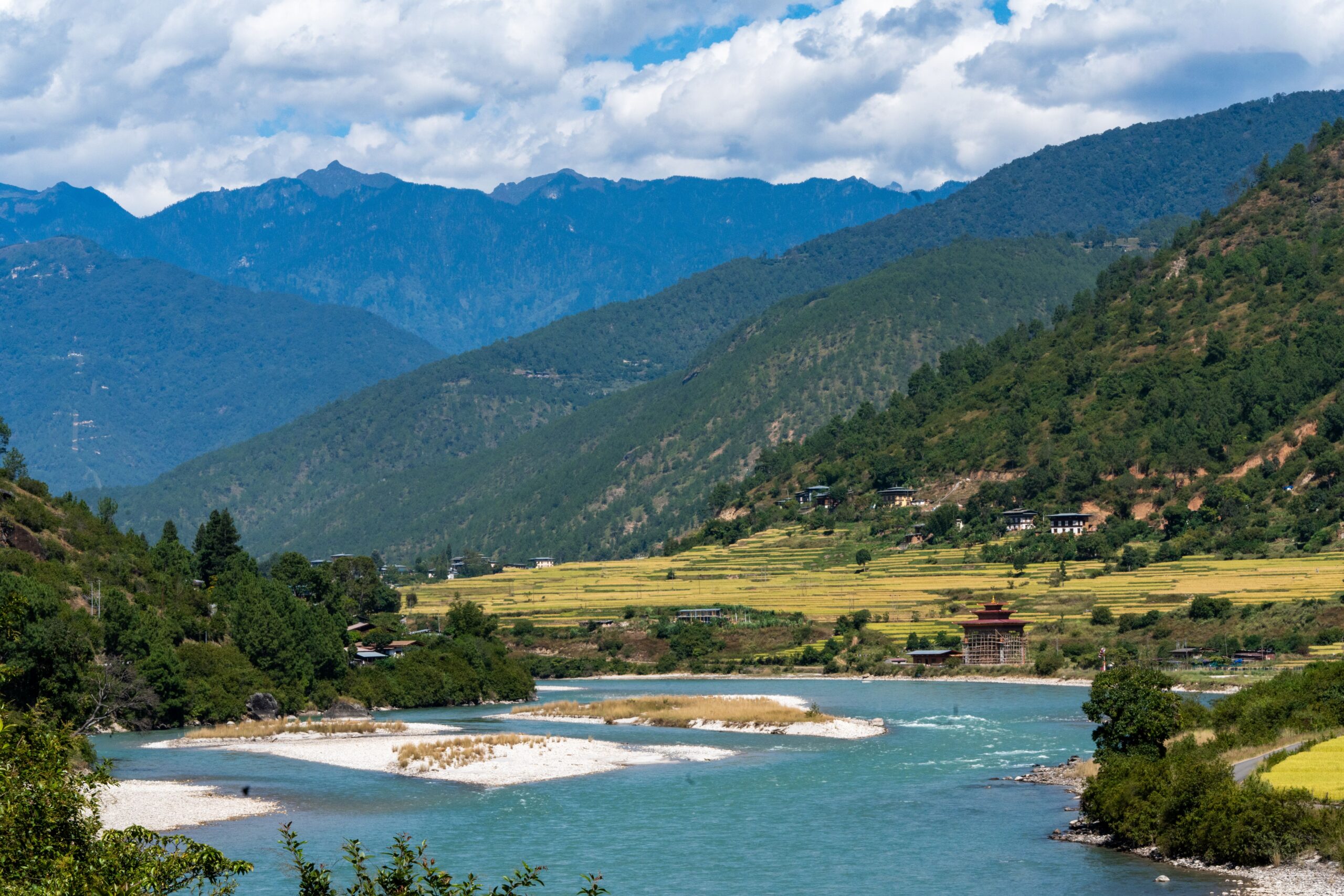
The route that gives Bhutan honestly — the country where the daily Sustainable Development Fee (USD 100 per person per day) is the mechanism that makes the visit worth the fee, because the mechanism that limits the visitor volume to a level the country can absorb without becoming the country it was visited to see is the mechanism operating correctly: two days in Paro for the Tiger’s Nest Monastery at dawn and the Rinpung Dzong and the valley that gives the Bhutan image in every direction, two days in Thimphu for the Tashichho Dzong and the National Memorial Chorten and the weekend market where the Bhutanese from the surrounding districts come to trade in the specific market that the government designed the way it designed everything — carefully, with the GDP not measured in growth but in happiness, and three days in the Punakha and the Phobjikha Valley for the Punakha Dzong at the river confluence and the black-necked crane (the sacred bird of the Bhutanese highland) visible in the Phobjikha Valley from October to February.
Reading time: 11 minutes | Last updated: 2026
Bhutan is the country that is not for everyone, and that is the correct assessment rather than a marketing failure. The visitor who arrives expecting the Himalayan equivalent of the Nepal teahouse trek — the independent circuit, the unbooked hostel night, the improvised day — is misunderstanding what Bhutan has chosen to be. The visitor who arrives having accepted the guide, the approved itinerary, the daily fee, and the understanding that Bhutan’s specific quality (the intact dzong architecture, the living Buddhist culture, the uncleared forest, the tiger above 4,000 metres) exists because of the mechanism rather than despite it receives the country that the fee protects.
Before You Leave
The visa and the SDF: Bhutan requires the Tourist Visa (USD 40 / £31.50) plus the Sustainable Development Fee of USD 100 / £78.74 per person per day (the fee reduced from USD 200 in 2024). The combined daily cost for the 7-day visit: USD 840 / £661.42 in fees, the accommodation, and the guide fees additional. Total 7-day visit per person: approximately USD 1,500-2,200 / £1,181-1,732.
The guide: Mandatory for all visitors. The licensed Bhutanese guide (the TCB-licensed guide registered with the Tourism Council of Bhutan): the guide included in the tour operator package. Book through a TCB-licensed tour operator: Bhutan Mandala Tours, Etho Metho Tours, or Yangphel Adventure Travels.
The flight: Druk Air and Bhutan Airlines are the only airlines permitted to fly into Paro International Airport (PBH — the approach through the Himalayas, the aircraft banking between the peaks, the runway at 2,235 metres visible through the windows moments before landing: the most specific approach of any commercial route in Asia). Druk Air connects Paro with Delhi, Kolkata, Bangkok, Kathmandu, and Singapore. Fly UK-Bangkok or UK-Delhi then connect.
The Route
Paro (2 nights) → Thimphu (2 nights) → Punakha (2 nights) → Phobjikha Valley (1 night, seasonal) → return Paro, fly home
DAYS 1-2 — Paro
The Tiger’s Nest Monastery (Paro Taktsang):
The Paro Taktsang (the monastery complex at 3,120 metres — the four temples built into the cliff face 900 metres above the Paro Valley floor, the monastery reached by the 4-hour return hike from the lower car park through the pine and rhododendron forest):
The dawn ascent (the guide collects from the Paro hotel at 6am, the car park at 6:30am, the trail clear of the day’s visitors until 9am): the Tiger’s Nest in the morning mist (the monastery appearing and disappearing in the cloud that forms in the valley below, the specific Bhutan landscape visible at the moments when the cloud clears — the Paro Valley below, the monastery above, the pine forest between):
The specific Tiger’s Nest instruction: the monastery is a functioning religious site. The final approach (the chain descent into the valley below the monastery and the ascent to the monastery entrance) leads to the four temples, the prayer flags, and the cave where Guru Rinpoche (Padmasambhava) is said to have meditated. Remove shoes at every temple entrance. Photography inside is not permitted. The prayer wheel corridor (the corridor beside the main temple, the brass prayer wheels turning from left to right as the visitor walks) is the correct Tiger’s Nest movement — the clockwise circumambulation.
The Rinpung Dzong:
The Rinpung Dzong (the 17th-century fortress-monastery at the Paro river crossing — the dzong (the Bhutanese architectural form combining the religious centre and the administrative centre in a single fortress) visible from the traditional covered cantilever bridge below): the morning visit (the monks in the courtyard at morning prayers, the administrative offices in the eastern wing, the specific Bhutan governance architecture visible in the working building):
Entry with the guide included in the tour package.
DAYS 3-4 — Thimphu
The Tashichho Dzong:
The Tashichho Dzong (the Thimphu dzong — the government and the religious centre of modern Bhutan, the throne room of the King visible to the visitor on the guided tour, the 1961 reconstruction of the original 13th-century dzong visible in the white-washed walls and the golden roof):
The Tashichho afternoon visit (the monks returning from the daytime administrative duties at 4pm — the specific Bhutan moment of 500 monks entering the dzong gate simultaneously in the late afternoon light, the saffron robes visible against the whitewashed wall).
The Buddha Dordenma Statue:
The Buddha Dordenma (the 51.5-metre bronze Buddha on the Kuenselphodrang hillside above Thimphu — the largest Buddha statue in the world built at this altitude, the valley visible in every direction from the statue platform): free.
The Takin Preserve:
The Takin (Budorcas taxicolor — the Bhutan national animal, the bovid that appears to be assembled from the wrong parts (the moose nose, the goat-sheep body, the bulky haunches), the animal found only in the Bhutan-China-India highland zone): the Motithang Takin Preserve (the former zoo converted to the open enclosure on the Thimphu hillside): free.
The specific takin instruction: the takin is real. The Bhutanese legend holds that the Tibetan saint Drukpa Kunley (the Divine Madman) created the takin from the skeleton of a goat and a cow by attaching the wrong heads. The actual taxonomy is clear but the legend is more satisfying.
The Thimphu Weekend Market:
The Thimphu Weekend Market (the open-air market on the east bank of the Wang Chhu river, operating Friday-Sunday — the produce from the surrounding Bhutan districts: the dried cheese, the dried red chilli, the wild mushroom, the yak butter, the rice, and the specific Bhutan agricultural produce visible at the source price):
The ara (the traditional Bhutanese spirit distilled from rice or wheat — available at the market stalls on the weekend): BTN 50-150 / £0.44-1.31 per small bottle. The correct market purchase.
DAYS 5-6 — Punakha
The Punakha Dzong:
The Punakha Dzong (the dzong at the Pho Chhu and Mo Chhu river confluence — the 1637 fortress-monastery, the architectural reference that all subsequent Bhutan dzongs are compared to, the jacaranda trees visible in spring (March-April) flowering along the dzong’s exterior wall, the river visible from the dzong windows in both directions):
The dzong at the river confluence: the specific Punakha sight — the whitewashed walls visible from the cantilever bridge connecting the dzong to the town, the two rivers meeting directly at the dzong’s lowest walls.
The Chimi Lhakhang:
The Chimi Lhakhang (the fertility temple of the Divine Madman — the 1499 temple on the hill above the Punakha valley, the walk through the rice paddies from the road (30 minutes each way), the temple’s collection of the Divine Madman’s wooden phallus (the phallus as the protective symbol against the evil eye — the specific Bhutan cultural detail that the tourism guide is obliged to explain and that the visitor is obliged to receive without the snicker that the context is designed to pre-empt)):
The Chimi Lhakhang instruction: the Divine Madman (Drukpa Kunley, 1455-1529) is the specific Bhutan saint — the figure who taught Buddhist philosophy through transgressive behaviour, who painted phalluses on houses as protective symbols, and who the Bhutanese honour as seriously as any more conventionally pious saint. The temple is not a comedy attraction. It is a pilgrimage site for Bhutanese couples seeking fertility. The visitor who approaches it as the comedy attraction is the visitor who has not read the guide.
DAY 7 — Phobjikha Valley (Seasonal: Oct-Feb)
The Black-Necked Crane:
The black-necked crane (Grus nigricollis — the crane species that breeds on the Tibetan Plateau and winters in the Phobjikha Valley of central Bhutan from October to February, the species that the Bhutanese consider sacred (the crane’s arrival in October is celebrated at the Gangtey Monastery festival)):
The Phobjikha Valley (the glacial valley at 2,900 metres — the Black Necked Crane Information Centre at the valley floor, the crane visible in the valley fields from October to February in numbers of 300-600 individuals):
The specific Phobjikha instruction: the Phobjikha is a day trip from Punakha (90 minutes by road) or an overnight. The overnight (the guesthouse in the valley, the crane at dawn in the valley mist) is the correct format.
What It Costs
| Category | Per Person |
|---|---|
| Return flights (UK-Bangkok or Delhi, Bangkok-Paro) | £700-1,200 |
| Bhutan Tourist Visa | £31.50 |
| SDF (7 days × USD 100) | £554.18 |
| Guide, accommodation, and meals (included in package) | £600-900 |
| Total per person | £1,885-2,685 |