
The route that gives Ethiopia its full civilisational argument in a week: two days in Addis Ababa for the National Museum (the Lucy skeleton, the 3.2-million-year-old australopithecine visible in the glass case, the specific Ethiopia that produced the oldest known human ancestor and that has been insufficiently impressed by this ever since) and the Merkato (the largest open-air market in Africa, 7,000 vendors visible from the road above) and the coffee ceremony that the world’s coffee culture originates from and that Ethiopia performs three times daily regardless of whether a visitor is present, three days in Lalibela for the rock-hewn churches carved into the basalt plateau in the 12th century and still in daily liturgical use and still requiring the removal of the shoes at the entrance because the worshippers are kneeling inside, and two days in the Simien Mountains for the gelada monkey (the grass-eating primate found only in the Ethiopian highlands, the male’s chest patch of bare red skin visible at 3,000 metres above sea level) and the Ras Dashen (the highest peak in Ethiopia at 4,550 metres, the Simien escarpment visible from the summit in every direction as the specific East African highland that the Nile runs from).
Reading time: 11 minutes | Last updated: 2026
Ethiopia is the country that the travel world has been about to discover for 30 years and that rewards the visitor who arrives before the discovery is complete. The Lalibela churches (the 11 rock-hewn churches carved into the volcanic basalt during the reign of King Lalibela in the 12th century — the churches still in use as the daily devotional centre of the Ethiopian Orthodox community, the priests visible in the churchyard in the white robes and the coloured umbrellas) receive 50,000 visitors per year. Machu Picchu receives that in a fortnight.
Before You Leave
The visa: Ethiopia requires a visa for UK citizens. The e-Visa is available at evisa.ethiopia.gov.et — USD 52 / £40.95 for the 30-day single entry tourist visa, processed within 3 working days.
The altitude: Addis Ababa sits at 2,355 metres (the highest capital city in Africa, the third highest in the world). Lalibela: 2,500 metres. The Simien Mountains: 3,000-4,550 metres. The mild AMS risk is real — the same protocol as the Nepal highland section applies.
The coffee: Ethiopia is the birthplace of coffee — the Coffea arabica plant (the arabica coffee species) originated in the Kaffa region of southwestern Ethiopia. The coffee ceremony (the bunna maflat — the roasting of the green coffee beans over the charcoal, the grinding, the brewing in the jebena (the clay coffee pot), the service in three rounds: abol, tona, and baraka) is the specific Ethiopia social and spiritual ritual. Accept every invitation.
The Route
Addis Ababa (2 nights) → Fly Addis-Lalibela (1 hour, Ethiopian Airlines) → Lalibela (3 nights) → Fly Lalibela-Gondar (45 minutes) → Simien Mountains (2 nights) → Fly Gondar-Addis, fly home
DAYS 1-2 — Addis Ababa
Day 1: The National Museum and the Coffee Ceremony
The National Museum:
The National Museum of Ethiopia (King George VI Street, Sidist Kilo — the museum housing the Lucy skeleton (Dinknesh in Amharic — “you are wonderful”), the 3.2-million-year-old Australopithecus afarensis partial skeleton discovered in the Afar Depression in 1974):
The Lucy cast (the original skeleton is preserved separately; the museum displays the cast — the 40% complete skeleton visible in the display case, the standing height approximately 1.1 metres, the bipedal stance visible in the hip structure that confirms Lucy walked upright): entry ETB 200 / £2.61.
The specific Lucy instruction: the skeleton is 3.2 million years old. The species it represents (Australopithecus afarensis) is the direct ancestor of the genus Homo — the evolutionary lineage that produced Homo sapiens. Standing at the display case in the Addis Ababa museum, the visitor is looking at the skeletal remains of the great-great-grandmother of all living humans. This is the correct register for the encounter.
The coffee ceremony:
The coffee ceremony in the Piassa neighbourhood (the old Italian quarter of Addis — the cafés visible from the street, the ceremony visible through the window from 3pm): the host roasts the green coffee beans over the charcoal brazier, the guests smell the beans passed in the pan (the offering of the scent before the brew), the coffee ground and brewed in the jebena, the service in the small handle-less cups with the popcorn (fogolo) alongside. Three rounds minimum — leaving after the first round is the specific social error.
Day 2: The Merkato and the Ethnological Museum
The Merkato:
The Addis Mercato (the largest open-air market in Africa — the 7,000+ vendors across multiple city blocks, the specific goods by quarter: the spice market, the coffee market, the fabric market, the electronics market, the second-hand imported goods market): at 9am, before the midday heat.
The Berbere (the Ethiopian spice blend — the dried red chillies, the fenugreek, the coriander, the ginger, the korarima (the Ethiopian cardamom), the specific spice compound that gives Ethiopian stew (wot) its specific character): the Merkato spice market at ETB 50-150 / £0.65-1.96 per 100g.
The Ethnological Museum:
The Institute of Ethiopian Studies Museum (Addis Ababa University campus, the former palace of Haile Selassie — the museum occupying the emperor’s former bedroom and bathrooms, the folk art collection, the musical instrument collection, the specific Ethiopia material culture visible at the domestic scale of the royal palace): entry ETB 150 / £1.96.
DAYS 3-5 — Lalibela
The rock-hewn churches:
The Lalibela churches (the 11 monolithic rock-hewn churches of the 12th-century reign of King Gebre Meskel Lalibela — each church carved from the single volcanic basalt rock, the church not built upward from the ground but carved downward into the plateau, the interior fully excavated from the solid rock):
Entry: USD 50 / £39.37 for the combined 4-day ticket (the churches divided into two groups, both accessible with the combined ticket).
The Bete Giyorgis (Church of Saint George):
The Bete Giyorgis (the most photographed of the Lalibela churches — the monolithic church visible from the plateau edge as the cross-shaped roof below the ground level, the 12-metre descent into the trench giving the church in its full rock-hewn context): the church at 7am (before the tour groups from the Lalibela hotels arrive), the morning liturgy audible from the descent into the trench, the priest in the white robes visible at the church entrance.
The Bete Medhane Alem:
The Bete Medhane Alem (the House of the Saviour of the World — the largest rock-hewn church in the world, the 72 pillars carved from the rock supporting the roof, the interior larger than most European cathedrals): the active liturgy visible at 6am, the priest chanting the Ge’ez liturgy (the ancient liturgical language of the Ethiopian Orthodox Church, unchanged since the 4th century).
The Timkat Festival (January timing):
The Timkat (the Ethiopian Orthodox Epiphany celebration — the most important religious festival in the Ethiopian calendar, the 19-20 January celebration when the tabot (the replica of the Ark of the Covenant) is carried from each church to the Lalibela pool for the blessing and the baptism): the Lalibela Timkat is the most specifically extraordinary public religious ceremony visible in Africa. If the January timing is achievable, the Lalibela Timkat visit gives the churches in their maximum liturgical context.
The local guide:
The local guide (the Lalibela guide from the local guide association — not the hotel-recommended national guide but the Lalibela resident who grew up in the church community and who explains the iconography, the liturgical calendar, and the specific function of each church from the insider position): ETB 500-1,000 / £6.53-13.07 per half day. The church complex without the guide is the architecture. With the guide it is the living theology.
DAYS 6-7 — Simien Mountains
Fly Lalibela-Gondar (45 minutes, Ethiopian Airlines):
The Simien Mountains National Park:
The Simien Mountains National Park (the UNESCO World Heritage Site — the Ethiopian Highlands escarpment, the gelada monkey habitat, the Walia ibex (Capra walie — the critically endangered mountain goat endemic to the Simiens, approximately 500 individuals remaining), and the Ras Dashen (4,550 metres — the highest peak in Ethiopia, the 10th highest in Africa)):
The gelada monkey:
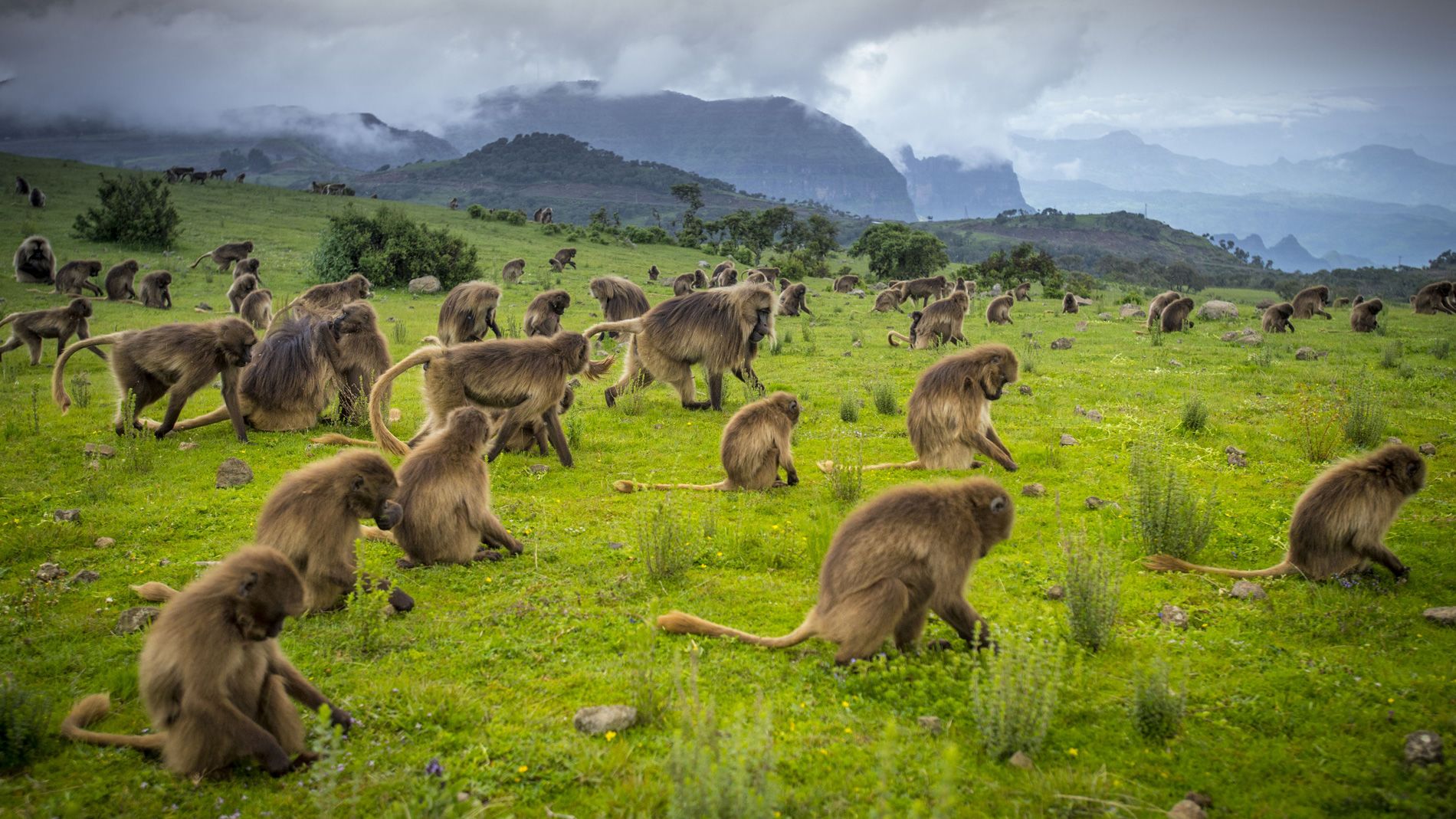
The gelada (Theropithecus gelada — the grass-eating primate, the only living species of its genus, found only in the Ethiopian Highlands above 2,500 metres): the gelada visible in herds of 50-400 individuals on the Simien escarpment grass, the male’s bare chest patch (the “bleeding heart” marking — the red skin visible as the signal of reproductive condition) visible at arm’s reach from the trail:
Park entry: ETB 500 / £6.53 per person per day. The guide and the scout (the armed scout mandatory for the national park trekking): ETB 300-500 / £3.92-6.53 per day.
The specific gelada instruction: the gelada troop is habituated to the human presence — the individual animals approach within 2 metres of the trail. The appropriate response is stillness. The gelada that approaches to within 1 metre and then grooms itself at that distance has performed the specific Ethiopian primate encounter.
What It Costs
| Category | Budget | Mid-Range |
|---|---|---|
| Return flights (UK-Addis Ababa) | £450-750 | £600-1,000 |
| Internal flights (Addis-Lalibela, Lalibela-Gondar, Gondar-Addis) | £100-200 | £150-280 |
| 7 nights accommodation | £70-210 | £210-560 |
| Lalibela church entry | £39 | £39 |
| Food (7 days) | £30-80 | £80-180 |
| Activities and guides | £40-100 | £80-180 |
| Total | £729-1,379 | £1,159-2,239 |