
The route that covers the four Imperial Cities (Marrakech, Fez, Meknes, Rabat), the Sahara dunes at Merzouga, the Todra Gorge, and the blue city of Chefchaouen — and does all of it without backtracking, without hiring a guide for every step, and without the specific mistake most Morocco first-timers make of spending all 7 days in Marrakech.
Reading time: 11 minutes | Last updated: 2026
Morocco is 3.5 hours from any UK airport. It has four UNESCO-listed medinas, the largest desert in the world, mountains that exceed 4,000 metres, and a food tradition that UNESCO has recognised as Intangible Cultural Heritage. Most UK travellers spend all of their time in Marrakech.
This itinerary covers the country.
Before You Leave
The CTM bus: Morocco’s national coach company (the CTM — Compagnie de Transports au Maroc) operates between all major cities. Book at ctm.ma — the advance purchase is significantly cheaper than the station price and the buses are reliable, comfortable, and the correct way to move between Moroccan cities without a hire car.
The hire car alternative: For Days 3-5 (the Sahara circuit), a hire car from Fez gives more flexibility than the organised tour. 4WD not required for the main Sahara road. Book through Rentalcars.com or the local agencies in Fez.
Currency: Moroccan Dirham (MAD). £1 ≈ 50 MAD. ATMs widely available. The dirham is a closed currency — cannot be purchased in the UK; exchange at the airport on arrival or at any Moroccan bank.
The Route Overview
Marrakech (2 nights) → Fez (1 night) → The Sahara circuit (Merzouga, Todra, Dades — 2 nights) → Chefchaouen (1 night) → Casablanca or Rabat (fly home)
Total distance: approximately 1,400km by road. Achievable by CTM bus and shared taxi (grand taxi) or by hire car from Day 3.
The 7 Days
DAY 1 — Arrive Marrakech
Afternoon: The Medina First Walk
The Djemaa el-Fna (the main square) at 4pm — the snake charmers, the henna artists, the juice vendors, the acrobats. Walk through the square to the souks behind (the covered market stretching north from the Djemaa — the spice souk, the carpet souk, the metalwork souk). Get lost deliberately. The medina is 1km × 1km — the waterfront is always north (the ramparts), the Djemaa is always south.
The Djemaa el-Fna at 7pm: the food stalls set up, the smoke from the grills, the specific evening transformation from entertainment square to outdoor restaurant. The circuit: urojo from the northeast stalls (the Zanzibar mix soup — yes, it exists in Marrakech, the North African-East African trade route visible in the food), the kefta skewers from the central grill section, the fresh orange juice (4 MAD / £0.08 per glass — the cheapest drink in the guide series).
Where to stay: A riad in the medina — the courtyard guesthouses, the traditional Moroccan house with the interior garden. Dar Salam (from £35-60/night), the Riad BE (from £55-90/night), the Riad Yasmine (from £40-70/night).
DAY 2 — Marrakech: The Depth Day
7:00am — Koutoubia Mosque (exterior)
The 12th-century minaret — the model for the Giralda in Seville and the Hassan Tower in Rabat (the three towers built by the same Almohad architects in the same period). Non-Muslims may not enter. The exterior at 7am: the mosque before the city wakes, the minaret in the morning light, the orange trees of the adjacent garden.
8:00am — Amlou and Msemen Breakfast
The neighbourhood café inside the medina (not the tourist cafés of the Djemaa el-Fna terrace) for the msemen (the layered Moroccan flatbread, pan-fried) with amlou (the walnut-argan-honey paste, the most specifically Moroccan breakfast spread). 20-35 MAD / £0.40-0.70.
9:00am — The Bahia Palace
The Bahia Palace (Rue Riad Zitoun el-Jdid) — the 19th-century palace built by the Grand Vizier Ahmed ibn Moussa (Si Moussa). The 8 hectares of gardens, the painted cedarwood ceilings, the courtyard tiles. Most impressive: the formal courtyard with the marble floor and the cedar screens above. Entry: 70 MAD / £1.40.
10:30am — The Mellah (Jewish Quarter)
The Mellah — the former Jewish quarter of Marrakech (Jews were required to live within the Mellah from the 16th century; the community was significant until the creation of Israel in 1948 dramatically reduced the Moroccan Jewish population). The Lazama Synagogue (the 16th-century synagogue, still maintained: free entry, donation requested), the Jewish cemetery (the oldest in Marrakech, the whitewashed tombs), and the specific Mellah architecture (the overhanging balconies, the wrought-iron screens — elements absent from the Muslim medina).
12:00pm — The Mechoui Alley
The mechoui vendors (Souk Ahl Fès, behind the Djemaa el-Fna, the lamb carcasses visible at the stall entrances): the whole lamb slow-roasted in underground clay ovens from 8am, sold by weight at the counter from noon. 120-160 MAD / £2.40-3.20 per kilo — feeds two people. Eat with the salt, the cumin, and the khoubz from the adjacent bread stall.
2:00pm — The Saadian Tombs
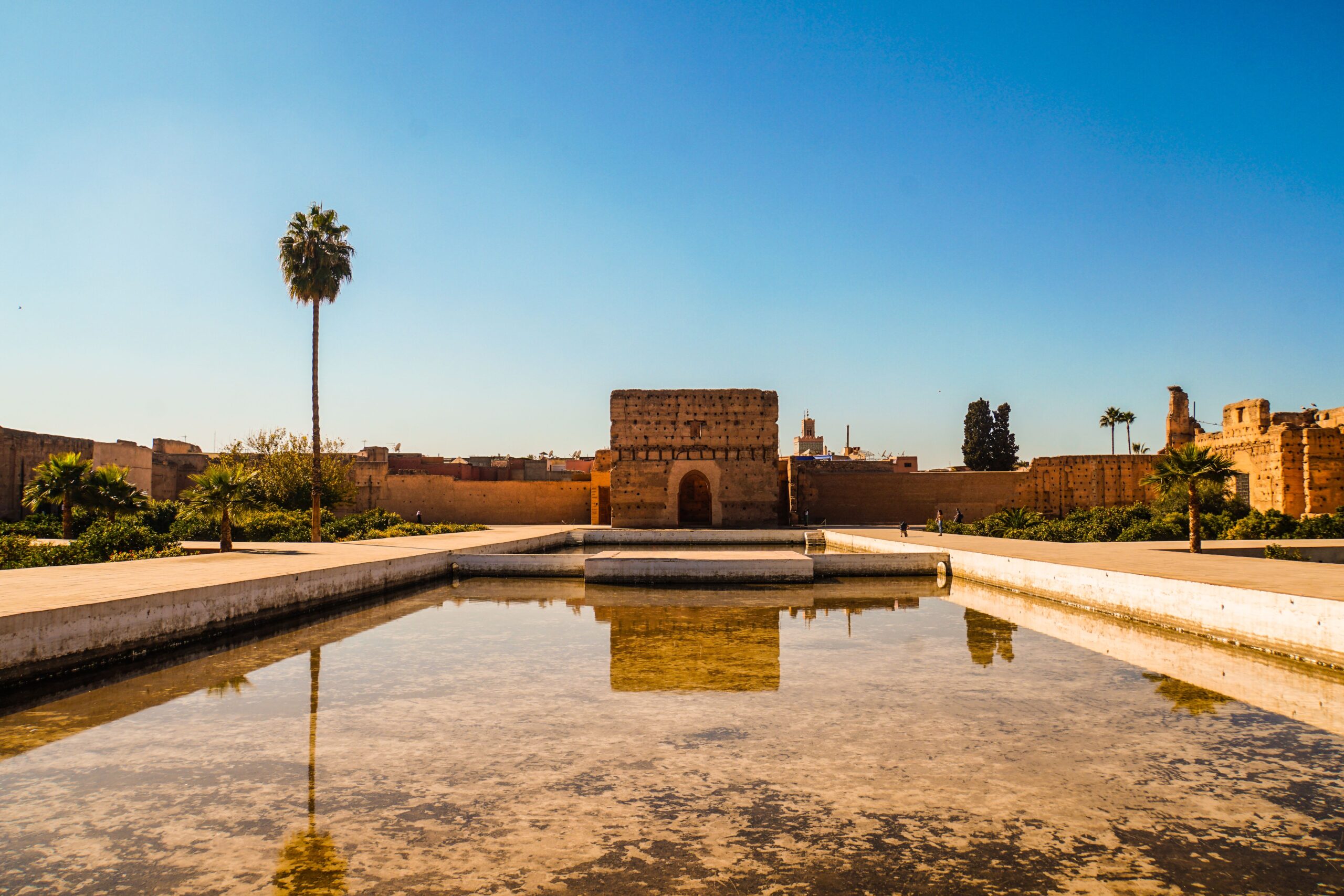
The Saadian Tombs (Rue de la Kasbah) — the 16th-century royal necropolis of the Saadian dynasty, discovered in 1917 behind a sealed wall (they were sealed by the Alaoui sultan Moulay Ismail who refused to demolish them for superstitious reasons and instead simply walled them in). The Hall of Twelve Columns (the chamber with the carved stucco and the cedarwood ceiling above the sultan’s tomb) is the finest single interior in Marrakech.
Entry: 70 MAD / £1.40. Queue from 11am-2pm — go at 2pm when the midday queue has passed.
4:00pm — Le Jardin Majorelle and the Yves Saint Laurent Museum
The Majorelle Garden (Rue Yves Saint Laurent) — the botanical garden designed by the French painter Jacques Majorelle in the 1920s, the cobalt blue buildings (the “Majorelle blue” — the specific shade of blue that gives the garden its visual identity), the cactus garden, the bamboo grove. Purchased by Yves Saint Laurent and Pierre Bergé in 1980 and restored.
The Musée Yves Saint Laurent adjacent to the garden — the retrospective of Saint Laurent’s work, the Moroccan influence on his designs. Entry: 150 MAD / £3 (garden), 100 MAD / £2 (YSL Museum).
Evening: The Forodhani Night Market Circuit
The full Djemaa el-Fna evening eating circuit (see Day 1 — the full version): 100-160 MAD / £2-3.20 per person.
DAY 3 — Marrakech to Fez (CTM Bus or Hire Car)
Morning: The CTM Bus
CTM bus Marrakech to Fez: 7-8 hours, 150-200 MAD / £3-4. Departs from the CTM station at Bab Doukkala. The Marrakech-Fez route crosses the Middle Atlas Mountains — the cedar forests, the Barbary macaques at the Azrou pass (the monkeys visible from the road, the bus stops at Azrou for 20 minutes). Take the 7am departure to arrive in Fez by 3pm.
Alternatively: the hire car route via Beni Mellal
The hire car from Marrakech to Fez via the N8 through Beni Mellal gives the option to detour through the Aït Benhaddou (the UNESCO-listed kasbah village, the most photographed mudbrick structure in Morocco, the Game of Thrones filming location — 35km detour from the Marrakech-Ouarzazate road). If taking the hire car to begin the Sahara circuit from Fez, pick up the car in Fez rather than Marrakech to avoid the Marrakech-Fez driving.
Evening: Fez First Night
Check in to the medina riad (the Riad Laaroussa, the Riad Meski, or the budget option — the Dar Bouanania). Walk the Talaa Kebira (the main artery of the Fes el-Bali medina) from the Bab Bou Jeloud gate downward. The medina at 7pm: the working city slowing from the day’s pace, the bread sellers returning from the communal ovens, the cafés at the Bou Jeloud gate for the evening tea.
The restaurant: Café Clock (Derb El Magana, Talaa Kbira) — the cultural café established by a British expatriate, the camel burger (the most reliably good meal for the visitor navigating Fez without a food contact), the evening music performances. 80-130 MAD / £1.60-2.60 per person.
DAY 4 — Fez Medina, then Drive South
7:00am — The Chouara Tanneries
The tannery viewpoint from the leather shop terraces (the terrace access free with the social contract of viewing the leather goods — a genuine transaction, not a scam). The tanneries at 7am: the workers already at the dyeing pits. The fresh mint sprigs provided at the terrace entrance: use them. The smell of the tanning process (the pigeon dung ammonia, the vegetable dyes) is significant.
9:00am — The Medersa Bou Inania
The 14th-century Islamic college — the zellige tilework, the carved stucco, the carved cedarwood of the upper balconies. The finest interior in Fez. Entry: 70 MAD / £1.40.
11:00am — Departure for the Sahara
The route: Fez → Azrou → Midelt → Errachidia → Merzouga (the Sahara dunes). Total: 5 hours by hire car. The road crosses the Middle Atlas (the cedar forests), the High Atlas passes (the Col du Zad at 2,178m), and descends into the pre-Saharan hamada (the rocky desert) before the sand dunes appear at Merzouga.
The dunes appear suddenly after 400km of desert plateau — the Erg Chebbi dunes (150 metres high) are visible from 30km away as an orange line on the horizon.
Afternoon: the Merzouga Camel Ride
The sunset camel ride from the Merzouga village to the camp in the dunes: 45-60 minutes each way. The camel is not comfortable. The dune at sunset (the specific Sahara colour, the shadow in the slipfaces) is worth the camel.
Evening: the Desert Camp
The overnight camp — the Berber-style camp with the shared tent accommodation, the dinner around the fire (the tajine, the mint tea, the stars). Camp cost: 400-600 MAD / £8-12 per person including dinner and breakfast.
The night sky: the Milky Way visible at 9pm, the Southern Pleiades below the horizon, the specific Saharan silence.
DAY 5 — Sahara to Chefchaouen via Todra
7:00am — The Dawn Dunes
The dune summit at dawn — the walk from camp (20 minutes), the view over the Erg Chebbi as the sun comes up behind the Algerian border mountains. The specific Sahara dawn: the light changing from grey to orange to gold over 15 minutes.
10:00am — Todra Gorge (Detour)
The Todra Gorge (the canyon south of the town of Tinghir, 120km northwest of Merzouga): the limestone walls 300 metres high and 10 metres apart at the narrowest point, the river running along the gorge floor. The 45-minute walk through the gorge. The local café at the gorge entrance for the mint tea.
Afternoon: Drive North to Chefchaouen
Tinghir → Khénifra → Azrou → Chefchaouen: 5 hours. The route crosses the Middle Atlas again and descends through the Rif Mountains to the northern coast.
Chefchaouen (the blue city) visible from the approach road — the town on the slope below the Rif mountains, the whitewashed medina tinted blue by the Jewish community who painted the streets in the 1930s (the blue colour is said to represent the sky and heaven, repelling mosquitoes, or marking the Jewish quarters — the origin is debated and the practice has continued by tradition).
Evening: Chefchaouen
The medina at dusk — the blue walls and the blue lanes in the last light. The Plaza Uta el-Hammam (the central square) for the evening meal. The Lala Mesouda (the restaurant in the square, the tajine and the pastilla at working-city prices). 80-120 MAD / £1.60-2.40 per person.
DAY 6 — Chefchaouen
Dawn: the Medina
The Chefchaouen medina at 6am: the lanes entirely empty, the blue walls in the pre-dawn light, the cats on the walls. The specific Chefchaouen dawn photograph (the lane descending between blue walls, the cat visible, the light from below the horizon) is achievable before 7am and not achievable after 9am when the photography tour groups arrive.
Morning:
The Spanish Mosque (the 45-minute hike above the medina, the mosque visible on the ridge above the town, the view over the rooftops of the medina and the valley below). Free. Open. The walk: the lane behind the medina rising steeply through the olive groves to the ridge.
The Ras el-Maa waterfall (15 minutes walk north from the central plaza, the spring that feeds the town’s water supply, the locals doing laundry at the pool below the falls). Free.
Afternoon: the Souks
The Chefchaouen souks: the woollen garments (the djellaba, the burnous — the specific Rif mountain wool tradition, the quality higher and the tourist orientation lower than Marrakech), the Kif (the cannabis trade that has made the Rif mountains internationally known — it is visible, it is available, it is illegal for foreign visitors and the legal situation for travellers is ambiguous: this guide mentions it factually without recommendation).
Evening: the Final Night
The medina at dusk, the final mint tea, the final attempt to understand how blue a street can actually be.
DAY 7 — Chefchaouen to Casablanca or Rabat, Fly Home
Morning: Transfer to Coast
CTM bus Chefchaouen to Casablanca: 4.5 hours, 130 MAD / £2.60. Or Chefchaouen to Rabat: 3.5 hours. Both cities have international airports.
Casablanca option: The Hassan II Mosque (the largest mosque in Africa — the minaret 210 metres, the prayer hall accommodating 25,000 worshippers, the Atlantic visible through the glass floor). Tour: 120 MAD / £2.40. Open non-Friday to non-Muslims.
The Rick’s Café (Blvd de la Corniche — the restaurant designed to replicate the fictional café from the 1942 film, which was not actually filmed in Casablanca): the meal costs 400-600 MAD / £8-12 per person and is unapologetically themed. Worth it once for the specific irony.
Fly home from CMN or RBA.
What It Costs
| Category | Budget | Mid-Range |
|---|---|---|
| Return flights (direct UK-Marrakech) | £60-130 | £80-160 |
| 7 nights accommodation | £140-280 | £280-560 |
| Food (7 days) | £70-120 | £140-250 |
| CTM buses (Marrakech-Fez, Chefchaouen-Casablanca) | £8-14 | £8-14 |
| Sahara camel ride and camp | £8-12 | £16-24 |
| Site entries (all 7 days) | £15-25 | £15-25 |
| Total | £301-581 | £539-1,033 |
Morocco is the most cost-efficient country in this guide relative to the quality of the experience it delivers.