
Table Mountain at the cable car’s first run at 8:30am when the cloud is still below and the cable car rises through it into the clear plateau above, the Bo-Kaap neighbourhood at 7am when the painted houses are in the morning light and the residents walking to the mosque are the only people on the street, the Boulders Beach penguin colony where 3,000 African penguins have been nesting since 1982 in a suburb of Simon’s Town, the Old Biscuit Mill Saturday market that has been the Cape Town food scene’s gathering point for fifteen years, and why Cape Town — consistently ranked among the top five most beautiful cities in the world — rewards the visitor who goes early and stays late more than any other city in this guide.
Reading time: 10 minutes | Last updated: 2026
Cape Town occupies the southwestern tip of the African continent at 33 degrees south latitude — the point where the Atlantic and Indian Oceans meet at Cape Point, the Cape of Good Hope visible from the mountain that watches over the entire city. The Table Mountain National Park covers 221 square kilometres of the Cape Peninsula, making it the most biodiversity-dense protected area in the world relative to its size. The city of 4.6 million people wraps around the base of the mountain, the Atlantic on the west, False Bay on the east, and the mountain above.
Cape Town is also a city of profound inequality — the apartheid geography (the Group Areas Act that placed the Cape Coloured and Black African communities in the Cape Flats townships while the white community occupied the mountain suburbs and the Atlantic Seaboard) is still the dominant spatial fact of the city, the township of Khayelitsha (1.5 million people, 30km from the city centre) visible from the mountain while the Clifton beaches below are among the most expensive real estate in Africa.
This guide covers the city honestly — the extraordinary landscape, the food and wine scene that is the finest in Africa, and the context that the visitor who engages with Cape Town seriously cannot avoid.
The 48 Hours
DAY ONE
7:00am — The Bo-Kaap
The Bo-Kaap (the neighbourhood of painted houses on the lower slopes of Signal Hill, the historic Cape Malay quarter — the community descended from the Muslim slaves and political exiles brought to the Cape Colony by the Dutch East India Company from the 17th century onwards): at 7am, the morning call to prayer from the Nurul Islam Mosque audible, the residents walking the steep streets, the painted houses (the cobalt blue, the lime green, the yellow, the terracotta — each house in a different colour, the tradition arising from the residents’ celebration of freedom after the abolition of slavery in 1834) in the first morning light.
The Bo-Kaap Museum (71 Wale Street — the 18th-century house preserved as a museum of the Cape Malay community’s history): entry R20 / £0.85. Open from 10am.
The specific 7am instruction: the warthog corner (the intersection of Chiappini and Rose Streets — the most photographed corner in the Bo-Kaap, the cobalt blue houses at the bend). At 7am: one or two photographers. At 10am: queued photography tours from the V&A Waterfront.
8:30am — Table Mountain Cable Car (First Run)
The Table Mountain Aerial Cableway (Tafelberg Road — the cable car running from the Lower Cable Station to the plateau): the first run leaves at 8am in summer (November-March) and 8:30am in winter. The ticket queue on a clear day builds from 9am — arriving at the Lower Station at 8:15am for the first or second run gives the summit at its least crowded.
The cable car ride (5 minutes, the rotating gondola floor giving a 360-degree view of the city as it rises): the moment of breaking through the cloud layer (on overcast mornings when the cloud sits at approximately 800m — the cable car rises through the grey, then the clear plateau appears above). This specific moment — cloud below, clear above — is available only at the cable car’s altitude and is the most photographed non-photogenic experience in Cape Town: it cannot be captured because the pleasure is physical, the sudden cold clarity of the plateau air after the marine layer.
Summit: 1,085 metres. The dassies (the rock hyrax — the small mammal resembling a guinea pig that lives on the plateau, the animal that is technically the closest living relative of the elephant by evolutionary lineage). The protea flowers (the Cape Floral Kingdom, the fynbos — the specific biome found only in the Cape, 9,600 plant species in an area the size of Portugal, 69% found nowhere else). The view: Robben Island visible in Table Bay, the Cape Peninsula south to Cape Point, the Cape Flats east, the Twelve Apostles (the mountain range on the Atlantic side) northwest.
Return cable car or walk down (the India Venster route — 2 hours, the path descending through the fynbos, the serious boots required).
Cable car: R400 / £17.02 return. Book at tablemountain.net — the advance booking eliminates the queue.
11:30am — Lunch: the Old Biscuit Mill (Saturday) or the Test Kitchen
The Old Biscuit Mill (375 Albert Road, Woodstock — the Saturday morning Neighbourgoods Market, 9am-2pm): the food market that the Cape Town food scene built itself around — the small artisan producers, the fresh pasta, the Franschhoek valley charcuterie, the Cape Malay curry from the koesisters and the koeksisters, and the coffee from the Truth Coffee roastery stall. R50-120 / £2.13-5.11 for a full market lunch.
On non-Saturday days: the Truth Coffee Roastery (36 Buitenkant Street, CBD — the steampunk coffee shop in the converted Victorian building, the most awarded independent coffee shop in Africa by the Sprudge and the Barista Magazine rankings): the flat white, the signature Third Wave coffee programme. R50-80 / £2.13-3.40.
The Test Kitchen (375 Albert Road, Woodstock — Luke Dale-Roberts’s restaurant, the most consistently acclaimed in South Africa): the tasting menu at the Old Biscuit Mill complex, the South African ingredients in the fine dining context. Book at thetestkitchen.co.za 4-6 weeks ahead. R1,800-2,500 / £76.60-106.38 per person for the full menu.
2:00pm — Robben Island
The Robben Island Museum ferry (the V&A Waterfront, Clock Tower Precinct — ferries depart at 9am, 11am, 1pm, and 3pm, the trip 30 minutes each way): the island where Nelson Mandela was imprisoned for 18 years (1964-1982), the cell visible, the limestone quarry where the prisoners worked. The tour guides are former political prisoners — the specific quality of a tour narrated by someone who was imprisoned here.
Entry: R750 / £31.91 including the ferry. Book at robben-island.org.za 2-4 weeks ahead in peak season (December-January). The 1pm ferry gives the afternoon tour with the return by 5pm.
5:30pm — Camps Bay
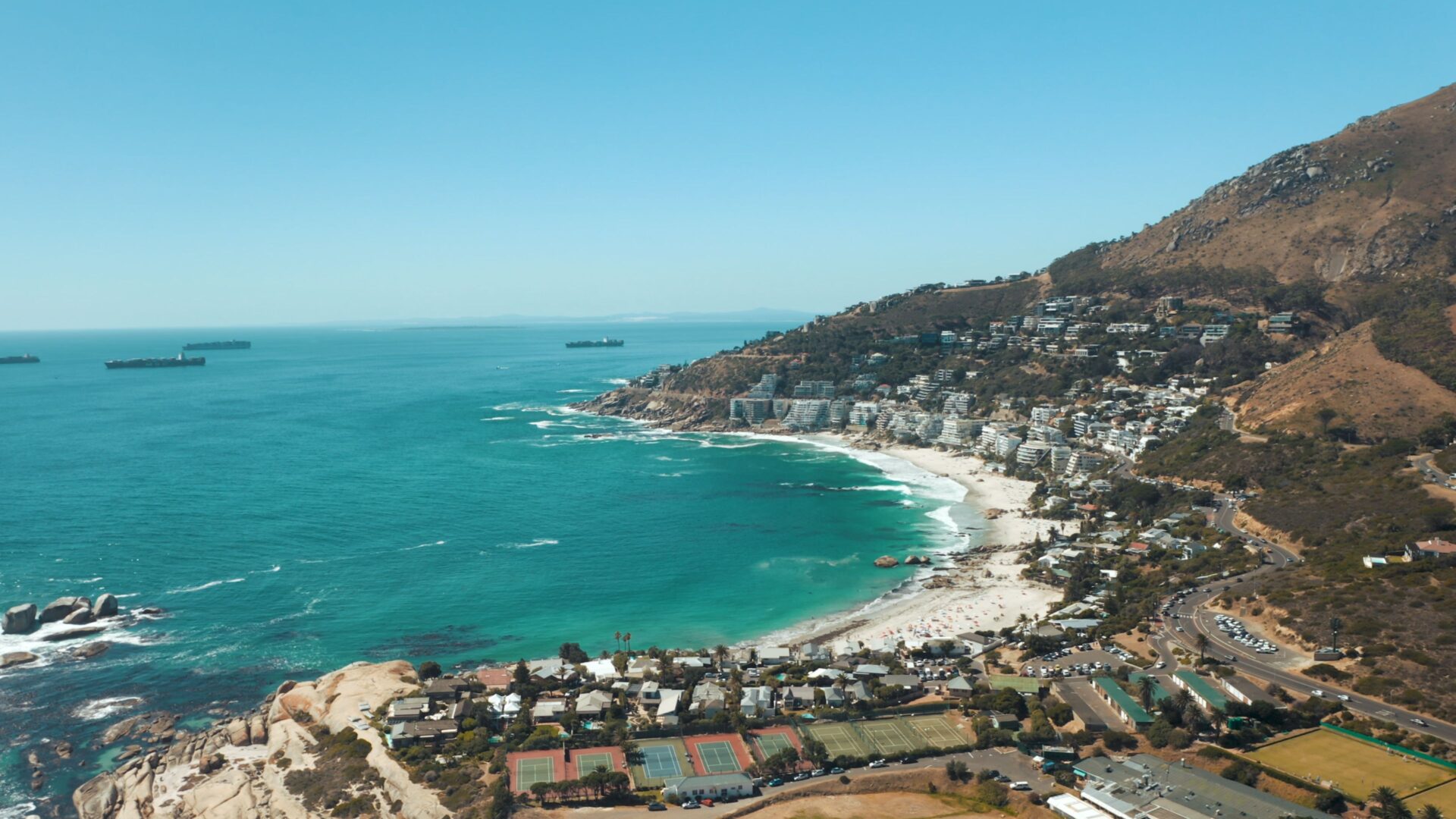
The Camps Bay beach (the Atlantic Seaboard, 10 minutes from the V&A Waterfront by taxi): the beach in the late afternoon — the Twelve Apostles mountain range directly behind, the Atlantic in front, the sunsets (the sun setting over the ocean rather than over land, the specific quality of the west-facing Atlantic Seaboard in the late day).
The Camps Bay beach strip (the restaurants and bars along Victoria Road): the sundowner at the Azure Restaurant (The Twelve Apostles Hotel) or the Shimmy Beach Club (the V&A Waterfront, for the harbour sunset alternative). Cocktails: R120-200 / £5.11-8.51.
8:00pm — Dinner: the V&A Waterfront or the City Bowl
The Harbour House (V&A Waterfront, Quay 4 — the seafood restaurant on the harbour, the Cape Rock Lobster, the Knysna oysters from the Garden Route, the West Coast snoek): R350-600 / £14.89-25.53 per person.
The city bowl alternative: the Chefs Warehouse & Canteen (Bree Street, CBD — the Cape Town restaurant that accelerated the city’s food scene’s shift to the sharing plate format): R400-650 / £17.02-27.66 per person. Book at chefswarehouse.co.za.
DAY TWO
7:30am — The Boulders Beach Penguin Colony
The Boulders Beach Penguin Colony (Boulders Beach, Simon’s Town — 45 minutes south of Cape Town by taxi or by the Metrorail Southern Line from Cape Town Station to Simon’s Town): the colony of 3,000 African penguins (Spheniscus demersus — the endangered species, the only penguin native to Africa, formerly called the Jackass Penguin for the braying call) that established itself on this beach in 1982 and has grown from a pair to 3,000 birds.
The specific Boulders Beach quality: the penguins nest between the granite boulders and the coastal vegetation, the beach boardwalk giving viewing access from above. At 7:30am: the colony active (the penguins feeding the chicks, the territorial displays, the specific sound of 3,000 African penguins calling simultaneously). By 10am: the organised tours from Cape Town arrive.
Entry: R220 / £9.36. The Simon’s Town walk after the penguin visit: the Victorian-era naval town, the South African Naval Museum (free), and the harbour fish and chips at the Bertha’s Restaurant on the Quay (the Cape snoek and chips at R120-180 / £5.11-7.66).
10:30am — Cape Point and the Cape of Good Hope
Cape Point (the southern end of the Cape Peninsula, the national park entry point at R353 / £15.02 for non-South African residents): the funicular to the Old Lighthouse at 249 metres (the view over the two oceans), the Cape of Good Hope (the rock at the peninsula’s southwestern extremity — not the southernmost point of Africa, the honour belonging to Cape Agulhas 150km to the east, but the symbolic meeting point of the Atlantic and Indian Oceans), and the baboons on the parking areas (the Cape Chacma baboon troop, habituated to vehicles, not to people — do not approach, do not feed, do not leave windows open).
1:00pm — Lunch: Seaforth Restaurant (Boulders) or the Two Oceans Restaurant (Cape Point)
The Two Oceans Restaurant (Cape Point, within the national park) for the lunch with the ocean view — the snoek pâté, the Cape Malay curry: R180-280 / £7.66-11.91 per main course.
3:00pm — The Winelands (Stellenbosch Day Trip)
Stellenbosch (50km east of Cape Town, 45 minutes by taxi or the Metrorail to Stellenbosch Station): the university town at the heart of the Cape Winelands, the oak-lined streets, the Cape Dutch architecture (the whitewashed gable facades, the thatched roofs, the specific architectural style developed by the Dutch settlers in the 18th century), and the wine estates accessible from the town.
The Spier Wine Farm (the most accessible from the Stellenbosch station area, the cheese and wine tasting, the Cape Malay restaurant, the owl sanctuary): R120-200 / £5.11-8.51 for the wine tasting. The Rust en Vrede (the Stellenbosch Helderberg ward, the estate that produces consistently the finest Cabernet-based wines in South Africa, the tasting room on the 1780 estate): R180-250 / £7.66-10.64 for the flight.
6:30pm — Sunset from Signal Hill
Signal Hill (the ridge connecting the Bo-Kaap to Lion’s Head, the road accessible by taxi to the Signal Hill Road viewpoint): the Cape Town sunset from the west-facing hillside — the sun over the Atlantic, the V&A Waterfront below, the Cape Town CBD visible, the Table Mountain behind. The traditional noon gun (the cannon fired daily at noon since 1806 from the Signal Hill Battery — the signal that ships in Table Bay used to set their chronometers): audible throughout Cape Town daily.
Free access. The taxi to the viewpoint: R80-120 / £3.40-5.11.
8:00pm — Final Dinner: Bree Street
The Bree Street (the Cape Town CBD street that became the city’s restaurant corridor in the 2010s): the La Colombe at Silvermist (the top of Constantia — the most consistently acclaimed fine dining in Cape Town, the tasting menu with the Japanese influence on South African ingredients, book at lacolombe.co.za): R2,200-3,000 / £93.62-127.66 per person.
The accessible Bree Street option: the Chefs Warehouse Bree Street, the Cause Effect Cocktail Kitchen, or the El Burro (the Mexican-Cape Town fusion): R300-500 / £12.77-21.28 per person.
The Essentials
Getting to Cape Town from the UK: British Airways direct from Heathrow (11 hours). Virgin Atlantic from Heathrow. Return: £500-850.
Getting around: Uber is the standard transport in Cape Town — the metered taxi system is unreliable and the minibus taxi (the shared minibus, the local transport) requires local navigation knowledge. The Metrorail operates to Simon’s Town and Stellenbosch but requires awareness of safety (avoid the trains after dark, avoid the first and last carriages). Uber for all evening journeys.
Safety: Cape Town’s safety situation is neighbourhood-specific. The areas in this guide (the V&A Waterfront, Camps Bay, the Bo-Kaap, the City Bowl, Woodstock, Simon’s Town, Stellenbosch) are accessible with standard urban precautions. The CBD requires awareness — walk in groups after dark, no visible valuables. The Cape Flats townships require specific township tour operators if visiting.
The mountain weather: The tablecloth (the orographic cloud that forms over the Table Mountain plateau when the southerly wind conditions are right — the cloud visible from the city as a white tablecloth draped over the mountain) closes the cable car when visibility is zero. Check at tablemountain.net before departure. The cable car closure rate is approximately 1 day in 4 on average.
Where to stay: The Silo Hotel (V&A Waterfront, the converted grain elevator — the most celebrated hotel in Cape Town: R6,000-12,000 / £255.32-510.64/night), the Ellerman House (Bantry Bay, the clifftop villa above the Atlantic: R8,000-15,000 / £340.43-638.30/night), the Grand Daddy Hotel (Bree Street, CBD, the rooftop trailer park hotel: R2,000-3,500 / £85.11-148.94/night).
The Context
Cape Town cannot be visited without encountering the apartheid legacy and its present consequences. The geography of the city — the mountain suburbs where the guidebook attractions are concentrated, the Cape Flats where 1.5 million people live in conditions that the Atlantic Seaboard view cannot see — is the direct result of the Group Areas Act of 1950 and its 50-year enforcement.
The Robben Island visit gives the political history. The District Six Museum (Buitenkant Street, CBD — the museum covering the forced removal of 60,000 residents from the District Six neighbourhood under the Group Areas Act, the area bulldozed and left vacant for 40 years: entry R60 / £2.55) gives the human history. Both are worth the time.
The city is extraordinary. The context is inseparable from it.
The Closing Moment
I was on the Table Mountain plateau at 9:04am. The cloud was below the plateau edge — visible as a white surface from above, the city invisible beneath it. The mountain was in full sun.
A dassie was on the rock three metres in front of me. It was warming itself, facing the sun, the specific posture of an ectotherm in the morning. The dassie is the closest living relative of the elephant by DNA lineage. It weighs 4 kilograms.
The Cape below was invisible in the cloud. The ocean was invisible. The city of 4.6 million people was invisible. There was the plateau, the fynbos, the rock, and the dassie.
The cable car had brought me up 20 minutes earlier. In those 20 minutes the cloud had closed the plateau edge entirely. The city was gone.
Cape Town is the most beautiful city I have stood above. The dassie assessed me, found me uninteresting, and returned to the sun.
I stayed for an hour.