
The route that gives Indonesia more than the Seminyak villa and the Canggu café: two days on Bali for the Ubud rice terrace sunrise and the Tirta Empul purification temple where the Balinese Hindu worshippers immerse in the spring-fed pools at 7am for the ritual that predates the tourist industry by a millennium, two days on Komodo for the Komodo dragon (the Varanus komodoensis — the largest living lizard on Earth, the venomous apex predator that the national park ranger escorts to within 3 metres of the visitor while carrying a forked stick that is, the ranger confirms, the only deterrent that works) and the Pink Beach (the beach that is pink because of the Foraminifera (the red-shelled microscopic organisms whose crushed shells mix with the white sand), one of only seven pink sand beaches on Earth), and three days on Java for the Borobudur at sunrise (the 9th-century Buddhist temple, the world’s largest Buddhist monument, the 72 stupas and the 504 Buddha statues visible in the first light from the top level before the tour groups arrive) and the Bromo volcanic sunrise (the most specifically Indonesian landscape — the Sea of Sand, the caldera, and the active volcano with the smoke rising from the crater at dawn).
Reading time: 11 minutes | Last updated: 2026
Indonesia is 17,508 islands, 270 million people, and the world’s fourth most populous country. The Indonesia circuit from the UK requires commitment to the distance (the 14-hour Heathrow-Jakarta or the 15-hour Heathrow-Bali with Doha or Dubai connection) and rewards it with the specific Indonesia that no other destination gives: the Komodo dragon that exists nowhere else, the Borobudur that gives the Buddhist monument at a scale and an intactness that supersedes everything outside Angkor Wat, and the Balinese Hindu culture that is the only living Hindu culture outside India.
Before You Leave
The visa: UK citizens receive 30 days visa-free on arrival at the major Indonesian airports. Extendable for a further 30 days at the Indonesian Immigration office.
The routing: Fly London-Denpasar, Bali (via Singapore, Kuala Lumpur, or Dubai — 15-16 hours total). Fly Bali-Labuan Bajo (Garuda Indonesia or Wings Air — 1.5 hours, from £40-80 one way, book 4-6 weeks ahead). Fly Labuan Bajo-Yogyakarta for Java (via Denpasar, 3-4 hours total, from £60-120). Fly Yogyakarta-Jakarta, fly London home.
The Route
Bali (2 nights: Ubud base) → fly Bali-Labuan Bajo → Komodo National Park (2 nights) → fly Labuan Bajo-Yogyakarta → Java: Borobudur and Bromo (3 nights)
DAYS 1-2 — Bali
Day 1: Ubud at Dawn
6am — The Tegallalang Rice Terraces:
The Tegallalang rice terraces (the subak irrigation terraces north of Ubud — the UNESCO-listed irrigation system, the rice terraces stepping down the river valley, the early morning mist visible in the valley before the heat builds):
At 6am: the terraces in the first light, the workers in the rice field visible at the day’s start, the tourists arriving from 8:30am onwards. The subak (the traditional Balinese cooperative water management system — the same irrigation structure that has maintained the Bali rice agriculture for 1,000 years, the specific cultural engineering that the UNESCO designation protects) visible in the channel distribution at the terrace edges.
The Tirta Empul:
The Tirta Empul (the 10th-century water temple at the Pakerisan River — the sacred spring that the Balinese Hindu worshippers have been purifying in since 962 CE, the 30 fountains in the main pool giving the specific purification ritual):
At 7:30am (before the tour groups): the worshippers visible in the spring pools in the white sarung (the ceremonial cloth), the mantras (the prayers audible from the pool edge), the specific Balinese Hindu morning. Visitors may enter the outer pool (the kepah ritual): bring or hire the sarung at the entrance (IDR 15,000 / £0.73).
Entry: IDR 50,000 / £2.41.
Day 2: The Campuhan Ridge and the Bali Spirit
The Campuhan Ridge Walk:
The Campuhan Ridge (the walking path from the Ubud centre along the ridge between the Wos River gorge and the Campuhan valley — the morning walk (1 hour, free) giving the rice fields and the jungle and the specific Ubud green that the villa-and-café Bali does not):
At 6:30am: the ridge walk in the cool before the 30°C midday, the jungle sounds audible from the path, the specific Bali morning.
DAYS 3-4 — Komodo National Park
Fly Bali-Labuan Bajo:
The Komodo Dragon:
The Komodo dragon (Varanus komodoensis — the world’s largest living lizard: the adult male to 3 metres, 70kg, the venom gland (identified in 2009 — the disputed mechanism, the bacteria-in-saliva theory now superseded by the venom-anticoagulant research) in the lower jaw giving the toxic bite that the deer, the water buffalo, and the occasional tourist have experienced):
The Rinca Island Komodo trek (the island 25km from Labuan Bajo, the easier access than the Komodo Island main site, the dragon population at approximately 1,300 animals on Rinca): the ranger (the petugas — the national park officer, the escort mandatory since 2017, the forked stick carried as the deterrent rather than the weapon): IDR 200,000 / £9.64 per person plus the ranger fee.
At 7am (the ranger at the dock at 6:30am, the dragon active in the morning cool before the midday heat sends them into the shade): the dragon on the path, visible at 3 metres, unmoving, assessing.
The Pink Beach (Pantai Merah):
The Pink Beach (the Komodo Island east coast beach — the pink sand visible at the waterline, the colour from the Foraminifera shells mixed with the white coral sand, the snorkel at the adjacent reef giving the Komodo National Park marine biodiversity at its most accessible):
The snorkel: the Komodo reef (the marine diversity: the manta ray at the Manta Point (the seasonal aggregation, April-October), the wobbegong shark visible in the coral at 5 metres, the Napoleon wrasse at 2 metres): IDR 150,000 / £7.22 for the National Park marine entry.
DAYS 5-7 — Java
Day 5: Borobudur at Sunrise
4:30am departure from Yogyakarta:
The Borobudur (the 9th-century Mahayana Buddhist temple — the world’s largest Buddhist monument, the 2 million stone blocks, the 72 dharmadhatu stupas (the latticed stupas each containing the Buddha statue), the 504 Buddha statues visible on the 10 levels, the ananda (the enlightenment) visible in the top level at the sunrise):
At 5:30am: the stupas visible in the mist as the light builds from the east, the Merapi volcano visible to the northeast (the active stratovolcano that last erupted significantly in 2010), the Sumbing and the Sindoro visible to the west, the Borobudur in the specific Java morning that makes the photographer’s journey worthwhile:
The sunrise ticket: IDR 350,000 / £16.87 per person (the premium sunrise access, sold separately from the standard entry).
The Prambanan:
The Prambanan temple compound (the 9th-century Hindu temple complex 17km east of Yogyakarta — the trimurti temples (Shiva, Vishnu, Brahma) on the central compound, the specific Hindu-Buddhist civilisational transition visible in the same century’s competing temple projects (the Buddhist Borobudur and the Hindu Prambanan built within 50 years of each other in the same kingdom)):
Entry: IDR 350,000 / £16.87.
Day 6: Mount Bromo
3am departure for the sunrise:
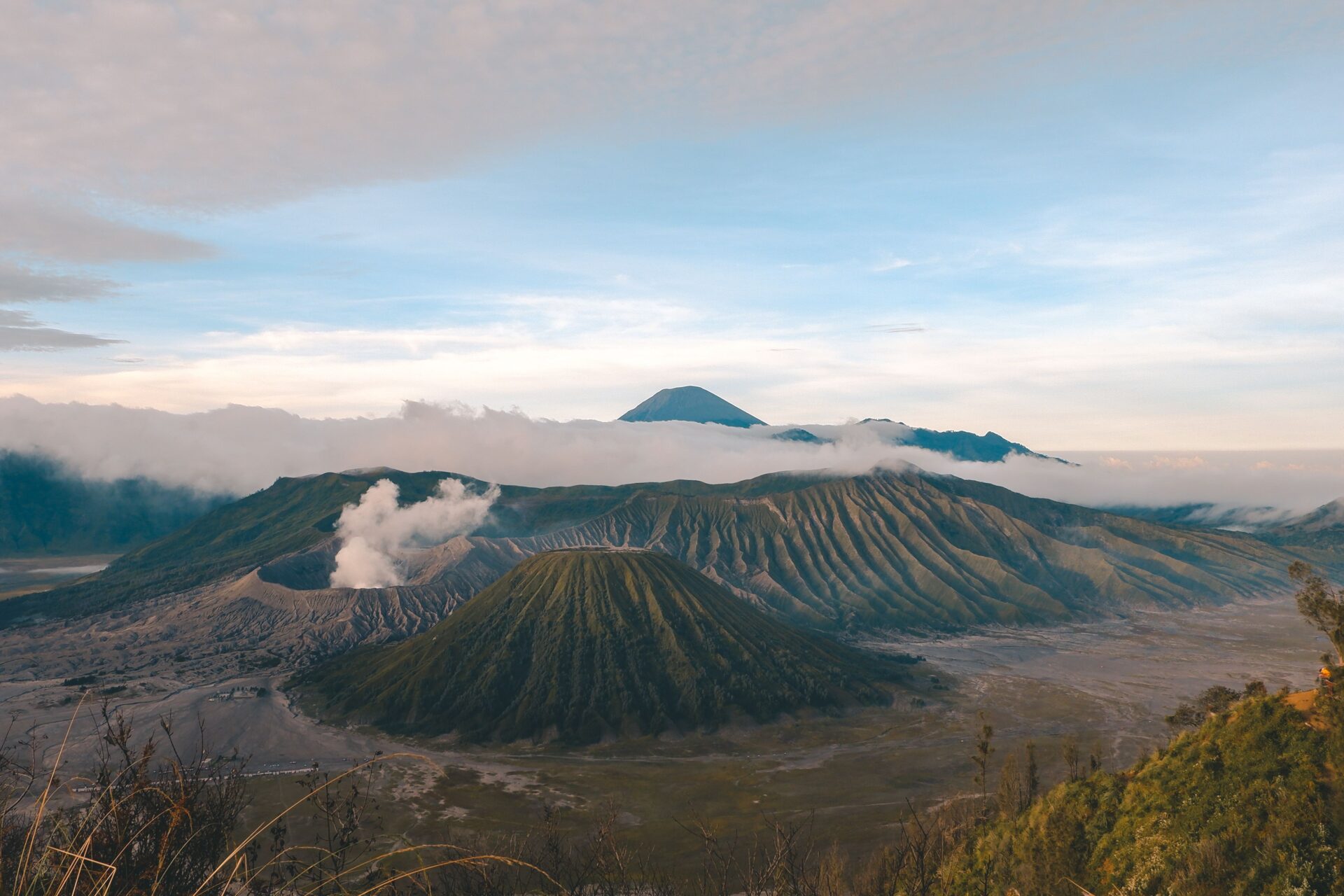
The Mount Bromo sunrise (the Bromo-Tengger-Semeru National Park — the caldera rim viewpoint at 2,392 metres, the sunrise over the Sea of Sand (the lautan pasir — the 10km diameter volcanic sand sea in the caldera floor, the specific Java landscape that the film and advertising industry uses as the otherworldly setting)):
The specific Bromo sequence: the jeep from Cemoro Lawang village to the Penanjakan viewpoint (the 4WD up the caldera wall, the 4am arrival at the viewpoint for the 5:30am sunrise), the sunrise revealing the Bromo crater (the active volcano, the smoke rising continuously from the crater at 2,329 metres), the Batok volcano (the extinct cone adjacent to Bromo), and the Semeru (the highest peak on Java at 3,676 metres) visible on clear mornings 45km to the southeast.
Jeep hire from Cemoro Lawang: IDR 350,000-500,000 / £16.87-24.10 per jeep (split between the group, the standard jeep carries 6).
The crater walk:
The walk from the Sea of Sand to the Bromo crater rim (the 1km walk across the sand, the 250 steps up the crater edge, the crater visible at the top — the 800-metre diameter crater, the sulfur gas and the ash plumes visible, the specific Bromo encounter at the active volcanic edge).
What It Costs
| Category | Budget | Mid-Range |
|---|---|---|
| Return flights (UK-Bali, Jakarta-UK) | £500-900 | £700-1,200 |
| Internal flights (Bali-Labuan Bajo, Labuan Bajo-Yogyakarta, Yogyakarta-Jakarta) | £100-250 | £150-350 |
| 7 nights accommodation | £70-210 | £210-560 |
| Komodo boat + ranger + marine entry | £40-80 | £60-120 |
| Borobudur sunrise + Prambanan | £34 | £34 |
| Bromo jeep (split) | £8-12 | £8-12 |
| Food (7 days) | £30-80 | £80-200 |
| Total | £782-1,566 | £1,208-2,476 |