
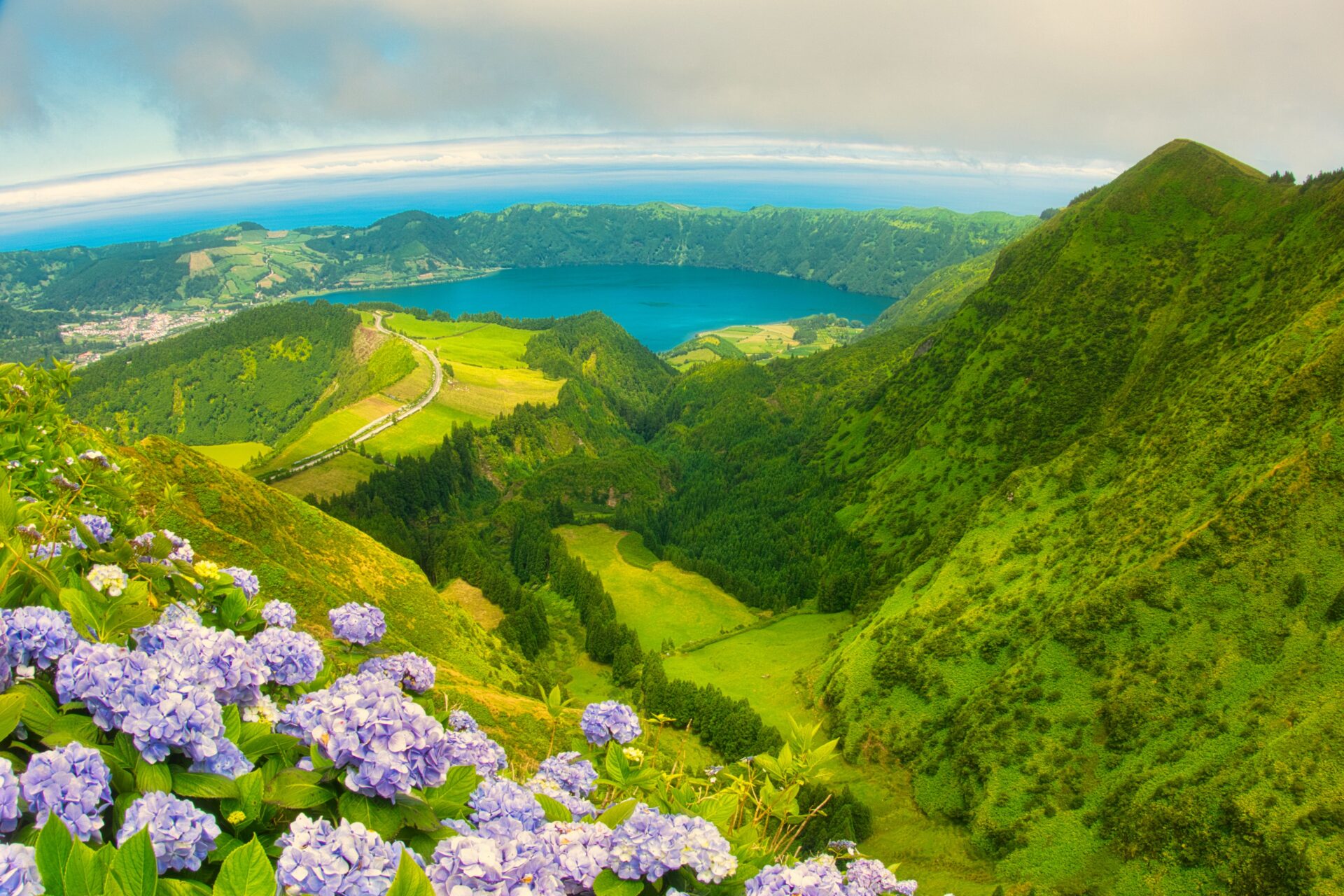
The route that gives the Azores its full argument: four days on São Miguel for the Sete Cidades (the twin-lake volcanic caldera visible from the Vista do Rei viewpoint at the specific angle that gives both lakes — the green and the blue — in the single photograph, the lakes formed in the same eruption with different pH giving the different colours), the Furnas thermal pools (the natural hot springs in the volcanic valley, the cozido das Furnas (the stew cooked underground by the volcanic steam for 7 hours, the Azorean one-pot meal at €15 that is the most specifically geological meal available in Europe)), and the whale watching (the Atlantic sperm whale (Physeter macrocephalus) visible from the Pico Island Vigia watchtower — the historical whale spotter’s post used first by the whalers who hunted and now by the whale-watching boats that photograph), and three days on Pico for the Pico Mountain (the 2,351-metre volcano — the highest point in Portugal) and the black basalt lava vineyards that the UNESCO listed as a cultural landscape.
Reading time: 10 minutes | Last updated: 2026
The Azores are Portuguese territory in the middle of the Atlantic — 1,500km from Lisbon, 3,900km from New York, the archipelago of 9 islands sitting on the Mid-Atlantic Ridge where the Eurasian and American tectonic plates meet. The specific Azores quality: volcanic geology, Atlantic biodiversity (the whale migration route passes through the Azores channel — the sperm whale, the blue whale, the fin whale, the sei whale all visible seasonally), and the specific island quality of the place that is very far from everything.
Before You Leave
Getting there: Fly London-Ponta Delgada, São Miguel (direct with SATA/Azores Airlines from Heathrow — 3.5 hours, or Ryanair from Stansted, 3.5 hours). Inter-island ferries: SATA Air Açores for the Pico connection (30 minutes, €50-80 return) or the Atlanticoline ferry (2-3 hours, €25-40).
The weather: The Azores give all four seasons in a single day — the cloud visible on the Sete Cidades caldera edge at 8am may clear by 10am or may not. The correct visitor disposition: the trip planned around the weather window available, not the schedule.
The Route
São Miguel (4 nights: Ponta Delgada base) → ferry or fly to Pico (3 nights)
DAYS 1-4 — São Miguel
Day 1: Sete Cidades at Dawn
7am — The Vista do Rei:
The Vista do Rei (the viewpoint above the Sete Cidades caldera — the two lakes visible in the caldera below, the Lagoa Verde (green) on the left, the Lagoa Azul (blue) on the right, the caldera walls visible in every direction):
At 7am: the caldera before the cloud that typically forms by 10am (the Atlantic moisture over the warm volcanic island giving the cloud layer that obscures the view regularly by midday). The Vista do Rei at dawn on a clear morning is the most visually specific single moment in the Azores.
The kayak on the Lagoa Azul (the kayak hire from the lake village of Sete Cidades — the lake surface in the morning stillness, the caldera walls visible from the water at eye level, the specific perspective unavailable from the road): €15-25 per person per hour.
Day 2: The Furnas Valley
The Caldeiras:
The Furnas caldeiras (the thermal vents in the Furnas village — the boiling mud pools, the steam vents, the sulfurous gases visible in the valley, the specific Azores geothermal landscape that São Miguel’s volcanic activity gives at the surface):
At 8am (before the tour groups): the caldeiras in the morning mist, the steam visible above the mud pools, the specific geological encounter.
The cozido:
The cozido das Furnas (the meal cooked underground in the volcanic heat — the pot buried adjacent to the caldeiras at 7am, the stew of the chicken, the chouriço, the blood sausage, the cabbage, the turnip, the sweet potato, the chickpea, the entire pot removed at 12:30pm for the lunchtime service): at the Tony’s Restaurant or the Caldeiras & Vulcões restaurant in the Furnas village: €15-18 per person.
The Terra Nostra botanical garden:
The Terra Nostra (the 1780 botanical garden in the Furnas valley — the thermal pool (the pool fed by the iron-rich thermal spring, the brown-orange water at 37°C, the specific Azores thermal bathing visible in the guests floating in the outdoor pool with the tree ferns above)): €12 entry including pool access.
Day 3: Whale Watching
The Atlantic sperm whale:
The sperm whale (Physeter macrocephalus — the largest toothed animal on Earth, the male reaching 16 metres, the species that the Azores whalers hunted from the open wooden boats until 1987, the same species that the Azores whale-watching fleet now photographs from the same waters):
The whale-watching boat (the catamaran from the Ponta Delgada marina, the 3-4 hour tour — the VIGIA watchtower (the former whale spotter’s post staffed by the same families who now direct the boats by radio to the whale sightings visible from the hilltop)):
Species visible seasonally: sperm whale (year-round), blue whale (April-June), fin whale (April-September), sei whale (April-June). Probability of sighting (year-round): 95%+ for the sperm whale. €50-65 per person.
Day 4: Lagoa do Fogo and Nordeste
The Lagoa do Fogo (the volcanic crater lake in the interior of São Miguel — the lake at 590 metres altitude, the steam from the geothermal vents visible at the lake margin, the specific Azores volcanic landscape): free.
DAYS 5-7 — Pico Island
The Pico Mountain ascent:
The Pico Mountain (the 2,351-metre volcano — the highest point in Portugal, the ascent from the Montanha Pictur car park (1,200m) to the summit (2,351m) in 3-5 hours, the crater rim visible at the summit with the Pacific floor visible on clear days):
The guide (mandatory for the first time — the Pico mountain guide available through the Pico Mountain visitor centre at the car park): €30-50 per person.
The Pico vineyards:
The Pico Wine Landscape (the UNESCO cultural landscape — the black basalt lava stone walls (currais) dividing the vineyard plots, the vines growing low to the ground behind the walls that the Atlantic wind requires, the specific Pico wine (Vinho do Pico — the Verdelho grape, the wine with the specific volcanic minerality that the black basalt soil gives)):
The Adega Regional de Pico (the wine cooperative — the Verdelho tasting: €5-8 for the 3-wine flight): the most specifically geological wine tasting in Europe.
What It Costs
| Category | Budget | Mid-Range |
|---|---|---|
| Return flights (UK-Ponta Delgada) | £50-150 | £100-250 |
| São Miguel-Pico ferry or flight | £25-80 | £40-100 |
| 7 nights accommodation | £105-280 | £280-700 |
| Food (7 days) | £40-90 | £90-220 |
| Whale watching | £50-65 | £50-65 |
| Furnas cozido + Terra Nostra | £30-40 | £30-40 |
| Pico Mountain guide | £30-50 | £30-50 |
| Total | £330-755 | £620-1,425 |