
The 24-hour format for the traveller who has the single day — the layover made useful, the overnight train connection, the day trip from the coastal resort to the inland city. Not the 48-hour guide (the guide that assumes you’ve slept twice), not the 7-day itinerary (the guide for the specific trip). The 24-hour guide: the one thing to see, the one meal to eat, the one moment that makes the 24-hour stay different from the transit. Three cities, three days, three arguments for staying.
Reading time: 6 minutes | Last updated: 2026
24 Hours in Fez — The Medina Before the Medina Knows You’re There
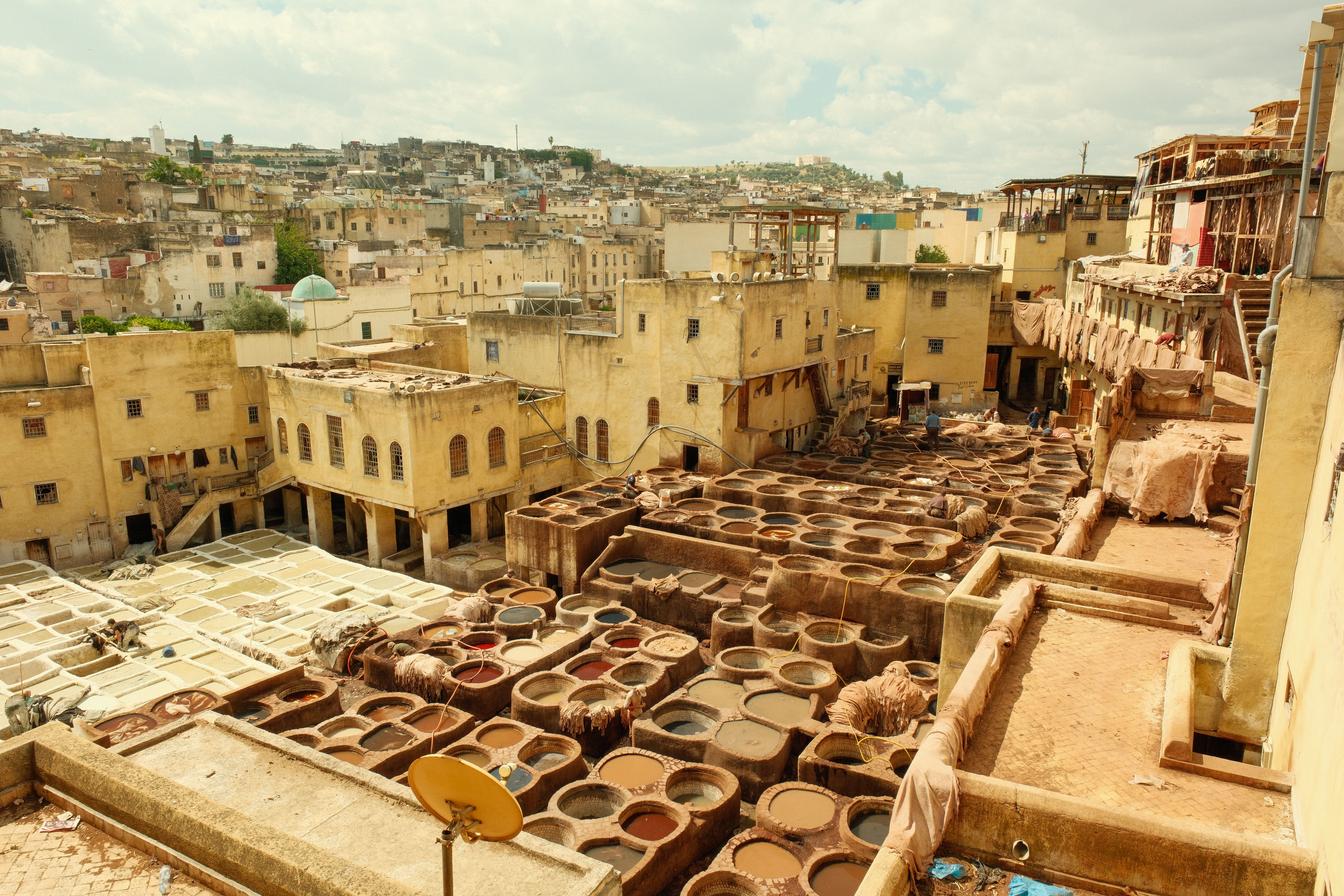
The one thing: The Chouara Tannery from the leather shop terrace at 8am.
The one meal: The harira (the Moroccan tomato-lentil-chickpea soup with the dates on the side — the Fez breakfast at the medina café at 7:30am): MAD 10-15 / £0.80-1.20.
The one moment: The Bou Inania Madrasa at 9am before the guided tour groups. The 14th-century Marinid theological college — the cedar carved geometric panels, the mosaic zellij tilework, the marble courtyard — at the first opening hour before the crowd. Entry: MAD 20 / £1.60.
The 24-hour sequence:
7am: The medina entrance from the Bab Bou Jeloud (the blue gate — the specific Fez threshold). The medina lanes before the shop shutters open. The msemen (the layered flatbread, the street breakfast) at the lane-side cart.
8am: The Chouara Tannery (the access via the leather shop terrace overlooking the vats — the leather workers visible from above in the circular vats of the dye (the saffron yellow, the indigo, the poppy red visible simultaneously) from 8am when the production begins). The shop will invite you to see the view free and will expect the leather purchase consideration. This is the arrangement.
9am: The Bou Inania Madrasa. The Attarine Madrasa (adjacent — the 14th-century Marinid school, the carved stucco above the carved cedar above the mosaic zellij, the specific layered Moroccan decorative programme visible at one complete address): MAD 20 / £1.60.
12pm: The Nejjarine Square (the carved cedar fountain, the fondouk (the caravanserai — the merchants’ inn) visible above the square as the cedar workshop museum): MAD 20 / £1.60 for the museum, free to view the square.
2pm: The mechoui (the slow-roasted lamb at the Mechoui Alley near the R’cif Square — the lamb shoulder served on the bread with the cumin and salt, the specific Fez afternoon meat): MAD 80-150 / £6.37-11.94 per portion.
4pm: The Marinid Tombs (the hill above the medina — the ruined tombs of the Marinid dynasty, the sunset view of the medina from the hilltop at 4:30pm in winter, 6:30pm in summer): free.
Get there: Fly to Casablanca or Marrakech and take the connecting train (Fez from Casablanca: 3.5 hours by CTM train). Or the direct flight from London (Ryanair from Stansted to Fez Saïss Airport — 3 hours, from £30 one way).
24 Hours in Cartagena — The Walled City at 7am and the San Felipe at Sunset
The one thing: The walled old city at 7am before the cruise ship passengers arrive.
The one meal: The arepas de huevo (the egg arepa — the fried corn dough filled with the egg and the meat, fried again, the specific Cartagena street breakfast at the Getsemaní neighbourhood corner stall): COP 4,000-6,000 / £0.74-1.12.
The one moment: The Castillo San Felipe de Barajas at 5pm. The 17th-century Spanish fortress above the city — the most sophisticated military fortification in the Americas, the tunnel system (the 15 interconnecting tunnels, the acoustic design audible at the junction point — a whisper at one end audible as a normal voice at the other end), the city visible from the fortress wall at the specific Cartagena late afternoon light.
The 24-hour sequence:
6:45am: The Portal de los Dulces (the candy vendors visible at the city wall entrance before the tourist crowd). The city walls at 7am — the 13km of 17th-century defensive wall, the bastiones (the bulwarks), the Caribbean visible on three sides.
8am: The Torre del Reloj (the clock tower — the main entrance to the walled city, the Plaza de los Coches behind it, the horse-drawn carriages visible at the stable from 8am). The Getsemaní neighbourhood (the neighbourhood outside the wall — the colourful street art, the cantina, the specific Cartagena that the tourist map marks as “up and coming” and that the Cartagena resident marks as home).
12pm: The Mercado de Bazurto (the local market 20 minutes by taxi from the old city — the wholesale food market, the ceviche at the market stall (the Caribbean ceviche with the leche de tigre and the plantain chip), the specific Cartagena market that the old city tourist zone does not contain): COP 8,000-15,000 / £1.49-2.79.
3pm: The Las Bóvedas (the 23 vaulted dungeons converted to the craft market at the city wall — the mochilas (the Colombian woven bags), the hammock, the emerald jewellery at the export price minus the Bogotá markup).
5pm: The Castillo San Felipe. The tunnel system (the guided tunnel walk — the acoustic demonstration at the junction point, the specific San Felipe engineering made sensory): COP 25,000 / £4.65.
Get there: Fly London-Cartagena (via Bogotá or Medellín — 13-15 hours total) or take the 1-hour flight from Bogotá (Avianca or LATAM, COP 150,000-350,000 / £28-65 one way).
24 Hours in Bergen — The Fish Market, the Funicular, and the Fjord
The one thing: The Fisketorget fish market at 7am.
The one meal: The fiskesuppe (the Bergen fish soup — the cream base, the salmon, the shrimp, the dill, the specific Norwegian coastal soup at the fish market café): NOK 180-250 / £12.86-17.86.
The one moment: The Fløibanen funicular at 7am. The 320-metre ascent in 8 minutes, the Bergen city visible from the Fløyen summit, the seven hills of Bergen visible in every direction, the Byfjorden visible to the west with the Bryggen wharves visible below.
The 24-hour sequence:
7am: The Fisketorget. The fish market at the working hour — the skrei (the Arctic cod from the Lofoten, January-April), the laks (the salmon), the reker (the shrimp) visible at the market stalls before the tourist presence at 9am. The gravlaks (the cured salmon, the specific market sandwich): NOK 80-140 / £5.71-10.
8am: The Fløibanen. The funicular from the Vetrlidsallmenningen station (the station 5 minutes’ walk from the fish market). The summit at 320 metres — the Bergen city visible below, the hiking trails visible from the summit café.
10am: The Bryggen (the UNESCO Hanseatic wharf — the 14th-century wooden warehouses, the Hanseatic Museum (the preserved merchant house, the 18th-century commercial life visible in the preserved interiors)): NOK 120 / £8.57.
12pm: The Bergen Kjøtbasaren (the covered food market — the brunost (the brown cheese, the goat milk caramelised whey — the specific Norwegian cheese that confuses and converts on the same bite), the lefse (the Norwegian flatbread with the butter and the sugar)):
2pm: The KODE Art Museums (the four art museum buildings along the Lille Lungegårdsvannet lake — the Edvard Munch collection, the Nikolai Astrup collection, the Norwegian craft tradition): NOK 160 / £11.43 for the combined ticket.
Get there: Fly London-Bergen (Ryanair from Stansted, Norwegian — 2 hours, from £30 one way). Or London-Oslo and then the Bergen Railway (the Bergen-Oslo scenic rail, 7 hours, from Oslo to Bergen — the most scenic train journey in Europe).