
The boutique hotel ranking that separates the hotel whose design photographs well on Instagram from the hotel whose design improves every hour spent inside it — the difference being that one has good angles and the other has the correct relationship between the room and the landscape, the material and the light, the architecture and the culture it sits inside. The Datai in Langkawi for the rainforest that the building inhabits rather than displaces. The Capella Ubud for the tent on the valley side that gives Bali from above. And the Rosewood Luang Prabang for the colonial-era villa that looks out over the Mekong and gives Laos at its most specific.
Reading time: 8 minutes | Last updated: 2026
The Ranking
1. The Datai Langkawi, Malaysia
Why it’s first: The Datai is the hotel most consistently cited by architects and landscape designers as the finest integration of a luxury hotel into a natural environment in Southeast Asia. The reason is specific: the 1993 original design by Kerry Hill placed the main building in the clearing of the Machinchang Cambrian Geoforest (the oldest geological formation in Southeast Asia, 550 million years old) and the villas between the trees rather than replacing the trees. The tree cover has been maintained — the canopy above the pool deck and the rainforest visible from the villa veranda are not landscaping. They are the original forest.
The specific Datai quality: The wildlife. The dusky leaf monkey visible from the restaurant deck at breakfast. The hornbill audible from the villa at dawn. The monitor lizard on the path between the beach and the main building. The hotel’s naturalist programme (the morning walks with the in-house naturalist, the bat observation at dusk, the specific Datai Langkawi ecological programme that the resort treats as a core offering rather than an add-on):
The marine biology team (the coral restoration programme visible from the beach — the coral frames in the shallow water that the hotel plants and monitors, the programme that restores the Andaman Sea reef that the development of Langkawi damaged): the most comprehensively integrated conservation hotel programme in Southeast Asia.
Cost: From USD 600-1,200 / £472.44-944.88 per night, full-board packages available. Book at thedatai.com.
2. Capella Ubud, Bali
Why it’s second: The Capella Ubud (the Bill Bensley-designed camp on the ridge above the Wos River valley in the hills north of Ubud — the tents on the valley side, the tent interiors fitted with the specific Bensley theatrical design (the bespoke furniture, the antiques, the art collection that gives each tent a different cultural reference), and the valley below the tent veranda at the specific altitude that gives the Bali landscape in the way that the flat-land Ubud hotel does not:
The camp as the architecture: Bensley designed the Capella as the fictional historical camp of the explorer who discovered this valley — the explorer’s collection of Balinese and Indonesian artefacts displayed in the common areas, the fictional explorer’s journal available at the camp library, the specific narrative that makes the Capella the most theatrically coherent boutique hotel in Southeast Asia.
The specific Capella experience: The morning in the tent at 6am (the valley mist visible from the veranda, the Wos River audible below, the rice farmer’s day beginning in the paddies on the opposite valley wall): the Bali that the Seminyak hotel and the Canggu surf bungalow cannot give.
Cost: From USD 800-1,800 / £629.92-1,417.32 per night, inclusive packages available. Book at capellahotels.com/ubud.
3. Rosewood Luang Prabang, Laos
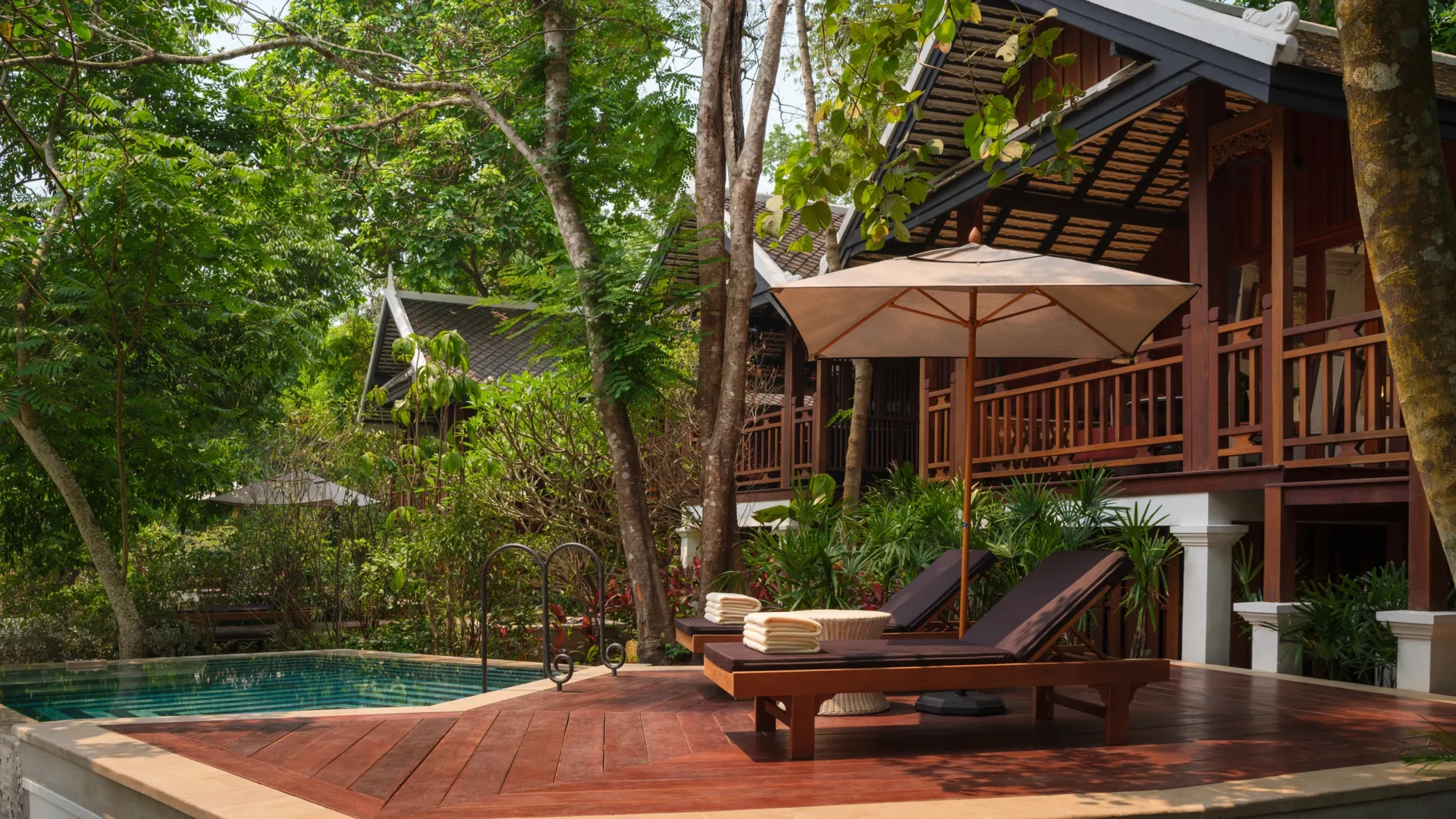
Why it’s third: The Rosewood Luang Prabang (the former provincial governor’s residence and the surrounding gardens converted to the 23-villa hotel on the hill above the Mekong and the Nam Khan confluence) gives the Luang Prabang quality that the town’s colonial architecture represents at its most specific:
The villas (the colonial-era buildings and the purpose-built wooden villas, each facing the river or the garden, the teak construction visible in the floors and the ceiling, the Laotian craftsmanship in the textile and the furniture) and the restaurant (Mekong) giving the northern Laos cuisine (the larb (the minced meat salad, the herb and the fish sauce and the toasted rice powder), the tam mak houng (the green papaya salad in the Lao rather than the Thai version — less sweet, more fermented fish paste), the riverbank setting:
The monk connection: The hotel is 400 metres from the main tak bat route — the dawn alms round that the Luang Prabang monks conduct every morning at 5:30am. The hotel’s tak bat guidance (the correct observation protocol — the standing at the side, no photography flash, the respect for the ceremony) is the most responsible take-bat orientation available in the town.
Cost: From USD 450-1,000 / £354.33-787.40 per night. Book at rosewoodhotels.com.
4. Four Seasons Tented Camp Golden Triangle, Thailand
Why it’s fourth: The Golden Triangle (the meeting point of Thailand, Laos, and Myanmar at the Ruak and Mekong rivers confluence) gives the camp’s specific geographic position — the tent on the Thai bank of the Mekong, the Laotian mountains visible across the water, the specific Tai Lue-influenced design of the tents (the hill tribe weaving, the bamboo construction, the elephant camp that the hotel operates in partnership with the Mae Teng Elephant Foundation):
The elephants: the Four Seasons Tented Camp operates with the Asian elephant population through the responsible tourism framework — the elephants in the forest habitat, the mahout tradition maintained, the bathing in the river visible from the camp’s deck. The specific Golden Triangle elephant encounter (the morning bath, the forest walk with the mahout) gives the ethical elephant experience in the most atmospherically specific setting in northern Thailand.
Cost: From USD 1,100-2,500 / £866.14-1,968.50 per person per night, all-inclusive. Book at fourseasons.com/goldentriangle.
5. The Strand, Rangoon (Yangon) — The Colonial Reference
Why it’s fifth: The Strand (the 1901 hotel on the Strand Road in central Yangon — the Sarkies Brothers hotel that gave the colonial era its specific Burma accommodation reference, the hotel that Somerset Maugham and Rudyard Kipling used as the base for the Burma chapter of their careers, the specific Burmese teak and the high ceilings and the ceiling fans and the colonial verandah that the Yangon heat requires):
The Strand gives the specific colonial Southeast Asia that the Singapore Raffles, the Manila Manila, and the Colombo Galle Face all claim — the 1901 hotel that has been through the Japanese occupation, the British return, the Burmese socialist government nationalisation, and the tourism reopening and that has maintained the specific Burmese teak interior through all of it.
Note on Myanmar travel: The UK FCDO advises against all travel to Myanmar as of 2025 following the 2021 military coup. Check the current FCDO advice at gov.uk/foreign-travel-advice/myanmar before any consideration of travel.
Cost (for future reference): From USD 250-500 / £196.85-393.70 per night. Book at hotelthestrand.com.
6. Alila Villas Uluwatu, Bali
Why it’s sixth: The Alila Villas Uluwatu (the cliff-edge resort on the Bukit Peninsula south of Bali — the infinity pool above the Indian Ocean at the cliff’s edge, the Balinese limestone (the palimanan stone) used throughout the construction, the specific Uluwatu quality of the dramatic position):
The specific Uluwatu positioning: the resort occupies the cliff at the point where the Indian Ocean swell hits the Bukit Peninsula headland — the surf visible from the pool, the horizon visible at the cliff’s edge, the Indian Ocean given at its most dramatic rather than most accessible.
Cost: From USD 700-1,600 / £551.18-1,259.84 per night. Book at alilahotels.com.
What Makes the Boutique Different
The specific difference between the boutique hotel and the international chain: the boutique hotel makes a position — the Datai says “the rainforest comes first,” the Capella Ubud says “the narrative is the design,” the Rosewood Luang Prabang says “the colonial building is the culture it represents.” The international chain makes a product.
The booking instruction: All six hotels on this list benefit from booking direct (the direct booking rate is either equal to or below the OTA rate, the loyalty points or the room upgrade available only through direct booking, the specific requests (the view, the villa placement, the dietary preference) accommodated more readily by the direct booking channel).