

The portable espresso maker review that starts from the only question that matters: does it produce an espresso that a person who drinks espresso would willingly drink? Not a coffee-flavoured beverage. Not a stimulant delivery mechanism with foam. An espresso — the 25-30 second 9-bar extraction that produces the 30ml shot with the crema that the specific coffee deserves. Three devices produce this. Several others produce something adjacent. This guide names the three that are correct, explains the bar pressure requirement that eliminates the rest, and names the one that the BGGD team puts in the carry-on for every trip of more than 3 days.
Reading time: 6 minutes | Last updated: 2026
The 9-Bar Requirement
Espresso requires 9 bars of pressure (9 atmospheres of force — the pressure that drives the hot water through the compacted coffee grounds at the rate that produces the emulsified colloids and the crema that distinguish espresso from strong coffee). The pump espresso machine achieves this with an electric pump. The portable espresso maker achieves this by one of two methods: the manual piston (the user’s hand pressure through a lever mechanism) or the pressurised chamber (the user’s squeeze of the bellows or the heated chamber).
The devices that do not achieve 9 bars:
The AeroPress (6 bars maximum, the result is a strong concentrate that is not espresso), the Moka pot (2-3 bars, the strong stovetop coffee that is not espresso), and the Nanopresso at minimum human pressure (approximately 18 bars available when pumped correctly — above the 9-bar requirement and producing the correct result).
The Three Correct Devices
1. Wacaco Nanopresso — The BGGD Carry-On
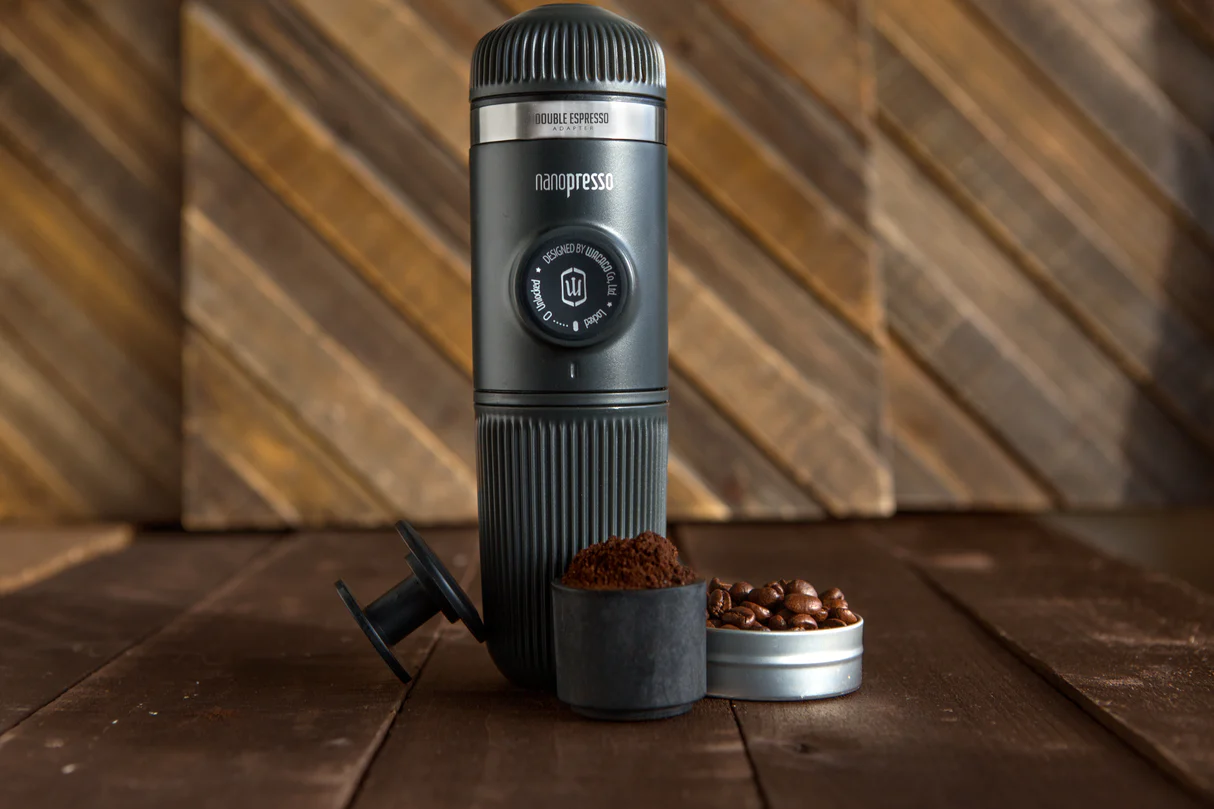
What it is: The self-contained manual espresso maker (the 18-bar pressure achieved by the piston pump mechanism — the user’s hand pumping the piston 16-20 times to build pressure, the espresso extracted in 25-30 seconds): the 145g device that produces a 40ml espresso with visible crema from any finely ground coffee or any compatible Nespresso capsule (the NS adaptor, sold separately at £12-15).
The travel workflow:
Ground coffee method: The 8-10g of finely ground coffee tamped into the basket, the hot water from the hotel kettle poured into the tank, the piston pumped. 90 seconds from hot water to espresso.
Capsule method: The NS adaptor, the Nespresso capsule inserted, the same pump process. The most convenient travel method — the Nespresso capsules available in any major supermarket globally.
The crema: The Nanopresso produces visible crema at the correct pump rate — the amber foam visible on the extraction, the specific espresso indicator that confirms the 9+ bar pressure was achieved.
The limitation: The single-shot extraction only. The double espresso requires the Barista Kit (the larger basket attachment, sold separately at £18-22).
Price: £55-70.
BGGD verdict: The correct portable espresso for the traveller who drinks 1-2 espressos daily and who finds the hotel coffee unacceptable. At 145g and 15cm × 6cm × 6cm, it fits in the suitcase toiletry bag without occupying meaningful space.
2. Wacaco Picopresso — The Upgrade
What it is: The Picopresso (the Wacaco upgrade from the Nanopresso — the wider basket for 8-12g of coffee, the improved pressure mechanism giving more consistent extraction, the slightly heavier build at 155g):
The specific advantage over the Nanopresso: The wider basket gives the professional-level coffee dose (8-12g versus the Nanopresso’s 8-10g maximum), the improved extraction consistency (the pressure more easily maintained at the 9-bar level across the pump strokes), and the better-sealed water tank (the Nanopresso’s occasional seal issue eliminated in the Picopresso design).
The limitation: Same single-shot constraint.
Price: £75-90.
BGGD verdict: The correct choice for the coffee drinker who uses the portable espresso maker daily and who has noticed the Nanopresso’s consistency variation.
3. Aeropress Go — The Best Non-Espresso Portable Coffee
What it is: The Aeropress Go (the travel version of the Aeropress — the compact design, the mug serving as the carrying case, the 6-bar maximum pressure): not an espresso maker by the technical definition but the best portable alternative for the traveller who drinks filter coffee rather than espresso and who finds the Nanopresso’s espresso-concentration unnecessary.
What it produces: The AeroPress concentrate (the 80-120ml extraction that is too concentrated to drink directly and that is best diluted with hot water to the 200ml American coffee or the flat white with frothed milk): the smoothest portable coffee available from any non-electric device.
Price: £35-45.
BGGD verdict: The correct choice for the filter coffee drinker. Not a substitute for the espresso drinker.
The Ground Coffee Solution
The Nanopresso and the Picopresso require finely ground coffee — the espresso grind (the grind that the hotel coffee grinder does not produce and that the pre-ground supermarket coffee approaches but does not achieve). The travel solution:
Pre-ground in single-serve packets: The Nespresso compatible capsule (the aluminium capsule, the 5-6g of pre-ground coffee at the espresso grind, the capsule with the NS adaptor): the most convenient and most consistent travel method. Nespresso pods available in any international supermarket.
The hand grinder: The Timemore C2 (the manual coffee grinder, the consistent 18-click espresso grind, the 300g device — heavier than the Nanopresso but giving the fresh-ground espresso from the whole beans that the pre-ground capsule cannot give): £55-70. The serious coffee traveller packs both.