

The War Remnants Museum at 9am before the heat arrives and before the tour groups work through it in the reverse emotional direction that solo visitors need, the Bến Thành Market at 6:30am when the city’s restaurant buyers are selecting the morning fish and the stall holders haven’t yet pivoted to tourist pricing, the Nhà Thờ Đức Bà (the Notre-Dame Cathedral) in the early light when the French colonial square belongs to the Saigon residents walking to work, and why Ho Chi Minh City — the city that still calls itself Saigon and means it — is the correct starting point for a Vietnam trip even though Hanoi is the capital.
Reading time: 10 minutes | Last updated: 2026
Ho Chi Minh City is the economic engine of Vietnam — a city of 9 million people on the Saigon River, the commercial capital that the government officially renamed but that every Vietnamese person from the south still calls Saigon in daily conversation. The renaming after the 1975 reunification was a political act. The continued use of the old name is a quiet, continuous act of southern Vietnamese identity.
The city is emphatically not Hanoi. Where Hanoi is restrained, politically weighted, and organised around its lakes and its French colonial centre, Ho Chi Minh City is kinetic, commercially urgent, and organised around the motorcycle — approximately 8 million motorcycles registered in the city, creating the specific HCMC traffic texture (the fluid negotiation of the junction without traffic lights, the city that moves by understanding rather than by signal) that first-time visitors find overwhelming and return visitors find addictive.
The 48 hours below works because it goes early, stays specific, and doesn’t try to see everything.
The 48 Hours
DAY ONE
6:30am — Bến Thành Market
The Bến Thành Market (the 1914 covered market at the intersection of Lê Lợi and Trần Hưng Đạo, the French colonial market building with the clock tower that is the most reproduced single image in Ho Chi Minh City): at 6:30am, the market in its working state before the tourist economy establishes itself at 9am.
The 6:30am Bến Thành: the wet market section (the fish from the overnight fishing boats at the Bình Điền wholesale market arriving at the Bến Thành stalls, the snakehead fish, the catfish, the freshwater prawns in the styrofoam coolers), the produce vendors (the morning herbs — the rau muống, the ngò gai, the húng quế — that supply the phở and the bún bò Huế kitchens), and the prepared food stalls at the market’s southern edge where the market workers eat before the day begins.
The specific Bến Thành instruction: the bánh mì from the stall at the southern gate (the bánh mì vendor who opens at 6am, the baguette split and filled with the liver pâté and the chả lụa and the pickled vegetables — 25,000-35,000 VND / £0.78-1.10 and genuinely better than the comparable Hanoi version for the richness of the filling). Eat it standing at the stall.
By 9am: the Bến Thành shifts. The fish vendors put away the coolers, the tourist fabric stalls open, the price structure changes. Go at 6:30am.
8:00am — The Notre-Dame Cathedral and the Central Post Office
The Nhà Thờ Đức Bà (the Notre-Dame Cathedral, built 1883 using materials shipped from Marseille — the red brick facade, the two 58-metre towers, the French Gothic interior): the Cathedral Square at 8am, the morning commuters crossing the square on the way to the District 1 offices, the city performing its daily routine around the colonial building.
The Bưu Điện Thành Phố (the Central Post Office — the 1891 building adjacent to the Cathedral, the ornate green ironwork ceiling attributed erroneously to Eiffel, the Ho Chi Minh portrait above the central portal, the functioning post office still operating under the French colonial vault): the interior at 8am before the tour groups, the telegram booths still intact along the interior wall, the functioning phone booths with their specific vintage technology. Entry: free.
The Ho Chi Minh City Museum (the 65 Lý Tự Trọng — the former Gia Long Palace, the museum covering the city’s colonial history and the American War period): entry 30,000 VND / £0.94.
10:00am — The War Remnants Museum
The War Remnants Museum (28 Võ Văn Tần, District 3 — the museum covering the American War from the Vietnamese perspective, the most important museum in southern Vietnam and the most emotionally affecting museum in Southeast Asia): arrive at 10am for the least crowded visit within the opening hours (the museum is crowded throughout the day in peak season — there is no optimal time, only less-crowded times).
The specific exhibits:
The Consequences of Agent Orange floor (the third floor): The documentation of the herbicide programme (Operation Ranch Hand, 1961-1971 — the approximately 80 million litres of herbicide including 44 million litres of Agent Orange sprayed over southern Vietnam) and its medical consequences for the Vietnamese population and their children. The photographs of the affected children are the most difficult material in the museum. The statistical context: 400,000 Vietnamese died directly from Agent Orange exposure; 500,000 children born with birth defects attributed to dioxin contamination. The programme’s legacy continues in the soil and the food chain in affected areas.
The Requiem exhibition (the second floor): The work of combat photographers — Vietnamese, American, Japanese, French — who were killed covering the war. The exhibition was curated by Horst Faas. The photographs include the work of Larry Burrows, Dickey Chapelle, Henri Huet, Sean Flynn, and others who did not return. The photographs are technically extraordinary. The context of their production — the photographers who made them did not live to see them exhibited — is the exhibition’s specific weight.
The outdoor exhibition (the courtyard): The military hardware (the M48 Patton tank, the A-1 Skyraider aircraft, the Huey helicopter, the artillery — the specific objects that appear in photographs and films of the war, now static in the Saigon courtyard).
Entry: 40,000 VND / £1.25.
1:00pm — Lunch: Cơm Tấm
The cơm tấm (broken rice — the dish that defines southern Vietnamese lunch, the broken rice grains cooked to a specific texture, served with the grilled pork chop or the pork belly or the fried egg or all three simultaneously, the fish sauce dressing, the pickled vegetables on the side): from any cơm tấm specialist in District 1 or District 3.
The Cơm Tấm Bụi (reference addresses: multiple locations in District 1 — the specific southern Vietnamese broken rice that does not exist in Hanoi, the regional dish that travels with the southern diaspora globally): 45,000-70,000 VND / £1.41-2.19 per plate.
2:30pm — The Reunification Palace
The Dinh Thống Nhất (Reunification Palace, 135 Nam Kỳ Khởi Nghĩa, District 1 — the building that served as the Presidential Palace of South Vietnam until April 30, 1975, the day when North Vietnamese T-54 tanks crashed through the gates and the war ended): the 1966 building preserved exactly as it was on that day — the war room in the basement (the maps, the communication equipment, the bunkers), the presidential dining room (the formal table still set), the rooftop helipad (the helicopter still there, the helicopter used by President Thiệu before his departure).
Entry: 40,000 VND / £1.25. The specific quality of the Reunification Palace: the preservation of a specific moment in history — the building as evidence of the day the war ended.
5:00pm — The Saigon River Walk
The Bạch Đằng quay (the riverside promenade along the Saigon River, adjacent to the Mê Linh Square): the specific HCMC late afternoon — the river traffic (the container ships heading to the Cát Lái port, the tourist boats, the water taxis crossing to the Thủ Thiêm peninsula), the Ben Thanh-Thu Thiem Metro Line 1 construction visible on the opposite bank (the infrastructure investment that is transforming the city’s geography), and the specific Saigon late-afternoon light on the water.
7:00pm — Dinner: The Nhà Hàng Ngon
The Nhà Hàng Ngon (160 Pasteur, District 1 — the courtyard restaurant serving the full range of Vietnamese regional street foods under one garden roof, the former French villa converted to the most accessible introduction to Vietnamese regional cooking in Ho Chi Minh City): the bánh xèo (the sizzling southern Vietnamese crepe — the rice flour and coconut milk batter, the shrimp and the bean sprouts and the pork inside, the lettuce and herb wrapping at the table), the gỏi cuốn (the fresh spring rolls, the prawn and the pork and the rice vermicelli in the rice paper), and the canh chua (the southern Vietnamese sweet and sour soup with the tamarind, the tomato, the pineapple, and the fish). 150,000-250,000 VND / £4.71-7.84 per person.
9:30pm — The Rooftop
The Chill Skybar (AB Tower, 76A Lê Lai, District 1 — the rooftop bar at 25 floors, the city grid visible in all directions, the Saigon River visible to the east): the Saigon Sling cocktail at the correct altitude. 150,000-220,000 VND / £4.71-6.90 per cocktail.
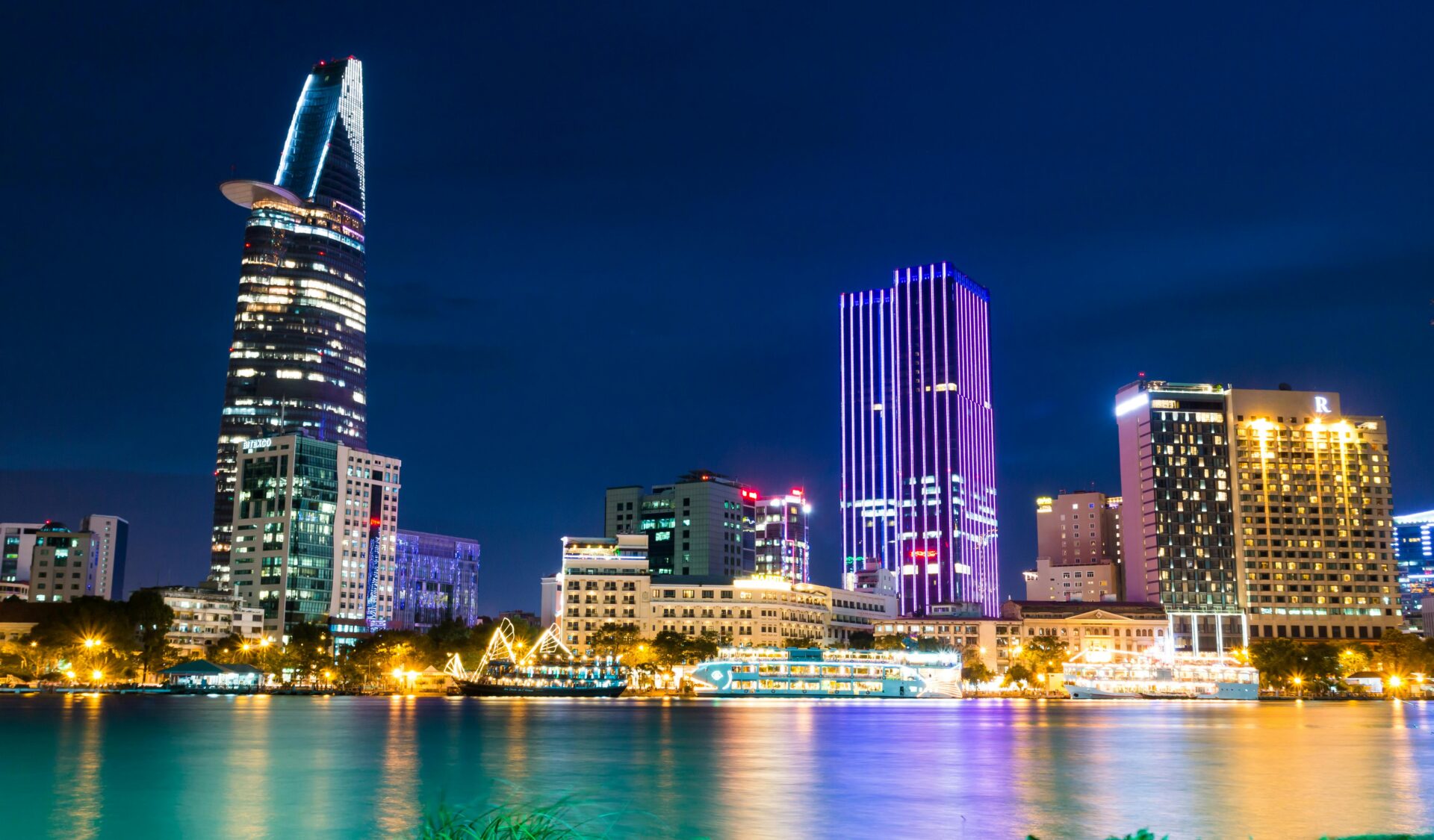
The alternative: the EON51 Lounge (Bitexco Financial Tower, 2 Hải Triều — the 51st floor of the most recognisable building in the Saigon skyline, the helicopter pad visible on the exterior, the view at 178 metres above the street): the observation deck at 200,000 VND / £6.28 or the restaurant and bar without entry fee with a food or drink purchase.
DAY TWO
7:00am — The Mekong Delta Day Trip (Cu Chi optional)
The Mekong Delta (the river delta 60km southwest of Ho Chi Minh City — the network of waterways, the floating markets, the fruit gardens, the rice paddies that produce approximately 50% of Vietnam’s rice output): the most accessible full-day experience from Ho Chi Minh City.
The Cái Bè or Mỹ Tho day tour (the specific delta towns accessible in a full-day circuit): the boat on the river channels, the floating market (most active early morning — the 8am arrival gives the market in working operation), the coconut candy factory (the traditional confection, the coconut milk reduced and set in the palm leaf mould), and the local lunch at the riverside restaurant (the canh chua at the source — the southern Vietnamese sour soup from the delta kitchen).
Organised day tour from District 1 guesthouses: 350,000-550,000 VND / £10.99-17.26 per person including transport and lunch.
Alternative Day Two morning: The Cu Chi Tunnels
The Củ Chi Tunnels (75km northwest of Ho Chi Minh City — the 250km network of tunnels used by the Viet Cong guerrillas during the American War, the tunnels connecting command centres, weapons stores, hospitals, and living quarters): the Ben Dinh or Ben Duoc sites (the Ben Dinh is closer and more accessible; the Ben Duoc is more authentic and less visited).
The specific Cu Chi experience: the crawling (the tunnel section enlarged for visitors is still genuinely tight — the claustrophobia is intentional, the demonstration of the conditions under which people lived underground for years), the trapdoors (the camouflaged entrance covers, now demonstrated), and the war film (the 1967 North Vietnamese propaganda film played in the visitor centre before the tunnel tour — the most specific piece of primary historical material available at any Vietnamese war site).
Organised day tour from District 1: 300,000-450,000 VND / £9.42-14.13 per person.
Afternoon: The Jade Emperor Pagoda
The Phước Hải Tự (Jade Emperor Pagoda, 73 Mai Thị Lựu, Bình Thạnh — the 1909 Taoist temple, the most atmospheric temple in Ho Chi Minh City and the one that most visitors miss because it is not in District 1):
The interior: the Jade Emperor’s hall (the three-dimensional tableau of the Jade Emperor’s court, the figures carved in wood and lacquered, the specific Taoist iconography of the celestial bureaucracy), the Hall of Ten Hells (the carved relief panels depicting the punishments awaiting sinners in each of the ten underworld courts — the panels that give the Haw Par Villa in Singapore its specific antecedent), and the turtles (the turtle tank in the rear courtyard, the turtles released as a merit-making act by Vietnamese Buddhists — the specific crossover of Buddhist and Taoist practice that characterises southern Vietnamese religious life).
Entry: free. Donation expected.
Evening: Phạm Ngũ Lão Walking Street
The Phạm Ngũ Lão Street (the backpacker district of District 1 — the street food, the draft beer from the sidewalk plastic stools, the bánh mì vendors, and the specific Saigon evening energy of a street that has been feeding budget travellers since the first backpacker wave arrived in the 1990s): the bún bò Huế (the spicy central Vietnamese beef noodle soup — better than the Hanoi phở by some accounts, available on the Phạm Ngũ Lão evening from 6pm): 60,000-80,000 VND / £1.88-2.51 per bowl. The Saigon beer: 20,000-30,000 VND / £0.63-0.94 per can from the street vendor.
The Essentials
Getting to Ho Chi Minh City from the UK: Connections via Doha (Qatar Airways), Dubai (Emirates), Kuala Lumpur (Malaysia Airlines, AirAsia), Singapore (Singapore Airlines, Scoot), Bangkok (Thai Airways). No direct UK-HCMC flight. Return: £500-800. The Qatar Airways and Emirates connections are typically the fastest at 14-15 hours total.
Airport to city: The Tan Son Nhat International Airport (SGN — 8km from the city centre): the Grab app (the ride-hailing standard in Vietnam): approximately 120,000-180,000 VND / £3.77-5.65. The metered taxi (Vinasun or Mai Linh — the two legitimate metered taxi companies in Ho Chi Minh City, identifiable by their branded livery): approximately 150,000-200,000 VND / £4.71-6.28. Never take a taxi from an unmarked driver at the arrivals hall.
Getting around: Grab motorcycle (the cheapest and fastest urban transport for solo travellers — the motorcycle taxi through the HCMC traffic negotiates junctions that the taxi cannot): 30,000-60,000 VND / £0.94-1.88 per journey. Grab car for the air-conditioned option and for carrying bags.
Where to stay: The Park Hyatt Saigon (2 Lâm Sơn, District 1 — the best location in the city, the opera house adjacent: £150-280/night), the Hotel des Arts Saigon (76-78 Nguyễn Thị Minh Khai, District 3: £80-140/night), the Lily’s Hotel (175/5 Phạm Ngũ Lão, District 1: private rooms from £18-35/night).
The Closing Moment
I was in the War Remnants Museum at 10:14am. The Agent Orange floor. The photographs of the children — two generations now, the dioxin persisting in the soil, the contamination measurable and ongoing.
I had visited the museum three times before this visit. Each visit begins with the intent to see the museum “objectively” — as a historical document, as evidence, as photography of the highest technical standard.
By the Agent Orange floor, the objectivity has always left.
The war ended in 1975. The documentation of its consequences is still being updated. The museum is a living record rather than a closed archive.
Ho Chi Minh City is a city that has decided to build forward at extraordinary speed — the Bitexco Tower, the Metro, the new districts rising across the Thủ Thiêm peninsula. The War Remnants Museum is the specific counterweight to the city’s forward momentum. Both are true simultaneously.
That specific combination is what makes this city worth 48 hours of careful attention.