


The Chiang Mai elephant sanctuary where the children walk alongside the elephants rather than sitting on them and where the interaction is the most affecting wildlife experience available to a family in Southeast Asia, the Bangkok temple circuit timed so the first arrival is at 8am before the heat and the crowds, the Ko Lanta island where the water is shallow enough for a six-year-old to stand 20 metres from shore, and why Thailand — the country that UK travellers often assume is not suitable for families — is the finest family destination in Southeast Asia at any budget level.
Reading time: 12 minutes | Last updated: 2026
Thailand is the BGGD recommendation for the first family trip to Southeast Asia. Not because it is the easiest (that distinction belongs to Singapore) and not because it is the cheapest (Cambodia has that title) but because it has the highest density of genuinely extraordinary experiences per day for children across the widest age range — the elephants, the temples, the street food markets, the islands — alongside a visitor infrastructure mature enough to remove the logistical friction that makes some Southeast Asian countries difficult for families with children under ten.
This guide covers Thailand for families with children of 3-15, organised by age group, with real costs and the specific practical details that most Thailand family guides omit.
When to Go
November to February — the optimal family window. The cool season (Bangkok at 27-31°C rather than the April 38°C), the dry season in most of Thailand, the school holiday alignment for the UK December half-term and February half-term.
The specific school holiday windows:
October half-term: Thailand in October is the tail of the rainy season — the south coast (Ko Lanta, Krabi) is affected by the southwest monsoon and should be avoided. The north (Chiang Mai) and Bangkok are largely fine. The Gulf of Thailand islands (Ko Samui, Ko Phangan) are in their dry season in October — the Gulf coast runs counter-season to the Andaman coast.
December-January: The prime family Thailand window. Dry throughout. The islands and the north simultaneously accessible. Book flights and accommodation 3-4 months ahead.
February half-term: Dry season continuing. Excellent.
Summer (July-August): The Andaman coast (Krabi, Ko Lanta, Ko Phi Phi) is in the rainy season — manageable but not the optimal beach experience. The Gulf islands and the north are fine. The peak UK summer holiday booking pushes prices up and availability down on the islands.
The Bangkok Circuit (All Ages)
Ages 3-6 with Bangkok
Bangkok is hot, crowded, and stimulating to the point of overload for very young children. The correct strategy: two days maximum, early morning activities only (before 11am, when the heat and the crowds reach the level that overwhelms the 3-6 age group), afternoon pool at the hotel.
The 8am temple instruction:
The Wat Pho (the temple of the Reclining Buddha — the 46-metre gold Buddha in the viharn, the length requiring a 180-degree turn to see from head to foot): arrive at 8am opening. Entry: 200 THB / £4.41 adult, children under 12 free at most Bangkok temples. The Reclining Buddha at 8am with 30 people in the room versus the Reclining Buddha at 11am with 400: this is the Bangkok family principle.
The specific child-accessible Bangkok experience: the boat on the Chao Phraya (the Chao Phraya Express Boat from the Tha Tien pier adjacent to Wat Pho — the orange-flag boat, 15 THB / £0.33 per adult, children under 90cm free, the river commuter service that passes the major temples and the Khao San Road pier). The boat is the correct Bangkok transport for children because it removes them from the traffic and gives the riverfront perspective.
The Dusit Zoo: The Dusit Zoo (adjacent to the Dusit Palace area) has been replaced by the Safari World and the privately operated zoos — research the current state of zoo welfare before visiting. The Safari World (Minburi, 40km from central Bangkok, the open-air wildlife park) gives the closest family-safe wildlife experience to Bangkok city.
Ages 7-12 with Bangkok
The 7-12 age group can handle more hours in Bangkok before the heat overwhelms them. The complete temple circuit becomes accessible.
The Grand Palace and Wat Phra Kaew:
The Grand Palace complex (Na Phra Lan Road — the most visited site in Thailand, the 8:30am opening time requiring arrival before 9am for manageable crowds): the Emerald Buddha (the 66cm jade-green jasper Buddha in the principal viharn — the figure dressed in one of three seasonal costumes changed by the King personally at the beginning of each season), the Prasat Phra Thep Bidon (the repository of the eight Buddha images — the gilded halls of the royal temples), and the scale of the complex (218,000 square metres, the equivalent of 30 football pitches).
Entry: 500 THB / £11.03 adult, children under 12 free. Dress code strictly enforced: covered shoulders, covered knees. The sarong rental available at the gate for those arriving under-covered: 100 THB / £2.21 refundable deposit.
The specific 7-12 Bangkok engagement:
The hands-on: the Thai cooking class (the Silom Thai Cooking School or the Blue Elephant — the half-day class where the child cooks 4 dishes under instruction, takes home the recipe card, and eats what they made): 1,500-2,000 THB / £33.10-44.13 per person.
The Chatuchak Weekend Market (if timing allows a Saturday or Sunday) — the world’s largest weekend market, 15,000 stalls, the children’s section with the toys, the animals (the bird market, the fish market), and the food court with the 40 THB / £0.88 mango sticky rice.
Chiang Mai (All Ages)
Chiang Mai is the BGGD family recommendation within Thailand. The reasons: the temperature (4-5°C cooler than Bangkok at all times due to the 300-metre elevation), the walking-city scale (the moat district is 2km × 2km — the family on foot can reach every central site without taxis), the night market (the Saturday Night Market on Wua Lai Road and the Sunday Walking Street on Thanon Wualai — the most family-friendly markets in Thailand), and the elephant sanctuary.
The Elephant Sanctuary
The ethical elephant sanctuary — the distinction that matters more in Chiang Mai than anywhere else in Thailand.
What to look for: A sanctuary where elephants are not ridden, where the interaction involves walking alongside the elephants rather than performing on them, where the elephants’ welfare programme is verifiable, and where the herd has retired from the tourism or logging industry.
The reference sanctuary: The Elephant Nature Park (ENP, north of Chiang Mai — the Lek Chailert-founded sanctuary, the most internationally recognised ethical elephant welfare organisation in Thailand): the day visit (the feeding, the bathing in the river, the walking alongside the herd): 2,500-3,000 THB / £55.18-66.21 per person including transport and lunch. Book at elephantnaturepark.org 2-4 weeks ahead in peak season.
The specific family experience at the ENP:
Children of 6 and above participate fully. Children of 3-5 can observe but the interaction level is managed by the staff based on the individual child’s confidence.
The elephant feeding: the cucumber and the sugarcane, the trunk extending toward the basket the child is holding, the specific size of the elephant head at close range (the adult Asian elephant head is approximately 80cm wide, the eye at the level of a 7-year-old’s head). This is the moment that changes the child’s relationship to the concept of a wild animal.
The bathing: the wading into the river alongside the elephant, the bucket of water thrown over the elephant’s back, the elephant’s response (the specific elephant pleasure visible in the relaxed posture, the half-closed eye, the tail movement). Children of 8 and above can participate in the bathing directly; younger children observe from the bank.
Children of 5 and under: The ENP has a minimum age of 3 for the day visit. The interaction for the under-5s is observation and feeding from the platform (rather than in the river). The experience is still extraordinary — the scale of the animal at close range is sufficient.
The Night Bazaar and the Walking Streets
The Chiang Mai Night Bazaar (Tha Phae Road area, nightly from 6pm): the covered market, the stalls selling the northern Thai handicrafts, the food court. For families: the mango sticky rice (20-30 THB / £0.44-0.66), the grilled corn, the pad thai from the wok cart.
The Sunday Walking Street (Wua Lai Road, Sunday evenings from 5pm): the most characterful market in Chiang Mai, the northern Thai handicrafts (the northern-style parasols, the hilltribe textiles, the silver jewellery from the craftspeople who travel from the villages), the food available throughout, and the specific Chiang Mai energy of a Sunday evening market where the vendor and the customer are from the same city.
Doi Inthanon National Park (Ages 8+)
The Doi Inthanon National Park (Thailand’s highest mountain, 2,565m, 2 hours from Chiang Mai): the Wachirathan Waterfall (the 30-metre fall visible from the road), the twin chedis of the royal family (the gardens, the orchids, the altitude-induced cool — 15°C at the summit, the equivalent of a Welsh autumn in August), and the summit (the cloud forest at the top, the birdwatching for the specific montane species).
The family hire car from Chiang Mai (the road is tarmac throughout, no 4WD required): the correct format for families with young children who need the flexibility to stop when required. Taxi tours from Chiang Mai: 1,500-2,500 THB / £33.10-55.18 per vehicle.
The Islands (Ages 3+)
Ko Lanta (Krabi Province) — The BGGD Family Island
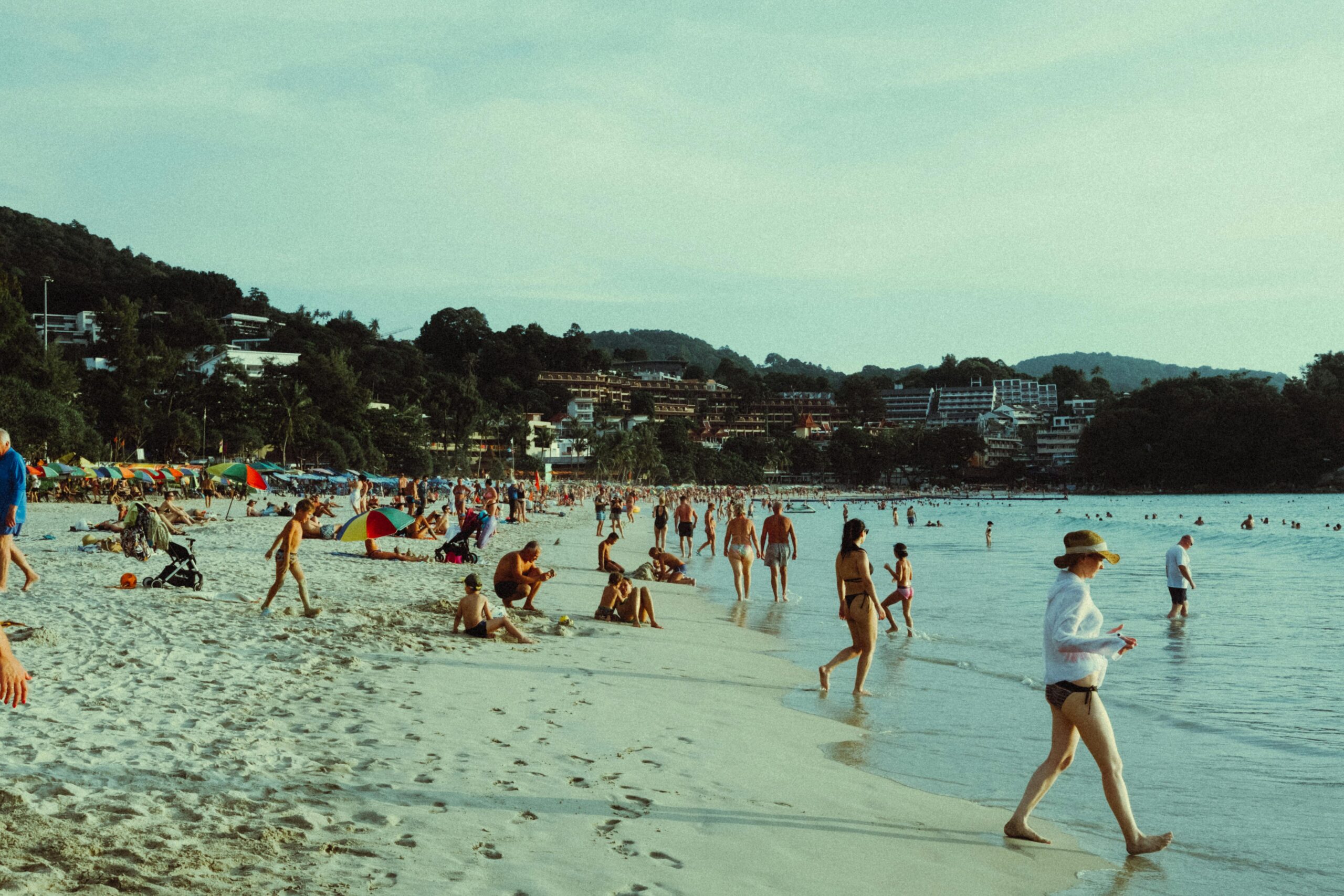
Ko Lanta is the family-optimal Andaman island. The reasons: the Long Beach (the most gradual shelving beach in the Krabi region — the water at knee depth for a 6-year-old at 20 metres from the shore, the sand white, the water the correct Andaman turquoise), the road system (Ko Lanta is the most easily driven island in the Andaman — the ring road paved, the hire motorbike or car accessible from the pier), and the accommodation (the family bungalows with the pool, the self-catering villas with the kitchen, at prices 30-50% below Ko Phi Phi and 20-30% below Krabi Town).
The Ko Lanta day circuit for families:
Morning (7-10am): the Long Beach or the Klong Dao Beach (the beach adjacent to the main pier, the softest sand on the island, the most child-friendly water). The snorkelling kit available from the beach rental (50 THB / £1.10 per mask and snorkel per day — bring your own for children to ensure fit).
Midday (10am-3pm): the pool at the resort or the villa (the midday sun on the beach in February is UV index 10 — the family pool under shade is the correct 10am-3pm activity).
Afternoon (3-5pm): the market at Ban Saladan pier (the fresh fish market where the boats return from the morning fishing — the children who have never seen a whole fish see approximately 200 of them simultaneously), the 4×4 tour to the Ko Lanta Old Town (the old Malay village on the eastern coast, the wooden houses on stilts over the water, the specific old Ko Lanta character that the western beach development has not reached).
Ko Lanta accommodation for families:
The Where Else? Resort (the villa compound with the family pool villas, the Long Beach location, the breakfast on the villa terrace): from 4,500-8,000 THB / £99.34-176.59 per night for the family villa.
The Layana Resort (the luxury option, the private pool villa, the children’s programme): from 5,500-12,000 THB / £121.42-264.88 per night.
The Lanta Nice Beach Resort (the budget family option, the bungalows with the AC, the pool, the Long Beach location): from 2,000-4,000 THB / £44.15-88.30 per night.
Ko Samui — Gulf of Thailand Alternative
For families travelling in October-December (when the Andaman coast is affected by the southwest monsoon), Ko Samui on the Gulf of Thailand coast is the alternative: the Choengmon Beach (the northeastern bay, the calmest water on the island, the family accommodation cluster), the Fisherman’s Village on Bophut Beach (the Monday night walking street, the most family-friendly evening market on Ko Samui), and the Ang Thong Marine National Park (the 42-island national park accessible by day boat from Ko Samui — the emerald lake at the centre of Ko Mae Ko island, the snorkelling at the coral gardens off Ko Wao — for children of 8+).
The Age-by-Age Thailand Guide
Ages 3-6
What works:
The elephant sanctuary (the feeding and the bathing, with the parent actively managing the proximity). The beach (Ko Lanta Long Beach, the 20-metre paddling zone). The night market (the food, the movement, the lights — the 6pm-8pm window before the child’s energy depletes). The Chao Phraya boat (the boat is stimulating and temperature-controlled by the river breeze).
What doesn’t:
The full Grand Palace circuit (2.5 hours in 33°C heat, compulsory long trousers). The overnight bus (the 8-hour overnight bus from Bangkok to Ko Samui via Surat Thani requires resilience beyond the 3-6 age group). The multi-day cooking class.
The specific packing addition for 3-6 in Thailand:
The Calpol / children’s paracetamol (liquid, not tablets — the Thai pharmacies carry the equivalent but the UK formulation is the one the child knows). The hydration sachets (the child in 33°C heat playing on the beach needs oral rehydration more rapidly than the adult). The rash vest (the Andaman sun on pale UK skin, even in the late afternoon).
Ages 7-12
What works:
Everything in the 3-6 list plus: the Grand Palace at 8:30am, the Doi Inthanon day trip, the multi-island boat day from Ko Lanta (the snorkel gear, the cave exploration, the stop at the sand bank), the Thai cooking class, the night market food circuit with the child choosing their own dishes.
The engagement strategy: The child of 9 who is given 200 THB / £4.41 and sent to the night market to buy dinner using Google Translate as the only tool has an experience. The child who is brought to the food stall by the parent and ordered for has a meal. The difference is the ownership.
Ages 12-15
What works:
The full Thailand experience, treated as an adult participant rather than a managed child. The specific 12-15 engagement in Thailand: the cooking class (the teenager as chef rather than as observer), the motorbike hire on Ko Lanta (from 14+ with parental permission, the 100cc automatic scooter at 200 THB / £4.41 per day), the Muay Thai class (the Chiang Mai training camps offer tourist sessions from 500 THB / £11.03 for the 2-hour class — the teenage engagement with Muay Thai culture rather than just watching it).
What the teenager who came reluctantly says after:
In every case, without exception in the BGGD experience: they want to come back.
What It Costs — Family of Four (2 Adults, 2 Children Ages 8 and 11)
| Category | Budget | Mid-Range |
|---|---|---|
| Return flights (UK-Bangkok direct, 2 adults + 2 children) | £1,800-2,800 | £2,400-3,600 |
| 14 nights accommodation | £700-1,400 | £1,400-2,800 |
| Food (14 days, mix of street food and restaurants) | £350-560 | £700-1,120 |
| Internal transport (Bangkok-Chiang Mai flight + Ko Lanta ferry) | £200-350 | £280-450 |
| Activities (elephant sanctuary, boat days, temples) | £300-500 | £450-700 |
| Total (family of 4, 14 nights) | £3,350-5,610 | £5,230-8,670 |
The budget range assumes street food for most meals, guesthouse or bungalow accommodation, and economy flights. The mid-range assumes a mix of restaurant meals, air-conditioned accommodation with pools, and the occasional activity upgrade.
The Practical Details
The food and fussy eaters: Thailand is the easiest country in Southeast Asia for fussy eaters. The grilled chicken (kai yang) and the white rice (khao suay) are available at every food court, every restaurant, and every street stall at 40-80 THB / £0.88-1.77. The pad thai (without chilli, specified by pointing at the chilli and shaking the head — universally understood) is available at every tourist restaurant from 60-120 THB / £1.32-2.65. The mango sticky rice for dessert is available everywhere and is universally accepted by children of all ages and preferences.
The medical preparation: The recommended vaccinations for Thailand include: Hepatitis A, Typhoid, and Tetanus (standard for Southeast Asia — consult a travel clinic). Malaria prophylaxis: required for the border areas (the Thai-Myanmar border in Mae Hong Son Province, the Thai-Cambodia border in Trat Province). Not required for Bangkok, Chiang Mai, Ko Lanta, Ko Samui, Ko Phangan. Consult a travel clinic for the specific itinerary.
The mosquito reality: Thailand has dengue fever (Aedes aegypti mosquito, biting during daylight hours — the critical difference from malaria transmission). DEET-based repellent applied morning and afternoon in addition to the standard malaria prevention.