
The complete guide for travellers: mountain gorillas at $700 (half the Rwanda price, same experience), chimpanzees in Kibale Forest at the highest density of any forest in Africa, the Nile’s source and its white water, Lake Bunyonyi’s thirty islands and the slowest morning available in East Africa, the tree-climbing lions of Queen Elizabeth National Park, and why Uganda is the finest complete East Africa experience available on a single trip.
Reading time: 13 minutes | Last updated: 2026
Uganda is called the Pearl of Africa. Winston Churchill coined the phrase in 1908 and it has been used in Ugandan tourism marketing ever since, which has given it the slightly worn quality of a compliment repeated too often. It is, however, accurate.
In an area roughly the size of the UK, Uganda contains: the mountain gorillas of Bwindi Impenetrable Forest (a third of the world’s total mountain gorilla population, accessible on a $700 permit that is half the Rwanda price for the same experience), the chimpanzees of Kibale Forest (the highest density of chimpanzees in any forest in Africa), the tree-climbing lions of Queen Elizabeth National Park (a population of lions that has developed the behaviour of resting in fig trees, a phenomenon found in only two places on Earth), the source of the Nile at Jinja (where the Nile emerges from Lake Victoria and begins its 6,650km journey to the Mediterranean), the Rwenzori Mountains (the “Mountains of the Moon,” permanently glacier-capped despite the equatorial latitude), Lake Bunyonyi (a caldera lake of extraordinary beauty in the southwestern highlands), and Murchison Falls (where the Nile forces itself through a 7-metre gap in the rocks in the most powerful waterfall on the Nile).
It also has a specific quality that Rwanda — the more polished, more internationally marketed East African gorilla destination — doesn’t quite match: the rawness of a country that is genuinely developing its tourism infrastructure rather than having fully arrived. The guesthouses around Bwindi are family-run rather than boutique. The roads to some of the best wildlife areas are what Ugandan roads are. The experience is less managed and, for most travellers who are looking for the right thing, more rewarding.
Quick Navigation
- The Case for Uganda — The Honest Comparison with Rwanda
- When to Go — Dry Season and Gorilla Windows
- Getting There — Entebbe as the Hub
- Kampala — The Capital
- Bwindi Impenetrable Forest — The Gorilla Permit at $700
- The Gorilla Permit — Uganda vs Rwanda
- Kibale Forest — The Chimpanzee Capital
- Queen Elizabeth National Park — The Tree Lions
- Murchison Falls — The Nile at Its Most Dramatic
- Lake Bunyonyi — The Slow Morning
- Jinja and the Nile Source
- The Rwenzori Mountains
- Hidden Uganda — The Places Most Itineraries Skip
- What It Costs — Real Numbers
- Eating in Uganda — Rolex and the Ugandan Kitchen
- Practical Notes
- The 10-Day Itinerary — Gorillas, Chimps, and Wildlife
The Case for Uganda — The Honest Comparison with Rwanda
The Rwanda vs Uganda gorilla decision is the primary planning question for UK travellers considering East Africa.
Rwanda:
- Gorilla permit: $1,500 / £1,185
- Infrastructure: high quality, well-developed
- Tourist density: higher, more international visitors
- Safety: excellent
- Other attractions: Kigali, Nyungwe chimps, Akagera National Park
Uganda:
- Gorilla permit: $700 / £553
- Infrastructure: good in tourist areas, variable elsewhere
- Tourist density: lower, fewer international visitors
- Safety: stable, with specific areas requiring FCO awareness
- Other attractions: Kibale chimps, Queen Elizabeth NP, Murchison Falls, Jinja
The price difference ($800 / £632 less per permit) is the most significant practical distinction. For a couple doing one gorilla trek each, Uganda saves £1,264 on permits alone — enough to pay for additional days, a better lodge, or the chimpanzee permit as well.
The experience in the forest is the same. The mountain gorillas don’t know which country they’re in.
The Uganda advantage beyond price:
Uganda’s density of distinct wildlife experiences within a single trip is higher than Rwanda. The combination of gorillas (Bwindi), chimpanzees (Kibale), tree-climbing lions (Queen Elizabeth), the Nile (Murchison Falls and Jinja), and the lake highlands (Bunyonyi) gives a trip that no single week in Rwanda quite matches.
The Uganda disadvantage: the infrastructure is less polished. Roads between national parks can be poor. The journey from Entebbe to Bwindi takes 8-9 hours by road; the equivalent Rwanda journey (Kigali to Volcanoes NP) is 3 hours. Budget more time.
When to Go — Dry Season and Gorilla Windows
June to August — The Long Dry Season
The primary tourist season. The roads between national parks are most accessible. Wildlife viewing in Queen Elizabeth and Murchison Falls is at its most concentrated around water sources. The gorilla habitat in Bwindi is accessible year-round regardless of rain, but the dry season makes the forest hikes more manageable.
Gorilla permits: book 3-6 months ahead for peak season (July-August). The Uganda Wildlife Authority allocates permits 2 years ahead — booking through a licensed Uganda tour operator is the standard approach, as they manage the permit queue and the logistics.
December to February — The Short Dry Season
The second reliable window. Fewer international visitors than June-August. Permit availability is better. The Bwindi forest in the short dry season: slightly drier underfoot, the vegetation less dense.
March to May and September to November — The Rainy Seasons
Heavy rain in much of Uganda — the roads between national parks can become impassable in the worst of the long rains (March-May). Gorilla permits are easier to obtain on shorter notice. The forests are intensely green. The chimps in Kibale are active at all times of year.
The BGGD recommendation: June or December-January. June for maximum conditions across all parks. December for permit availability and lower lodge prices.
Getting There — Entebbe as the Hub
Entebbe International Airport (EBB):
Direct flights from London with several airlines. The most consistent service: KLM via Amsterdam (12-13 hours total), British Airways via connections, Kenya Airways via Nairobi (11-12 hours).
RwandAir connects Kigali to Entebbe in 1 hour — the natural routing for a Rwanda-Uganda double circuit.
Return flights from the UK to Entebbe: £550-850 booked 8-12 weeks ahead.
Getting from Entebbe to Kampala:
Entebbe Airport is 45km from Kampala. Taxi: approximately £15-20 negotiated. The road is good; the journey takes 45-90 minutes depending on traffic (Kampala traffic is significant during rush hours).
Getting around Uganda:
Private driver/guide vehicle: the standard approach for national park circuits. Uganda’s national parks are not connected by reliable public transport, and the road conditions between parks require vehicles with good clearance. A driver-guide for 8-10 days including the vehicle: $80-120 / £63-95 per day, everything negotiated in advance. Uganda tour operators based in Kampala (Red Chilli Hideaway, Safari Link, Gorilla Trekking Africa) handle the permit booking and vehicle logistics.
Domestic flights: Aerolink Uganda connects Entebbe to Kasese (for Queen Elizabeth NP), Kihihi (for Bwindi), and Pakuba (for Murchison Falls). 1 hour vs 8-10 hours driving. Costs: $150-250 / £118-197 one way. Worth considering for the Bwindi leg if time is limited.
Kampala — The Capital
Kampala is a city of 3.5 million people built across seven hills — chaotic, energetic, and not primarily a tourist destination, but worth a night on arrival to acclimatise before the national park circuit.
The Kasubi Tombs:
A UNESCO World Heritage Site on one of Kampala’s hills — the burial ground of the Baganda kings (kabakas), the traditional rulers of Buganda (the kingdom that forms the cultural heart of Uganda). The main structure (the Muzibu-Azaala-Mpanga) was the largest thatched building in the world before being damaged by fire in 2010; the reconstruction is now largely complete. Entry: UGX 20,000 / £4. The site is an active place of Baganda cultural identity, not merely a historical exhibit.
The Uganda Museum:
The oldest museum in East Africa (founded 1908) — covering Ugandan natural history, archaeology, and cultural history. Entry: UGX 10,000 / £2. The ethnographic collection is particularly strong, covering the material culture of Uganda’s 50+ ethnic groups.
The Ndere Cultural Centre:
Weekly traditional dance and music performances on Friday evenings — 16 performing groups representing different Ugandan regions. The most accessible introduction to Uganda’s cultural diversity. Entry: UGX 40,000 / £8. Friday evenings at 7pm.
Bwindi Impenetrable Forest — The Gorilla Permit at $700
Bwindi Impenetrable National Park is in the southwestern corner of Uganda — a mountainous rainforest of 331 square kilometres that has been forested continuously for 25,000 years and is home to approximately 459 mountain gorillas (roughly 40% of the world’s total remaining population).
The forest is called “impenetrable” for a reason — the dense undergrowth of climbing plants, stinging nettles, and bamboo that covers the slopes makes navigation extremely difficult outside the existing trails. The gorilla families are tracked to their sleeping positions each evening by habituators, whose radio report the following morning tells the ranger teams and tourist groups where to start the day’s search.
The gorilla permit ($700):
Purchased through the Uganda Wildlife Authority (ugandawildlifeauthority.go.ug) or through a licensed tour operator. The permit covers one tracking session with one habituated family group, with up to 8 visitors, for a maximum of one hour with the gorillas once found.
The 19 habituated families are distributed across four sectors of Bwindi: Buhoma (the most visited, on the northern edge), Ruhija (highest altitude, the most strenuous trek), Rushaga (the most families, the most permit availability), and Nkuringo (the most scenic approach).
The trek:
From the sector headquarters, the morning briefing at 8am assigns groups to families based on the previous evening’s tracking data. The walk through the forest to find the family takes 30 minutes to 5 hours depending on where the gorillas have moved overnight. When found: the one hour begins.
The Bwindi gorilla experience is broadly the same as Rwanda’s Volcanoes — the same species, the same habituation, the same hour in the forest, the same emotional weight. The forest itself is different (Bwindi is denser, more dramatically mountainous) and the sector infrastructure varies (Buhoma is the most developed; Nkuringo has the finest views).
The Gorilla Permit — Uganda vs Rwanda
The definitive comparison for the planning decision:
| Factor | Uganda (Bwindi) | Rwanda (Volcanoes) |
|---|---|---|
| Permit cost | $700 / £553 | $1,500 / £1,185 |
| Drive from capital | 8-9 hours from Entebbe | 3 hours from Kigali |
| Flight alternative | Yes (Aerolink, 1 hour) | Domestic flight not standard |
| Park infrastructure | Good, variable by sector | Consistently high |
| Forest character | Dense, dramatic mountains | More open in places |
| Families available | 19 habituated | 10 habituated |
| International visitors | Fewer | More |
| Combined with… | Kibale, Queen Elizabeth, Murchison | Kigali, Nyungwe, Akagera |
The BGGD verdict: If budget is a consideration (which a $800 per-permit difference makes it for most travellers), Uganda is the correct choice. If the priority is infrastructure quality, minimum travel time from the capital, and Rwanda’s specific additional offerings (Kigali, Nyungwe), Rwanda is correct. Both produce an extraordinary gorilla experience.
Kibale Forest — The Chimpanzee Capital
Kibale National Park is 4 hours from Entebbe by road — a lowland and montane forest in western Uganda containing the highest density of primates of any African forest: 13 primate species, including the largest population of chimpanzees in Uganda (approximately 1,500 individuals).
The chimpanzee trek: a permit ($200 / £158 per person) gives access to a habituated chimpanzee community for a 1-hour encounter. The chimps in Kibale move faster and more erratically than the mountain gorillas — the encounter is more kinetic, louder (the chimps call continuously), and less contemplative. Both types of ape encounter are extraordinary; they are simply different experiences.
The Bigodi Wetland Sanctuary:
Adjacent to Kibale — a community-run wetland conservation area that is the finest birding site in Uganda accessible without specialist equipment. The 4km boardwalk through the wetland: the red-tailed monkey, L’Hoest’s monkey, the grey-cheeked mangabey, and over 200 bird species. Entry: $10 / £7.90. One of the finest community conservation projects in East Africa — run entirely by the local community, the income supporting local schools and health clinics.
Queen Elizabeth National Park — The Tree Lions
Queen Elizabeth National Park covers 1,978 square kilometres of western Uganda — savannah, wetlands, the Kazinga Channel (connecting Lake Edward and Lake George), and the forests of the Ishasha sector in the south.
The tree-climbing lions:
The Ishasha sector contains a population of lions (Panthera leo) that has developed the behaviour of resting in the branches of fig trees (Ficus natalensis) during the day — a phenomenon found in only two places in the world (Ishasha and Tanzania’s Lake Manyara National Park). The reason for the behaviour is debated: escaping ground-level insects, accessing a breeze, or a tradition learned from a single individual that has spread through the pride over generations.
The sighting probability for tree lions in Ishasha: high during dry season (June-August, December-January) when the lions use the shade of the trees during the midday heat. A 2-3 hour game drive in the Ishasha sector specifically searching for tree lions finds them on the majority of visits.
The Kazinga Channel boat trip:
A 2-hour launch trip on the channel between the two lakes — the highest concentration of hippopotamus per kilometre in Uganda, the Nile crocodiles on the banks, the African buffalo herds coming to water, and the bird diversity (the African skimmer, the goliath heron, the Malachite kingfisher). One of the finest boat-based wildlife experiences in East Africa. Cost: included in most national park lodge packages or available through the Uganda Wildlife Authority at the park gate ($30-40 / £23.70-31.60 per person).
Murchison Falls — The Nile at Its Most Dramatic
Murchison Falls National Park is Uganda’s largest protected area — 3,840 square kilometres of savannah and riverine forest in the northwest. The centrepiece: Murchison Falls itself, where the entire volume of the Victoria Nile forces itself through a 7-metre gap in the rocks, creating a waterfall of extraordinary violence and beauty.
The falls:
The Nile at this point is approximately 50 metres wide. The 7-metre cleft compresses the full river into a jet of white water that plunges 43 metres. The spray from the base is visible from 1km. The specific violence of the compression — the sound audible from 500 metres, the rainbow permanent in the mist — makes Murchison Falls the most dramatic single sight available in Uganda.
The approach: boat upstream from Paraa (the park’s main accommodation hub) to the base of the falls (2.5 hours, the boat approaching through hippo-dense shallows), then a 1km walk to the top of the falls. The view from the top: the river narrowing to the slot, the water plunging, the Nile continuing placidly below as though nothing extraordinary has just happened.
The game drives:
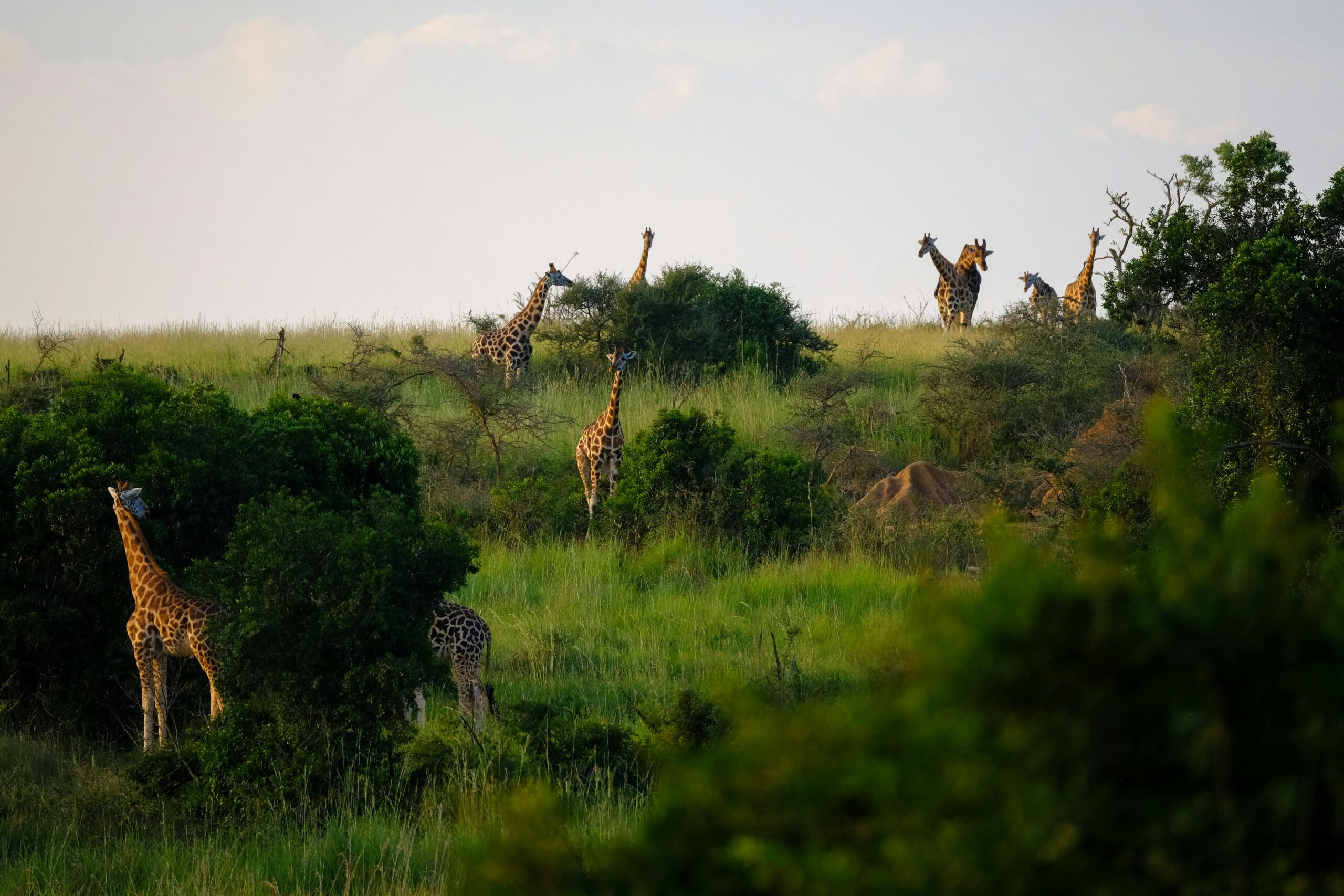
The north bank of the Nile in Murchison Falls NP has Uganda’s finest savannah game viewing — elephants (the largest concentration in Uganda), giraffe (Rothschild’s giraffe, the most endangered subspecies, found in significant numbers in Murchison), lion, leopard, and the Uganda kob (an antelope specific to Uganda, the national animal, the male’s territorial displays among the most dramatic animal behaviours visible from a game vehicle).
The morning game drive (6am start) through the north bank savannah: 3-4 hours, guided by a park ranger, the morning light on the savannah extraordinary. Cost: UGX 150,000 / £30 for the ranger.
Lake Bunyonyi — The Slow Morning
Lake Bunyonyi is in the southwestern highlands of Uganda, 25km from the Bwindi sector of Gorilla Country — a deep caldera lake at 1,962m above sea level, surrounded by heavily terraced hillsides, dotted with 29 islands. The name means “place of many little birds” in the local Rukiga language.
The lake is the deepest in Uganda (900m) and one of the few bodies of water in East Africa free of the bilharzia parasite (which affects most Ugandan freshwater bodies) — safe for swimming.
The experience:
Lake Bunyonyi is not primarily about activities or attractions. It is about the specific quality of a morning at 1,962m above sea level, in a dugout canoe on a flat lake, with the mist on the water and the terraced hills above and no urgency whatsoever.
Hiring a dugout canoe (with or without a paddler): UGX 10,000-20,000 / £2-4 per hour. Paddling between the small islands in the morning, the water perfectly still, the birds calling in the surrounding forest. One of the slowest and most restorative mornings available in East Africa.
The islands:
Akampene (Punishment Island): historically the island where unmarried Bakiga girls who became pregnant were abandoned to die — the practice ended with colonial-era intervention. The island is now freely visited; the story requires telling in context rather than as a curiosity.
Bushara Island: a community campsite and guesthouse on the lake’s most developed island — canoe access, bird watching, the community-operated cultural experience. The canoe trip from the shore guesthouses to Bushara: 20 minutes.
Jinja and the Nile Source
Jinja is a city of 100,000 people on the northern shore of Lake Victoria, where the Nile River begins its 6,650km journey to the Mediterranean. The source of the Nile was one of the great geographical questions of the 19th century; John Hanning Speke reached it in 1862 and declared Lake Victoria the source. The specific point where the Nile emerges is marked by a stone monument accessible by boat from Jinja town.
The source:
The boat trip to the source of the Nile (from Jinja pier, approximately 30 minutes, £10-15): the point where Lake Victoria becomes the Victoria Nile, marked by a small floating platform and a monument. The water here is calm; 500km downstream at Murchison Falls it is violent. Standing at the source — the beginning of the river — is a specific geographical experience.
The white water:
The section of the Nile between Jinja and Bujagali (15km downstream) contains the finest white water in East Africa — Grade 4-5 rapids formed by the Nile forcing through the rocky gorge below the source. White water rafting: $130-150 / £102-118 per person for a full day (9 rapids, Grade 3-5 depending on water level, all the major operators are safety-certified). The most accessible extreme sport in East Africa.
The bungee jump at the Nile: a 44-metre platform above the Nile, operated by Adrift (the primary rafting operator). The jump is over the water rather than into it. Cost: $115 / £91.
The Rwenzori Mountains
The Rwenzori Mountains (the “Mountains of the Moon” of Ptolemy’s 2nd-century geography, the specific mountains that Speke’s expedition misidentified as the Nile source) straddle the Uganda-DRC border in western Uganda, rising to 5,109m at Mount Stanley’s Margherita Peak — the third-highest point in Africa.
The Rwenzori are the only mountains in Africa with permanent glaciers outside of Mount Kilimanjaro — the equatorial snow fields of the summit zone (visible from the Queen Elizabeth NP plains on clear days) exist because of the extraordinary rainfall of the western rift.
The trek:
The Rwenzori trek is 6-8 days minimum for the summit circuit — through successive vegetation zones (the bamboo zone, the giant heather zone, the afro-alpine moorland, the glacier zone) to the summit peaks. The specific Rwenzori flora: giant lobelias (the giant groundsel of the Rwenzori grows to 10 metres on the alpine moorland — surreal, unique), tree heathers of 6-8 metres covered in lichen, the specific moss and fern landscape of the cloud zone.
The trek requires a licensed guide and porters (mandatory), the equipment (gaiters, trekking poles, warm layers — the summit temperatures are below freezing), and advance booking through the Uganda Wildlife Authority. The full summit circuit costs approximately $800-1,200 / £632-949 including park fees, guide, and porters for 7 days.
For travellers who want the Rwenzori landscape without the summit commitment: the community trails around the base of the mountains (accessible from Kasese town) give the giant lobelia and tree heather vegetation in 2-3 hour day hikes.
Hidden Uganda — The Places Most Itineraries Skip
Sipi Falls:
On the slopes of Mount Elgon in eastern Uganda — a series of three waterfalls on the Sipi River, the largest dropping 100 metres into a pool surrounded by coffee plantations. The area produces Arabica coffee on the mountain slopes; the local coffee washing station offers farm tours and tastings. Accessible from Jinja (2 hours by road) or from Mbale (45 minutes). Almost no international visitors despite being genuinely extraordinary.
Mgahinga Gorilla National Park:
A smaller gorilla park than Bwindi, sharing the Virunga volcano range with Rwanda’s Volcanoes NP and DRC’s Virunga NP. One habituated gorilla family (the Nyakagezi group). Permits: $700 (same as Bwindi). The advantage: almost guaranteed availability, the gorilla encounter in a smaller park context, the volcano landscape.
The golden monkey trek in Mgahinga: the same golden monkey species (Cercopithecus kandti) as Rwanda’s Volcanoes NP — a permit separate from the gorilla permit, $100 / £79. The two experiences (golden monkey morning, gorilla afternoon) make Mgahinga a unique combined-primate day.
Lake Mburo National Park:
The closest national park to Kampala (3 hours) and the only park in Uganda with zebra and impala — the wildlife more accessible than Murchison or Queen Elizabeth without the distance. The acacia savannah, the lake circuits, and the walking safari option (the only national park in Uganda where walking without a vehicle is permitted) make it a distinctive addition to the circuit.
What It Costs — Real Numbers
Uganda’s costs divide between the permit costs (significant and fixed) and the daily costs (significantly lower than Rwanda).
The Permit Costs
| Activity | Cost |
|---|---|
| Mountain gorilla trek | $700 / £553 |
| Chimpanzee trek (Kibale) | $200 / £158 |
| Golden monkey trek (Mgahinga) | $100 / £79 |
| Murchison Falls boat trip | $40 / £32 |
| Queen Elizabeth launch (Kazinga) | $30 / £24 |
Daily Budgets (Excluding Permits)
Budget (£35-50/day)
- Accommodation: budget guesthouse or campsite (£12-25/night)
- Food: local restaurants, Ugandan cuisine (£6-10/day)
- Transport: included in driver-guide vehicle
Mid-range (£55-80/day)
- Accommodation: mid-range lodge (£30-55/night)
- Food: lodge meals and local restaurants (£14-22/day)
What 10 Days in Uganda Costs from the UK
| Category | Budget | Mid-Range |
|---|---|---|
| Return flights (via Nairobi or Amsterdam) | £550–800 | £650–900 |
| Gorilla permit (1 person) | £553 | £553 |
| Chimpanzee permit (1 person) | £158 | £158 |
| Driver-guide vehicle (10 days) | £630–950 | £800–1,200 |
| 10 nights accommodation | £145–275 | £330–580 |
| Food (10 days) | £70–115 | £150–240 |
| Park entry fees | £60–90 | £80–120 |
| Total (1 person) | £2,166–2,941 | £2,721–3,751 |
The Rwanda comparison:
The same 10-day trip with a Rwanda gorilla permit ($1,500 vs Uganda’s $700) costs £632 more per person. For two people: £1,264 more for the Rwanda permits alone.
Eating in Uganda — Rolex and the Ugandan Kitchen
Ugandan food is less internationally known than Ethiopian or Rwandan cuisine and deserves significantly more attention than it receives.
The Rolex:
Uganda’s most famous street food — nothing to do with the Swiss watch brand. The name is a corruption of “rolled eggs” — a chapati (thin flatbread) rolled around a freshly made omelette (with optional vegetables, tomato, and avocado). Available at rolex stands throughout Uganda from 7am: UGX 1,500-3,000 / £0.30-0.60. The correct Uganda breakfast, eaten standing at the roadside.
Roasted Groundnuts:
Uganda is one of the world’s largest groundnut producers — roasted groundnuts sold in newspaper cones at bus parks, market stalls, and roadside stands throughout the country. UGX 500-2,000 / £0.10-0.40. The specific flavour of freshly roasted Ugandan groundnuts (nuttier, less processed than the supermarket version) makes them impossible to stop eating.
Matoke:
Green bananas steamed in banana leaves until soft — the starchy base of most Ugandan meals. The matoke of the Baganda tradition (central Uganda) is served as a side with groundnut stew, beef stew, or beans. The specific flavour: mild, slightly banana-sweet, more substantial than potato and more complex.
Posho:
Maize flour cooked with water to a stiff, polenta-like consistency — the western and northern Ugandan equivalent of matoke as the starch base. Eaten with beans (katogo — beans cooked with matoke or posho in the same pot), groundnut stew (a peanut-based sauce), or smoked fish from the Nile or the lakes.
Tilapia (Ngege):
The Nile tilapia — eaten throughout Uganda, the freshwater fish that feeds on algae in Lake Victoria, the Nile, and the western lakes. Fried whole (with banana chips and a chilli sauce), grilled over charcoal, or in a light stew. At a lakeside restaurant in Jinja or Entebbe: the freshest tilapia available in East Africa. UGX 8,000-15,000 / £1.60-3.
Ugandan Coffee:
Uganda is the second-largest coffee producer in Africa after Ethiopia — primarily Robusta coffee grown at lower altitude, with some Arabica production in the Rwenzori and Elgon highland areas. The Sipi Falls Arabica (grown at 1,800-2,200m on the slopes of Mount Elgon) is the finest Ugandan coffee, recognised by international specialty buyers. At the Sipi Falls coffee washing station: farm tour and fresh-brewed coffee tasting, UGX 20,000 / £4.
Practical Notes
Visa: E-visa required for UK passport holders. Apply at visas.immigration.go.ug at least 2 weeks before travel. Cost: $50 / £39 for a single-entry tourist visa. Also available on arrival at Entebbe Airport ($50) — but the online application is recommended for certainty.
Getting there: KLM via Amsterdam (12-13 hours), Kenya Airways via Nairobi (11-12 hours), British Airways via connections. Return flights: £550-850. RwandAir connects Kigali to Entebbe in 1 hour for a Rwanda-Uganda circuit.
Currency: Ugandan Shilling (UGX). £1 ≈ 5,000 UGX at time of writing. USD is widely accepted in tourist-facing businesses and for all permit payments. ATMs in Kampala, Entebbe, and Jinja; carry USD cash for national parks and remote areas.
Safety: Uganda is generally safe for tourists in the main tourist circuits. The FCO advises against travel to specific areas near the DRC border and the Karamoja region in the northeast — neither affects the standard tourist circuit. Check gov.uk/foreign-travel-advice/uganda before travel.
Health: Yellow fever vaccination certificate required for entry from many countries — essential for UK travellers. Malaria prophylaxis recommended throughout Uganda. Hepatitis A and Typhoid recommended. The Rwenzori and Bwindi areas are at altitude — acclimatise before strenuous treks.
The 10-Day Itinerary — Gorillas, Chimps, and Wildlife
Day 1: Arrive Entebbe Land at Entebbe Airport. Hotel in Entebbe (the lakeside town is significantly quieter than Kampala — the Boma Guest House or the Entebbe Backpackers are the references). Rest.
Day 2: Drive to Kibale Forest (4 hours) Early departure from Entebbe. Drive via Fort Portal to Kibale. Afternoon: Bigodi Wetland Sanctuary walk. Night at Primate Lodge Kibale or Kibale Forest Camp.
Day 3: Chimpanzee Trek 8am briefing at Kanyanchu Visitor Centre. Chimpanzee tracking (2-5 hours). Afternoon: optional habituation experience (a full day with the chimps, $250 / £197 — the most immersive chimp experience available in Africa).
Day 4: Kibale to Queen Elizabeth National Park (2 hours) Morning drive south. Afternoon: Kazinga Channel boat trip (2pm, book at the gate). Hippos, crocodiles, water birds.
Day 5: Queen Elizabeth NP Early morning game drive (6am) in the Ishasha sector for tree-climbing lions. Return north. Afternoon rest or community walk.
Day 6: Drive to Bwindi (3 hours) Through the Bwindi approach roads. Briefing at the sector headquarters. Afternoon: community walk in the forest edge villages (the Buhoma Community Walk — coffee and banana farming, the traditional healer, the village school). Night at Buhoma Lodge or Silverback Lodge.
Day 7: Gorilla Trek The trek. Everything before this day has been preparation. Everything after will be context.
Day 8: Bwindi to Lake Bunyonyi (1.5 hours) Morning departure. Lake Bunyonyi by noon. Afternoon: dugout canoe on the lake. Sunset from the shore.
Day 9: Lake Bunyonyi to Jinja (7 hours via Kampala) Long driving day. Stop in Kampala for the Ndere Cultural Centre if the Friday evening timing works. Jinja for the night.
Day 10: Jinja — Nile Source — Return Entebbe Morning: boat to the Nile source. Optional white water rafting (half day, book the day before). Return Entebbe for the evening flight.
Final Thought
I was in the Bwindi forest at 9:40am. The tracker had stopped. He pointed.
In the undergrowth 8 metres ahead: a silverback, sitting, eating celery. The same posture, the same calm, the same specific disregard that the Rwanda silverback had — these are related animals across a border, habituated to humans by the same method, in the same genus of the same forest type.
But the forest was different. Bwindi is denser, darker, the slopes steeper. The walk had taken 3.5 hours rather than Rwanda’s 2 hours. The path had not been maintained for tourists; it had been cleared by the trackers who walked it before us that morning.
When the hour ended and we walked back through the forest, one of the trackers said something to the other and they both laughed. I asked what he’d said. He looked slightly embarrassed.
“He said: the gorilla looked at you for a long time.”
The gorilla had. For approximately 3 seconds, which in gorilla terms is a considered look. Then it returned to the celery.
$700 is the price of that look.
It is exactly the right price.
Question about Uganda this guide doesn’t cover? Drop it in the comments.