
The Treasury at 6am before the tour buses, the Monastery that most visitors never reach because it requires 850 steps and they run out of time, the colours in the sandstone that don’t exist anywhere else on Earth, the Bedouin community who carved this city and whose descendants still live inside it, Little Petra that gives you the whole thing without the crowds, and why Petra requires two days minimum and rewards three.
Reading time: 13 minutes | Last updated: 2026
The Treasury photograph is accurate.
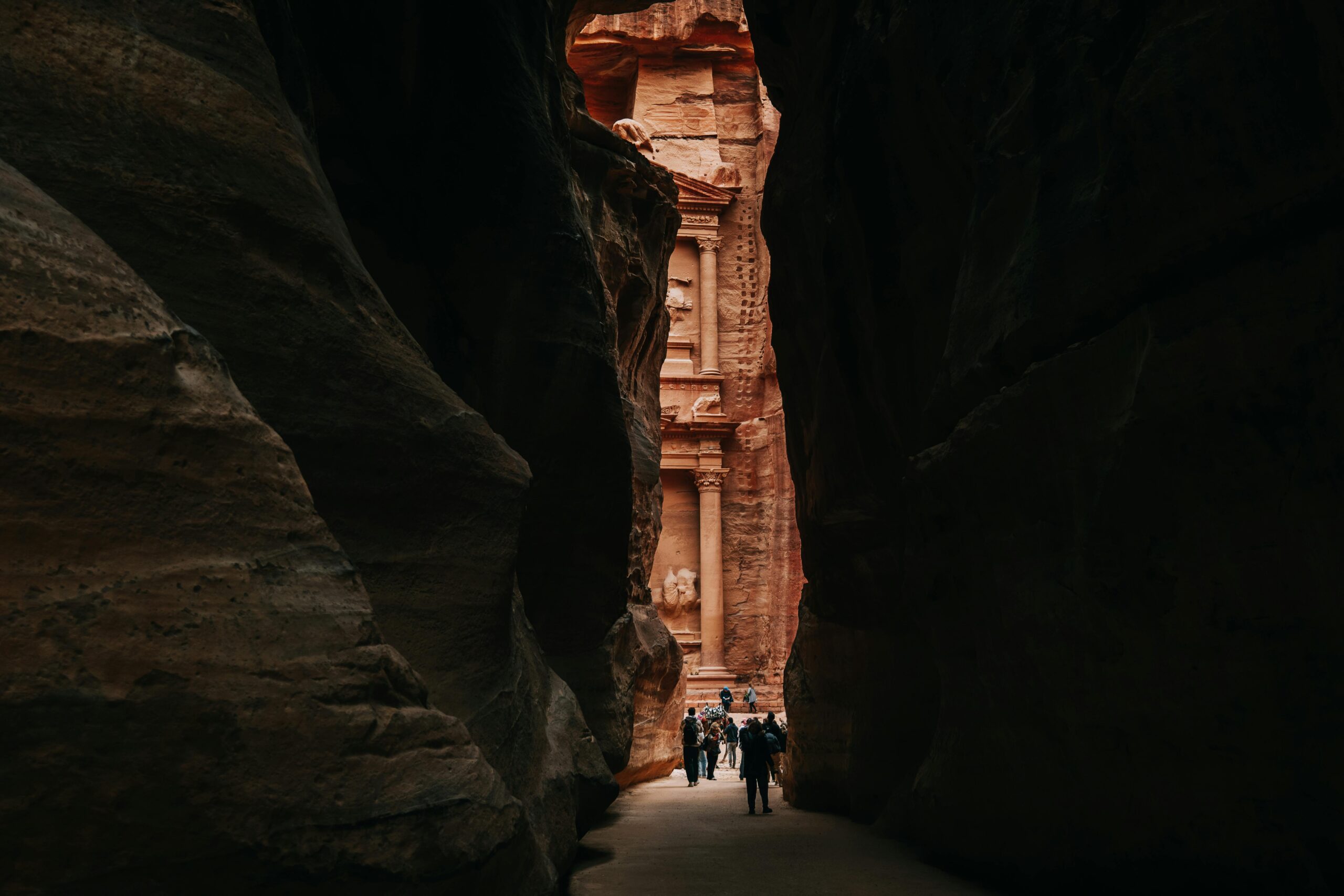
You walk through the Siq — a 1.2km canyon of sandstone narrowing to 3 metres — and at the end the crack opens and the Treasury appears: a 40-metre carved facade in rose-red stone, two storeys of columns and pediments and urns, impossibly intact after 2,000 years. The photograph you’ve seen is that. Exactly.
What the photograph doesn’t show: you walk out of the Siq and there are 500 other people also photographing the Treasury, and the camel handlers want you to ride a camel, and the postcard sellers have appeared, and the tour guide is speaking at full volume fifteen metres away.
This is Petra at 10am on a Tuesday in March. Real, present, overwhelming in the crowd sense as well as the monument sense.
Petra at 6am — when the site opens and the only people there are the rangers, a handful of early risers from the on-site lodges, and the Bedouin families setting up their stalls — is a different place. The same Treasury, the same sandstone, the same 2,000 years. But in the silence, with the morning light coming through the Siq, the specific quality of the moment when the crack opens and the facade appears is available unmediated.
This guide is about getting the unmediated version. It is also about the Monastery, which requires 850 steps and which most visitors don’t reach. And the Street of Facades, and the High Place of Sacrifice, and the colours in the rock, and Little Petra, and what the Nabataeans who built this actually were.
Quick Navigation
- Who Built Petra — The Nabataeans
- When to Go
- Getting There — Aqaba, Amman, and the Jordan Pass
- Where to Stay — Inside and Outside the Gates
- The 6am Strategy — The Only Way to See the Treasury
- The Siq — The Approach
- The Treasury (Al-Khazneh)
- The Street of Facades and the Royal Tombs
- The Colonnaded Street and the Great Temple
- The High Place of Sacrifice
- The Monastery (Al-Deir) — The One Worth 850 Steps
- The Colours — What the Rock Actually Does
- Little Petra — The Underrated Option
- Petra by Night
- The Bedouin of Petra
- What It Costs — The Jordan Pass Calculation
- Eating at Petra
- Practical Notes
- The 2-Day Itinerary
Who Built Petra — The Nabataeans
The Nabataeans were an Arab trading people who controlled the frankincense and spice routes between the Arabian Peninsula, Egypt, and the Mediterranean from approximately the 4th century BCE to the 1st century CE. Their capital — Petra, in what is now southern Jordan — was the trading hub at the crossroads of these routes.
The Nabataean achievement that most visitors don’t register: Petra is not a collection of carved tombs. It is a complete city — temples, markets, colonnaded streets, residential quarters, a theatre seating 7,000, and an extraordinarily sophisticated water management system that channelled flash flood water from the surrounding mountains through ceramic pipes and cisterns to supply a city of 20,000-30,000 people in a desert canyon.
The carved facades — the Treasury, the Monastery, the Royal Tombs — are the tomb fronts of the Nabataean royal family and elite merchants. The city itself was largely built of conventional construction that hasn’t survived as dramatically as the carved stone. What you’re seeing is the monumental periphery of a complete urban civilisation, the non-carved centre mostly gone.
The Nabataean script became the direct ancestor of the Arabic script used today — Nabataean is the typographic parent of every Arabic letter in every Arabic text in the world.
The Romans absorbed Petra in 106 CE, the Nabataean kingdom becoming the province of Arabia Petraea. The city continued under Roman administration, the colonnaded street and the great temple dating from this period. The earthquake of 363 CE and the subsequent loss of the spice trade routes led to gradual abandonment; the city was largely unknown to the outside world from the 7th century until the Swiss explorer Johann Ludwig Burckhardt rediscovered it in 1812.
When to Go
March to May and September to November — The Best Windows
Spring: the wildflowers in the surrounding desert, comfortable walking temperatures (18-25°C), the rock colours most vivid in the soft spring light. The Petra site at its most enjoyable for the multi-hour walking required to reach the Monastery and the High Place.
Autumn: the heat has broken, the tourist density reducing from summer peak. October is the finest single month — warm, clear, manageable crowds.
June to August — Hot
35-42°C in the Petra basin. The walk to the Monastery (850 steps in direct sun) becomes genuinely strenuous and potentially dangerous without careful water management. The site opens at 6am — doing the Monastery before 10am in summer is the only safe approach.
December to February — Cool and Quiet
10-18°C, occasional rain, the site at its least crowded. The site can be atmospheric in the winter quiet; the occasional rainy day produces the specific experience of Petra in a flash flood (the water rushing through the Siq, the drainage channels filling — the Nabataean water system becomes legible). Snow on the surrounding mountains is rare but has happened.
The BGGD recommendation: March or October, without hesitation. Both give manageable temperatures, good light, and a visitor-to-site ratio that allows the Treasury’s first appearance to land.
Getting There — Aqaba, Amman, and the Jordan Pass
From Aqaba (the south):
The closest major city to Petra — 130km north, 2 hours by car. Aqaba receives direct charter flights from UK airports in summer (Jet2, TUI) and is connected to Amman by Air Arabia and Royal Jordanian (1 hour). From Aqaba, shared taxis and minibuses go to Wadi Musa (the town adjacent to Petra) throughout the day.
From Amman (the north):
The capital, connected to London by Royal Jordanian direct (5 hours) and by Emirates, Qatar, and Turkish Airlines via their hubs. The JETT bus from Amman South Bus Station to Wadi Musa: 3 hours, 11 JOD / £11.60, one departure daily at 6:30am. Private taxi: £55-70 negotiated.
From Wadi Rum (southeast):
The natural combination — Wadi Rum desert camp the night before or after Petra. Shared taxi from Wadi Rum to Wadi Musa: 1.5 hours, £15-20 negotiated.
The Jordan Pass:
Non-negotiable for UK visitors doing a full Jordan circuit. The Jordan Pass (jordanpass.jo) covers: the Jordanian tourist visa ($40 / £32 — saved immediately), the Petra entry for 1, 2, or 3 consecutive days, and free or discounted entry to 40+ other Jordanian sites. The 2-day Petra version costs $75 / £60. The calculation: visa ($40) + 2-day Petra entry ($55) = $95 / £76 without the pass, vs $75 / £60 with it. Always buy the Jordan Pass.
Where to Stay — Inside and Outside the Gates
Wadi Musa:
The town adjacent to the Petra visitor centre — the standard base, with everything from £10/night budget hostels to £90/night mid-range hotels. The advantage: walking distance to the gate, the restaurants and shops of the town accessible.
Recommended: Rocky Mountain Hotel (mid-range, pool, the highest rated consistently in the mid-range bracket). Petra Guest House (the closest hotel to the gate, literally attached to the entrance — the bar is carved into a cave that is itself a Nabataean tomb).
Inside Petra — The Petra Guest House Cave Bar:
Not accommodation within the site — the closest you can get is the Petra Guest House hotel, whose bar occupies the Nabataean tomb of Triclinium. Drinking a beer inside a 2,000-year-old tomb while outside is the city of Petra is a specific Wadi Musa experience.
The lodges inside the site:
The Seven Wonders Bedouin Camp operates within the Petra archaeological zone — staying inside the site gives the 5am access advantage (walking to the Treasury before the gates open for day visitors). Access to this requires booking directly.
The 6am Strategy — The Only Way to See the Treasury
The Petra site opens at 6am. The first tour buses from Aqaba (2 hours) and Amman (3 hours) arrive between 8:30 and 9:30am. The window between 6am and 9am is the window.
The 6am walk:
The site at 6am is occupied by: the Bedouin families who live within the archaeological zone and are setting up their stalls, the site rangers making their morning circuit, and a small number of visitors who have read this or an equivalent guide and set their alarms accordingly.
The Siq at 6am: the light comes from above (the canyon is too narrow for direct sunrise light at the floor level) but the quality of the early morning — the stillness, the specific pink of the sandstone in the pre-direct-light period — is distinct from any later hour.
The Treasury at 6:15am: the facade catching whatever light exists, the camel handlers (the camels not yet saddled), the postcard sellers not yet present. The specific experience of walking out of the Siq and having the Treasury in relative quiet — perhaps 30-40 people, some of them also quiet in the presence of something extraordinary.
Photograph it. Sit with it. The tour buses arrive at 9am and the Treasury becomes a different place. Leave before they arrive or accept that it will be shared.
The Siq — The Approach
The Siq is the 1.2km canyon approach to Petra — a natural geological formation (a fault line in the Jebel al-Madhbah mountain, later widened by the Nabataeans for processional access) that narrows from 12 metres to 3 metres at the narrowest point.
The walls: the Nabataean water channels (ceramic pipes embedded in the wall, carrying water from the Ain Braq spring — one side bringing in fresh water, one side carrying waste water out, the two systems never mixing) run at eye level for much of the Siq. The votive niches (small carved recesses housing Nabataean deity figures), the camel caravan inscription visible on the right wall 200 metres in, and the specific swirling colours of the sandstone — iron oxide (red), manganese (purple), silica (white) — make the Siq itself a significant archaeological site, not merely an approach.
The narrowest point (3 metres) comes 200 metres before the exit. The Nabataean processional dam (visible above the left wall at the Siq entrance — the dam that controlled flood water entering the canyon) and the Bab al-Siq triclinium (a carved dining chamber at the entrance, flanked by two obelisk tombs) bracket the approach.
The Siq takes 20 minutes to walk at a moderate pace without stopping. At 6am: 40 minutes because you will stop.
The Treasury (Al-Khazneh)
The Treasury is not a treasury. The name — Al-Khazneh — was given by the local Bedouin who believed the large stone urn at the top of the second storey (visible from below, the surface marked by Bedouin rifle fire over centuries from people who believed it contained hidden gold) stored the treasure of an Egyptian pharaoh. The urn is solid stone.
The building is a tomb — almost certainly the mausoleum of the Nabataean King Aretas IV (reigned 9 BCE to 40 CE), based on stylistic dating. The facade is 39 metres wide and 40 metres high, carved from a single rock face. The style: a synthesis of Nabataean, Egyptian, Greek, and Roman architectural elements that reflects the Nabataean position at the intersection of the Mediterranean and Arabian worlds.
The interior:
A single large chamber, undecorated (the Nabataeans didn’t fresco their tombs — the exterior was the statement). Access to the interior was restricted for many years due to floor excavation; check current access. The chamber is tomb-sized and tomb-dark — the carved exterior is more significant than the interior.
The high viewpoint:
Above and to the left of the Treasury (take the path that climbs from the right side of the Siq exit) — a rocky viewpoint above the Treasury gives the full facade from above and slightly to the right, the Siq entrance visible behind it. This view (used in Indiana Jones and the Last Crusade) requires a 10-minute climb on an unmarked path. Worth every step.
The Street of Facades and the Royal Tombs
Beyond the Treasury, the Outer Siq opens into a wider canyon — the Street of Facades (a row of carved tomb fronts from the 1st century BCE to 1st century CE, the facades less elaborate than the Treasury but giving a sense of the density of Nabataean funerary carving) and, further along, the Royal Tombs.
The Royal Tombs:
Four large tomb complexes on the eastern cliff face — the Urn Tomb (the largest, the interior used as a Byzantine church in 447 CE, the columns added at that point still visible), the Silk Tomb (the most vivid colour in the rock face, the swirling maroon, cream, and blue-grey of the sandstone most concentrated here), the Corinthian Tomb (modelled on the Treasury but less well-preserved), and the Palace Tomb (the widest facade in Petra, four storeys).
The Royal Tombs in the afternoon light (3-5pm) when the sun is to the west and the rock face is directly lit: the colours are at their most saturated. The Silk Tomb specifically: a natural canvas of mineral colour that justifies the name.
The Colonnaded Street and the Great Temple
The main street of Roman Petra — a colonnaded limestone street from the 2nd century CE, the column bases still standing in a continuous row along the valley floor. The Great Temple (a Nabataean religious complex of extraordinary scale — 7,000 square metres, the largest structure in Petra, still being excavated by Brown University archaeologists) south of the street. The Qasr al-Bint (the Temple of Dushara — the primary Nabataean deity, the only freestanding building in Petra surviving to significant height, the 23-metre walls still intact).
This section of Petra — beyond the Treasury and the Street of Facades — is where the architecture of the living city is most evident, and where most day visitors have run out of time and energy before reaching.
The High Place of Sacrifice
The most accessible mountain route in Petra — a 45-minute ascent from the Outer Siq (take the path between the obelisks) to the High Place of Sacrifice on the summit of Jebel al-Madhbah.
The summit: a Nabataean outdoor altar (two altars carved into the rock, a drainage channel for sacrificial blood, and the specific exposure of a mountain plateau above the city), and the finest view of Petra’s full urban layout — the Royal Tombs, the colonnaded street, the Great Temple, and the valley continuing south toward the Monastery.
The descent via the Wadi Farasa (the long descent route that passes the Garden Tomb, the Roman Soldier Tomb, and the Triclinium): 1.5 hours down a different valley, arriving at the colonnaded street from the south. This circuit (up via the obelisks, down via Wadi Farasa) gives 3-4 hours of the best Petra hiking available.
The Monastery (Al-Deir) — The One Worth 850 Steps
The Monastery is larger than the Treasury — 47 metres wide, 48 metres high, a single massive facade with a central doorway leading to a single large chamber. Built in the 3rd century CE as a tomb, later used as a Christian chapel (the crosses carved into the walls are Byzantine, not Nabataean).
The 850 steps:
From the Petra basin (near the Qasr al-Bint), the path to the Monastery climbs 800 metres horizontally and 200 metres vertically through a series of rock-cut stairs. The climb takes 45 minutes to 1 hour at a moderate pace. The steps are wide and not particularly steep — the challenge is the sustained ascent in sun and the altitude gain.
What most visitors do: Turn back at the colonnaded street, never starting the climb. On a typical day with 3,000 visitors at the Treasury, 400 reach the Monastery.
What the 400 find:
A facade significantly larger than the Treasury in a valley that is entirely private — the Wadi Deir, accessible only by the single path. A tea stall run by a Bedouin family at the summit plateau (the cold soft drink at the top of 850 steps in the Jordanian sun is one of the finest £1.50 transactions in travel). The view from the viewpoint above the Monastery (15 minutes further, a barely-marked path to the left of the facade): the Wadi Araba desert stretching south toward Saudi Arabia, the outline of the Sinai visible on clear days.
The timing:
Leave the Petra basin by 9am for the Monastery. Arrive at the summit by 10am. The 2 hours before the midday heat begins are the correct window. Return to the basin by noon for lunch, then the Royal Tombs in the afternoon light.
Do not skip the Monastery. It is the finest single thing in Petra.
The Colours — What the Rock Actually Does
The sandstone of Petra contains iron oxide (producing the reds and oranges), manganese oxide (purple and blue-grey), silica (white and cream), and combinations of all three in every proportion. The geological process that deposited these minerals worked in irregular horizontal bands — the result is stone that swirls with colour in ways that look painted but are entirely natural.
The specific colours visible at different sites:
The Siq: predominantly red-orange with white bands. The Treasury: paler, the iron content lower in this section. The Silk Tomb: the most colour-saturated surface in Petra — the maroon, cream, and blue-grey swirling in the same square metre of rock face. The Monastery: similar in palette to the Treasury, the larger scale giving more of each colour.
The Petra map available at the visitor centre marks the “Rainbow Rock” — a specific boulder near the Petra basin where the full range of the sandstone colours is most concentrated. Not significant archaeologically; the finest single object for understanding what the sandstone does.
Little Petra — The Underrated Option
Siq al-Barid (“the cold canyon”) — 8km north of Petra, accessible by car from Wadi Musa — is a miniature version of the full site: a narrow canyon, carved Nabataean facades, a painted triclinium (the only Nabataean painted interior in the region, the floral fresco partially intact), and the whole thing free of charge and almost entirely free of visitors.
Little Petra was the Nabataean caravanserai — the staging post where the merchant caravans stopped before entering the main city. The facades are smaller, the canyon shorter, and the painted room gives the only glimpse of Nabataean interior decoration available at the site.
Free entry. No more than 50 visitors on a busy day.
The correct use: visit Little Petra on the way to or from Wadi Rum, or as an afternoon extension from Wadi Musa. The 30-minute walk through the canyon in the afternoon light, with almost no other visitors, gives Petra in miniature without the site management.
Petra by Night
Three evenings per week (Monday, Wednesday, Thursday — check current schedule at visitpetra.jo), the Siq and the Treasury are lit by 1,500 candles for a 2-hour evening experience.
The honest assessment:
The candle-lit Siq is genuinely beautiful — the sandstone walls in candlelight, the flickering shadows, the quiet. The Treasury at the end, lit entirely by candles, is one of the finest visual experiences in Jordan.
The event also includes a Jordanian music performance at the Treasury and ends with Bedouin tea. The crowd for this specific event is smaller than the daytime crowd. Cost: 17 JOD / £18 (separate from the main site entry).
Go on the Wednesday (midweek, smallest crowd) if visiting in peak season.
The Bedouin of Petra
The Bdoul Bedouin (a sub-tribe of the larger Bedouin community) have been the traditional inhabitants of Petra for centuries — living in the caves and carved chambers of the city, maintaining their community in a landscape they consider their ancestral home.
In 1985, when Petra was designated a UNESCO World Heritage Site, the Jordanian government relocated the Bdoul community to the village of Umm Sayhoun (built specifically for them, 3km from the site). The relocation was contentious — conducted without full community consent and resulting in the loss of the Bdoul’s connection to their specific landscape.
The Bdoul who remain associated with the site work as guides, horse handlers, and stall operators within the archaeological zone. The horse handlers at the Siq entrance, the donkey operators at the colonnaded street, and the tea stall at the Monastery summit are all Bdoul community members for whom this represents the primary income from the city their ancestors carved.
The relevant decision: The donkey and horse rides within Petra are a persistent ethical question. The animal welfare record of the site’s working animals has been poor historically; the SPCA Jordan monitors conditions and has worked with the Petra authorities on welfare standards that are still inconsistently applied. If you choose to ride (the horse to the Siq entrance is particularly marketed), assess the animal’s condition before deciding. Walking is always possible and preferable from an animal welfare perspective.
What It Costs — The Jordan Pass Calculation
The Jordan Pass is mandatory: As described above, the Jordan Pass ($75 for 2-day Petra access) covers the visa cost, saving money immediately. Buy at jordanpass.jo before departure.
Site Costs
| Item | Cost |
|---|---|
| Jordan Pass (2-day Petra) | $75 / £60 |
| Petra by Night (optional) | 17 JOD / £18 |
| Little Petra | Free |
| Horse to Siq entrance (optional) | 10 JOD / £11 |
| Donkey to High Place (optional) | 20 JOD / £21 |
What 2 Days at Petra Costs from the UK (Combined with Jordan)
| Category | Budget | Mid-Range |
|---|---|---|
| Return flights to Amman (Royal Jordanian direct) | £200–420 | £250–500 |
| Jordan Pass (2-day Petra, visa included) | £60 | £60 |
| 2 nights Wadi Musa accommodation | £25–55 | £80–160 |
| Food (2 days at Petra) | £18–28 | £35–55 |
| Transport (Petra→Wadi Rum or Amman) | £20–35 | £30–50 |
| Petra section total | £123–178 | £205–325 |
Eating at Petra
The Basin Restaurant:
Inside the Petra site, at the colonnaded street level — a buffet lunch that is the only sit-down dining option within the site. Expensive by Jordanian standards (20-25 JOD / £21-26 per person) but solves the problem of what to eat at 1pm after the Monastery when the walk back to Wadi Musa seems daunting. The food is standard Jordanian: mansaf (the Jordanian national dish — lamb on rice with dried yoghurt sauce), mezze, grilled meats. The location (inside Petra, shade provided) justifies the price.
The Monastery summit tea stall:
A Bedouin family selling cold water, Pepsi, and tea at the top of 850 steps. A bottle of cold water at the summit of a desert mountain climb costs 2 JOD / £2.10. Worth every penny.
Wadi Musa town:
The restaurants of the main street (most serving standard tourist Jordanian food) and the Al-Qantarah restaurant (the most consistently recommended in Wadi Musa, traditional Jordanian, mansaf prepared correctly). The local falafel stalls in the market area below the main tourist street: breakfast falafel in pita, 0.50 JOD / £0.53.
Practical Notes
Jordan Pass: Buy before departure at jordanpass.jo. Covers visa and Petra entry. Without it you pay separately: $40 entry visa + $55 one-day or $65 two-day Petra entry. The pass always saves money.
Site opening hours: 6am to 6pm (summer), 6am to 4pm (winter). The 6am opening is the critical timing.
What to bring: Water (2 litres minimum for a full day, 3+ litres in summer), sun protection, comfortable hiking shoes (the paths are rocky), a headscarf or hat. The site has no shade for most routes.
Photography: No restrictions on photography within the site. Flash photography in the painted triclinium of Little Petra is discouraged by the site managers (the light damages the fresco).
Language: Arabic. English is spoken by all guides and most visitor-facing workers within the site. “Shukran” (thank you), “La shukran” (no thank you — essential for declining the horse ride offers at the Siq entrance).
Guides: Official licensed guides available at the visitor centre (25-40 JOD / £26-42 for a half-day). Worth hiring for the first day to get the Nabataean context; the second day independently gives the freedom to set your own pace for the Monastery.
The 2-Day Itinerary
Day 1: The Treasury, High Place, and Royal Tombs
5:50am: at the gate. Enter at 6am.
The Siq (20-40 minutes). The Treasury. Photograph. Sit. Leave before 9am.
Continue into the Outer Siq. Street of Facades. Path up to the High Place of Sacrifice (45 minutes). Summit: the Nabataean altars and the panorama.
Descend via Wadi Farasa (1.5 hours) — past the Garden Tomb and the Roman Soldier Tomb and the Triclinium. Emerge at the colonnaded street.
Lunch at the Basin Restaurant or return to Wadi Musa.
Afternoon (3pm): return to the site for the Royal Tombs in the afternoon light. The Silk Tomb specifically. The Urn Tomb interior (if open). Return by sunset.
Evening: Petra by Night (if Monday, Wednesday, or Thursday).
Day 2: The Monastery
6am: enter (the gate is quieter on day two, when the day-trip crowds have moved on).
Walk directly through the Siq and the Treasury without stopping (you’ve seen them; the morning light is already good; the Monastery is 1 hour from the Treasury at a walking pace through the colonnaded street section).
Begin the Monastery climb at 8am. Summit by 9am.
The Monastery for 30 minutes. The viewpoint above the Monastery (15 minutes further, the Wadi Araba view). Cold drink at the Bedouin stall.
Descent: 45 minutes. Colonnaded street, Qasr al-Bint. Afternoon: Little Petra (8km north by car, 30-minute canyon walk, almost entirely alone).
Return Wadi Musa. Departure.
Final Thought
I was at the Treasury at 6:18am. A ranger was sitting on a rock to one side, drinking tea. Three other visitors were standing at different distances from the facade, all silent.
The light in the Siq behind me was changing — the top of the walls beginning to catch direct sun, the lower walls still in shadow. The Treasury facade, carved from a single rock face, was in the direct light of the rising sun.
I have seen the Treasury in photographs approximately 10,000 times. The specific experience of standing in front of it in the early morning, with the sound of the site waking up around me and the cold of the canyon still present, and understanding viscerally that 2,000 years ago a person stood where I was standing and chose this specific rock face and carved it by hand into this specific thing — that experience is not in the photographs.
The photographs are accurate. The photographs are not sufficient.
Go at 6am. See it for yourself.
Question about Petra this guide doesn’t cover? Drop it in the comments.