
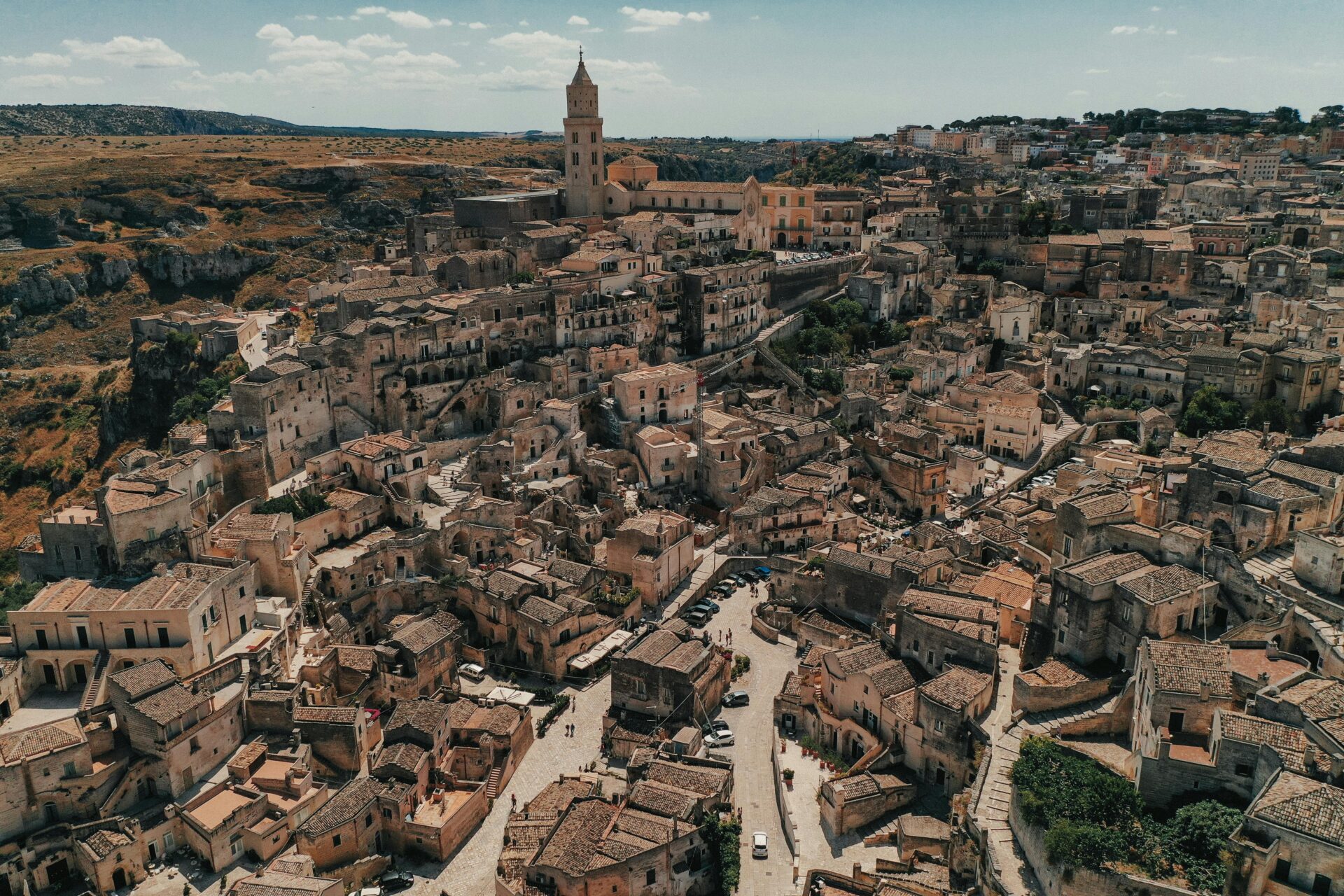
The sassi — the ancient cave neighbourhoods carved into a canyon in the heel of Italy’s boot — were called a national disgrace in 1952 and are now a UNESCO World Heritage Site and European Capital of Culture. The cave churches with Byzantine frescoes that nobody visits, the house-museums that show what living in a cave actually looked like, the rooftop view over the gorge at dusk, the bread baked in the same wood-fired ovens for 700 years, and why Matera is the most genuinely surprising city in Italy.
Reading time: 12 minutes | Last updated: 2026
In 1952, the Italian Prime Minister stood in Matera’s Sasso Caveoso and called it a national disgrace. The sassi — cave dwellings carved from the limestone canyon walls, inhabited continuously for at least 9,000 years — housed 15,000 people in conditions of extreme poverty. No running water. No sewage. Families, livestock, and insects sharing the same carved chambers. A child mortality rate so high that the writer Carlo Levi used it as evidence that the Italian state had abandoned the south entirely.
Between 1952 and 1967 the entire population was forcibly relocated to modern housing on the plateau above. The caves were sealed.
Then came the reassessment. UNESCO designated the sassi a World Heritage Site in 1993. Restoration began. Cave hotels arrived. In 2019, Matera was a European Capital of Culture.
The same neighbourhood declared a disgrace now contains hotels charging £200 a night. The transformation is extraordinary, somewhat ironic, and entirely worth a 2-day visit from anyone within reach of Bari airport.
Quick Navigation
- Understanding the Sassi
- When to Go
- Getting There
- The Sasso Caveoso — Where to Start
- The Cave Churches
- The House-Museums
- The Palombaro Lungo — Underground Cistern
- The Murgia Plateau — The View from the Other Side
- The Cathedral and the Piano
- The Bread of Matera
- Hidden Matera
- Where to Stay — Cave Hotels Honestly Assessed
- What It Costs
- Eating in Matera
- Practical Notes
- The 2-Day Itinerary
Understanding the Sassi
The sassi divide into two neighbourhoods separated by the Civita — the oldest rock spur, the historic centre, the cathedral location.
Sasso Barisano (north): More developed, more restored, more visited. The cave hotels concentrate here. The main tourist routes run through it.
Sasso Caveoso (south): Less developed, more atmospheric, deeper into the canyon. The finest cave churches. The most dramatic views across the Gravina gorge.
The correct approach: start in Sasso Caveoso (most immersive), cross the Civita, end in Sasso Barisano (best sunset views and restaurants).
The wider context: the sassi are not primarily tombs or curiosities. They are a complete urban system — cave dwellings combined with constructed limestone rooms, private cisterns under every floor, drainage channels carved into the lanes, churches carved into the cliff faces at every level. The whole city grew from the rock rather than being built upon it.
When to Go
May and late September — The Best Windows
Spring gives wildflowers on the Murgia plateau, the low sun turning the limestone gold in the morning, and visitor density well below summer peak. October brings the harvest atmosphere and the finest autumn light in southern Italy.
July and August — Peak Season
Hot (32-38°C), expensive, and crowded. The evening atmosphere is good; the midday hours in the exposed sassi are uncomfortable.
November to March — Quiet
The cave churches accessible with almost no other visitors. Occasional morning fog lying in the canyon is one of the finest atmospheric conditions available in Matera. Some restaurants close, some cave hotels reduce their schedules.
The BGGD recommendation: May. The bread bakeries are at peak production, the canyon flowers are out, and the sassi receive a fraction of August’s visitors.
Getting There
Matera has no connection to the national rail network and no airport. This preserves its character and requires planning.
From Bari (nearest hub): FAL narrow-gauge train from Bari Centrale to Matera Sud (1.5 hours, £5, runs every 2 hours). Or direct bus (1 hour, £4). Bari is served by Ryanair direct from multiple UK airports (return flights: £40-120). The natural approach is fly Bari, train to Matera, continue south through Puglia.
From Naples: Flixbus direct (3.5-4 hours, £12-20).
From Rome: Flixbus from Tiburtina (4.5 hours, £15-25).
The Sasso Caveoso — Where to Start
Enter from the Via Buozzi viewpoint — the first view of the full canyon from above, the cave facades descending in tiers to the gorge floor, the Murgia Plateau visible across the canyon with its own rock-cut churches on the opposite face.
Then descend into it.
The neighbourhood navigates by steep lanes, carved stairways, and paths cut from the same limestone as the caves. The specific quality: there is no clear boundary between natural rock and human construction. The cave facades, the steps, the lane walls, and the rock outcroppings are all the same material. The city grew from the landscape.
The canyon walls show 9,000 years of stratigraphy — every generation carved downward into the rock, the newest layers over the oldest, the whole stack visible in cross-section where erosion has cut through.
The Cave Churches
Matera contains approximately 150 rock-cut churches — Byzantine monastic churches carved into the canyon walls from the 7th to 13th centuries, when monks fleeing iconoclasm in the east established communities throughout the limestone landscapes of southern Italy.
Most receive very few visitors. This is the specific opportunity of the Matera cave churches.
Santa Maria de Idris: On the rock spur of Monte Errone, the facade visible across the Sasso Caveoso — Byzantine frescoes from the 13th-14th centuries, the view from the rock above the church the finest panorama over the neighbourhood. Entry: £3.
Santa Lucia alle Malve: The first Benedictine women’s convent in Matera — the most complete Byzantine fresco programme in the sassi, the colours (blue, gold, terracotta) vivid after recent restoration. Entry: £3.
Madonna de Virtù and San Nicola dei Greci: A two-level cave church complex — the lower church from the 9th-11th centuries, the upper from the 12th. The most dramatic interior space in the Matera church circuit. Combined entry: £5.
The Crypt of the Original Sin (Cripta del Peccato Originale): 12km from Matera by car — an 8th-century cave church discovered in 1963 with the oldest surviving fresco cycle in the region. Called the “Sistine Chapel of the rupestrian churches.” Guided visit only, book in advance at cripta.it. Entry: £8. Non-negotiably worth the detour.
The House-Museums
The house-museum concept in Matera is one of the finest interpretive approaches to social history in Italy — a furnished cave dwelling presented exactly as it was inhabited in the 1940s-50s, with the specific objects of a peasant family: ceramic pots, religious icons, straw mattresses, agricultural tools.
Casa Noha: FIA (Italian national heritage trust) presentation of sassi life — a film installation projecting former cave dwellers’ stories against the cave walls. Entry: £4.
Musma — Museum of Contemporary Sculpture: Contemporary sculpture installed within the cave rooms and carved cisterns of the 16th-century Palazzo Pomarici. One of the finest contemporary art installations in southern Italy, the 21st-century works in genuine dialogue with their thousand-year-old setting. Entry: £6.
The Palombaro Lungo — Underground Cistern
Beneath Piazza Vittorio Veneto (the main square on the upper plateau) — a vast underground cistern carved from the limestone in the 16th century and expanded continuously. Capacity: 5 million litres. Structure: 15 metres deep, 50 metres long, arched limestone ceiling on carved pillars.
Discovered in 1991 when a section of the piazza subsided — Matera sits on a limestone plateau that is itself extensively hollow, the underground infrastructure of cisterns, passages, and cave rooms extending beneath the entire upper city.
Guided tours from the piazza: £4, 30 minutes. Essential context for understanding how 15,000 people managed water in a landscape with no surface rivers.
The Murgia Plateau — The View from the Other Side
Across the Gravina canyon — accessible by car (15 minutes) or a 3-hour circular walk. The view from the Murgia plateau back toward Matera: the full sassi in cross-section, the cave facades in tiers from the canyon floor to the cathedral on the Civita above, the modern city on the plateau behind.
At dawn with mist in the gorge: the finest version of this view. This is the image all the drone photographs use, and the drone photographs are accurate.
The Murgia plateau churches: On the canyon walls of the Murgia side — rock-cut Byzantine churches receiving fewer than 100 visitors per year. The Madonna della Palomba and the Cristo la Selva are the most significant. Accessible with a local trekking guide (operators available through the Matera tourist office).
The Cathedral and the Piano
The Cathedral of the Madonna della Bruna (1268-1270) stands at the peak of the Civita — Apulian Romanesque, the bell tower visible from the opposite canyon wall. The interior contains the 16th-century fresco of the Last Judgement (the largest surviving fresco in Basilicata) and the Byzantine Madonna della Bruna icon, object of Matera’s most significant festival (the Festa della Bruna, July 2nd — the icon processed through the city on a papier-mâché float then ritually destroyed by the crowd, a tradition whose specific violence has been documented since the 15th century).
The Piano (upper plateau): The Baroque and Renaissance buildings of the prosperous Materan bourgeoisie, who built their palazzi above while the poor inhabited the cave below. Piazza Vittorio Veneto, Via Ridola, the Church of San Francesco d’Assisi (built over a cave church complex, the original cave visible in the crypt).
The Bread of Matera
Pane di Matera — Protected Geographical Indication since 2008. Made from semola rimacinata (re-milled durum wheat semolina), leavened with natural sourdough starter maintained continuously by the city’s bakeries, baked in wood-fired stone ovens.
The result: a hard dark crust, dense yellow crumb, strong wheat flavour, shelf life of 7-10 days (a practical characteristic developed for a peasant economy where bread was baked once a week).
The bakeries start at 5am. The wood-fired smell reaches the sassi from 6am.
Forno Cice (Via Fiorentini) — operating since 1900, the oldest continuously operating bakery in Matera. A 500g loaf at 7am: £2. With local ricotta and the Lucanica sausage: sufficient.
Hidden Matera
Matera Archaeological Museum (Musma Ridola): The finest museum in Basilicata — prehistoric and classical archaeology of the Matera area, including Neolithic and Bronze Age settlements of the Murgia that predate the sassi and extend the occupation timeline to 9,000 years. The Magna Graecia ceramic collection is among the finest in southern Italy. Entry: £3.
Soğanlı comparison: The cave churches on the Murgia plateau receive roughly the same number of visitors as the Soğanlı Valley in Cappadocia — i.e. almost none. The quality of the frescoes is comparable to the Göreme Open-Air Museum. The access is more difficult. The experience for the visitor who makes the effort is more rewarding.
Where to Stay — Cave Hotels Honestly Assessed
The cave hotel is the defining Matera accommodation. The finest conversions use the natural irregularity of the carved space — the alcoves, the curved walls, the stone pillars — as architectural features. The worst are caves that have been over-restored into something indistinguishable from a standard hotel room that happens to have stone walls.
Budget (£30-50/night): Locanda di San Martino (basic cave rooms, good location, reliable breakfast).
Mid-range (£80-140/night): Corte San Pietro (terraces overlooking the Sasso Caveoso, the most consistently recommended mid-range cave hotel). Palazzo Gattini (cave room option in a renovated noble palace).
Splurge (£180-350/night): Sextantio Le Grotte della Civita (the original Matera cave hotel, the restoration philosophy of maintaining the cave as found — only the minimum necessary infrastructure added, no fake antiques, no theatrical lighting). Aquatio Cave Luxury Hotel (infinity pool overlooking the full sassi — the most photographed hotel image in southern Italy).
What It Costs
What 2 Days in Matera Costs from the UK
| Category | Budget | Mid-Range |
|---|---|---|
| Return flights (Bari, Ryanair) | £40–120 | £60–150 |
| Bus/train Bari to Matera (return) | £10 | £10 |
| 2 nights accommodation | £55–85 | £175–290 |
| Food (2 days) | £32–50 | £60–90 |
| Cave churches and museums | £20–30 | £25–35 |
| Palombaro Lungo | £4 | £4 |
| Total | £161–299 | £334–579 |
Eating in Matera
Crapiata: The ancient peasant soup of Matera — chickpeas, broad beans, lentils, barley, and wheat cooked slowly with onion, tomato, and olive oil. The feast-day food of the sassi, now available year-round at traditional restaurants. £6-9.
Lucanica: The cured pork sausage of Basilicata — smoked, spiced with wild fennel and peperoncino, aged in the mountain air. The Romans recorded it so enthusiastically that their legions brought the recipe back from the region (the word “lucanica” appears in Apicius). On a board with bread and caciocavallo: the correct aperitivo in Matera.
Caciocavallo Podolico: Semi-hard cheese from Podolico cattle grazing the Murgia on wild herbs. The flavour is intensely herbal from the milk. Aged 6-12 months, the shape of a gourd (the name means “cheese on horseback” from the traditional aging method). Available at cheese shops on Via del Corso.
Practical Notes
Getting there: Fly to Bari. FAL train or bus to Matera (1-1.5 hours). No direct international access.
Currency: Euro. Cards widely accepted. Cash useful at smaller churches and bakeries.
Shoes: The sassi streets are steep, cobbled, and uneven. Comfortable walking shoes with grip are non-negotiable.
Cave church access: Most open 9am-7pm (shorter in winter). The Crypt of Original Sin requires advance booking at cripta.it.
The 2-Day Itinerary
Day 1: Sasso Caveoso, Cave Churches, Cistern
7am: Forno Cice for bread. Sasso Caveoso viewpoint and descent. Santa Maria de Idris, Santa Lucia alle Malve, Madonna de Virtù. Optional canyon descent to the Gravina floor (1.5 hours return). Lunch at Ristorante Baccanti. Afternoon: Palombaro Lungo cistern tour, Casa Noha house-museum, Cathedral. Sunset from the Sasso Barisano rooftop terrace.
Day 2: Murgia, Rock Churches, Departure
6:30am: Murgia Plateau for dawn view across the gorge. Morning: Cripta del Peccato Originale (12km, taxi — book the day before). Return to Matera by noon. Afternoon: Musma sculpture museum, Archaeological Museum Ridola, Piano walk. Departure transfer to Bari.
Final Thought
I was in the Sasso Caveoso at 6:30am. A woman was hanging washing across her cave doorway — carved limestone arch, iron handle, ordinary shirts and a towel. The canyon fell away below her doorstep. The Murgia Plateau across the gorge was catching the first light.
She hung the last shirt, looked at me in the lane with a camera, said something in the Materan dialect I didn’t understand, and went inside.
People live here now. Not 15,000 — perhaps 1,000 in the restored cave dwellings. But the woman hanging her washing in a cave doorway above a 150-metre gorge, at 6:30am on a May morning, is performing the same act that women in this canyon have been performing for 9,000 years.
The continuity is not a tourist product. It is the place itself, still being itself.