
The honest Australia with kids assessment: Australia is the longest long-haul destination in this guide (24 hours from the UK, the route via Singapore or Dubai or Hong Kong depending on the airline), the most expensive per day, and the one that gives the child the most specifically extraordinary encounter with a wildlife tradition that evolved in isolation for 50 million years and that produces the kangaroo in the wild and the koala at arm’s length and the platypus (the mammal that lays eggs and detects electrical fields with its bill and that every child who has ever studied it declares “impossible”) in the creek at dusk. The Australia that earns the flight is the one that gives the child the Uluru at sunrise and the Great Barrier Reef from below the surface and the specific Australian wilderness that no zoo in the world has successfully replicated.
Reading time: 10 minutes | Last updated: 2026
When to Go
April-October: The correct family Australia window. The Australian tropical north (Darwin, Cairns, the Daintree) is in the dry season (April-October is the correct visit — the wet season (November-March) gives the tropical downpours that close the outback roads and make the Uluru sunrise a rain-affected event). Sydney is pleasant year-round (18-25°C April-October). The Great Barrier Reef: April-October gives the best visibility (the cyclone season November-April reduces visibility and closes some reef tours).
July-August (the UK summer school holiday): The peak season for Australian tourism — the accommodation books out in the Whitsundays and the Cairns reef tours in July-August 3-4 months ahead. The weather is excellent.
The Family Australia Circuit (14 Days)
Sydney (3 days)
The Sydney Morning:
The Sydney Harbour at 7am (the ferry from Circular Quay to Manly — the 30-minute ferry crossing, the Opera House visible from the water, the Harbour Bridge visible, the Sydney Harbour National Park on the northern shore visible as the ferry passes the Middle Head): AUD 9.80 / £4.95 per adult (the Opal card), the child under 5 free.
The Manly Beach (the ocean beach at the harbour entrance, the beach immediately outside the Manly Wharf, the swimming in the ocean pool at the beach): the most specifically Sydney family morning — the ferry crossing giving the harbour, the beach giving the ocean, the fish and chips on the Manly promenade giving the lunch.
The Taronga Zoo:
The Taronga Zoo (the harbour-side zoo accessible by ferry from Circular Quay — the koala encounter (the specific Taronga close encounter — children can be photographed beside the koala but not hold it, the NSW law prohibiting handling): AUD 49 / £24.78 adult, AUD 29 / £14.69 child. Book at taronga.org.au.
The specific Australian wildlife at Taronga: the platypus (in the Platypus exhibit — the animal in the underwater viewing tank, the bill visible as it sweeps the tank bottom), the echidna (the egg-laying mammal, the specific Australian monotreme, the quills and the long nose), and the wombat (the marsupial that produces cubic faeces — the only animal in the world known to produce cubic faeces, the specific fact that children retain longer than any other animal fact at Taronga).
The Blue Mountains day trip:
The Blue Mountains (80km west of Sydney by train from Central Station — 1 hour 40 minutes, the Three Sisters rock formation at Katoomba, the Scenic World cable car and railway (the steepest railway in the world at 52°, the descent into the Jamison Valley visible from the railway cars)): AUD 49 / £24.78 per person for the Scenic World circuit.
Uluru (2 days)
Fly Sydney-Uluru (Yulara):
The direct flight from Sydney to Ayers Rock Airport (QAL — the airport 6km from the Uluru-Kata Tjuta National Park entrance): 3 hours, AUD 200-400 / £101.31-202.63 per person one way.
Uluru at sunrise:
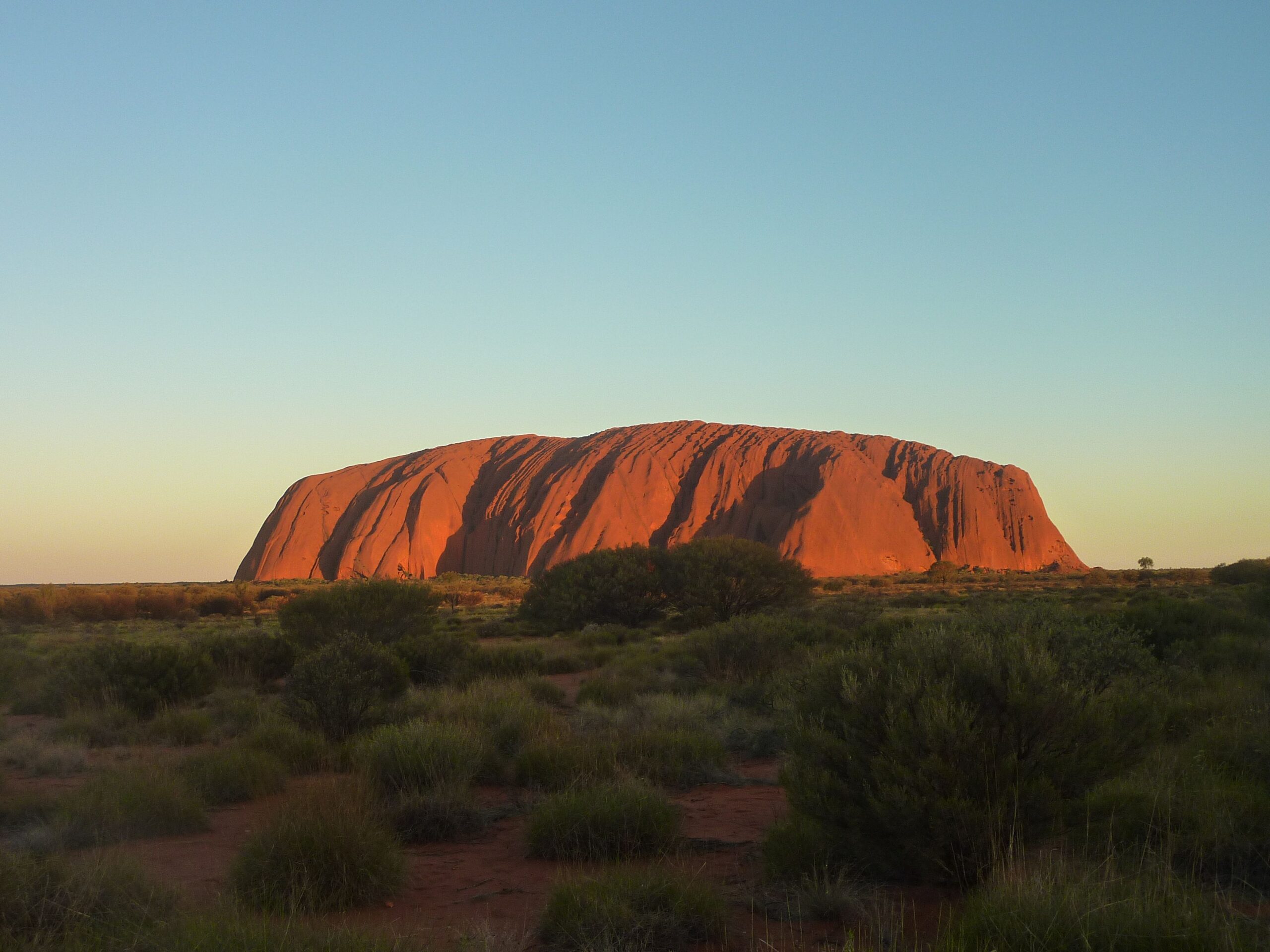
The Uluru (the sandstone monolith, 348 metres above the surrounding plain, the most visited natural monument in Australia): the sunrise viewing area (the designated viewpoint 10km from the rock, the first light striking the rock from the east and turning it from black through purple to the specific amber-red that every Uluru photograph attempts and none fully captures): arrive 45 minutes before the published sunrise time.
The specific Uluru instruction for children: the climb of Uluru has been closed since October 2019 at the request of the Anangu Traditional Custodians (the climb was culturally inappropriate and is now closed permanently — do not mention the climb as a possibility or regret its closure in the child’s presence). The 10.6km base walk (the circuit around the rock, the rock art caves visible on the northern and southern faces, the waterholes, the specific Anangu cultural sites explained by the audio guide available from the Cultural Centre): 3-4 hours. The correct Uluru experience.
The Kata Tjuta:
The Kata Tjuta (the “many heads” — the 36 domed rock formations 25km west of Uluru, the Valley of the Winds walk (the 7.4km circuit through the valley between the domes, the highest dome at 546 metres visible from the valley floor): AUD 35 / £17.73 park entry (combined Uluru-Kata Tjuta entry, valid 3 days).
The Great Barrier Reef — Cairns (4 days)
Fly Uluru-Cairns via Alice Springs or Sydney:
Cairns (the tropical north Queensland city, the Gateway to the Great Barrier Reef): the reef accessible by boat from the Cairns marina (the reef pontoon at the outer reef, accessible by catamaran from the marina in 1.5 hours).
The Outer Reef:
The Great Barrier Reef outer reef (the reef pontoon — the submerged observatory, the snorkelling from the pontoon, the semi-submersible coral viewing, and the introductory scuba dive for children 8+): the snorkel from the pontoon over the coral gives the specific reef experience that the beach snorkel at the inner reef cannot replicate (the coral density, the fish variety, the specific visual impact of the outer reef ecosystem at snorkel depth).
For children 8+: the guided snorkel tour (AUD 50-80 / £25.33-40.52 per person, the guide leading the group through the reef with the specific fish identification): the guide names the specific species as they encounter them — the clownfish (the Nemo — the recognition response from every child who has seen Finding Nemo is immediate and reliable), the parrotfish (the fish eating the coral and producing the sand — “the Whitehaven Beach sand is parrotfish poo” is the specific Great Barrier Reef fact that children retain and report to parents for months), and the maori wrasse.
The Daintree Rainforest:
The Daintree Rainforest (the rainforest 80km north of Cairns that is the oldest continuously surviving tropical rainforest in the world at 135 million years): the Cape Tribulation section (the beach where the rainforest meets the Great Barrier Reef, the only place in the world where two UNESCO World Heritage Sites share a shoreline): the family walk through the Daintree (the guided rainforest walk, the cassowary visible at the edge of the canopy in season — the cassowary is the world’s most dangerous bird by the Australian classification, the specific Australian danger that adds the specific Australian frisson to the rainforest walk).
The Wildlife Dome (Cairns):
The Cairns ZOOM and Wildlife Dome (the wildlife sanctuary on the roof of the Reef Hotel Casino — the saltwater crocodile, the koala, the nocturnal animals): AUD 25 / £12.66 adult, AUD 15 / £7.60 child. The crocodile feeding display (the saltwater crocodile, the world’s largest reptile, the specific predator that has not changed significantly since the Cretaceous) gives the child the specific Australian wildlife encounter that the Taronga Zoo in Sydney also provides but from a different ecological context.
The Age-by-Age Australia Guide
Ages 3-7
What works: The Taronga Zoo (the platypus, the koala, the wombat cubic faeces fact). The Uluru base walk (the child who walks the full 10.6km base circuit earns the specific sense of scale — the rock visible from the same distance throughout the walk, the size registered over the walking distance). The reef pontoon (the glass-bottom boat and the semi-submersible viewing are accessible to 3+; the snorkel requires swimming confidence).
Ages 8-14
What works: Everything in the 3-7 list plus: the introductory scuba dive at the outer reef (ages 8+ with Open Water certification or the resort dive), the Blue Mountains Scenic Railway (the 52° descent), and the specific Australian wildlife night walk (the nocturnal animals — the possum, the quoll, the tawny frogmouth owl) that require the patience the older child has.
What It Costs — Family of Four
| Category | Budget | Mid-Range |
|---|---|---|
| Return flights (UK-Sydney, 4 persons) | £4,800-7,200 | £6,400-9,600 |
| Internal flights (Sydney-Uluru, Uluru-Cairns, Cairns-Sydney) | £1,200-2,000 | £1,600-2,800 |
| 14 nights accommodation | £840-1,680 | £1,680-3,360 |
| Food (14 days, self-catering 4 days) | £700-1,200 | £1,200-2,400 |
| Activities (reef, zoo, Scenic World, park fees) | £600-1,000 | £900-1,600 |
| Total (family of 4, 14 nights) | £8,140-13,080 | £11,780-19,760 |
Australia is the most expensive destination in this guide per family trip. The long-haul flight cost for four people is the primary variable. Book 9-12 months ahead for the best fares.