


The comparison that the Indian Ocean luxury market has been making since the Seychelles opened to tourism in the 1970s: Maldives or Seychelles? The Maldives gives the most consistently perfect beach-and-reef experience in the world in the most purpose-built luxury resort infrastructure. The Seychelles gives the granite mountain islands that the Maldives cannot offer, the oldest ocean island ecosystem (the Aldabra Atoll — the largest raised coral atoll in the world, older than the Australian Great Barrier Reef), and the specific Seychelles quality of the island that has been inhabited for 250 years and that therefore has a culture, a cuisine, and a history that the Maldives resort island deliberately lacks.
Reading time: 7 minutes | Last updated: 2026
The Core Distinction
The Maldives is an artificial construct for the visitor. The resort island is an uninhabited sandbank leased to the resort operator — the Maldivian population lives on separate islands that the resort guest does not visit. The experience is entirely resort-constructed: the beach, the snorkel, the overwater villa, the meal. It is extraordinary precisely because of this construction — the resort has no competing interest, and the result is the most consistently excellent beach resort experience in the world.
The Seychelles is an inhabited country with 100,000 permanent residents, a history (the French and British colonial periods, the first multiparty election in 1993, the specific Seychellois Creole culture), and a landscape that the volcanic islands and the granite mountains give in the way no atoll can. The Seychelles resort exists within the context of the island — the fishing boat visible from the beach, the village 2km from the resort, the specific Creole restaurant that the local population uses for the Sunday lunch and that the resort guest reaches by taxi.
Category by Category
The Marine Environment
Maldives wins:
The Maldives atoll (the coral ring, the lagoon, the house reef at snorkel depth from the resort beach): the world’s most consistently accessible coral reef beach experience. The south Ari Atoll whale shark residency (the year-round resident whale sharks, the highest probability whale shark encounter on Earth): the full guide in Best Scuba Diving Destinations.
Seychelles competes with:
The Aldabra Atoll (the UNESCO World Heritage Site — the 156,000 giant tortoises on the raised coral atoll, the world’s largest population of giant land tortoises, the seabird colonies, the coral reef surrounding the atoll): accessible by the Silhouette Cruises liveaboard (the 7-10 day circuit, USD 3,000-5,000 / £2,362-3,937 per person).
The Cousin Island Special Reserve (the UNESCO-protected bird sanctuary 3km west of Praslin — the hawksbill turtle nesting, the roseate tern colony, the frigatebird visible from the boat): day trip from Praslin, approximately USD 100 / £78.74.
Verdict: Maldives for the consistent coral reef and the whale shark. Seychelles for the giant tortoise and the bird sanctuary.
The Landscape
Seychelles wins decisively:
The granite islands of the inner Seychelles (Mahé, Praslin, La Digue) give the landscape that makes the Seychelles visually distinct from any other Indian Ocean destination: the Vallée de Mai (the UNESCO World Heritage Site on Praslin — the primeval palm forest, the coco de mer palm (the species that produces the largest seed of any plant in the world at 25kg, the double coconut, the specific botanical rarity that grows only on Praslin and Curieuse in the world): entry SCR 300 / £17.37 per person.
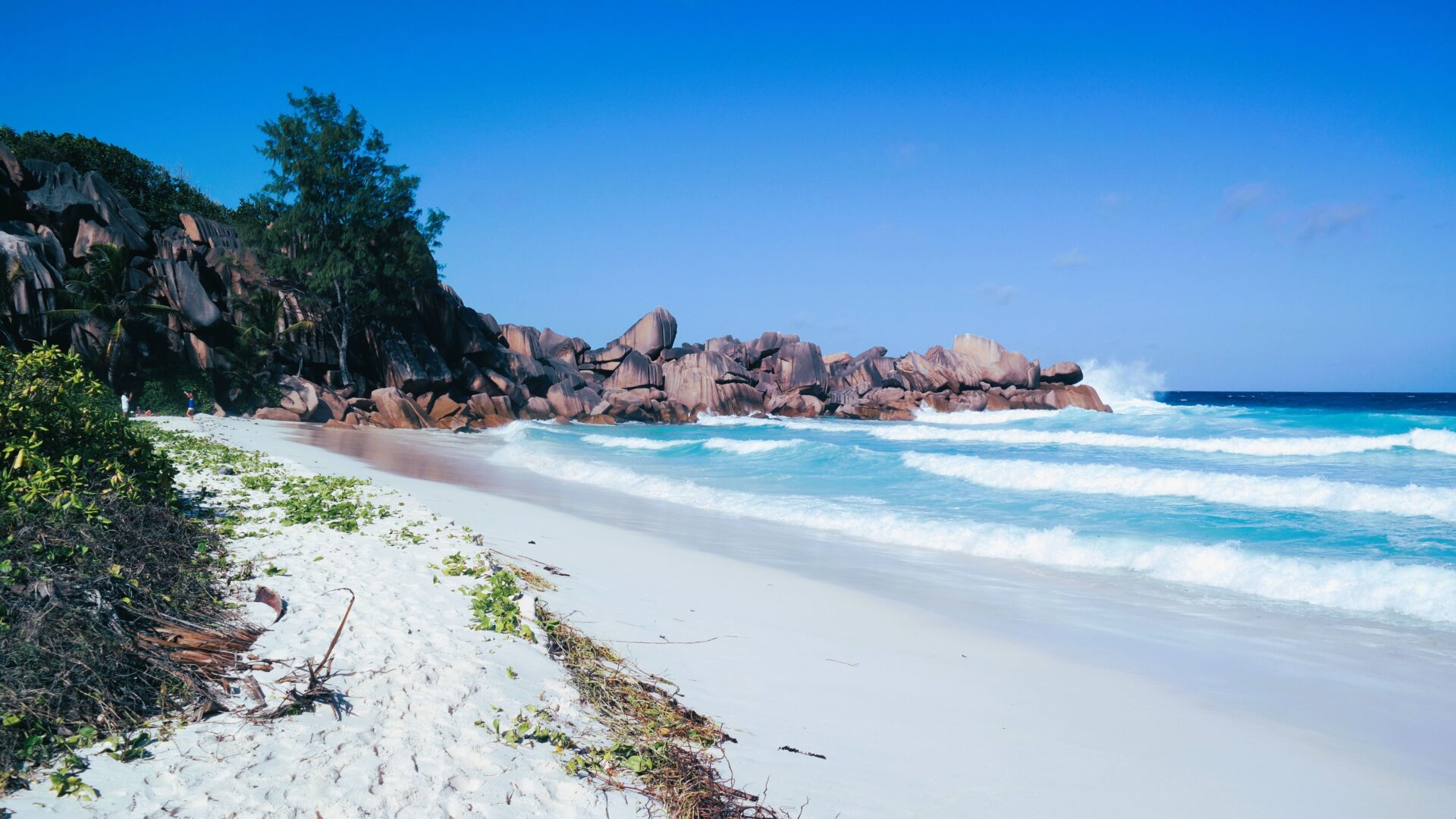
The Anse Source d’Argent (La Digue island — the beach consistently cited as the most beautiful in the world by the international travel media for 30 years: the pink-tinged granite boulders in the aquamarine water, the beach visible from the interior of the granite formations): free access (the L’Union Estate entry SCR 100 / £5.79 gives access through the estate).
Verdict: Seychelles wins completely on landscape. The Maldives has no mountains, no boulders, no primeval forest.
The Culture
Seychelles wins:
The Seychellois Creole culture (the French-African-South Asian-British synthesis visible in the food (the rougaille — the tomato-based sauce with the turmeric and the curry leaves, the Creole base for the fish and the chicken), the music (the moutya, the traditional Creole music of the enslaved population that maintained the specific rhythm and the call-and-response pattern through the plantation era), and the architecture (the colonial Creole house, the verandah, the corrugated iron roof, the specific tropical architecture visible in Victoria, the capital)): the most specific culture of any Indian Ocean island destination.
Maldives culture: The Malé (the Maldivian capital accessible by speedboat from the resort transfer — the Male Friday Mosque, the fishing harbour, the local market): the culture accessible with effort but not integrated into the resort stay as it is in the Seychelles.
The Cost
| Category | Maldives | Seychelles |
|---|---|---|
| Return flights (UK) | £550-800 | £650-950 |
| 7 nights accommodation (mid-luxury) | £2,100-4,200 | £1,400-2,800 |
| Food (included at most Maldives resorts) | Included | £400-800 extra |
| Total | £2,650-5,000 | £2,450-4,550 |
The Seychelles is marginally less expensive than the Maldives at the comparable luxury level when the full-board comparison is made — the Maldives all-inclusive resort (the food and activities included in the rate) versus the Seychelles half-board resort (the accommodation and breakfast included, lunch and dinner extra) gives a misleading price comparison that the all-in figure resolves.
The BGGD Verdict
Choose Maldives if: The overwater villa, the coral reef at snorkel depth from the beach, the whale shark, and the completely immersive resort experience are the primary motivation. Or if the beach holiday without the need to explore the island or the culture is the purpose.
Choose Seychelles if: The landscape (the granite boulders, the Vallée de Mai, the Anse Source d’Argent), the culture (the Creole food, the island history), and the giant tortoise are part of the motivation. Or if the island that has a culture as well as a beach is what you came for.