
The circuit that gives Central Europe in the depth two weeks allows and at the price that makes Central Europe the correct answer to “where in Europe can I spend two weeks for under £1,500 all-in”: four days in Prague for the Charles Bridge at 6am and the Old Town astronomical clock at noon and the svíčková (the slow-braised beef tenderloin, the cream sauce, the bread dumpling) at the restaurant that the Czech residents use rather than the tourist price on the main square, three days in Vienna for the Kunsthistorisches Museum and the Café Central and the Wiener Schnitzel that the hotel charges €28 for and the Gasthaus charges €12 for, four days in Budapest for the thermal bath at dawn and the ruin bars at midnight and the specific Hungarian parliament that is the most beautiful neo-Gothic building in Europe and that the Danube gives its correct context, and three days in Krakow for the Wawel Castle and the Kazimierz Jewish quarter and the Auschwitz-Birkenau memorial that this guide includes because omitting it is the specific dishonesty of the Europe travel guide that treats Krakow as a party city.
Reading time: 11 minutes | Last updated: 2026
The Central European circuit (Prague-Vienna-Budapest-Krakow) gives the four most historically layered capital cities in continental Europe at prices that the Western European equivalents (London-Paris-Amsterdam-Barcelona) charge 2-3× for equivalent accommodation and food quality. The Czech Crown, the Hungarian Forint, and the Polish Zloty all trade at rates that give the UK traveller a significant purchasing power advantage over the Euro zone.
Before You Leave
The routing: Fly London to Prague (Ryanair, easyJet, British Airways — from £30 return), travel the circuit overland by rail and bus (the Prague-Vienna night train, the Vienna-Budapest Railjet, the Budapest-Krakow overnight bus), fly home from Krakow (Ryanair from Krakow Balice to London Stansted — from £25 one way). The open-jaw (London-Prague, Krakow-London) is typically the same price as the return to Prague.
The transit card: The Prague metro card (CZK 120 / £4.20 for the 24-hour pass), the Vienna transit day card (€8 / £6.90 for the 24-hour unlimited), the Budapest transit card (HUF 1,650 / £3.57 for the 24-hour pass), the Krakow bus day ticket (PLN 10 / £1.88): the 4-city transit card total for the 14-day circuit: approximately £30 — the most affordable public transit circuit in Europe.
The Route
Prague (4 nights) → overnight train to Vienna (3 nights) → Railjet to Budapest (4 nights) → overnight bus to Krakow (3 nights) → fly home
DAYS 1-4 — Prague
The Charles Bridge at 6am:
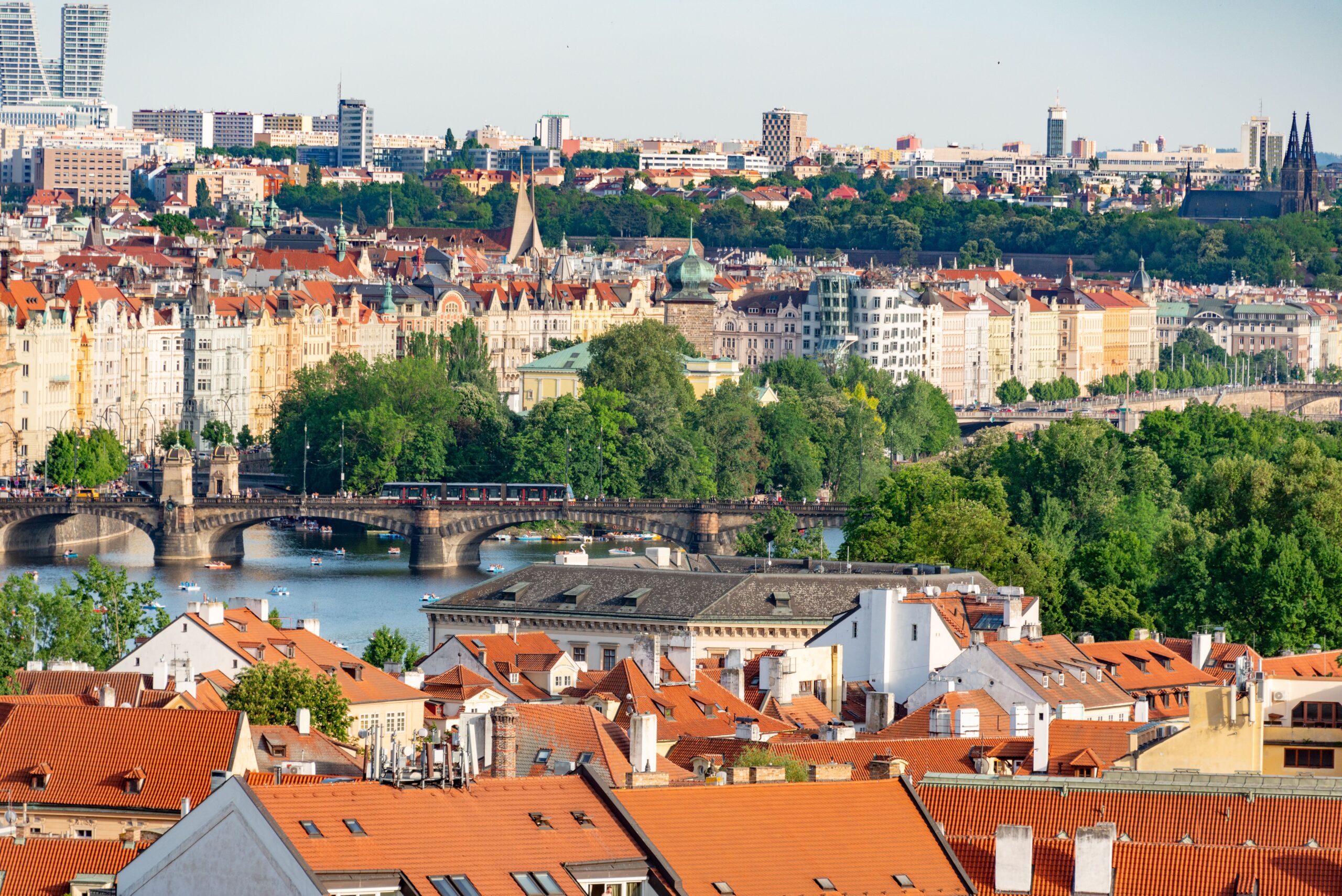
The Karlův Most (the 1402 stone bridge — the 30 Baroque statues on the bridge parapets, the towers at both ends, the Hradčany visible above the west bank): at 6am, the bridge in the morning mist, the Vltava below, the castle above. By 10am: the tourist photographs every 3 metres.
The specific Charles Bridge instruction: the 6am arrival is the non-negotiable. The bridge is the most visited tourist site in the Czech Republic. The experience of standing on the bridge in the morning quiet is fundamentally different from the experience of shuffling through the crowd at noon.
The Old Town Square astronomical clock:
The Pražský orloj (the 1410 mechanical astronomical clock on the Old Town Hall — the clock that performs the mechanical procession of the 12 Apostles every hour, the astronomical dial showing the position of the sun and the moon in the zodiac): at noon, the clock face surrounded by 200 visitors. At 6am: two other people and the pigeons.
The svíčková:
The svíčková na smetaně (the slow-braised beef tenderloin, the cream sauce with the lemon, the bread dumpling, the cranberry, the whipped cream on the cream sauce): the Czech national dish, the specific Bohemian comfort food:
At Lokál Dlouhááá (Dlouhá 33, Prague 1 — the restaurant that the Prague food press consistently cites as the reference for svíčková and for unpasteurised Pilsner Urquell from the tank): CZK 295 / £10.35. Not the tourist main square price (CZK 450-600 / £15.79-21.06 for inferior quality).
The Jewish Quarter:
The Josefov (the former Jewish ghetto, the 6 synagogues and the Old Jewish Cemetery): entry CZK 500 / £17.54 for the circuit. The Old Jewish Cemetery (the 12 layers of graves — the medieval cemetery that had no room to expand so the graves were layered vertically over 300 years, the oldest stones dating from 1439):
The specific Josefov instruction: the Pinkas Synagogue (the walls inscribed with the names of the 77,297 Bohemian and Moravian Jewish Holocaust victims, the names in red handwritten script covering the entire interior of the former synagogue): the most affecting single space in Prague.
DAYS 5-7 — Vienna
The Kunsthistorisches Museum:
The KHM (the Art History Museum — the collection in the monumental 1891 building, the Vermeer The Art of Painting (the 1666-68 painting in which Vermeer depicts himself painting in the studio, the allegorical rendering of the act of painting itself), the Pieter Bruegel the Elder collection (the most comprehensive Bruegel collection in the world — the Tower of Babel and the Hunters in the Snow in the same room)):
Entry: €21 / £18.10. The KHM at 10am Tuesday (the quieter day): the Bruegel room at the opening.
The Naschmarkt (Day 6, Saturday):
Full guide: Best Street Markets in Europe. The Saturday flea market section (the antique and vintage section, the silverware, the Art Nouveau glass) and the market breakfast (the Grüner Veltliner at 11am at the wine stall — the Austrian breakfast that extends through to noon).
DAYS 8-11 — Budapest
The thermal bath at dawn:
The Széchenyi Thermal Bath (Városliget — the 1913 neo-Baroque spa in the city park, the outdoor pool visible as the steam rises from the 38°C water against the morning air): at 7am (the bath opens at 6am), the pool occupied primarily by the elderly Hungarian regulars doing the specific Hungarian morning that the tourist afternoon replaces with the Instagram selfie.
Entry: HUF 6,800 / £14.72 adult.
The Hungarian Parliament:
The Országház (the 1902 neo-Gothic Parliament building on the Danube bank — the 691-room building, the 40kg of gold used in the decoration, the dome visible from the opposite bank): at sunrise from the Fisherman’s Bastion (the terrace above the Buda bank, the Parliament visible across the Danube in the first light): the most specifically beautiful single view in Budapest.
The Parliament guided tour (the interior — the Crown of Saint Stephen, the Gobelin tapestries, the grand staircase): HUF 8,700 / £18.84 for the English guided tour. Book at jegymester.hu.
The ruin bars:
The Romkerts (the ruin bars of the 7th District — the derelict buildings converted to bars and clubs in the early 2000s): the Szimpla Kert (the original ruin bar, the decaying courtyard, the eclectic furniture, the flea market on Sunday mornings): the Budapest nightlife that the European city break market has not yet homogenised.
The Cadilac restaurant:
The Két Szerecsen (Jókai utca 20, Terézváros — the Hungarian restaurant in the 6th District, the gulyás (the beef goulash, the paprika-rich broth), the pörkölt (the stew), and the kürtőskalács (the chimney cake)): HUF 3,500-6,000 / £7.58-12.99 per main.
DAYS 12-14 — Krakow
The Wawel Castle:
The Wawel (the royal castle on the limestone hill above the Wisła River — the 16th-century Renaissance castle, the Crown Treasury and Armoury, and the Wawel Cathedral (the tombs of the Polish kings and queens, the bell of Zygmunt, the largest bell in Poland visible in the belfry)): entry PLN 35-55 / £6.57-10.32 depending on the circuit.
The Kazimierz:
The Kazimierz (the former Jewish quarter — the synagogues, the Jewish bookshops, the specific Krakow urban district that the Schindler’s List filming (the Podgórze district adjacent) brought to the international attention, the specific Jewish history visible in the architectural and the cultural remnants): the Stara Synagoga (the Old Synagogue, the oldest in Poland), the Remuh Synagogue (the active synagogue, the adjacent cemetery with the Renaissance tombstones).
The Auschwitz-Birkenau Memorial:
The Auschwitz-Birkenau Memorial and Museum (70km from Krakow — the site of the Auschwitz concentration camp complex where approximately 1.1 million people were murdered between 1940 and 1945, primarily Jewish victims from across occupied Europe):
The specific Krakow instruction: the visit to the Auschwitz-Birkenau memorial is the correct and necessary context for the Krakow visit. The guide who takes you to the camp gives the history in the most concentrated form available. The guide who does not take you gives the tourist experience without the moral weight that the region’s history requires.
Book the guided tour at auschwitz.org — the free entry, the tour in English: PLN 80 / £15.01 per person. Book 4-6 weeks ahead; the morning tours sell out.
What It Costs
| Category | Budget | Mid-Range |
|---|---|---|
| Return flights (London-Prague, Krakow-London) | £55-120 | £80-200 |
| Overnight train/bus (Prague-Vienna, Budapest-Krakow) | £30-70 | £60-150 |
| Vienna-Budapest Railjet | £20-45 | £30-70 |
| 14 nights accommodation | £350-700 | £700-1,400 |
| Food (14 days) | £150-300 | £300-560 |
| Activities and entries | £80-150 | £120-250 |
| Transit cards | £30-40 | £30-40 |
| Total | £715-1,425 | £1,320-2,670 |