
Hot air balloons at dawn that look fabricated but aren’t, underground cities 85 metres deep where Byzantine Christians hid from Arab raids for months, cave hotels carved from the same volcanic rock as the fairy chimneys, the hiking valleys that most balloon tourists never reach, the pottery town that’s been throwing the same clay for 4,000 years, and how to do Cappadocia in a way that doesn’t feel like a theme park.
Reading time: 13 minutes | Last updated: 2026
The photographs of Cappadocia are accurate.
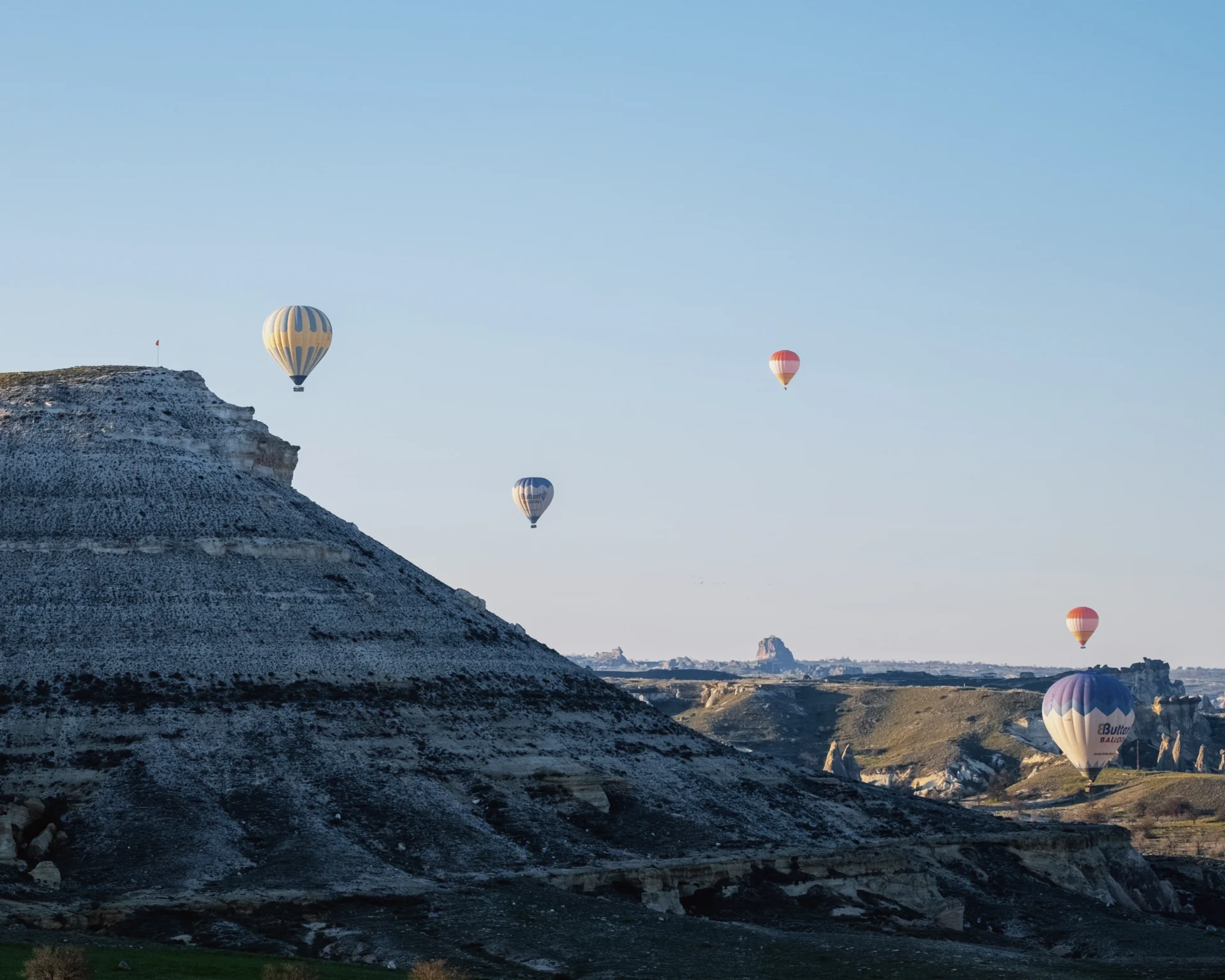
This is unusual. Most destination photography involves careful framing, golden hour timing, and the selective exclusion of the car parks and the other tourists. The Cappadocia hot air balloon photographs — the dozens of balloons rising simultaneously over the volcanic landscape of fairy chimneys and eroded valleys in the dawn light — look exactly like that. All the time. Even in the photographs taken by people who have no idea what they’re doing.
The landscape earns the photographs because the landscape is genuinely extraordinary. Volcanic ash deposited 10 million years ago, compressed into tuff, then eroded by wind and rain over millions of years into the specific cone-shaped formations (peribacası — “fairy chimneys” in Turkish) that give Cappadocia its defining silhouette. The same soft tuff that produced the fairy chimneys made it possible for the people who lived here — from the Hittites through the Phrygians, the Persians, the Macedonians, the Romans, the Byzantines, and the Seljuk Turks — to carve their homes, churches, monasteries, and entire underground cities directly into the rock.
The result: a landscape that is simultaneously one of the finest examples of natural geological formation and one of the most extraordinary archives of human habitation in the Mediterranean world. The balloon ride is the entry point. The underground cities, the fresco churches, and the hiking valleys are where the depth is.
This guide covers all of it — including the timing, the operators, and the approach that makes Cappadocia feel like a discovery rather than a tourist conveyor belt.
Quick Navigation
- The Case for Cappadocia — Geology, History, and the Balloon
- When to Go — The Balloon Season and the Shoulder Windows
- Getting There — Kayseri and Nevşehir Airports
- Where to Stay — Göreme, Ürgüp, and the Cave Hotels
- The Hot Air Balloon — How to Book It Right
- Göreme Open-Air Museum — The Fresco Churches
- The Underground Cities — Derinkuyu and Kaymaklı
- The Hiking Valleys — Where the Real Cappadocia Is
- Ihlara Valley — The Canyon Churches
- Avanos — The Pottery Town
- Uçhisar — The Rock Fortress
- The Sunset Viewpoints
- Hidden Cappadocia — The Places Most Tours Don’t Reach
- What It Costs — Real Numbers
- Eating in Cappadocia — Anatolian Food at Its Best
- Practical Notes
- The 3-Day Itinerary
The Case for Cappadocia — Geology, History, and the Balloon
Cappadocia is a region rather than a city — the historical name for a plateau in central Anatolia (modern Turkey) covering approximately 5,000 square kilometres around the towns of Göreme, Ürgüp, Avanos, and Uçhisar. The volcanic activity of Mount Erciyes and Mount Hasan deposited the tuff layer across the plateau 10 million years ago. The erosion that followed created the fairy chimneys.
The human occupation: continuous since at least the Hittite period (2000 BCE), the region’s soft rock making construction and habitation easy. The Byzantine Christian communities who inhabited Cappadocia from the 4th century CE carved an extraordinary archive of rock-cut churches — the Göreme Open-Air Museum alone contains more than 30 churches with fresco programmes from the 9th to 13th centuries. The underground cities (Derinkuyu descends 85 metres below the surface, the largest of 36 known underground cities in the region) were used as refuges during Arab raids from the 7th to 10th centuries.
The specific argument for Cappadocia beyond the balloon: it is one of the few destinations in Turkey where the pre-Ottoman, pre-Islamic history is the primary attraction. The Byzantine churches, the underground cities, the Hittite archaeological sites — all give a picture of Anatolia that the Ottoman and Islamic heritage of Istanbul doesn’t provide.
When to Go — The Balloon Season and the Shoulder Windows
April to June and September to October — The Best Windows
The finest conditions for balloon flights (the wind patterns are most favourable for safe flying in spring and autumn), comfortable temperatures for hiking (18-25°C), and manageable tourist density. April is particularly good — the wildflowers on the valley floors, the cooler mornings, and post-winter quiet.
October: the harvest season for the Cappadocian vineyards (the region produces wine on the volcanic soil — the red wines of Ürgüp from the Öküzgözü and Boğazkere grapes are among the finest in Turkey), the autumn light on the valleys, and the specific atmosphere of the region as the peak season ebbs.
July and August — Peak Season
Hot (30-38°C), crowded, and the balloon flights most in demand. The balloon rides are still extraordinary; the sites are more crowded. Accommodation prices are at maximum. The underground cities in August: queue-driven.
November to March — Off-Season
Cold (can drop below 0°C at night, occasional snow), the balloon flights cancelled more frequently due to wind. The region in snow is visually extraordinary — the fairy chimneys white-capped, the valleys quiet. Some cave hotels and restaurants close November-February. A specific and genuinely atmospheric winter visit is possible but requires flexibility and lower expectations of balloon flying.
The BGGD recommendation: Late April or October. Both give excellent balloon conditions, comfortable hiking, and a traveller-to-site ratio that allows the landscape to breathe.
Getting There — Kayseri and Nevşehir Airports
Kayseri Airport (ASR):
1 hour from Göreme by taxi or shuttle. Turkish Airlines and Pegasus both fly from Istanbul (1.5 hours). From the UK: fly to Istanbul (4 hours), then domestic connection. Total journey: 7-8 hours. Return flights UK to Kayseri via Istanbul: £150-350.
Nevşehir Airport (NAV):
30 minutes from Göreme. Fewer flight connections than Kayseri. Anadolu Jet and Pegasus serve it from Istanbul.
From Istanbul by bus:
Overnight bus from Istanbul (10-11 hours) — a legitimate option for travellers already in Istanbul who want to avoid a domestic flight. Metro Tourism and Nevtur are the reliable operators. Cost: £20-30.
Airport transfers:
Most Göreme hotels arrange airport pickup (£15-25 for Kayseri, £10-15 for Nevşehir). Alternatively, the shuttle buses that meet most Istanbul flights at Kayseri are £8-12 per person.
Where to Stay — Göreme, Ürgüp, and the Cave Hotels
Göreme:
The most central town, with the highest concentration of accommodation, restaurants, and tour operators. The best base for visitors without a hire car — everything is walkable. Cave hotels from £30/night (simple rooms carved into the tuff) to £180/night (boutique cave suites with private terraces and valley views).
The cave hotel experience:
The rooms carved into the tuff maintain a naturally stable temperature (18-20°C year-round) regardless of outside conditions — cool in summer, warm in winter. The specific quality: the walls are stone, the ceiling is low and curved, the room feels like being inside something rather than inside a building. The better cave hotels have carved their rooms into the valley walls with terrace views over the fairy chimneys.
Recommended mid-range: Kelebek Heritage Hotel (carved into the valley wall, pool, valley view terrace, reliable quality). Sultan Cave Suites (the most photographed cave terrace in Cappadocia, the balloon views from the terrace at dawn are the specific image you’ve seen).
Ürgüp:
The larger, more local town — more Turkish restaurants, a wine bar scene, slightly fewer tourists. The hamam (Turkish bath) in Ürgüp is the finest in the region. Cave hotels here are slightly less expensive than Göreme equivalents.
Uçhisar:
The village at the highest point, with views over the full valley. The Argos in Cappadocia (a collection of cave rooms and terraces in the rock of Uçhisar — the finest hotel in the region, Relais & Châteaux, £180-350/night) is the benchmark for Cappadocia accommodation.
The Hot Air Balloon — How to Book It Right
The Cappadocia balloon flight is the activity most associated with the region and the one most subject to price variation and operator quality differences.
The operators:
There are approximately 30 licensed balloon operators in Cappadocia. The Civil Aviation Authority of Turkey licenses them; the best maintain fleets of newer balloons with higher safety records. The established operators with strong safety records and English-speaking crew:
Royal Balloon: The most consistently recommended. The largest fleet, the most experienced pilots, English-speaking guides throughout. Price: £160-200/person for the standard flight.
Butterfly Balloons: Smaller group sizes (max 8-12 per balloon vs 24+ for larger operators), more intimate experience. Price: £180-220/person.
Voyager Balloons: Mid-range pricing, consistent reviews. Price: £140-175/person.
What to avoid: The agents selling balloon flights on Göreme’s main street on behalf of commission. Book directly with the operator online or through your hotel for the most reliable experience and fair pricing.
The flight:
Pickup at 4:30-5am from your hotel. Transfer to the launch site. The balloon inflation takes 30-40 minutes — watching the balloon fill is part of the experience. The flight lasts 45-75 minutes, reaching 300-500m above the valley. The landing: the ground crew follows the balloon by vehicle, the landing typically in a field or on a road, champagne served immediately after.
The conditions:
Balloon flights are weather-dependent and can be cancelled at short notice (the decision is made at 4am based on current wind conditions). Cancellation rates in spring and autumn: 10-15%. In summer: lower. In winter: 30-40%. A cancelled flight is refunded or rescheduled.
The honest assessment:
The balloon flight is the finest way to understand Cappadocia’s scale — from the valley floor, the fairy chimneys are individually impressive; from 400m above, the full plateau of formations extending to the horizon gives the geological scale that the ground doesn’t. It is worth the cost. It is not, however, the depth of Cappadocia — it is the opening act.
Cost: £140-220/person depending on operator and flight type.
Göreme Open-Air Museum — The Fresco Churches
The Göreme Open-Air Museum is a UNESCO World Heritage Site — a valley of rock-cut churches and monasteries from the 9th to 13th centuries, the most concentrated example of Byzantine religious rock-cut architecture in the world.
The churches:
The Dark Church (Karanlık Kilise): The most significant fresco programme in the museum — a 12th-century church carved into the rock, the frescoes preserved in extraordinary condition because the church’s single small window allowed minimal light and therefore minimal UV degradation. The scenes: the Nativity, the Baptism, the Entry into Jerusalem, the Last Supper, the Crucifixion, the Anastasis. Entry: additional charge above the main museum ticket (40 TRY / £1.10).
The Snake Church (Yılanlı Kilise): A 12th-century church with a painted scene of Saint George killing the dragon that has been consistently mistaken for Saint Michael killing a snake — the specific confusion documented in medieval sources.
The Apple Church (Elmalı Kilise): One of the largest churches in the museum, the frescoes covering the full interior in a coherent iconographic programme. The dome paintings: the Pantocrator (Christ Almighty, the standard Byzantine dome image) surrounded by the archangels.
The timing:
Open from 8am. The museum receives most visitors between 10am and 2pm — arrive at opening or after 3pm for the most atmospheric visit. The late afternoon light in the valley (when the sun is low to the west and the tuff takes on the golden colour that appears in all the best Cappadocia photographs) makes the 3-4pm visit the finest for photography.
Entry: 200 TRY / £5.50. The additional Dark Church ticket: 40 TRY / £1.10. Both are worth it.
The Underground Cities — Derinkuyu and Kaymaklı
The underground cities of Cappadocia are among the most extraordinary human constructions available to visit anywhere in the world. The soft tuff that made the fairy chimneys possible also made it possible to carve vertically downward — the Derinkuyu underground city descends 85 metres through 18 floors, with space for an estimated 20,000 people, their livestock, food stores, wine cellars, chapels, and schools.
Derinkuyu:
The largest and deepest of the 36 known underground cities — 30km south of Göreme. The descending tunnels (deliberately narrow, requiring single-file movement with one hand on the wall — designed to prevent cavalry from riding through and to allow defenders to hold the passage against far larger forces), the ventilation shafts (deep holes cut from the surface, designed to prevent smoke from fires from accumulating), the millstone doors (large circular stones that could be rolled across the tunnel entrances from the inside, impossible to push open from outside).
The scale: 8 floors are open to visitors (descending to approximately 60m). The full 85m depth includes floors still under excavation. The specific experience: at the 6th or 7th floor, in a lit tunnel underground, the ceiling pressing down, the passages narrowing — the specific claustrophobic intimacy of a space designed for survival rather than comfort.
Entry: 200 TRY / £5.50. The site is 30km from Göreme — require either a hire car, a tour, or a taxi (£25-30 return with waiting time).
Kaymaklı:
Closer to Göreme (20km), shallower (8 floors open), and more accessible — the tunnels wider in some sections, the experience slightly less intense than Derinkuyu. The advantage: less crowded in peak season. The wine cellars of Kaymaklı (the large storage rooms with carved wine jars) and the stables (carved with specific features for tethering animals) give the clearest picture of the underground city as a complete functioning community space.
The honest advice: visit one underground city, not both, unless you have a specific archaeological interest. Derinkuyu is the more impressive of the two.
The Hiking Valleys — Where the Real Cappadocia Is
The hiking valleys of Cappadocia are the least crowded and most rewarding part of the region — accessible on foot from Göreme in most cases, with trails through formations that the tourist bus circuit never reaches.
Rose Valley and Red Valley (Güllüdere and Kızılçukur):
A 3-4 hour circular hike from Çavuşin village to Göreme — through the valleys of pink and red tuff formations, past cave churches (the Haçlı Kilise and the Direkli Kilise, both with remnant frescoes), the formations turning vivid red in the late afternoon light (the iron oxide content in the tuff oxidising on the surface).
The best time: start at 3pm for the sunset in the Red Valley — the specific red light on the red tuff produces the most extraordinary hour of colour available in Cappadocia.
Pigeon Valley (Güvercinlik Vadisi):
The valley between Göreme and Uçhisar, named for the pigeon houses carved into the tuff walls (the pigeon droppings used as fertiliser in the Cappadocian vineyards — a practice going back to Byzantine times). The 45-minute walk from Göreme town to Uçhisar gives the finest fairy chimney landscape accessible on foot.
Love Valley (Aşk Vadisi) and Imagination Valley:
The valley of phallic fairy chimneys northeast of Göreme — the formations given their distinctive shape by differential erosion of a harder basalt cap protecting the softer tuff below. The naming is self-evident. The valley is genuinely extraordinary as a geological formation regardless of the visual association. From Göreme: 30-minute walk to the valley entrance.
Zemi Valley:
South of Göreme, connecting to the Göreme Open-Air Museum — the least visited of the accessible valleys. Rock-cut rooms visible in the tuff walls throughout, some still containing traces of paint. A 2-hour walk through the valley is almost always quiet.
The approach for serious hikers:
The Cappadocia Hiking Map (available at the Göreme visitor centre and from local bookshops) marks 10+ trails across the region. The full Red Valley-Rose Valley-Çavuşin loop (15km, 5-6 hours) covers the finest formation variety in a single day walk. Water: essential (no water sources in the valleys). Sun protection: critical (no shade in most valley sections).
Ihlara Valley — The Canyon Churches
60km southwest of Göreme — a 14km volcanic canyon carved by the Melendiz River through the tuff plateau, with 105 Byzantine rock-cut churches in the valley walls, most with remnant frescoes.
The valley is navigated by a path along the river — flat, shaded (the poplar trees lining the river), and offering a completely different landscape from the dry fairy chimney valleys of the Göreme plateau. The water is audible throughout; the specific sound of a river in a canyon is one of the finest acoustic environments in Cappadocia.
The specific churches:
Ağaçaltı Kilise (Church Under the Tree): the finest fresco programme in the Ihlara Valley, the Ascension scene on the ceiling above the entrance remarkably well-preserved. Kokar Kilise (Fragrant Church): named for the incense that was burned here, the carved interior particularly elaborate for a rock-cut church of this period.
The logistics:
Ihlara requires a vehicle or a day tour from Göreme (most Cappadocia day tours combine Ihlara, Selime Monastery, and the underground cities in one circuit). The full valley walk (Ihlara village to Selime, 14km) takes 4-5 hours. Most visitors do a 3-4km section. The shuttle point at Belisırma village (the midpoint) has a restaurant on the river — fresh trout from the river, the most specific lunch available in the Cappadocia region.
Entry: 50 TRY / £1.40.
Avanos — The Pottery Town
On the Kızılırmak River (the Red River — named for the red clay it carries, the same clay that has supplied Avanos’s pottery industry for 4,000 years). The Hittites were producing pottery from this clay; the tradition has been unbroken.
The pottery workshops: several families maintain working pottery studios open to visitors — the wheel demonstration, the hand-building techniques, the specific character of the red clay from the river. Chez Galip (the most famous pottery workshop, its walls lined with thousands of locks of hair from visiting women, a tradition the owner began in 1979) is both genuinely impressive and slightly overwhelming.
The wine:
Avanos is the wine hub of Cappadocia — the volcanic soil and the altitude (1,100m average) produce the conditions for the indigenous grape varieties. The Kocabağ and Turasan wineries both offer tastings. The Öküzgözü (a dark red grape producing full-bodied wines) and Emir (the white wine of Cappadocia) are the indigenous varieties worth seeking.
Uçhisar — The Rock Fortress
Uçhisar is a natural rock formation (the highest point in Cappadocia at 1,350m) that has been carved and inhabited since antiquity — the Byzantine community cut rooms, passages, and escape tunnels through the full height of the rock. The abandoned village rooms, the views from the summit over the full plateau, and the specific quality of standing on top of a human-carved rock that has been occupied for 3,000 years.
Entry: 60 TRY / £1.65. Open 8am-8pm. The view from the summit at sunset: the finest single panorama in Cappadocia, the balloon landing fields visible below, the fairy chimneys extending to the Erciyes volcano on the horizon.
The Sunset Viewpoints
The sunset in Cappadocia is the equivalent of the dawn balloon — a daily event that reliably produces extraordinary photographs and reliably attracts significant crowds to specific viewpoints.
The viewpoints:
Sunset Point, Göreme: The organised viewpoint above the town — wine and sunset, tourist buses from 5pm, the view genuine, the atmosphere less so.
Uçhisar Fortress: The finest view, above, accessible until sunset.
Red Valley (Kızılçukur): Walk into the valley at 3pm, hike to the ridge viewpoint for the sunset — the best version, with the tuff formations between you and the sky rather than below you.
Çavuşin: The old Greek village above the new settlement, the abandoned rock-cut houses giving a foreground to the valley sunset.
Hidden Cappadocia — The Places Most Tours Don’t Reach
Soğanlı Valley:
60km south of Göreme — a valley with 100+ Byzantine rock-cut churches, the least visited significant archaeological site in the Cappadocia region. The pigeon houses (more elaborate than the Pigeon Valley versions), the Yılanlı Kilise and the Geyikli Kilise (with frescoes from the 10th-11th centuries), and the absolute quiet of a site that receives perhaps 50 visitors on a busy day. Entry: 60 TRY / £1.65.
Zelve Open-Air Museum:
3km north of Göreme — an entire abandoned village carved into three converging valleys of fairy chimneys, inhabited until 1952 (when the residents were relocated because the eroding tuff was making the buildings unsafe). The monastery complex, the mosque carved into the tuff, and the specific atmosphere of an abandoned human settlement that is not presented as a theme park. Entry: 120 TRY / £3.30.
Mustafapaşa (Sinasos):
A former Greek village south of Ürgüp — the Greek Orthodox population lived here until the 1923 population exchange, when the Greek community of Cappadocia was relocated to Greece and Turkish communities from Greece were relocated here. The Greek houses (large, stone-built, with carved facades), the abandoned Greek churches, and the current Turkish Muslim community living in the Greek architecture give the most specific expression of the Anatolian cultural exchange of the 20th century. No entry fee.
What It Costs — Real Numbers
Cappadocia is more expensive than most of Turkey (the balloon industry has established a pricing environment that elevates everything) but significantly cheaper than equivalent European experiences.
Daily Budgets
Budget (£45-60/day)
- Accommodation: basic cave guesthouse (£18-28/night)
- Food: local restaurants, market lunches (£10-14/day)
- Transport: walking and occasional taxis
Mid-range (£75-110/day)
- Accommodation: mid-range cave hotel with terrace (£40-65/night)
- Food: quality restaurants (£18-28/day)
- Hire car (£25-35/day) for underground cities and Ihlara
What 3 Days in Cappadocia Costs from the UK
| Category | Budget | Mid-Range |
|---|---|---|
| Return flights (Istanbul connection) | £150–320 | £180–380 |
| Airport transfer | £15–25 | £20–30 |
| 3 nights accommodation | £75–110 | £165–260 |
| Hot air balloon | £140–180 | £170–220 |
| Food (3 days) | £38–50 | £65–100 |
| Göreme Museum + Dark Church | £8 | £8 |
| Derinkuyu underground city | £6 | £6 |
| Hire car or day tour | £30–50 | £45–70 |
| Total | £462–749 | £659–1,074 |
Eating in Cappadocia — Anatolian Food at Its Best
Testi Kebabı (Pottery Kebab):
The signature Cappadocian dish — lamb or chicken with vegetables, sealed inside a clay pot (testi) and cooked slowly in a wood-fired oven until the pot is brought to your table and broken open with a knife. The sealed cooking preserves the steam and the juices; the result is extraordinarily tender, the clay giving a mineral note to the sauce. Available at traditional restaurants in Göreme and Ürgüp. £10-15/person.
Mantı (Turkish Dumplings):
The Central Anatolian pasta — tiny dumplings (smaller than a thumbnail, each containing a pellet of minced lamb) boiled and served with yoghurt, brown butter, and dried chilli flakes. The mantı of Kayseri (the nearest city, the regional capital of Turkish mantı culture) is the most famous in Turkey. Available throughout Cappadocia. £5-8.
Gözleme:
Thin flatbread filled with cheese, spinach, or minced meat, folded and cooked on a griddle — the ubiquitous Turkish breakfast and snack food, made to order at market stalls throughout the region. £1.50-3.
The Cappadocian Breakfast:
The Turkish breakfast (kahvaltı) at a cave hotel — a spread of olives, white cheese, tomato, cucumber, eggs (boiled, fried, or menemen — scrambled with tomatoes and peppers), honey, jam, and fresh bread. The specific pleasure of a Turkish breakfast in a cave room with a valley view at 7am is the finest morning in Cappadocia. Included in most mid-range cave hotel rates.
Practical Notes
Getting to Cappadocia: Fly to Kayseri (ASR) or Nevşehir (NAV) via Istanbul (Turkish Airlines, Pegasus) from any UK airport. Total journey including domestic connection: 7-9 hours. Return flights: £150-380 via Istanbul.
Currency: Turkish Lira (TRY). £1 ≈ 36 TRY at time of writing (the rate has varied significantly — verify before travel). ATMs in Göreme, Ürgüp, and Avanos. Cards accepted at hotels, restaurants, and balloon operators; cash useful at smaller sites and markets.
Language: Turkish. English is spoken by most hotel and tour operator staff. “Teşekkürler” (thank you), “Lütfen” (please), “Ne kadar?” (how much?).
Hire car: Available from agencies in Göreme and Ürgüp (£25-35/day). Useful for the underground cities, Ihlara, and the more remote valleys. The region is small enough that most main sites are within 30km of Göreme.
The balloon cancellation protocol: Book the balloon for the first or second morning of your stay. If cancelled, the operator will attempt to rebook for a subsequent morning. Most 3-day visitors get at least one flight.
The 3-Day Itinerary
Day 1: Arrival + Afternoon Hiking
Arrive Kayseri. Transfer to Göreme. Cave hotel check-in. Afternoon: Pigeon Valley walk to Uçhisar (45 minutes). Uçhisar Fortress at sunset. Return to Göreme by dolmuş (shared minibus, £0.50). Dinner at a Göreme restaurant. Book balloon for Day 2 morning and day tour (underground cities + Ihlara) for Day 3.
Day 2: Balloon + Göreme Museum + Red Valley
4:30am: balloon pickup. Flight (45-75 minutes). Champagne landing. Return hotel by 8am. Breakfast. Göreme Open-Air Museum at 9am (Dark Church first, then the valley churches). Lunch in Göreme. Afternoon: Red Valley hike (depart Çavuşin at 3pm, hike to sunset viewpoint, return by sunset or walk to Göreme by dark). Evening: Ürgüp wine bar or Göreme restaurant.
Day 3: Underground Cities + Ihlara Valley
Day tour from Göreme (departs 9am, returns 6pm): Kaymaklı or Derinkuyu underground city, Selime Monastery (a massive rock-cut monastery complex at the northern end of Ihlara Valley — the largest rock-cut religious structure in the world, frequently missed by the valley-only tours), Ihlara Valley walk (3-4km section), lunch at Belisırma riverside restaurant. Return Göreme by 6pm. Departure transfer.
Final Thought
I was in the balloon at 400 metres. The Cappadocia plateau extended below in every direction — the fairy chimneys visible as individual formations from this height, the valleys between them dark in the morning shadow, the balloons of the other operators visible as coloured spheres at different altitudes across the plateau.
Then the light reached the tuff.
At a specific moment — approximately 20 minutes after dawn, when the sun clears the eastern plateau rim — the light comes in at a low angle from the east and hits the fairy chimneys while the valleys are still in shadow. The formations glow orange against the dark valley background. It lasts perhaps 10 minutes before the sun rises enough to flood the valley floor as well and the contrast disappears.
The photographs from this 10-minute window are the Cappadocia photographs. The photographers who understand this are in the balloon at 400 metres at dawn. Everyone else is looking at photographs of it later.
Get in the balloon. Be there for the 10 minutes.
Question about Cappadocia this guide doesn’t cover? Drop it in the comments.