
The Hagia Sophia before 9am when the first group tours arrive, the Grand Bazaar at 9am when the shopkeepers are opening their stalls and the selling pressure is at its lowest, the Bosphorus ferry to the Asian side for lunch, the Galata Bridge and the fishermen who have been there every morning since the bridge was built, the specific Istanbul of the residential neighbourhoods that the tourist circuit never reaches, and the 48 hours that make the largest city in Europe comprehensible.
Reading time: 8 minutes | Last updated: 2026
Istanbul is the only city in the world that spans two continents — the European side (Sultanahmet and Beyoğlu) and the Asian side (Kadıköy and Üsküdar) connected by the Bosphorus, the 31km strait between the Black Sea and the Marmara Sea. The city’s population is approximately 15 million. It has been continuously inhabited for 3,000 years, serving as the capital of the Byzantine Empire for 1,000 years and then the Ottoman Empire for 500 years.
The 48 hours that follow are not primarily about the famous buildings (though they appear). They are about the city that exists around, between, and beneath them.
Hour-by-Hour
Day 1
7:30am — Hagia Sophia
The Hagia Sophia (Ayasofya) was a church from 537 to 1453, a mosque from 1453 to 1934, a museum from 1934 to 2020, and a mosque again from 2020 to the present. Entry is currently free for prayer; visitor access outside prayer times is managed. Check the current access protocol at ayasofyacamii.com before visiting — the status has changed multiple times.
At 7:30am (before the 9am first prayer service, when crowds begin building): the interior at near-capacity solitude. The specific scale — 55 metres to the central dome, the largest enclosed space in the world for nearly 1,000 years after its completion — requires the quiet to be comprehensible. The golden mosaics of the Byzantine period (partially covered, partially visible — the Christ Pantocrator in the upper gallery, the Deësis mosaic considered the finest surviving Byzantine mosaic): available in the current mosque configuration from the public gallery areas.
9:00am — Topkapı Palace
The administrative and residential complex of the Ottoman sultans from 1465 to 1856 — 80 hectares of palace buildings, courtyards, and gardens on the promontory between the Golden Horn and the Bosphorus. The Harem (the private residential quarters — the most visited section, entry separate from the main ticket, ¥TRY 400 / £11 for both), the Imperial Treasury (the Topkapı Dagger, the Spoonmaker’s Diamond), and the view from the terrace over the Bosphorus.
Entry: TRY 700 / £19.30 + TRY 400 / £11 for the Harem. Pre-book online at muze.gov.tr to avoid the entrance queue. Allow 3 hours.
12:30pm — Lunch: Karaköy
Ferry from Eminönü to Karaköy (4 minutes, TRY 5 / £0.14) or walk across the Galata Bridge (20 minutes, the fishermen on the bridge the entire way). The Karaköy neighbourhood: the galata fish sandwich from the boats moored under the bridge (balık ekmek — grilled mackerel in a white roll with pickled cabbage and onion: TRY 70 / £1.93, the most specifically Istanbul street food), the meyhane (traditional tavern) district south of the fish market.
2:00pm — Galata and Beyoğlu
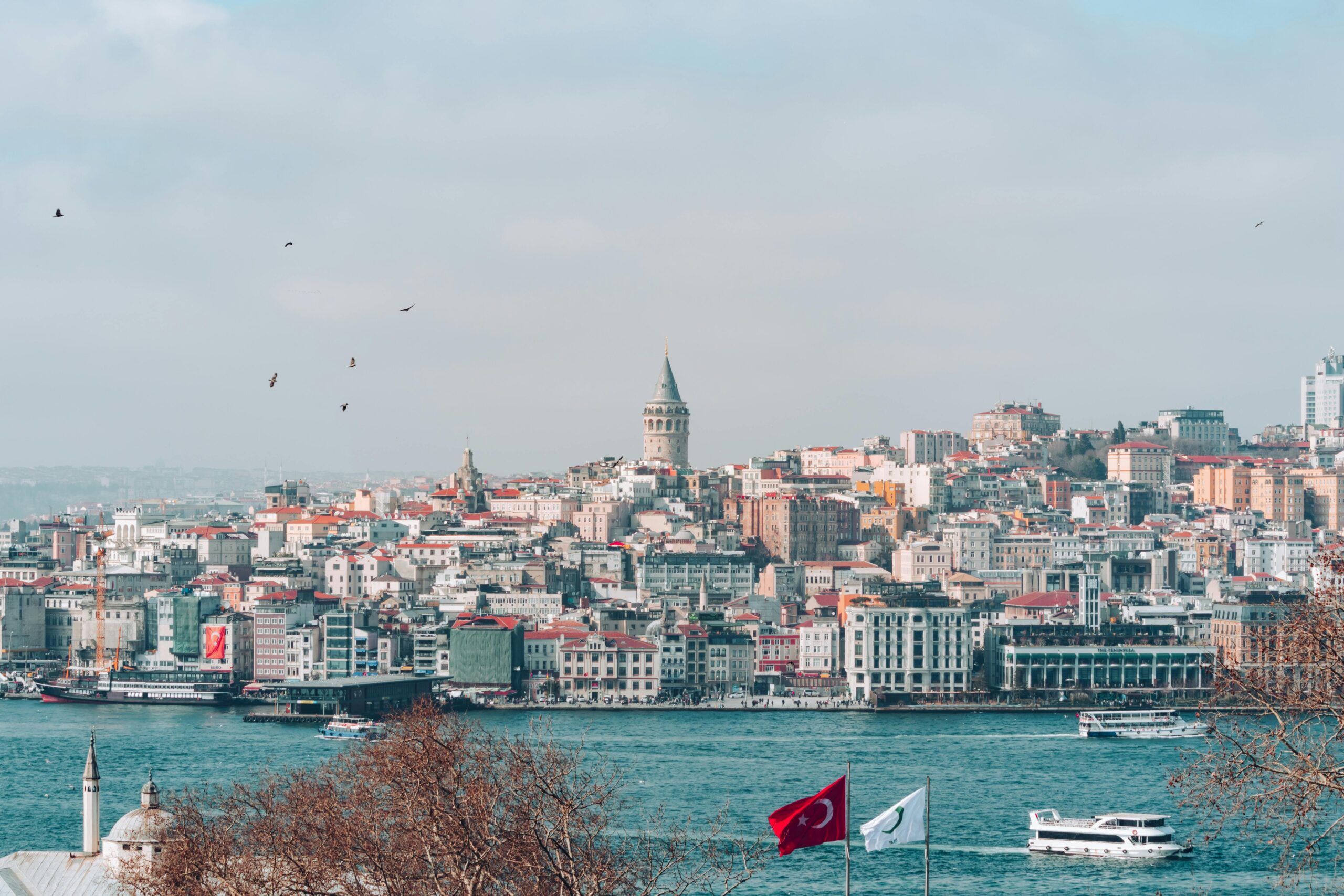
The Galata Tower (14th-century Genoese tower, the view over the Golden Horn from the top): TRY 350 / £9.65. Then up the hill via the Galata neighbourhood (the Jewish quarter, the churches of the Genoese merchants, the specific layers of the non-Muslim Istanbul) to the İstiklal Caddesi (the Grand Avenue): the 1.4km pedestrian boulevard from Tünel to Taksim Square, the 19th-century European apartment buildings, the Pera Palace Hotel (where Agatha Christie wrote Murder on the Orient Express), the fish and produce market of Balık Pazarı.
4:00pm — The Grand Bazaar
The Kapalı Çarşı: 61 covered streets, 4,000 shops, operating since 1461. At 4pm: the tourist peak of the day. Go anyway, but with the correct approach — walk through without engaging the carpet sellers (the word “la” — no — said once, clearly, works in Istanbul as it does in every Arabic-influenced market), navigate toward the centre where the jewelry and textile shops serving the local wholesale market operate with less tourist pressure.
The specific purchase in the Grand Bazaar: Turkish tea glasses (the tulip-shaped glasses), the copper and brass items from the Kalpakçılar section, the local deodorant stone (natural mineral alum, the original aluminium deodorant). None of these require sustained negotiation.
6:00pm — Sunset from the Galata Bridge
The bridge at 6pm: the fishermen still fishing, the Sultanahmet skyline (the minarets of the Blue Mosque and the dome of Hagia Sophia) visible to the south, the Bosphorus open to the east. The view at sunset — the light from the west on the mosque minarets — is the Istanbul image.
7:30pm — Dinner: Karaköy or Beyoğlu Meyhane
A meyhane dinner: the rakı (the anise-flavoured spirit, served with water to produce the specific cloudy “lion’s milk”) and the meze spread (the white cheese, the baba ganoush, the marinated fish, the stuffed vine leaves). Karaköy Lokantası (the refined version, mid-range) or any of the meyhane on the Nevizade Sokak behind the fish market (the informal version, the tables on the street in summer, the accordion player working the tables).
Dinner with rakı, per person: TRY 400-700 / £11-19.30.
Day 2
8:00am — The Asian Side: Kadıköy
Ferry from Eminönü or Karaköy to Kadıköy (25 minutes, TRY 5 / £0.14 — the Bosphorus ferry crossing that costs 14 pence and crosses one of the world’s great waterways). The Kadıköy market (the Kadıköy Çarşı — the produce market and the surrounding food streets): the finest market in Istanbul, functioning primarily for the Asian-side resident population. The Moda neighbourhood (the residential streets south of Kadıköy): the Kadıköy that tourist Istanbul doesn’t see.
Breakfast at the market: the simit (the sesame-crusted ring bread, TRY 10 / £0.28) with the specific Kadıköy börek from the specialist börek shop.
11:00am — Return to Sultanahmet: Blue Mosque
The Sultan Ahmed Mosque (Blue Mosque) — the only mosque in Istanbul with six minarets, built 1609-1616, the interior tiled with 20,000 Iznik tiles in 50 different tulip designs. Entry free (non-Muslims welcome outside prayer times; check times at sultanahmetcamii.org). Dress modestly; head covering provided.
The Blue Mosque interior at 11am (between the late morning and noon prayers): the specific blue of the Iznik tiles in the filtered light from the 260 windows — one of the finest interior spaces in Islamic architecture.
12:30pm — The Sunken Palace (Basilica Cistern)
The Yerebatan Sarnıcı: a 6th-century CE Byzantine cistern beneath the Sultanahmet district — 336 marble columns, the ceiling 9 metres above the water, the two Medusa heads used as column bases (one upside-down, one sideways — the traditional explanation is that the upside-down position neutralises the Medusa’s gaze, though the actual reason is likely structural). The cistern supplied the Byzantine Great Palace complex with water.
Entry: TRY 700 / £19.30. The cistern in any lighting condition is extraordinary; avoid peak midday crowds by going at opening (9am) or after 4pm.
2:00pm — Balat and Fener
The residential neighbourhoods north of the Golden Horn — the Greek Orthodox Patriarchate, the Jewish community of Balat, the coloured wooden houses on the steep lanes, the specific Istanbul that the Sultanahmet circuit never includes.
The walk from the Atatürk Bridge along the Golden Horn waterfront and up into Balat: 30-40 minutes walking. The neighbourhood cafes (the Forno Balat for the best coffee in the area, the Balat Kıraathanesi for the tea-and-backgammon culture of a local establishment).
4:00pm — Üsküdar and the Bosphorus
Ferry from Eminönü to Üsküdar (20 minutes, TRY 5 / £0.14) — the Asian shore, quieter than Kadıköy, the Şemsi Pasha Mosque directly at the ferry landing (the smallest imperial mosque in Istanbul, designed by the architect Sinan in 1580, the mosque’s apse extending over the Bosphorus). The view from Üsküdar back across to the European shore: the Topkapı Palace, the Hagia Sophia, the Blue Mosque aligned on the promontory.
6:00pm — The Bosphorus Strait
The public ferry from Eminönü to Anadolu Kavağı (the northernmost public ferry stop on the Bosphorus, adjacent to the Black Sea): 2 hours each way, TRY 40 / £1.10 return. The full Bosphorus cruise in the late afternoon — the yalı (the waterfront Ottoman mansions), the Rumeli Fortress (the Ottoman fortification on the European bank), the traffic of tankers from the Black Sea passing within metres of the ferry. Return by 9pm.
The alternative: the Bosphorus sunset cruise boats from the Eminönü pier (shorter, more tourist-facing, still the Bosphorus).
Essentials
Transport: Istanbulkart (the Istanbul transit card, loaded at any station, works on metro, tram, ferry, and bus — TRY 60 / £1.65 to purchase, load as much as needed). The T1 tram from Bağcılar to Kabataş covers the Sultanahmet area. Metro M2 for Taksim and Beyoğlu.
When: April-June or September-October for the finest weather and manageable crowds. July-August: hot (32-38°C), tourist-crowded in Sultanahmet, but the Bosphorus breezes provide relief.
Budget: TRY 600-1,000 / £16.55-27.60/day (street food, ferries, local transport) for food and transport. Accommodation adds TRY 500-2,000 / £13.80-55.20/night depending on district and quality.