
The route that most Portugal guides miss: three days in Lisbon with Sintra as the day trip, two days driving the Alentejo (the interior that most visitors fly over on the way from one coast to the other), and two days in Porto — and why this specific sequence gives you the full depth of a country that most visitors see only from its edges.
Reading time: 11 minutes | Last updated: 2026
Portugal is a small country — 561km north to south, 218km east to west — and its compactness makes the 7-day circuit genuinely achievable without the feeling of rushing. The three-city structure of this itinerary (Lisbon, Alentejo, Porto) is not the standard Portugal route (Lisbon + the Algarve beach) but it is the one that gives the country in its full register: the maritime capital, the interior that has been making wine since the Romans, and the northern river city that is nothing like Lisbon and everything like itself.
Before You Leave — The Booking Sequence
2-4 weeks before:
- Car hire for Days 3-5 (the Alentejo circuit) — pick up Lisbon, drop off Porto, or pick up and return Lisbon and take the train to Porto. Rentalcars.com or AutoEurope.
- Porto accommodation for Days 6-7 — the Ribeira guesthouses fill quickly.
- Sintra timed entry at parquesdesintra.pt — the Pena Palace slots sell out in July-August.
The open-jaw flight option: Fly Lisbon in, Porto out (or vice versa). Ryanair, easyJet, and TAP all operate both routes from UK airports — the price is often the same as a return, and it eliminates backtracking.
The Route
Lisbon (3 nights) → Sintra day trip (Day 2) → Alentejo circuit (2 nights — Évora base) → Porto (2 nights)
The 7 Days
DAY 1 — Arrive Lisbon
Afternoon and evening: the Alfama
Most flights from the UK arrive in Lisbon by early afternoon. Metro from the airport (Line Vermelha to Alameda, transfer to Line Verde to the city): 30 minutes, €1.65 / £1.42.
The Alfama immediately on arrival: the pastéis de nata from the nearest pastelaria (within two minutes of any Lisbon Metro station), then the walk from the Portas do Sol viewpoint down through the Alfama lanes before the evening sets in. The Alfama in the late afternoon: the narrow streets catching the western light, the laundry on the lines, the cats on the window ledges.
Dinner in the Alfama: the Zé da Mouraria (Rua Joao do Outeiro 24) for the working neighbourhood restaurant experience — the daily specials on the board, the wine in a ceramic jug, the bacalhau in the preparation the kitchen has chosen that day. €20-30 / £17.24-25.86 per person.
DAY 2 — Sintra Day Trip and Lisbon Evening
8:30am: Rossio to Sintra by Train
The train from Rossio Station (the Moorish-revival station at the centre of Lisbon) to Sintra: 40 minutes, €2.25 / £1.94. The first train that allows a 9am arrival in Sintra.
Sintra:
The Pena Palace (9:30am entry — book online): the yellow and red Romanticist palace on the hilltop, the drawbridge, the ornate tilework, the view over the Serra de Sintra forest. 45 minutes inside and on the terraces.
The Quinta da Regaleira (11am — 15-minute walk downhill from Pena): the initiation wells, the underground tunnels, the eccentric neo-Manueline estate. The wells require headtorch-level darkness adjustment — the tunnels are genuine underground passages. 60 minutes.
Lunch in Sintra village (the cafés on the main pedestrian street): the travesseiro (the pastry pillow filled with almond cream and egg — the specific Sintra pastry, different from the Lisbon custard tart, the Piriquita bakery the reference for both the travesseiro and the queijada). €2-3 / £1.72-2.59 each.
Return to Lisbon by 3pm.
Lisbon afternoon:
The Museu Calouste Gulbenkian (the private collection of Calouste Gulbenkian — the Armenian oil magnate who left his entire art collection to Portugal in 1953, the collection covering Egyptian antiquities, Islamic art, French 18th-century decorative arts, and Impressionist paintings): the finest private collection in Portugal, the least crowded major museum in Lisbon. Entry: €10 / £8.62. Free on Sundays.
The Bairro Alto evening: the ginjinha at a Bairro Alto bar, the late dinner (10pm is the correct Lisbon dinner hour on the second night, when the jet lag has passed).
DAY 3 — Lisbon: The Belém Circuit and Departure
Morning: Belém
The tram 15E from Cais do Sodré to Belém (30 minutes): the Pastéis de Belém at 8am (before the queue), the Jerónimos Monastery (9:30am opening — the cloister, the tombs of Vasco da Gama and Luís de Camões, the Manueline carved stone), and the Belém Tower.
Midday: Pick up the car and drive to the Alentejo
Car hire from the Lisbon city centre or the airport (arrange pickup for noon). Drive: the A2 motorway south from Lisbon, then east on the IP2 toward Évora — 1.5 hours.
Afternoon: Évora Arrival
Évora (the Alentejo capital — the UNESCO-listed historic centre, the largest Alentejo city, the Roman temple visible from the main square): check in to the accommodation. The late afternoon walk: the Roman Temple of Diana (the 1st-century CE Corinthian temple, 14 columns still standing, the most intact Roman temple on the Iberian Peninsula — free to view from the street), the Cathedral (the Sé de Évora, the 13th-century Gothic cathedral with the Romanesque elements still visible in the tower bases), and the Praça do Giraldo (the main square, the 16th-century fountain, the cafés).
The specific Évora dinner: the Taberna Típica Quarta Feira (Rua do Inverno 16) for the Alentejo cooking — the migas (the bread and garlic and olive oil base dish, the specific Alentejo carbohydrate that supports the working agricultural day), the pork cheeks (the bochechas de porco, slow-braised), and the Alentejo red wine. €20-30 / £17.24-25.86 per person.
DAY 4 — The Alentejo Circuit
Morning: Cromeleque dos Almendres
The Almendres Cromlech (15km from Évora on the Guadalupe road): the largest megalithic monument on the Iberian Peninsula — 95 standing stones arranged in an oval formation, the earliest stones dated to approximately 6,000 BCE, making this older than Stonehenge by 2,000 years. The path through the cork oak forest to the stone circle: 1km from the car park.
At 9am: typically empty. The specific Alentejo quality of a monument of this age and scale with no visitor infrastructure and no queue.
Midday: Monsaraz
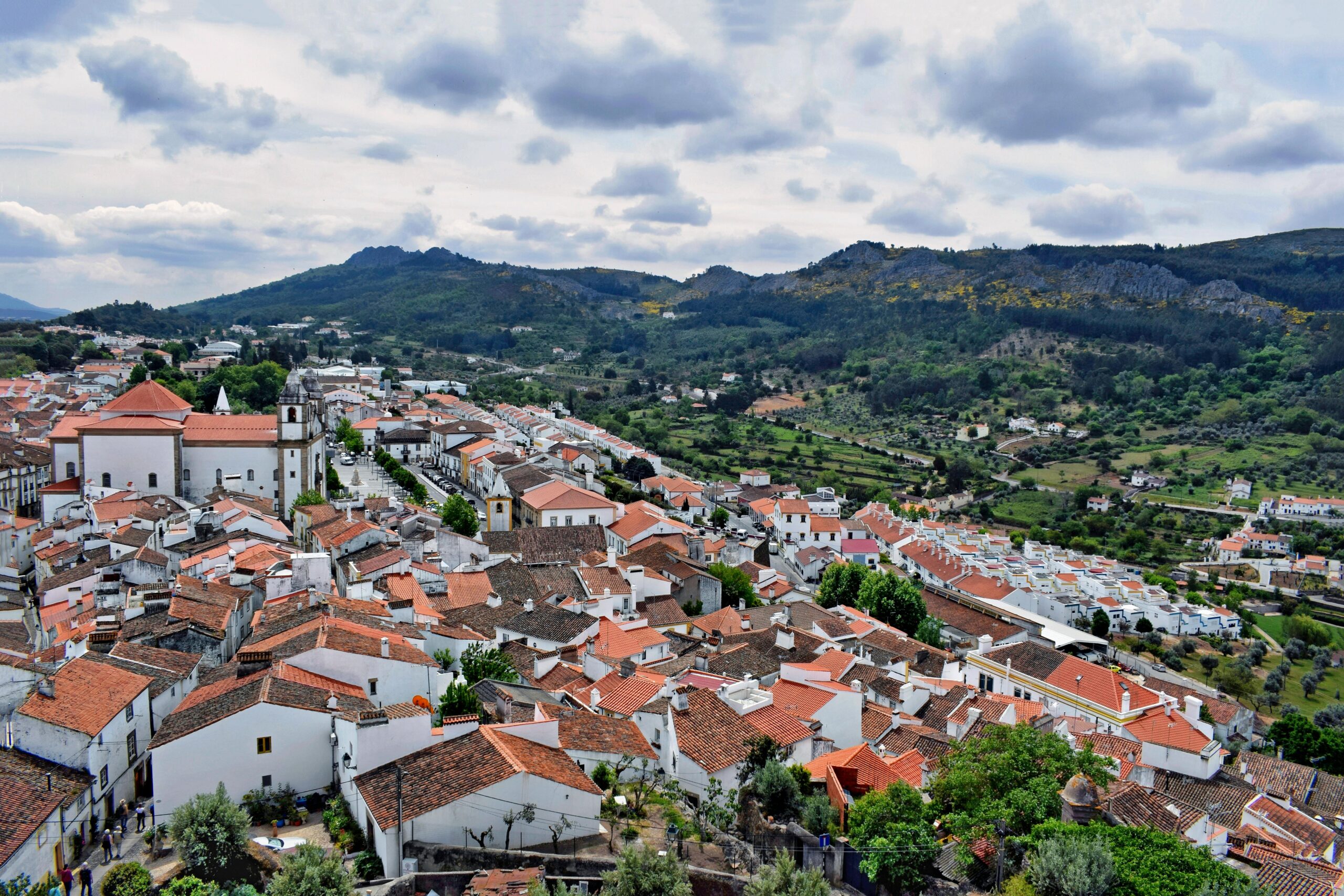
The hilltop village of Monsaraz (60km southeast of Évora) — the medieval village entirely enclosed within its walls, the 360-degree view over the Alqueva reservoir (the largest artificial lake in Western Europe, the surface of the water visible in every direction from the walls). The village: 150 permanent residents, one main street, the castle at the northern end, the whitewashed houses, the específic Alentejo architectural palette (white with blue or yellow trim, the colour indicating the village’s historical water source).
Lunch in Monsaraz: the restaurant inside the castle walls (the São Lourenço wine estate restaurant if open, otherwise the village café): the Alentejo black pig (porco preto, the acorn-fed Iberian pig, the same animal as the jamón ibérico source in Spain), the sheep’s milk cheese aged in olive oil, the Reguengos de Monsaraz red wine.
Afternoon: The Alqueva Dark Sky Reserve
The Alqueva Dark Sky Reserve (the area around the Alqueva reservoir, the first Dark Sky tourism destination certified in Europe): the least light-polluted area in Western Europe. If staying in the Monsaraz area for the night (recommended for the stargazing), the Clube de Astronomia de Monsaraz offers guided night observations from April-October.
Alentejo accommodation options: the Horta da Moura (the rural quinta near Monsaraz with the pool, the cork oaks, the horses: from €100-160 / £86.21-137.93 per night), or the Pousada Convento de Évora (the converted convent in Évora: from €120-200 / £103.45-172.41 per night).
DAY 5 — Alentejo to Porto
Morning: The Douro Wine Country
Drive north from Évora toward Porto (3.5 hours direct, 4.5 hours via the Douro). The Douro Valley route (the N222 road through Pinhão, the road that National Geographic voted most scenic in the world): the vineyard terraces descending to the river, the schist hillsides, the quintas visible behind the terrace walls.
Stop at Quinta do Crasto (Gouvinhas — one of the most accessible Douro wine estates, the tasting room on the terraced plateau above the river): the Douro white, the entry-level red, the aged tawny Port. Tasting: €10-15 / £8.62-12.93. Book at quintadocrasto.pt.
Afternoon: Porto Arrival
Arrive Porto by 3pm (adjusting for the Douro detour). The Ribeira (the riverside neighbourhood, the coloured buildings, the bridges) as the arrival walk — the Dom Luís I Bridge (the double-deck iron bridge designed by Théophile Seyrig, a collaborator of Eiffel), the view from the bridge across to the Port wine lodges of Vila Nova de Gaia.
The São Bento Station (the azulejo tile panels): the 20,000 tile panels depicting Portuguese historical scenes — visible by walking into the station concourse at any time, free.
Evening: Dinner in the Foz
The Foz do Douro (the mouth of the Douro where the river meets the Atlantic — the ocean-facing neighbourhood 5km from the Ribeira, the most atmospheric Porto dinner destination): the Boa Nova Tea House (Rua da Ladrões, Leça da Palmeira — the Álvaro Siza Vieira-designed tea house on the Atlantic rocks, the finest piece of architecture in the Porto area, now a Michelin-starred restaurant): book at restaurantebaonova.pt. Tasting menu from €150 / £129.31.
The accessible alternative: the Cantinho do Avillez (Rua de Mouzinho da Silveira 166) for the modern Portuguese at a reasonable price: €35-50 / £30.17-43.10 per person.
DAY 6 — Porto: The Essential Day
8:00am: The Mercado do Bolhão
The Mercado do Bolhão (Rua Formosa — the renovated 1914 market building, the city’s main food market): the fresh fish (the Atlantic coast catch arriving from 6am — the fresh percebes, the barnacles scraped from the Atlantic rocks south of Porto, the sea bass, the sardines), the fruit and vegetables, the Porto cheese (the queijo da Serra, the soft sheep’s milk cheese from the Serra da Estrela mountains 200km inland).
The morning order at the market café: the galão (the Portuguese coffee with milk — between a cortado and a latte, the standard Porto morning coffee) and the torrada (the thick-sliced toasted bread with butter, the Porto breakfast).
10:00am: The Livraria Lello
The Livraria Lello (Rua das Carmelitas 144 — the 1906 bookshop, the red Art Nouveau spiral staircase, the painted glass ceiling): book timed entry at livrarialello.pt (essential — the queue without a booking is 45-90 minutes in peak season). Entry: €5 / £4.31, redeemable against a book purchase.
The specific Lello instruction: look at the staircase from the ground floor (the full curved profile visible from the entrance), then from the top (the view down the red helical staircase). The Harry Potter visual connection is accurate but secondary to the architecture itself.
11:30am: The Clérigos Tower
The Torre dos Clérigos (Rua São Filipe de Nery — the 76-metre Baroque tower, the tallest building in Porto for 200 years, the 240 steps to the panoramic gallery): entry €6 / £5.17. The view: the Douro to the south, the Atlantic visible on clear days to the west, the Porto rooftop mosaic of tile and terracotta.
1:00pm: Lunch — the Francesinha
The Francesinha (the Porto sandwich — the bread layers containing the cured meat, the sausage, the steak or pork, covered with melted cheese and then the spiced tomato-beer sauce poured over the entire construction, a fried egg on top). The city’s signature dish, genuinely specific to Porto, unrelated to anything else in the Portuguese culinary vocabulary.
The reference Francesinha: the Café Santiago (Rua de Passos Manuel 226) — the most consistently cited Francesinha in Porto by locals. €12-15 / £10.34-12.93 per portion (a full meal alone, no starter required, no dessert possible immediately after).
Afternoon: The Port Wine Lodges
Vila Nova de Gaia (across the Dom Luís I Bridge from the Ribeira, the southern bank of the Douro where the Port wine lodges have aged their wine since the 17th century): the lodge visits.
The Quinta do Noval (the most characterful lodges tour, the 1,200 barrels in the atmospheric lodge cellars, the oldest reserves dating to the 1960s): €15-25 / £12.93-21.55 for the tour and tasting. Book at quintadonoval.com.
The Sandeman lodge (the iconic figure of Don Sandeman visible from the Douro — the free walking tour of the terrace and the basic tasting available without booking in the afternoon).
Evening: the Ribeira
The Ribeira at sunset (the Golden Hour light on the coloured buildings, the bridge, the Douro) followed by dinner at the DOP restaurant (Largo de São Domingos 18 — Rui Paula’s Porto institution, the modern Portuguese tasting menu using Douro Valley and Atlantic ingredients): book at restaurantedop.com. Tasting menu from €80 / £68.97.
DAY 7 — Porto: Departure or Extension
Morning before flight: the Serralves Museum
The Museu de Arte Contemporânea de Serralves (Rua D. João de Castro 210 — the contemporary art museum in a 1999 Álvaro Siza Vieira building in the Serralves Foundation garden): the finest contemporary art museum in Portugal, the park (the Art Deco garden surrounding the 1930s Villa Serralves and the 1999 museum) providing the most pleasant morning walk in Porto.
Entry: €15 / £12.93 (includes both the museum and the gardens).
Fly home from Francisco Sá Carneiro Airport (OPO) — the Metro Pink Line from the city centre to the airport: 40 minutes, €2.50 / £2.16.
What It Costs
| Category | Budget | Mid-Range |
|---|---|---|
| Return flights (UK-Lisbon, Porto-UK) | £50-130 | £80-180 |
| 7 nights accommodation | £280-490 | £490-840 |
| Car hire (3 days Alentejo) | £60-100 | £80-140 |
| Food (7 days) | £140-250 | £280-490 |
| Ferries, trains, Metro | £25-40 | £35-55 |
| Site entries and wine tastings | £60-100 | £80-140 |
| Total | £615-1,110 | £1,045-1,845 |
The Key Decision: Alentejo vs the Algarve
The standard Portugal 7-day itinerary (Lisbon + the Algarve) is valid and beautiful. This itinerary replaces the Algarve with the Alentejo and Porto because:
The Alentejo has the megalithic monuments, the Dark Sky Reserve, the cork oak forests, the black pig, the Alentejo wine, and almost none of the tourist infrastructure of the Algarve. The Alentejo in May costs 40% less than the Algarve in May and is quieter by a factor of 10.
The Algarve is the beach. This itinerary has no beach. If the beach is the trip’s primary requirement, the Algarve is correct. If the beach is secondary to the culture, the food, and the landscape — this route is correct.