
Fushimi Inari at 6am before the 3,000 torii gates are full of tourists, the geisha districts of Gion done on foot in the evening not on a bus, the Arashiyama bamboo grove before 8am and why the 8am version is the only one worth taking seriously, Nishiki Market for the pickled things and the grilled things on sticks, the temples that charge entry versus the ones that are free, and the 48 hours that make Kyoto comprehensible rather than overwhelming.
Reading time: 8 minutes | Last updated: 2026
Kyoto has 1,600 Buddhist temples, 400 Shinto shrines, 17 UNESCO World Heritage Sites, and receives approximately 50 million visitors per year. The city is simultaneously the most culturally significant destination in Japan and the most comprehensively processed by tourism infrastructure.
The traveller who arrives by the 8am Shinkansen from Tokyo and joins the first Arashiyama bus tour is in a different Kyoto from the one that rewards the early alarm and the walking shoes.
These 48 hours are the walking shoes version.
Hour-by-Hour
Day 1
5:30am — Fushimi Inari Taisha
The 10,000 torii gates (actually more than 10,000 — the count is approximate) forming the tunnel paths up Mount Inari are one of the most photographed landscapes in Japan. The tunnel paths at noon in peak season: genuinely wall-to-wall tourists, the photography impossible without waiting for gaps.
At 5:30am: almost empty. The shrine opens 24 hours — there is no gate, no closing time. The lower torii tunnels at first light, the specific orange-red of the lacquered wood in the dawn, no other people: this is the Fushimi Inari that earns the reputation.
From Kyoto Station: 5 minutes by JR Nara Line local train to Inari Station (¥150 / £0.79). Trains run from approximately 5am.
The full ascent of Mount Inari (232m) takes 2-3 hours. The lower tunnels (the most photographed section, accessible in 20 minutes from the base) are sufficient for the dawn experience; the upper sections become less crowded the higher you go and more so throughout the morning.
8:30am — Nishiki Market
The 400-metre covered market arcade running east from Teramachi Street — “Kyoto’s Kitchen,” the daily market of Kyoto’s restaurants and households. The specific Nishiki breakfast: the grilled skewers from the stalls that open at 8am (the grilled tako dango — octopus ball on a stick, ¥200 / £1.06), the fresh tofu from the tofu specialist, the pickled vegetables that are the defining flavour of Kyoto cooking.
The market closes to fresh produce by noon; the remaining stalls continue to the afternoon. The 8:30-10am window: the freshest produce, the earliest vendors, the market serving the restaurants rather than the tourists.
10:00am — Nijo Castle
A short walk west of the city centre — the Tokugawa shogunate’s Kyoto palace (built 1603), the “nightingale floors” (the squeaking wooden floors engineered to make silent approach impossible — the specific defensive measure of a shogun who trusted nobody), the Ninomaru Palace interior (the painted sliding screen panels by the Kano school artists, the finest decorative painting in Kyoto), and the garden.
Entry: ¥1,300 / £6.90. Allow 1.5 hours.
1:00pm — Lunch: Pontocho Alley
The narrow laneway running parallel to the Kamo River — the finest restaurant street in Kyoto. At lunch (12-2pm) the restaurants are less crowded and the prices lower than evening. The kaiseki-influenced lunch sets (the multi-course Kyoto cuisine, the lacquerware boxes, the seasonal ingredients in restrained preparation) at the mid-range establishments: ¥2,000-4,000 / £10.60-21.20.
For something more casual: the soba restaurants off Pontocho. The cold soba with dipping sauce (zaru soba) in a simple setting: ¥900-1,200 / £4.77-6.36.
2:30pm — Gion Walking
The Gion district — the geisha (geiko in Kyoto dialect) and apprentice geisha (maiko) quarters — is walkable and free. The Hanamikoji street (the main Gion street, the machiya townhouses, the tea houses where the geisha entertain) in the afternoon: tourists but manageable. The Shirakawa area (the small canal with the cherry trees, the stone lanterns, the specific Kyoto townhouse streetscape) in the late afternoon: genuinely atmospheric.
The geisha sighting: geiko and maiko travel between appointments in the early evening (5-7pm) — the Hanamikoji and the side streets around the Ichiriki Ochaya tea house are the most reliable sighting spots. Observe respectfully, do not pursue, do not touch, do not use flash.
5:00pm — Kinkaku-ji (The Golden Pavilion) — Alternative Option
If combining with Kyoto’s most famous sight: the Golden Pavilion (the three-story structure covered in gold leaf above a reflecting pond) is best visited at opening (9am) or in the 4pm-closing window when the light is most dramatic. Entry: ¥500 / £2.65.
The alternative (and BGGD preference): skip Kinkaku-ji and use the afternoon for the Philosopher’s Path and the Nanzen-ji temple complex (below) — less famous, significantly more atmospheric.
5:30pm — Nanzen-ji and the Philosopher’s Path
Nanzen-ji: a Rinzai Zen temple complex in the eastern foothills — the giant Sanmon gate (the largest in Japan, the view from the second level over the temple complex and the Higashiyama hills), the Hojo garden (the finest dry garden in Kyoto, the raked gravel and the stone arrangement representing a tiger and her cubs crossing a river). Entry to the complex: free. Entry to the Sanmon gate second level: ¥600 / £3.18.
The Philosopher’s Path (Tetsugaku no Michi): the stone path running along the Shishigatani canal from Nanzen-ji north through the eastern foothills — 2km, lined with cherry trees (the finest cherry blossom walk in Kyoto in April) and connecting 6 significant temples. In the late afternoon: the light from the west, the canal, the almost complete absence of the tour buses that cover every other Kyoto temple.
7:30pm — Dinner: Nishiki Area or Pontocho
Return to the centre for dinner. The depachika (department store basement food halls) of the Takashimaya Kyoto (the Shijo Kawaramachi intersection) for the finest prepared food in Kyoto: the Kyoto-style pickles (tsukemono), the tofu-based preparations, the yudofu (boiled tofu in light broth — the specific Kyoto winter preparation). Alternatively, the ramen restaurants of the Nishiki area for a closing bowl.
Day 2
5:45am — Arashiyama Bamboo Grove
The bamboo grove opens at first light. The JR Sagano Line from Kyoto Station to Saga-Arashiyama (15 minutes, ¥240 / £1.27), then a 5-minute walk.
At 6am: the bamboo grove is empty. The specific quality of the bamboo at dawn — the light filtering through, the sound of the stalks moving, the path clear ahead — is the Arashiyama experience. By 9am: the tour groups from Osaka and Kyoto fill the grove. By 10am: it is wall-to-wall.
Walk through the grove (10 minutes end to end at dawn). Continue to the Tenryu-ji temple garden (UNESCO-listed, the finest pond garden in Arashiyama, entry ¥500 / £2.65, opens at 8:30am) or cross the Togetsukyo Bridge to the north bank before 8am.
8:30am — Sagano Scenic Railway
The 7.3km train from Arashiyama to Kameoka through the Hozu River gorge — an open-carriage tourist train, the gorge visible from the train rather than from the river. ¥880 / £4.66 one way. The Hozu River rafting (the alternative — a 16km river trip through the gorge by traditional wooden boat) takes 2 hours.
10:30am — Return to Kyoto: Kiyomizudera
The Kiyomizudera (Pure Water Temple) is on the eastern hillside — the wooden stage extending from the main hall over the hillside, the view over Kyoto from the stage. The temple dates from 778; the current structure from 1633. Entry: ¥500 / £2.65. Best at opening (6am) or 4-5pm; at 10:30am on a weekend it will be busy.
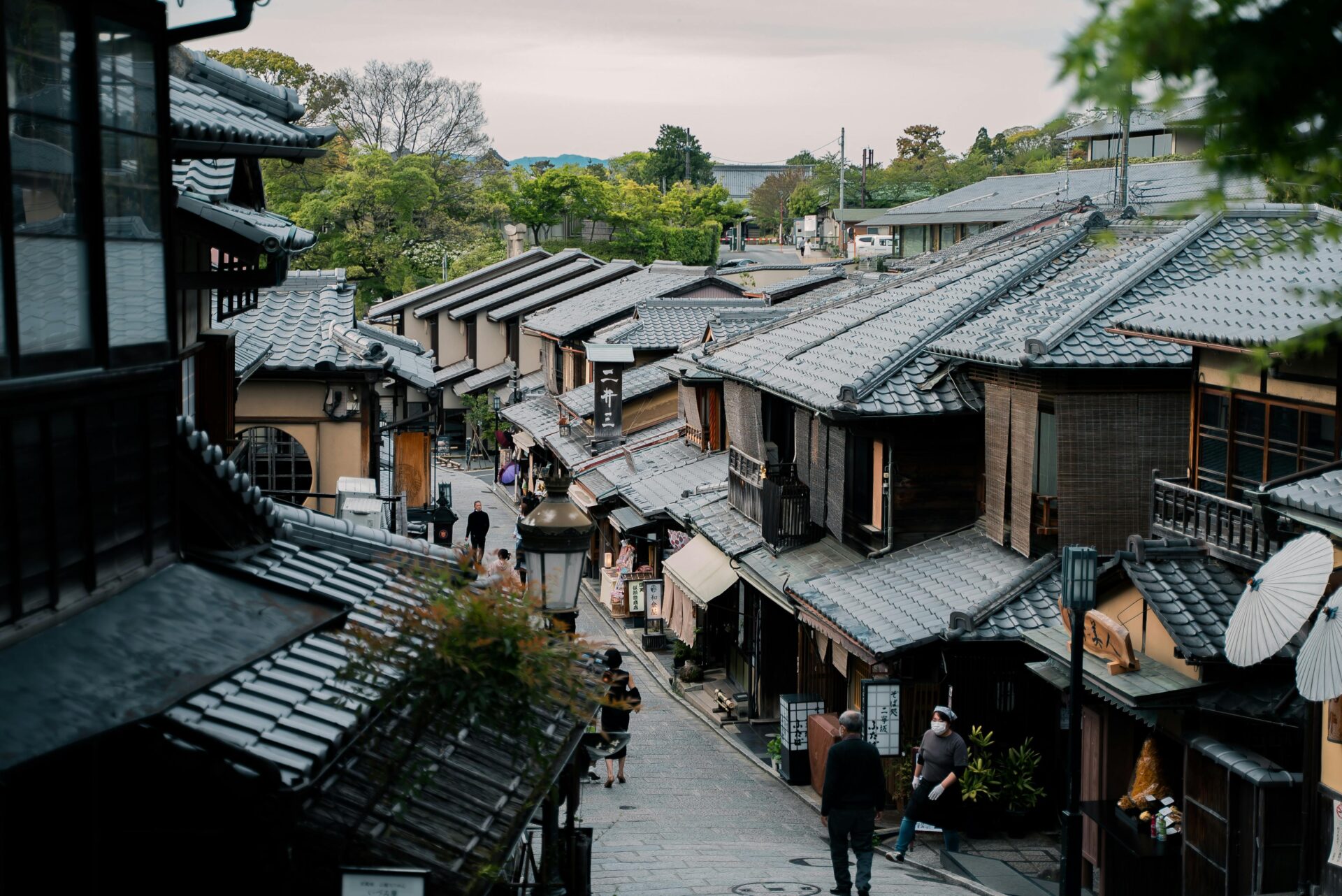
The approach through the Ninenzaka and Sannenzaka stone-paved lanes — the finest machiya townhouse streetscape in Kyoto, the craft shops and tea houses in preserved Edo-period buildings. Best before 10am.
1:00pm — Ryoan-ji
The most famous dry garden in Japan — 15 stones of varying sizes arranged on a raked white gravel rectangle, the composition from any viewing angle always obscuring one stone from view (the number you can see from any position is always 14). The garden’s meaning is deliberately not explained by the temple — the ambiguity is the point.
Entry: ¥600 / £3.18. The garden is small (25 × 10 metres), the viewing veranda typically crowded. The garden at opening (8am) is the correct version; at 1pm it is manageable.
3:00pm — Nishiki Market (second visit, different focus)
Return for the afternoon specialities: the soft tofu from Nishiki Warai, the yuba (tofu skin) products from the specialist stalls.
4:30pm — Departure Preparations
Kyoto Station for the Shinkansen to Tokyo (2.5 hours, the Mount Fuji visible from the right side — sit right-hand side facing forward, between Shin-Fuji and Mishima stations, approximately 40 minutes into the journey).
Essentials
Transport: IC Card (Suica or ICOCA — load at any JR station, works on all trains, subways, and buses) for all Kyoto public transport. Day bus pass (¥700 / £3.71) if doing only bus routes. JR Pass for the Shinkansen connections.
When: April (cherry blossom, the busiest period, worth it) or November (autumn colour, equally crowded, equally worth it). Both require advance hotel booking of 3-6 months.
Budget: ¥10,000-15,000 / £53-79/day (accommodation budget, temple entries, local transport, meals) or ¥20,000-30,000 / £106-159/day (mid-range hotel, mix of restaurants and market food, the Sagano Railway).