

The honest Buenos Aires nomad assessment: the most culturally rich nomad base in South America, the most economically complex, and the one where the exchange rate situation requires specific understanding before the first ATM withdrawal. The monthly cost at the blue dollar rate is £400-700 for a comfortable life that includes the Malbec at dinner and the steak twice a week and the tango class on Thursday and the co-working space on Palermo Soho. At the official rate, the same life costs £800-1,400. The difference is significant and the mechanism is legal for tourists.
Reading time: 9 minutes | Last updated: 2026
Buenos Aires is the Paris of South America — the claim is a cliché, the cliché is accurate in the specific sense that both cities have a bourgeois café culture, a preoccupation with their own literary and artistic tradition, an architecture built in a period of exceptional wealth, and a population that considers the city the cultural centre of its continent.
Argentina has been in economic crisis, in recovery, in crisis again across the past 25 years. The crisis is real. It does not make Buenos Aires a less extraordinary place. It makes it — for the foreign visitor earning in pounds or dollars or euros — one of the most affordable cities in the world for quality of life.
The Exchange Rate Reality
Argentina has two exchange rates:
The official rate: The rate set by the Argentine Central Bank. As of 2025: approximately 900 ARS to £1 (verify at xe.com — the rate moves significantly).
The blue dollar rate (dólar blue): The parallel market rate, accessible through the cuevas (the exchange houses) and the arbolitos (the street exchangers) throughout Buenos Aires. As of 2025: approximately 1,100-1,300 ARS to £1, varying.
What this means in practice: A £10 note at the official rate buys ARS 9,000 in goods. At the blue dollar rate, the same £10 note buys ARS 11,000-13,000. The difference is 20-40%.
Is using the blue dollar legal? For tourists, exchanging foreign currency through unofficial channels is technically illegal under Argentine law but is not enforced against foreign visitors. The Argentine government has periodically attempted to close the parallel market without success. The cuevas operate openly in the Florida Street pedestrian zone in the centre. The risk is exclusively for Argentine citizens who use the parallel market.
The BGGD instruction: Bring cash (pounds, dollars, or euros — the dollar rates are typically the most favourable). Exchange at the cueva through the hotel recommendation or the nomad community’s current recommended exchange. Do not use ATMs for cash if you can avoid it — the ATM withdrawal applies the official rate with an additional bank fee.
The Current Monthly Budget
| Category | Palermo (Mid) | San Telmo (Character) | Villa Crespo (Budget) |
|---|---|---|---|
| Accommodation (1-bed, blue dollar) | ARS 350,000-600,000 / £310-530 | ARS 250,000-450,000 / £221-398 | ARS 200,000-350,000 / £177-310 |
| Food (cooking + eating out) | ARS 150,000-300,000 / £133-265 | ARS 120,000-250,000 / £106-221 | ARS 100,000-200,000 / £88-177 |
| Transport (Subte + taxi) | ARS 30,000-60,000 / £27-53 | ARS 25,000-50,000 / £22-44 | ARS 20,000-40,000 / £18-35 |
| Co-working (optional) | ARS 80,000-160,000 / £71-142 | ARS 80,000-160,000 / £71-142 | ARS 80,000-160,000 / £71-142 |
| Social (tango, wine, restaurants) | ARS 100,000-200,000 / £88-177 | ARS 80,000-160,000 / £71-142 | ARS 60,000-120,000 / £53-106 |
| Monthly total (blue dollar) | £629-1,167 | £491-947 | £407-770 |
At the blue dollar rate, Buenos Aires is comparable to Tbilisi (£446-910/month) and Medellín (£433-755/month) in overall monthly cost — well below Lisbon and significantly below any Western European city.
Where to Work
AreatreBA (Palermo)
AreatreBA (Armenia 1978, Palermo Hollywood — the most established co-working in Buenos Aires, the campus-style building with the multiple co-working floors, the event space, the café, the outdoor terrace):
Monthly hot desk: ARS 80,000-140,000 / £71-124. Day pass: ARS 8,000-12,000 / £7.08-10.62.
The AreatreBA community (the Buenos Aires tech startup and creative community) is the most active co-working community in Argentina — the Monday networking breakfast and the Thursday after-work events are the community access points.
Regus and Spaces (Multiple Locations)
The international co-working chains in Buenos Aires — the corporate environment, the reliable internet (100-200 Mbps), the meeting rooms, the professional infrastructure.
Monthly hot desk: ARS 90,000-180,000 / £80-159 depending on location.
The Coffee Shop Circuit
Buenos Aires’ café culture (the café notable — the heritage café, the tradition of the Buenos Aires intellectuals in the café) has been supplemented by specialty coffee shops since 2015.
Lab Tostadores de Café (Charcas 4399, Palermo): The most cited specialty coffee in Buenos Aires — the sourcing from the Colombian and Ethiopian farms directly, the wifi reliable at 80-100 Mbps, the laptop-welcome culture: ARS 2,000-4,000 / £1.77-3.54 per coffee.
Café Paulin (Palermo Soho): The most atmospheric work café in the Palermo neighbourhood — the exposed brick, the natural light, the specific Buenos Aires café quality: ARS 1,500-3,000 / £1.33-2.65 per coffee.
The Specific Buenos Aires Advantages
The steak:
The Argentine beef is the reason for the specific Buenos Aires dinner — the pasture-raised Hereford and Aberdeen Angus from the Pampas, the asado tradition (the slow grill over the quebracho hardwood charcoal), and the specific Buenos Aires parrilla (the grill restaurant, the menu of 15 cuts of beef, the provoleta and the chimichurri and the Malbec from the Mendoza valley):
The parrilla at the budget level (the La Cabrera on Cabrera Street or the El Desnivel on Defensa in San Telmo — the most cited steaks by the Buenos Aires food press): ARS 5,000-12,000 / £4.42-10.62 for a 400g steak. The same steak at a midrange London steakhouse: £30-45.
The tango:
The tango lesson (the milonga — the tango practice event, the group class and the social dancing, the Thursday evening at the La Viruta or the DNI Tango): ARS 3,000-6,000 / £2.65-5.31 for the group class and the milonga entry. The tango class as the Thursday social event rather than as the tourist activity.
The Malbec:
The Argentine Malbec (the Mendoza red wine — the highest-altitude wine region in the world, the varietal that Argentina has made its own, the bottle of the DOC Mendoza Malbec at the almacén — the neighbourhood wine shop — at ARS 3,000-8,000 / £2.65-7.08 for the correct drinking quality):
The wine at the parrilla (the restaurant’s house Malbec at ARS 2,000-4,000 / £1.77-3.54 per 375ml, the wine that the Buenos Aires resident drinks with the steak as a matter of daily life rather than as an occasion).
The architecture:
Buenos Aires was built in the 1880s-1920s with the specific wealth of the Argentine beef and grain export economy — the Belle Époque Paris imposed on the South American grid, the Teatro Colón (the opera house, the finest acoustics in the world according to National Geographic, the standing room from ARS 3,000 / £2.65), and the Recoleta Cemetery (the marble mausolea of the Argentine political and cultural aristocracy, the Evita Perón tomb visible from the main entrance, free access).
The Specific Challenges
The inflation:
Argentina’s annual inflation rate in 2024-2025 was among the highest in the world. The prices quoted in this guide are in Argentine Pesos — they will have changed from the moment of writing to the moment of reading. The blue dollar conversion is the nomad’s inflation hedge: by converting to pesos at the rate of arrival rather than carrying a peso balance, the erosion of the blue dollar rate is the relevant risk rather than the official rate inflation.
The visa:
UK citizens: 90-day visa-free entry. Extensions are available at the Dirección Nacional de Migraciones office in Buenos Aires — the 90-day extension process takes 1-2 hours and extends the stay to 180 days. Beyond 180 days: the exit to Uruguay (Colonia del Sacramento by the Buquebus ferry from the Puerto Madero terminal, 1 hour each way, USD 40-60 / £31.50-47.24 return) and immediate re-entry resets the 90-day cycle.
The internet:
Reliable in the co-working spaces and the specialty coffee shops. Variable in the older apartment buildings — the copper-wire infrastructure in the pre-war Recoleta and San Telmo buildings produces the inconsistent home wifi that the VPN and the co-working backup resolve.
The Neighbourhoods
Palermo (Soho and Hollywood): The nomad neighbourhood of choice — the specialty coffee, the co-working, the international restaurant density, and the monthly rent at ARS 350,000-600,000 / £310-530 for the 1-bedroom. The Buenos Aires equivalent of Lisbon’s Príncipe Real.
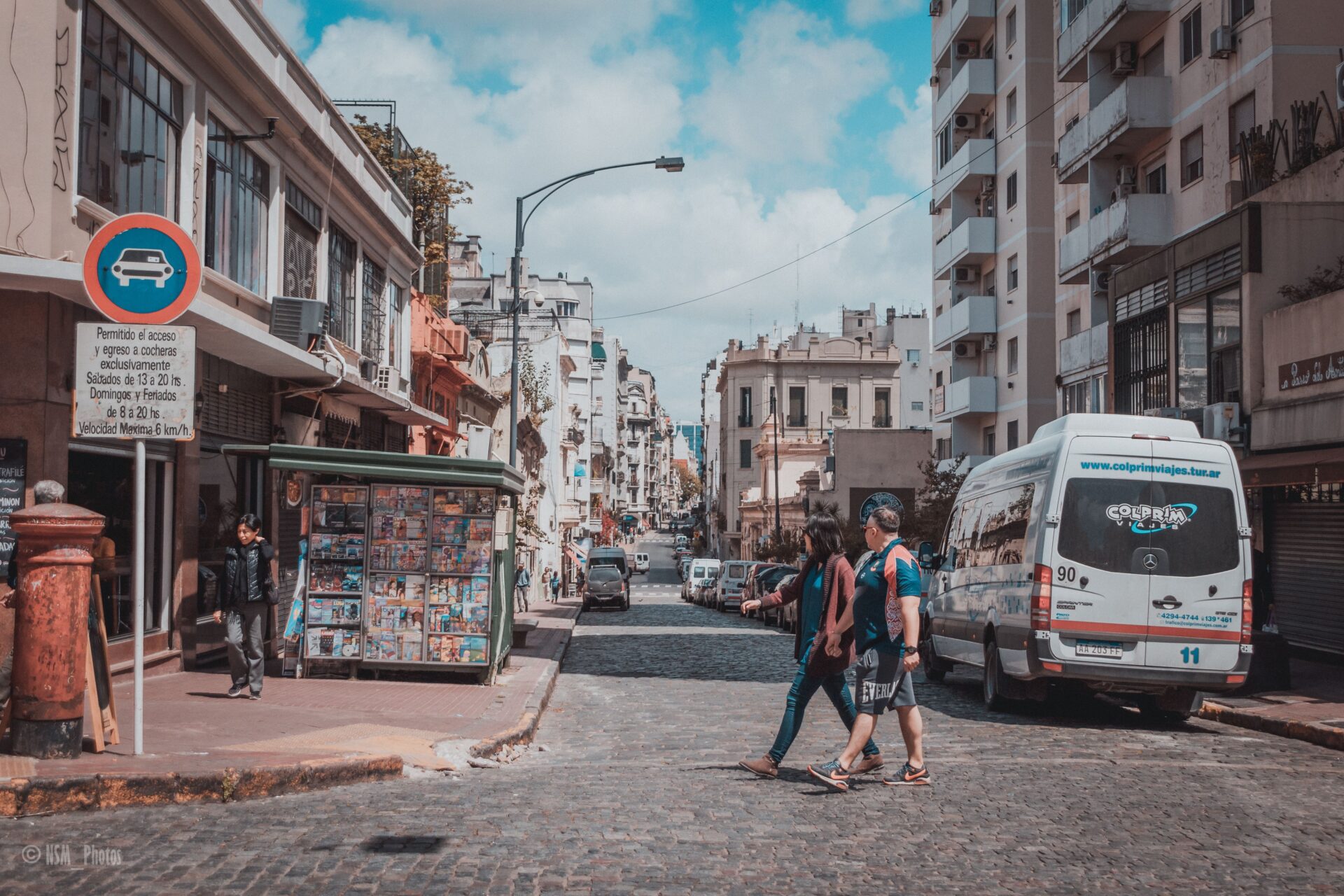
San Telmo: The historic neighbourhood — the cobbled streets, the antique market, the tango bars, the colonial architecture. The accommodation is cheaper (ARS 250,000-450,000 / £221-398) and the character is more specifically Buenos Aires. The internet in the older buildings is less reliable.
Villa Crespo: The emerging neighbourhood between Palermo and Almagro — the local food market, the leather craft workshops, the specific Buenos Aires neighbourhood that the 2022 nomad wave discovered before the prices followed. ARS 200,000-350,000 / £177-310 for the 1-bedroom.