
The route that gives Uzbekistan its full Silk Road argument: two days in Samarkand for the Registan at 7am when the madrassas are in the first light and the tiles give the blue that no photograph adequately represents and the specific Uzbekistan that the Silk Road caravans rested at for 1,000 years because Samarkand was the pivot between China and Persia and Rome, two days in Bukhara for the most intact medieval Islamic city in Central Asia — the Kalon Minaret that Genghis Khan spared when he destroyed everything else, the covered bazaars, the Lyabi-Hauz pool at sunset with the teahouse still operating — and three days driving the Kyzylkum Desert for the Ayaz-Kala mud-brick Zoroastrian fortresses on the desert plateau and the yurt camp under the Central Asian night sky that has more stars per square metre of darkness than any sky available from a hotel room.
Reading time: 10 minutes | Last updated: 2026
Uzbekistan is the Central Asian country that the travel world is actively discovering — the Silk Road cities (Samarkand, Bukhara, Khiva, Tashkent) were the medieval world’s most important urban corridor, and the Soviet preservation of the Islamic architecture (a political choice more than a cultural one — the Soviets preserved the monuments as evidence of the feudal past rather than as the expression of the religious present) left the tile-work and the domes in a condition that the non-Soviet countries of the Islamic world did not uniformly achieve.
The specific Uzbekistan gift: the Registan (the three-madrassah ensemble at Samarkand) and the Poi Kalon complex (the minaret-mosque-madrassa ensemble at Bukhara) are the finest surviving examples of Timurid Islamic architecture in the world. Both are accessible without a tour group and for a fraction of the cost of the equivalent sites in Iran, which most UK citizens cannot visit.
Before You Leave
The visa: UK citizens can apply for an Uzbekistan e-Visa at e-visa.uzbekistan.gov.uz — USD 20 / £15.75, processed within 3 business days, valid 30 days. UK citizens also benefit from visa-free access (the 30-day visa-free arrangement introduced in 2022 for UK passport holders — verify the current status at the Uzbekistan Embassy website before travelling, as bilateral agreements change).
The currency: The Uzbekistani Som (UZS). Cash-heavy economy — ATMs available in Tashkent, Samarkand, and Bukhara but reliability outside the cities is variable. Change GBP or USD (the USD preferred) at the bank or the licensed exchange office (obmennik).
The internal transport: The Afrosiyob high-speed train (the bullet train from Tashkent to Samarkand, 2 hours, UZS 90,000-160,000 / £5.73-10.19, and Samarkand to Bukhara, 1.5 hours) gives the correct inter-city connection. The Bukhara-Khiva desert road (280km, 4 hours by shared taxi or private car): UZS 150,000-300,000 / £9.55-19.10 per person in the shared taxi.
The Route
Tashkent (1 night, arrival and connection) → Samarkand (2 nights) → Bukhara (2 nights) → Kyzylkum Desert (2 nights yurt camp) → fly Urgench-Tashkent, fly home
DAY 1 — Tashkent
The Tashkent connection (the evening in Tashkent — the city that the 1966 earthquake destroyed and that the Soviets rebuilt in the specific Soviet monumental style that gives Tashkent its distinct character from the older Silk Road cities): the Chorsu Bazaar (the 16th-century covered bazaar under the blue domes — the spice sellers visible from the dome entrance, the suzani (the embroidered textiles) at the surrounding stalls): free.
DAYS 2-3 — Samarkand
Day 2: The Registan at Dawn
7:00am — The Registan:
The Registan (the three-madrassa ensemble at the centre of Samarkand — the Ulugh Beg Madrassa (1420, left), the Sher-Dor Madrassa (1636, right), and the Tilya-Kori Madrassa (1660, rear), the three buildings forming the ensemble visible from the square):
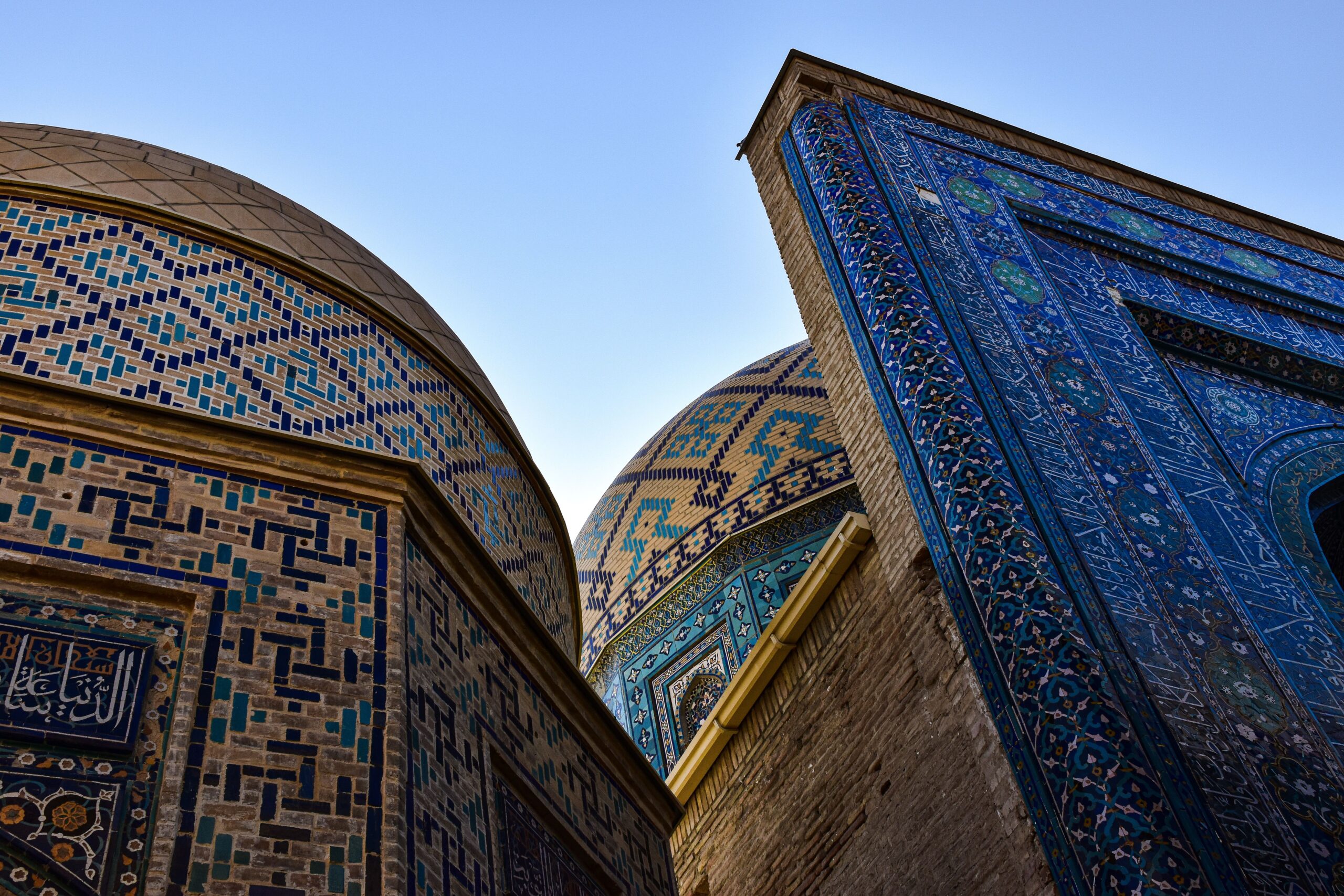
At 7am: the square empty, the tile-work in the morning light, the blue-turquoise-gold colour combination visible in the full saturation that the midday glare reduces. The blue of the Registan tile-work (the lazuli glaze — the specific mineral blue that the Timurid architects used and that the photography approximates at 60% accuracy and the eye receives at the full 100%): the specific Registan experience is the physical presence rather than the image, and the 7am presence is the experience before the crowd.
Entry: USD 15 / £11.81. The evening illumination (the Registan at night, the light-and-sound show from 9pm): USD 8 / £6.30.
The Shah-i-Zinda:
The Shah-i-Zinda (the necropolis on the Afrasiyab hill — the alley of mausoleums from the 11th-15th centuries, the tile-work visible on every surface of the 21 tombs, the specific necropolis that the Samarkand aristocracy competed to build their tomb within, the result being the highest concentration of decorated Islamic funerary architecture in the world): USD 5 / £3.94.
The Gur-e-Amir:
The Gur-e-Amir (the mausoleum of Timur/Tamerlane — the ribbed turquoise dome visible from the Registan, the interior gold-painted papier-mâché ceiling, the black jade tomb slab (the karakul) covering Timur’s actual burial vault below): USD 5 / £3.94.
The Timur legend: the Soviet archaeologist Mikhail Gerasimov opened the tomb in June 1941 and found the inscription “Whomever disturbs my tomb will unleash an invader more terrible than I.” Three days later, Operation Barbarossa began. Gerasimov’s team closed the tomb in November 1941 and the Soviet counter-offensive began. The inscription is real. The causation is left to the visitor.
DAYS 4-5 — Bukhara
The Poi Kalon:
The Poi Kalon complex (the Kalon Minaret (1127, 47 metres — the minaret that Genghis Khan spared when he destroyed the rest of Bukhara in 1220, his alleged reason being that he could not resist a structure that made him bow his head to look up), the Kalon Mosque (the 16th-century mosque capable of 10,000 worshippers), and the Mir-i-Arab Madrassa (the 1535 madrassa, still functioning as a religious school, the only functioning Soviet-era madrassa in Uzbekistan)): free to the exterior, USD 3 / £2.36 for the Kalon Mosque interior.
The Lyabi-Hauz:
The Lyabi-Hauz (the pool in the central Bukhara — the 17th-century pond, the mulberry trees planted in 1477 still shading the pool, the teahouse chairs at the water’s edge, the Nadir Divanbegi Madrassa reflected in the evening water): the Bukhara evening, the plov (the Uzbek pilaf — the rice with the lamb, the carrot, the chickpea, the cumin, the cotton-seed oil, cooked in the qazan (the cast iron cauldron) by the oshpaz (the plov cook) at the Lyabi-Hauz restaurant: UZS 40,000-70,000 / £2.55-4.46.
The Covered Bazaars:
The Bukhara tim (the domed trading domes — the Trading Dome of the Jewellers (Tim Abdullah Khan), the Trading Dome of the Money Changers (Tok-i-Sarrofon), and the Trading Dome of the Hatmakers (Tok-i-Telpakfurushon)): the covered bazaars of the 16th century, the specific Bukhara trade infrastructure visible in the buildings that the trade routes justified.
DAYS 6-7 — Kyzylkum Desert
The drive from Bukhara:
The shared taxi or private car from Bukhara west toward Khiva (280km, 4 hours) — the Kyzylkum Desert visible from the road as the agricultural plateau gives way to the red sand (kyzyl = red, kum = sand in Kazakh-Uzbek).
The Ayaz-Kala:
The Ayaz-Kala fortress complex (the 4th-century BCE Zoroastrian fortresses on the Kyzylkum plateau — the three mud-brick fortresses visible from the desert road, the kariz (the underground irrigation channel) visible at the fortress base, the specific Chorasmian (pre-Islamic Central Asian) civilization visible in the unbaked mud brick that the desert preserved):
The Ayaz-Kala 1 (the accessible fortress, the walls standing to 7 metres, the interior open to the desert wind): free. The yurt camp adjacent (the overnight camp below the fortress — the yurt interior (the felt walls, the wooden frame, the specific Central Asian domestic architecture), the desert at night (the stars at this latitude and this distance from any city giving the specific darkness that the urban visitor’s eyes require several hours to adjust to)):
UZS 200,000-400,000 / £12.73-25.45 per person for the yurt overnight with dinner and breakfast.
The Toprak-Kala:
The Toprak-Kala (the “Clay City” — the 2nd-4th century CE palace complex visible as the earthwork mounds above the desert floor, the wall paintings from the royal palace removed to the Hermitage Museum in St Petersburg during the Soviet excavations, the specific absence (the paintings that should be here are in Russia) that is the specific Central Asia archaeological grief):
What It Costs
| Category | Budget | Mid-Range |
|---|---|---|
| Return flights (UK-Tashkent) | £350-650 | £500-900 |
| 7 nights accommodation (hotels + yurt) | £70-210 | £210-560 |
| Train (Tashkent-Samarkand-Bukhara) | £15-31 | £20-45 |
| Desert transport + yurt | £30-70 | £60-130 |
| Food (7 days) | £25-65 | £65-160 |
| Entries and activities | £30-70 | £50-100 |
| Total | £520-1,096 | £905-1,895 |