
The temple at 7am before the tour buses, the pad kra pao at a plastic-stool market before the office workers have finished their plates, the Jim Thompson House that nobody expects and everyone should visit, the Chaophraya ferry that costs £0.12 and crosses to a Bangkok most tourists never reach, and the specific 48 hours that cover the essential Bangkok without the tourist conveyor belt version.
Reading time: 8 minutes | Last updated: 2026
Bangkok is the most visited city in the world by international arrivals in many years — approximately 23 million tourists annually in normal operation. Most of them spend 2-3 days between the Khao San Road area and the main temples, eating at restaurants with English menus and taking tuk-tuks at tourist prices.
This is not that version.
These 48 hours cover the Bangkok that rewards the early alarm, the street-level eating, and the one river crossing that changes everything.
Hour-by-Hour
Day 1
6:00am — Wat Pho
The Grand Palace and Wat Phra Kaew open at 8:30am. Wat Pho opens at 8am. The strategic move: arrive at Wat Pho’s Chetuphon Gate at 8:00am and walk directly to the Reclining Buddha before the Grand Palace tour groups (which typically combine both temples) arrive from approximately 9:30am.
The Reclining Buddha (Phra Buddhasaiyas): 46 metres, gold leaf, the soles of the feet inlaid with mother-of-pearl depicting the 108 auspicious characteristics. The hall containing it is narrow — you walk from the head end and the scale reveals gradually.
The Wat Pho massage school (the original Thai massage school in Thailand, operating within the temple complex since 1832): opens at 8am. A 60-minute traditional Thai massage: 420 baht / £9.55. The correct use of the 45 minutes between the Reclining Buddha and the Grand Palace opening.
Entry: 200 baht / £4.55.
8:30am — Grand Palace and Wat Phra Kaew
The 8:30am opening. Dress code enforced: shoulders and knees covered (sarong hire available at the gate for 200 baht deposit, refundable). The route: through the Grand Palace ceremonial halls (the Chakri Maha Prasat — the main throne hall, its hybrid Thai-European architecture the visual expression of King Chulalongkorn’s modernisation project), then into the Wat Phra Kaew compound for the Emerald Buddha (in the ordination hall, the image 66cm tall and made of jasper rather than emerald, the three golden seasonal costumes changed by the king personally). The galleries surrounding the temple: the entire Ramakien mural (the Thai version of the Ramayana) in 178 panels covering the full gallery walls.
Entry: 500 baht / £11.40. Allow 2 hours.
11:00am — Tha Tien Market (breakfast, second round)
Below Wat Pho at the river pier — the Tha Tien market serves the temple workers and the local pier community. The pad kra pao (Thai basil minced pork on rice with a fried egg) at the market stalls: 60-80 baht / £1.40-1.80. Eat standing or at the plastic stools.
11:30am — Cross the River
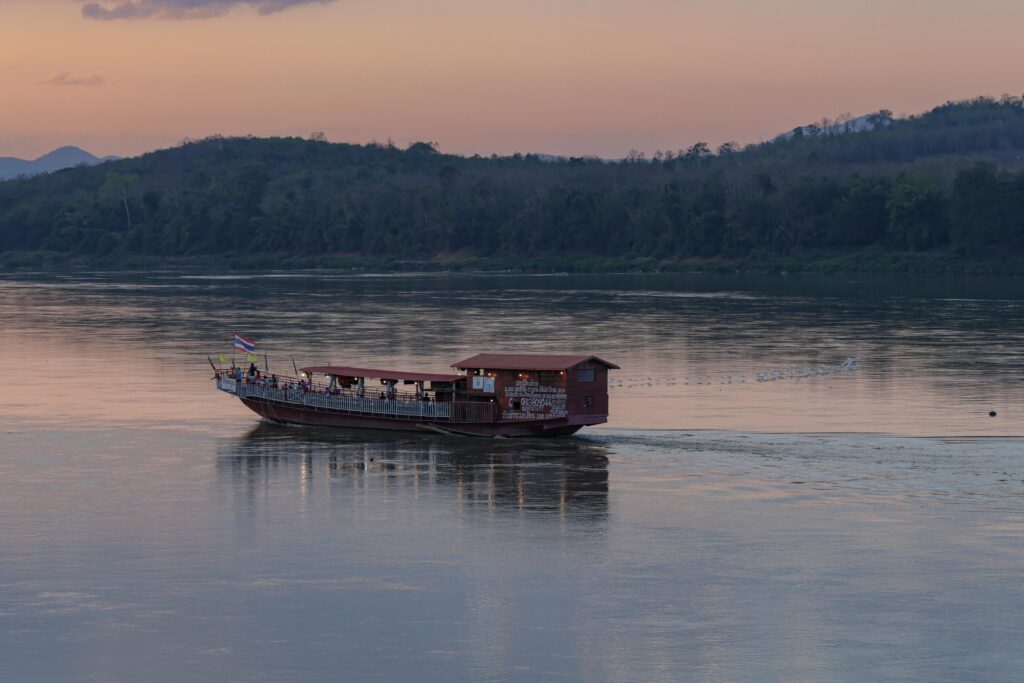
The cross-river ferry from Tha Tien pier to Wat Arun (Temple of Dawn): 5 baht / £0.12 each way. Runs continuously. Two-minute crossing.
Wat Arun: the Khmer-style prang covered in broken Chinese porcelain and faience, the mosaic visible close-up as a million individual fragments. The second-terrace climb (steep steps, the rope handholds): the view back across the river to the Grand Palace from the terrace — the finest river view in Bangkok.
Entry: 100 baht / £2.30. Allow 45 minutes.
1:00pm — The Wang Lang Market
From Wat Arun: the Phra Pinklao pier is 5 minutes north, the ferry crosses to Wang Lang market (3 baht). The Wang Lang market serves the Siriraj Hospital community — the most genuine non-tourist market within 15 minutes of the Grand Palace. Lunch from the market stalls: 50-80 baht / £1.15-1.80.
2:30pm — Jim Thompson House
BTS Skytrain to National Stadium. 5-minute walk. The compound of six traditional Thai houses assembled by the American silk entrepreneur Jim Thompson (who disappeared in Malaysia in 1967 and whose disappearance remains one of the finest unsolved mysteries in Southeast Asia) — the finest private collection of Asian art in Bangkok, each room of the house containing objects of genuine museum quality.
Guided tour mandatory (40 minutes, departs every 20 minutes). The guide’s knowledge of the collection is the experience — the objects without context are beautiful; with context they’re extraordinary.
Entry: 200 baht / £4.55.
5:00pm — Chatuchak Weekend Market or Or Tor Kor
If Saturday or Sunday: Chatuchak Weekend Market (MRT Chatuchak Park or BTS Mo Chit). Section 27 for antiques and collectibles, Section 26 for plants, the food section on the internal streets. Arrive at 5pm for the most active trading hour before closing at 6pm.
If weekday: Or Tor Kor Market (adjacent to Chatuchak, open daily until 6pm). The premium produce market — the mango sticky rice vendors, the freshly made Thai sweets, the orchid sellers.
7:00pm — Chinatown (Yaowarat)
MRT Hua Lamphong, 10-minute walk. The Yaowarat Road at 7pm: the neon signs, the smoke from a hundred charcoal grills, the specific Bangkok sensory overload at full intensity. T&K Seafood (49-51 Phadungdao Road — the most recommended hoi tod in Bangkok) for the oyster omelette. Continue along Yaowarat for grilled seafood, roast duck, and the sugar cane juice vendors.
Dinner: 300-500 baht / £6.85-11.40 per person.
Day 2
7:00am — Damnoen Saduak Floating Market
80km southwest of Bangkok, 90 minutes by car or tour minibus. The floating market opens at 6am — the wholesale trading is at full pace from 6-8am, the tourist boats arrive from 8:30am.
Book a tour minibus from the Khao San Road area (the most convenient departure point, multiple operators, 250-350 baht / £5.70-8 per person including transport). Arrive at 7:30am for the 30-minute window before the tour boat volume peaks.
The floating market: the vendors in wooden boats selling tropical fruit, vegetables, and prepared food from boat to boat. The commerce is genuine (it supplies the surrounding villages); the tourist boat presence is also genuine. Both exist simultaneously.
Alternative for the market-averse: the Maeklong Railway Market (the market where the vendors’ awnings retract to let the train through, 8 times daily) is 20 minutes from Damnoen Saduak and operates at a different pace.
10:30am — Ancient City (Muang Boran)
50km east of Bangkok, best reached by taxi or Uber (35-40 minutes, approximately 400 baht / £9.10) from the BTS Bearing terminal. The Ancient City (Muang Boran): a 1:1 scale open-air museum of 120 replicas of the most significant architectural monuments in Thailand — from Ayutthaya period temple complexes to the Sukhothai monuments to vernacular Thai structures — arranged in the approximate geographic positions of their originals.
Not a tourist trap but a genuinely useful spatial introduction to Thai architectural history that the actual monuments (spread across different cities) don’t provide in a single day. Hire a bicycle at the entrance (100 baht / £2.30) to cover the 2-square-kilometre site. Entry: 700 baht / £16.
2:00pm — Lumphini Park
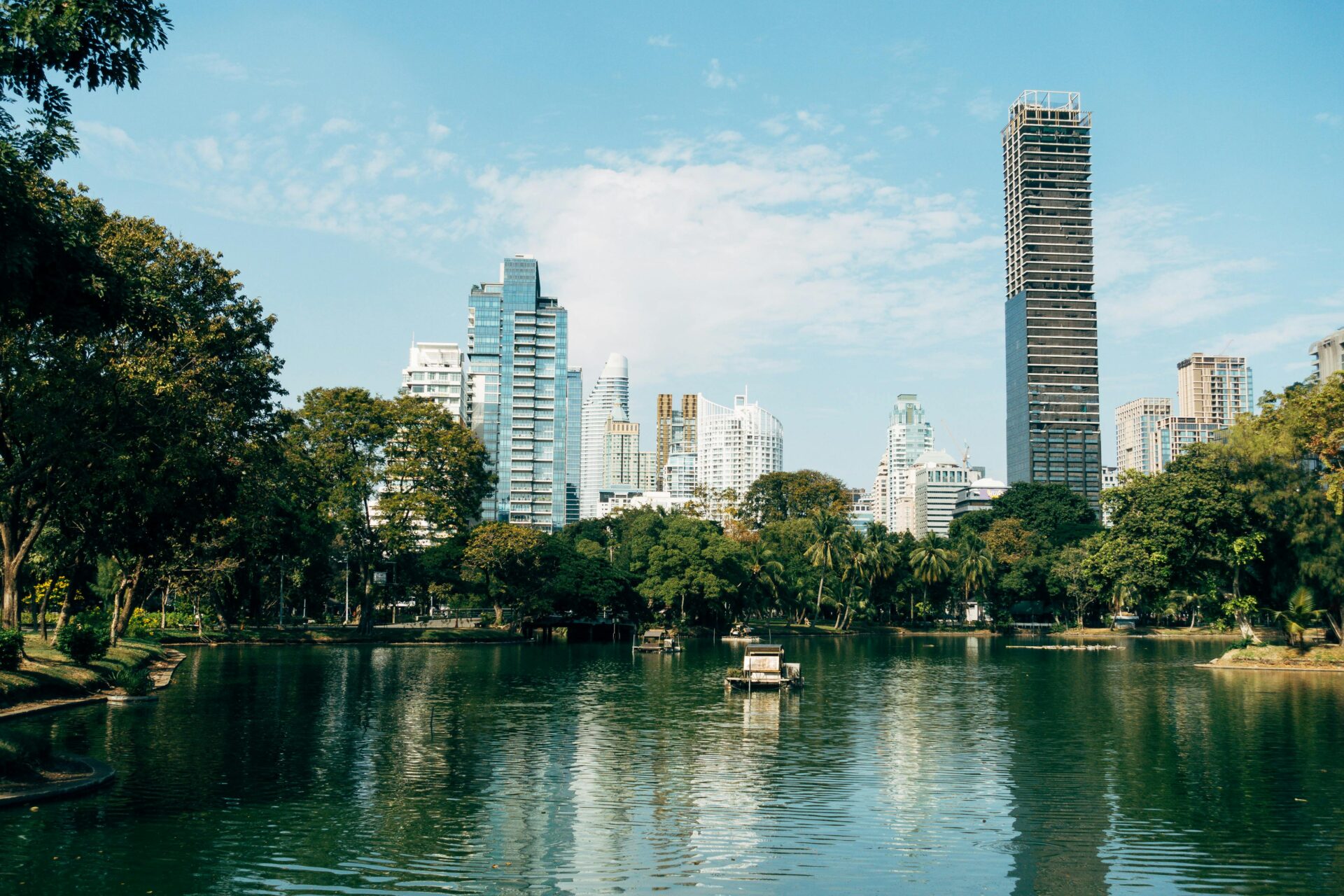
The green lung of central Bangkok — 57 hectares of park in the heart of the city, the resident monitor lizards (Asian water monitors up to 2 metres long, entirely habituated to humans, visible basking on the lake banks throughout the afternoon) a specific Bangkok experience. Free entry.
The park at 2pm: the tai chi groups, the joggers, the office workers on lunch, the monitor lizard on the path that nobody avoids because everybody knows it’s harmless.
4:00pm — Sukhumvit and the Sky Bar
BTS to Asok or Phrom Phong. The Sukhumvit corridor — the international Bangkok of the embassies and the expat restaurants and the rooftop bars. The Vertigo Bar at the Banyan Tree Hotel (61st floor, open-air, the 360-degree panorama over Bangkok): drinks from 500 baht / £11.40, the view priceless. Sunset at approximately 6:30pm.
7:00pm — Soi 38 Night Market or Terminal 21 Food Court
Soi 38 (Sukhumvit Soi 38): The classic Sukhumvit-area night market — pad thai vendors operating since 1997, mango sticky rice, grilled meats. Dinner: 150-250 baht / £3.40-5.70 per person.
Terminal 21 Food Court (5th floor): The most popular affordable food court in Sukhumvit — dishes from 39-70 baht / £0.89-1.60, airport-style ordering system, the entire range of Thai food in a single floor.
Essentials
Transport: BTS Skytrain (Rabbit Card — load at any station, 15 baht / £0.34 per journey) for the Sukhumvit and Silom areas. MRT for the old city area and Chatuchak. Grab (the regional Uber equivalent) for everywhere the trains don’t reach. River ferry: 15 baht / £0.34 (orange flag boat, the tourist route, Phra Arthit to Sathorn — 30+ stops, 60 minutes end to end).
When: Bangkok year-round. The cool season (November-February) is most comfortable (28-32°C vs 35-40°C in April). Avoid Songkran (Thai New Year, April 13-15) if not specifically coming for the festival — the water fight makes normal transit impossible.
Budget: £35-50/day all-in (accommodation budget guesthouse, street food, BTS, sites) to £70-100/day (mid-range hotel, mix of restaurants and street food, all sites).
What to Skip
Khao San Road: The backpacker area has its function. It is not Bangkok.
The tuk-tuk from the Grand Palace: The £2 tuk-tuk ride that “just happens to pass” a gem shop or a tailor. The driver’s commission from the shop is the point.
The river cruise dinner show: The content-free tourist experience on the Chao Phraya. Spend the same time at Yaowarat instead.