
The levadas — the irrigation channels cut into the cliff faces of the island over 500 years that now give Madeira the finest walking network in the Atlantic — the Monte toboggan that has been running from the hilltop church since 1850, the Mercado dos Lavradores in Funchal for the passion fruit (the maracujá) and the espada (the scabbardfish that lives at 1,000m depth and is Madeira’s most specific culinary product), and why Madeira in November is a better destination than Madeira in August despite what the charter flight market suggests.
Reading time: 9 minutes | Last updated: 2026
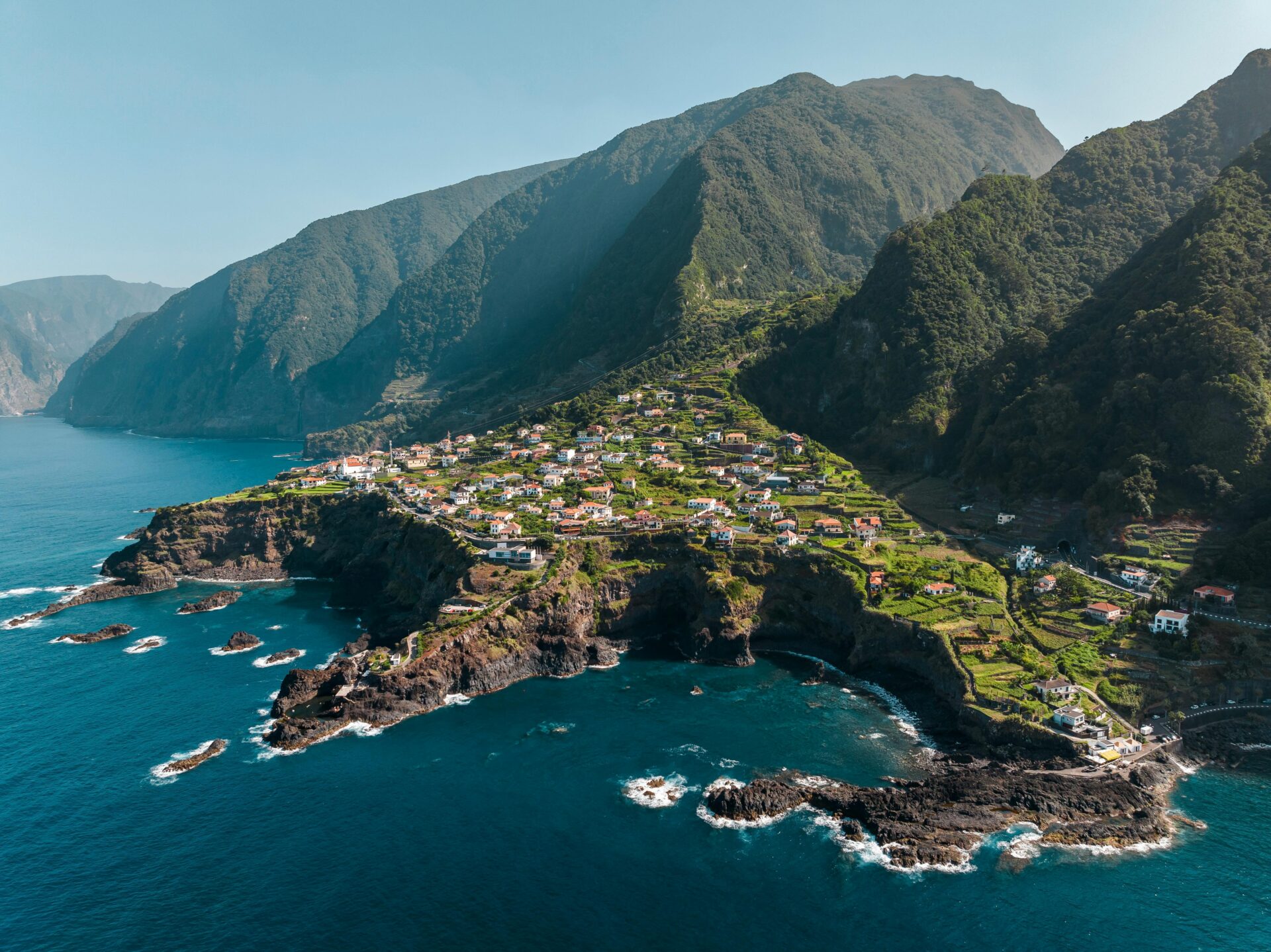
Madeira is a Portuguese island in the North Atlantic, 978km from Lisbon and 520km from the Moroccan coast — the closest major island to mainland Europe that is not in the Mediterranean. The island: 57km long, 22km wide, the terrain consisting almost entirely of mountain (the highest peak, Pico Ruivo, 1,862m) descending to the sea in the north on sheer cliff faces and in the south in the more gradual slopes where Funchal and the tourist infrastructure are concentrated.
The specific Madeiran landscape: the laurisilva (the laurel forest, UNESCO-listed, the last significant remnant of the ancient subtropical forest that covered much of Europe before the ice ages), the levadas (the irrigation channels that carry water from the wet north to the dry south — 2,500km of channels across the island, most with a maintenance path beside them that gives a ready-made walking network at any altitude), and the specific Atlantic light of an island positioned at 32°N where the cloud and the sun alternate continuously.
When to Go
Year-round destination — Madeira’s specific advantage: the mild climate (17-24°C throughout the year) makes it genuinely all-seasons. The north coast is wetter; the south coast (where Funchal is) is drier.
April-June: The levada walks in full spring flower (the agapanthus, the strelitzia, the hydrangea visible along the paths). The laurisilva at its greenest.
September-October: After the summer dryness, the first rains green the landscape. The Atlantic sea temperature at its warmest (23-24°C).
November-March: The quietest season. The Carnival (February) is the busiest weekend of the year.
Getting There
Funchal Cristiano Ronaldo International Airport (FNC): easyJet, Ryanair, Jet2, British Airways, TAP direct from UK airports. Return: £80-200. Flight time: 3.5 hours.
The Levada Walks
Levada do Caldeirão Verde (the most dramatic levada walk):
From Queimadas (the forest park, accessible by bus from Santana) — the levada path cuts along the cliff face for 5.5km (one way, 2.5 hours each way), tunnels through four short mountain tunnels (headtorch required), and ends at the Caldeirão Verde — the green cauldron, the waterfall falling 100m into a lake surrounded by the laurisilva. The tunnel sections are the most specific Madeiran levada experience: the path narrows to 50cm, the levada immediately beside the path, the cliff wall on one side and the drop on the other, the darkness of the tunnel broken by the headtorch.
Levada do Rei (the easiest):
A flat, easy 4.5km walk through the laurisilva near São Jorge on the north coast — the most accessible introduction to the levada system for visitors without hiking experience.
The Pico Ruivo Summit:
From Achada do Teixeira (accessible by road to 1,592m) — a 45-minute walk to the summit at 1,862m, the highest accessible point in Madeira. Views over the full island on clear days (clear summit days occur approximately 3-4 days per week throughout the year).
Funchal
The Mercado dos Lavradores (the workers’ market) — the covered market with the flower sellers on the ground floor (the bird-of-paradise flowers, the proteas, the anthuriums that are Madeira’s primary export), the fruit stalls on the upper floor, and the fish market in the basement. The espada (the scabbardfish — the elongated black fish with the permanently open jaw that lives at 800-1,000m depth and can only be brought to the surface at night) displayed in the fish section.
The Monte toboggan: from the Monte church (reached by the Funchal cable car — €15 / £12.93 one way) to Funchal centre, the traditional wicker toboggan steered by two men in white uniforms and straw hats running alongside. Operating since 1850, the trip takes 10 minutes over 2km of downhill Funchal road. €30 / £25.83 per person (2-3 people per toboggan).
Madeira Wine
The fortified wine of Madeira — unlike any other wine in the world because it is deliberately oxidised and heated during production (the estufagem process — the heating of the wine in large tanks at 45-50°C for 3 months minimum, a process that would ruin any other wine but that stabilises and concentrates the Madeira wine in a way that gives it a potential lifespan of 200+ years).
The four styles by grape variety: Sercial (the driest, the most acidic, best as an aperitif), Verdelho (medium dry), Bual (medium sweet, the most versatile for pairing), Malmsey (the sweetest, the after-dinner wine). At the Blandy’s Wine Lodge in Funchal (the oldest wine merchant in Madeira, tours and tasting from €15 / £12.93): the full range in the cellar of the former 18th-century convent.
Practical Notes
Car hire: essential for the levada access and the north coast exploration. The roads are narrow, winding, and frequently terrifying (the north coast road between Santana and Porto Moniz is a specific driving experience — vertical cliffs above, vertical cliffs below). Hire a small car. £25-40/day.
The Funchal cable car (to Monte) and the Teleférico do Funchal (from Monte to Jardim Botânico): both give the island view without the driving commitment. €15 / £12.93 one way, €20 / £17.24 return each cable car.