
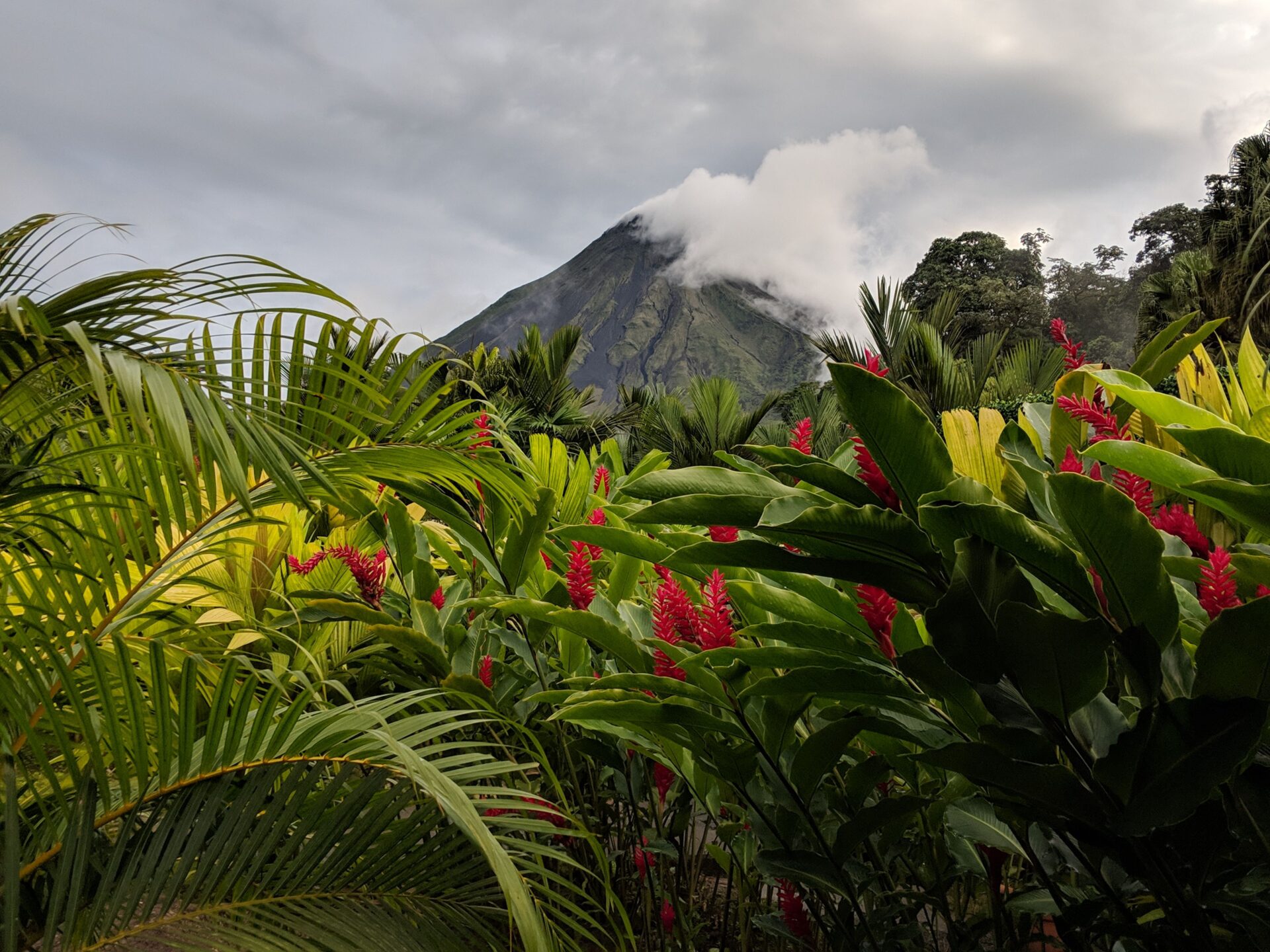
The route that gives Costa Rica its full ecological argument in seven days without the car-rental anxiety that most Costa Rica itineraries require: three days in the Arenal-Monteverde zone for the hanging bridges and the cloud forest and the volcano at 3pm when the cloud breaks and the cone appears for the 2-hour window that makes the base camp stay worthwhile, two days on the Osa Peninsula for the Corcovado National Park and the scarlet macaw visible from the lodge breakfast terrace and the specific southern Pacific coast that most Costa Rica visitors never reach because the bus takes 7 hours, and two days in the Manuel Antonio National Park for the white-faced capuchin monkeys on the beach and the sloth visible in the cecropia tree at the park entrance and the specific Manuel Antonio quality of the national park beach accessible only through the park gate at 7am.
Reading time: 11 minutes | Last updated: 2026
Costa Rica is 51,100 square kilometres — the country that contains 5% of the world’s biodiversity in 0.03% of the world’s land area. The ecological density gives the country its specific tourist proposition: the wildlife visible from the road, from the hotel breakfast table, from the park trail within 30 minutes of the trailhead. The scarlet macaw pair visible from the Osa Peninsula lodge terrace at 6am requires no specialist guiding and no 5-hour trek. They are simply there because the forest is there.
Before You Leave
The visa: UK citizens enter Costa Rica visa-free for 90 days.
The car: The Arenal-Monteverde and Manuel Antonio sections are car-accessible (the road quality good on the main routes). The Osa Peninsula requires either the domestic flight to Puerto Jiménez (Sansa Air, USD 120-180 / £94.49-141.73 one way) or a 7-hour bus journey. The domestic flight is correct.
The season: December-April (the dry season) for the Pacific coast (the Manuel Antonio, the Osa Peninsula). May-November (the green season) for the wildlife density — the animals more active and more concentrated in the green season, the prices 20-30% lower, the visitor numbers 40-50% lower.
The Route
San José → Arenal/La Fortuna (3 nights) → Monteverde (day trip from Arenal) → fly La Fortuna to Puerto Jiménez → Osa Peninsula/Drake Bay (2 nights) → fly Puerto Jiménez to Quepos → Manuel Antonio (2 nights) → fly Quepos-San José, fly home
The 7 Days
DAYS 1-3 — Arenal
Day 1: The Arenal Volcano and La Fortuna Waterfall
The La Fortuna Waterfall (the 70-metre waterfall on the Río Fortuna, accessible by the 500-step descent from the car park — the waterfall pool at the base, the swimming in the volcanic-rock pool at the cascade base, the temperature at 20-22°C from the highland spring source):
Entry: USD 18 / £14.17. The steps down are steep; the steps up are the exercise that the Costa Rica visitor recalls most viscerally 48 hours later.
The Arenal Volcano (the full guide in Costa Rica with Kids): the 3pm-5pm weather window for the cone visibility.
Day 2: The Hanging Bridges (Arenal)
The Mistico Arenal Hanging Bridges (the 16-bridge trail through the Arenal highland forest — the 6 suspension bridges, the longest at 98 metres, the forest visible from below and from above the canopy simultaneously): the full guide in Costa Rica with Kids.
The specific Mistico addition for the extended guide: the dawn walk (the 6am entry at the park opening — the howler monkey audible from the first suspension bridge, the sound that the dawn Costa Rica forest produces (the deep bass roar that carries 2km through the forest, the most alarming sound that any bird or mammal in the Costa Rica forest produces, the sound that the first-time visitor interprets as a large mammal predator and that is in fact a 7kg monkey)).
Day 3: Monteverde Day Trip
The Santa Elena Reserve (the northern alternative to the Monteverde Cloud Forest Reserve — fewer visitors, the same cloud forest ecosystem, the resplendent quetzal and the three-wattled bellbird in the same forest as the Monteverde reserve at 40% of the entry cost): USD 20 / £15.75.
The Monteverde Butterfly Garden (the 7-species butterfly enclosure, the morpho butterfly — the iridescent blue wing visible in the flight, the specific underside (the brown, the eye pattern) different from the upper surface in the way that gives the butterfly its specific camouflage): USD 15 / £11.81.
Return to Arenal.
DAYS 4-5 — Osa Peninsula
The domestic flight:
The Sansa Air service from the La Fortuna airstrip to the Puerto Jiménez airport (2 hours including the San José stop, USD 120-180 / £94.49-141.73 one way).
Drake Bay:
Drake Bay (the village on the Drake Bay in the Osa Peninsula’s northwest corner — the departure point for the Corcovado National Park guided tours, the area that Sir Francis Drake reportedly anchored in 1579, the specific Costa Rica wilderness that the National Geographic has described as the most biodiverse place on Earth per unit area):
The Corcovado National Park:
The Corcovado entry (the San Pedrillo or the La Leona entrance, accessible only with a certified naturalist guide — the unguided entry prohibited since 2014): USD 15 / £11.81 park entry + the certified naturalist guide (USD 40-80 / £31.50-62.99 per half-day depending on the group size and the guide).
The Corcovado wildlife: the Baird’s tapir (the largest native land mammal in Central America — the tapir following the river courses through the forest, visible at the beach edges at dawn and dusk), the white-lipped peccary (the herd animal of the lowland forest — the herd of 50-200 peccaries moving through the forest, the specific sound (the teeth clacking) audible before the herd is visible), the harpy eagle (the largest eagle in the Americas — the eagle visible only in the deep forest interior, the Corcovado interior trail the highest probability location in Costa Rica), and the 13+ resident primate species.
The scarlet macaw:
The scarlet macaw (Ara macao — the red-and-blue parrot, the species that has recovered from near-local-extinction in the Osa Peninsula through the conservation work funded by the eco-lodge economy): the macaw pair visible from the Drake Bay lodge breakfast terrace at 6am, flying between the almond trees on the beach edge, the species that the visitor who arrives at the Osa Peninsula for the first time and sees immediately from the breakfast table typically describes as the best wildlife encounter of their life.
DAYS 6-7 — Manuel Antonio
The domestic flight:
The Sansa Air service from Puerto Jiménez to Quepos (45 minutes, USD 80-120 / £62.99-94.49 one way).
The Manuel Antonio National Park:
The Parque Nacional Manuel Antonio (the most visited national park in Costa Rica — the 6 beaches, the capuchin monkey packs, the 3-toed sloth in the cecropia trees at the entrance, and the specific Manuel Antonio quality of the Pacific beach accessible only through the national park gate):
The 7am park entry:
The park opens at 7am; the daily entry is capped at 1,500 visitors. The visitor who arrives at 6:45am for the 7am opening has the first hour of the park — the beach before the midday crowd, the capuchin monkeys at their most active in the cool morning — and the certainty of entry. The visitor who arrives at noon risks finding the capacity reached.
Entry: USD 22 / £17.32 adult.
The Manuel Antonio wildlife:
The white-faced capuchin (the monkey that approaches the visitor on the beach, the specific Manuel Antonio wildlife encounter that the guide describes as “intelligent” and that the visitor describes as “bold” and that the beach vendor describes as “a thief” — the capuchin monkeys of Manuel Antonio have learned that the beach visitor carries food, that the bag can be unzipped, and that the sprint is faster than the human):
The specific Manuel Antonio monkey instruction: do not feed the monkeys (the park regulation and the conservation guideline), do not leave food unattended on the beach, and do not interpret the capuchin’s approach as an invitation to interact. The monkey is assessing whether you have food and whether the food is accessible. The answer should be: no, and no.
The Bioluminescent Bay (evening):
The Damas Island mangrove kayak (the night kayak through the Damas Island mangrove channels — the bioluminescent plankton (Noctiluca scintillans) visible as the paddle stroke disturbs the water, the blue-green light visible in the paddle’s wake, the mangrove visible in the near-total darkness by the bioluminescence alone): USD 40-65 / £31.50-51.18 per person. The season dependency: the bioluminescence is strongest in the dry season (December-April) when the plankton concentration is highest.
What It Costs
| Category | Budget | Mid-Range |
|---|---|---|
| Return flights (UK-San José) | £550-900 | £750-1,200 |
| Domestic flights (La Fortuna-Jiménez, Jiménez-Quepos, Quepos-SJO) | £190-380 | £250-500 |
| 7 nights accommodation | £210-490 | £490-1,050 |
| Food (7 days) | £80-180 | £180-380 |
| Activities (bridges, Corcovado guide, park entries) | £100-200 | £150-300 |
| Total | £1,130-2,150 | £1,820-3,430 |