
The monks collecting alms at dawn on a street that has been doing this since the 14th century, the Mekong at the point where the Nam Khan joins it, Kuang Si waterfall and the turquoise pools below it, the night market that operates on the same street every evening without becoming a tourist trap, the 33 Buddhist temples in a city of 56,000 people, and why Luang Prabang is the finest small city in Southeast Asia.
Reading time: 9 minutes | Last updated: 2026
Luang Prabang is a UNESCO World Heritage city at the confluence of the Mekong and the Nam Khan River in northern Laos — a city of 56,000 people with 33 Buddhist temples, a population of approximately 800 monks, and a specific quality of life that has been described by every writer who has visited it as unlike anywhere else in Southeast Asia.
The comparison that most accurately frames it: Luang Prabang is what Hoi An was before it became what Hoi An is now. The old city is intact. The temples are functioning. The monks are real. The night market is not primarily a tourist product. The French colonial buildings on the peninsula between the rivers are inhabited by Lao families, not boutique hotels in every case. The rhythm of the city — the temple bells, the alms-giving ceremony at dawn, the market, the evening — is its own rhythm rather than a performance of itself.
This will change. The airport has been expanded. The Chinese high-speed rail now connects Vientiane to Boten on the Chinese border, with Luang Prabang on the route. The visitors are increasing. The window for Luang Prabang before the full transformation is open now.
The Tak Bat — Alms-Giving Ceremony
Every morning at dawn — the specific time changes with the season but is typically between 5:30am and 6:30am — the monks of Luang Prabang’s 33 temples walk in procession through the streets to collect alms (food offerings from the lay population). The ceremony (tak bat, or sai bat) is the most important daily ritual in Theravada Buddhist practice: the monks receive food, the givers accumulate merit, the relationship between the monastery and the lay community is maintained.
The procession at 6am on the main street (Sisavangvong Road): the monks in saffron robes, the barefoot walk on the cold morning street, the women kneeling to offer sticky rice from woven baskets.
The ethics of watching:
The tak bat has become the most visited morning event in Luang Prabang, and the tourism around it has created genuine problems — tourists who approach too closely, who use flash photography, who distribute inappropriate foods. The Buddhist community has asked for respectful observation from a distance.
The correct approach: stand or sit quietly on the opposite side of the street from the ceremony, at least 5 metres back. No flash. No approaching the monks. No joining the alms-giving line unless you have been specifically invited by a local family with whom you are staying. Observe from a respectful distance.
The ceremony in the early morning light — the saffron against the French colonial buildings, the steam from the rice bowls, the specific morning quality of the Nam Khan mist — is available for observation from this respectful distance and is extraordinary.
The Temples
Wat Xieng Thong: The finest temple in Luang Prabang — built in 1560, the low sweeping rooflines (the “flame” design, the roof extending almost to the ground on each side) a specifically northern Lao architectural style found nowhere else. The back wall of the sim (the main sanctuary): a “tree of life” mosaic in coloured glass on a black background, the finest single decorative element in any Luang Prabang temple. The funeral carriage house (adjacent to the main sim): the elaborate gilded carriage used for royal funerals, the largest in Southeast Asia.
Entry: 20,000 kip / £0.85.
Wat Mai: Adjacent to the former Royal Palace — the most elaborate temple facade in Luang Prabang, the five-tiered roof and the gold relief panels on the portico depicting the story of the last Buddha’s earthly life (Jataka tales) in a specific northern Lao style. The longest surviving temple in Luang Prabang (continuously operating since 1796).
Phu Si Hill: The hill at the centre of the old city peninsula — 328 steps to the summit, the That Chomsi stupa at the top, the finest panorama over the old city and the two rivers. At sunset: crowded. At sunrise (before the tak bat): empty, the city below in the morning light, the Mekong and the Nam Khan visible simultaneously.
Entry to the hill: 20,000 kip / £0.85.
Kuang Si Waterfall
30km south of Luang Prabang — a multi-tiered travertine waterfall feeding a series of turquoise pools, the same calcium carbonate chemistry as the Plitvice Lakes in Croatia or Hierve el Agua in Mexico, the colour produced by the dissolved minerals in the water.
The lowest pools are swimmable (cool — the water is 18-20°C, refreshing rather than warm). The walk to the upper waterfall takes 20-30 minutes through forest. The full height of the waterfall system: approximately 50 metres.
The Kuang Si Bear Sanctuary at the waterfall entrance: Asiatic black bears rescued from illegal wildlife trade, rehabilitated in an enclosure adjacent to the waterfall. The sanctuary is one of the few places in Laos where the bears can be observed at close range. Entry to the waterfall and sanctuary: 20,000 kip / £0.85.
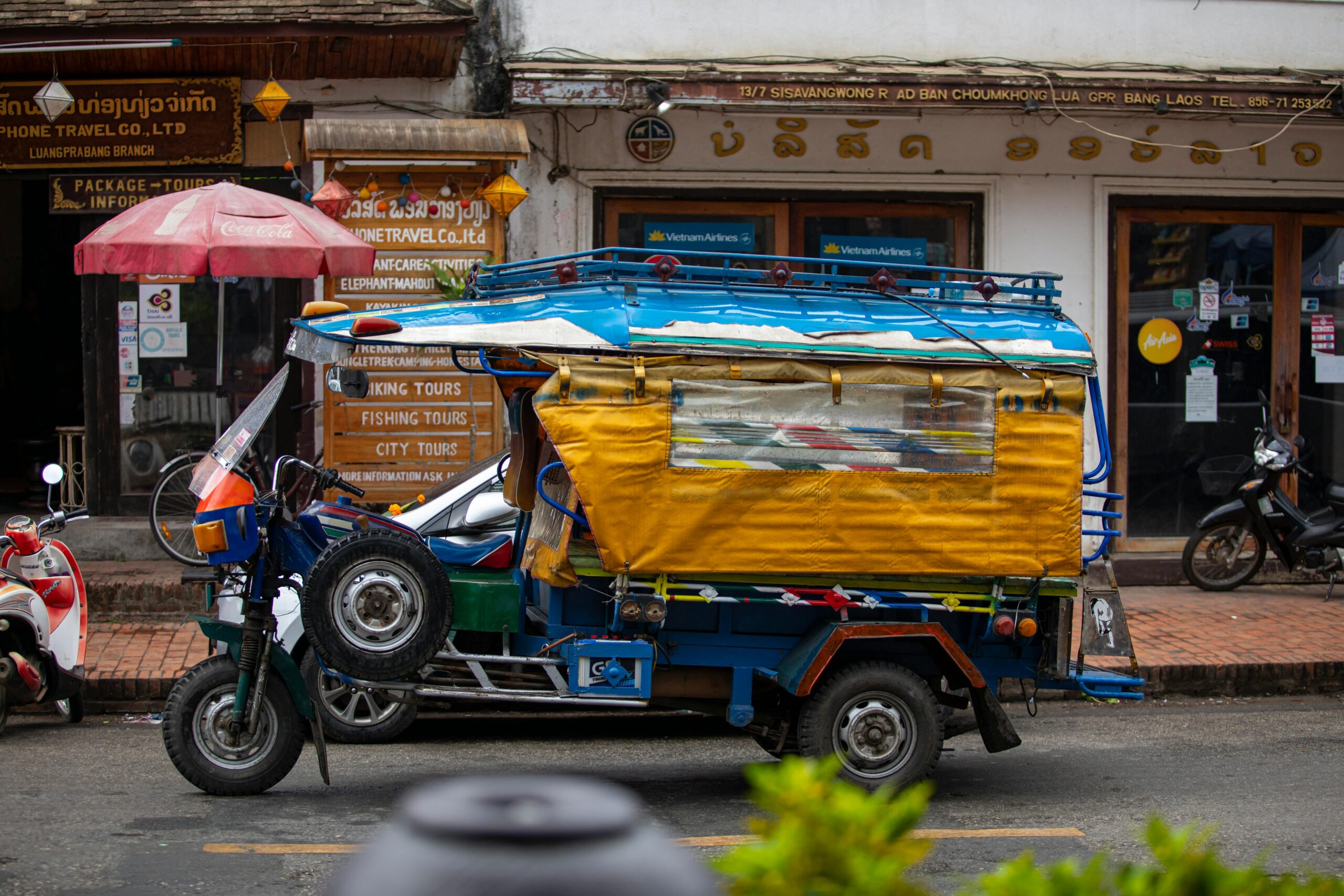
Getting there: Tuk-tuk from Luang Prabang: 40 minutes each way, 80,000 kip / £3.40 per person (shared) or 200,000 kip / £8.50 for a private tuk-tuk. Go at opening time (8am) before the tour groups arrive from 9:30am.
The Night Market
The Luang Prabang night market operates on Sisavangvong Road every evening from 5pm — the handicraft vendors setting up their stalls as the sun goes down, the silk textiles, the silver jewellery, the handmade paper products, the Hmong embroidery from the mountain villages.
The specific quality: the night market has not become primarily a food and entertainment market. The handicrafts are genuine — the silk weavers visible at their looms in the surrounding villages produce the same textiles sold at the stalls. The prices are fixed and honest (no prolonged negotiation, unlike some Southeast Asian markets).
The market ends at approximately 10pm. Prices are best in the final 30 minutes when vendors begin packing.
Essentials
Getting to Luang Prabang: Luang Prabang International Airport (LPQ): direct flights from Bangkok (1.5 hours, Bangkok Airways — the most consistent service), from Vientiane (1 hour), from Hanoi (1 hour). From UK: fly to Bangkok and connect. Alternatively: the Laos-China high-speed railway from Vientiane (accessible from Bangkok by overnight train) to Luang Prabang — a 2.5-hour train journey that opened in 2021 and transformed the Luang Prabang connection.
Where to stay: The Apsara (boutique, riverside, the finest mid-range option in the old city, £45-70/night). 3 Nagas by Alila (the finest full-service hotel in Luang Prabang, the old city location, pool, £120-200/night). Budget: the guesthouses on the streets off Sisavangvong Road, £12-20/night.
Visa: E-visa for UK passport holders, available at laoevisa.gov.la: $30 / £24 for a 30-day single entry.
The 3-Day Itinerary
Day 1: Arrive afternoon. Phu Si Hill at sunset (less crowded than its reputation). Night market.
Day 2: 5:45am tak bat (observe respectfully from the opposite pavement). Kuang Si Waterfall (depart 8am, return by noon). Afternoon: Wat Xieng Thong and Wat Mai. Evening: riverside restaurant on the Mekong.
Day 3: Morning boat on the Mekong (the cave temples of Pak Ou — two caves filled with thousands of Buddha images donated by pilgrims over 600 years, 25km upstream, 2 hours by slow boat). Afternoon: the Traditional Arts and Ethnology Centre (the finest museum in Luang Prabang, covering the material culture of Laos’ 49 ethnic groups, entry 30,000 kip / £1.30). Evening departure or extension to the Plain of Jars.
The Closing Moment
I was on Phu Si Hill at 6:10am. The monks were still visible on the streets below — the procession ending, the last saffron figures disappearing into the temples on the south side of the peninsula. The Nam Khan River was catching the first light. The Mekong beyond it was grey-green.
33 temples in a city of 56,000 people. The proportional density of temple to population — roughly one temple per 1,700 people — is unlike anywhere else in Southeast Asia. The monks who inhabit them are young (many boys spend a period of their adolescence as novice monks) and old and every age between.
The city that contains them is small enough to walk end to end in 20 minutes. It has been here since the 14th century. The specific quality it has — the river, the temples, the morning ceremony, the market — is not manufactured. It is the place being itself.
Go before it isn’t.