
The complete guide for UK travellers: the Valley of the Kings at 6am before the tour buses, Abu Simbel explained and the sunrise worth the 3am departure, Dahab’s world-class diving and the reason it’s better than Sharm, Siwa Oasis and its 2,500-year-old oracle, the Nile by felucca, what the tourist scams look like and how to navigate them, and why Egypt is one of the most extraordinary trips available from the UK — done right.
Reading time: 17 minutes | Last updated: 2026
Egypt is the country that invented monumental architecture and has been receiving travellers who want to see it for approximately 2,500 years.
Herodotus visited in 450 BC and wrote about the pyramids. Napoleon arrived in 1798 with 150 scientists and began the field of Egyptology. The Thomas Cook Company ran the first package Nile tours in 1869. By any measure, Egypt is the oldest continuous tourist destination on Earth, and the infrastructure — the guides, the hotels, the logistics around the major sites — reflects 25 centuries of practice.
All of which means: the tourist economy is sophisticated, the major sites are comprehensively organised, and navigating the gap between the experience being sold and the experience available is a specific skill that this guide is designed to give you.
Because the experience available in Egypt — the Valley of the Kings in the early morning before the tour buses arrive from Hurghada, the 3am departure that delivers you to Abu Simbel as the sun rises and illuminates the inner sanctuary for the 21 minutes per year it was designed for, the felucca drifting south from Aswan through palm-lined banks, the desert silence of Siwa where Alexander the Great came to consult an oracle in 331 BC — is genuinely extraordinary.
The difference between a good Egypt trip and a disappointing one is almost entirely about timing, planning, and knowing which advice to take.
Quick Navigation
- The Case for Egypt — The Scale of What’s Here
- When to Go — The Nile, the Desert, and the Coast
- Cairo — The City That Never Slows Down
- The Pyramids — What the Experience Actually Is
- The Egyptian Museum and the New Grand Egyptian Museum
- The Nile Corridor — Luxor and Aswan
- Luxor — The Valley of the Kings
- Aswan — The Nile at Its Most Beautiful
- Abu Simbel — The 3am Departure That’s Worth It
- Cruising the Nile — The Felucca vs the Cruise Ship
- Dahab and the Sinai — The Diving and the Desert
- Siwa Oasis — The Oracle and the Desert Silence
- The Western Desert — White Desert and the Black Desert
- Navigating the Tourist Scam Economy — The Honest Guide
- What It Costs — Real Numbers
- Eating in Egypt — Koshary and Everything Else
- Practical Notes
- Two Itineraries — Classic Nile and the Extended Circuit
The Case for Egypt — The Scale of What’s Here
The statistics exist in a different category from any other destination in this guide.
The Great Pyramid of Giza (2,560 BC) was the tallest man-made structure on Earth for 3,800 years. The 146-metre height was surpassed only in 1311 CE by the Lincoln Cathedral spire. The construction required an estimated 2.3 million stone blocks with an average weight of 2.5 tonnes, placed with a precision that allowed for a final height error of less than 2cm over the full structure. The engineering methodology remains subject to scholarly debate 4,500 years after completion.
The Valley of the Kings contains 63 known tombs of New Kingdom pharaohs and nobles, carved into the limestone cliffs above the floodplain of Thebes between 1539 and 1075 BC. The most famous is Tutankhamun’s (discovered 1922, nearly empty compared to what was looted from the others — yet still containing 5,398 artefacts including the gold death mask). The tomb of Seti I contains the finest artistic programme in the entire valley — hieroglyphic texts and painted scenes covering every surface of every room.
The Temple of Karnak is the largest religious complex ever built — a processional temple city that grew over 2,000 years, each pharaoh adding to what the previous one built. The Hypostyle Hall (134 massive columns, the tallest reaching 21 metres) was constructed for roughly 400 years between Ramesses II and the Late Period and appears regularly in discussions of the finest architectural spaces in human history.
None of this is close to home. None of it has a direct comparison.
Egypt is one of the most worthwhile trips available from the UK for travellers who want to understand where the concept of monumental human achievement came from. The flights are four hours. The entry visas are simple. The food is excellent and cheap. The experience is irreplaceable.
When to Go — The Nile, the Desert, and the Coast
Egypt’s climate divides by region more clearly than most:
October to April — The Nile Corridor and Cairo
The correct season for Cairo, Luxor, Aswan, and Abu Simbel. Temperatures are comfortable: 20-28°C in Luxor, 15-22°C in Cairo. The summer heat (June-August) in Upper Egypt (Luxor, Aswan) is brutal — 40-45°C, making any outdoor archaeology an endurance exercise rather than an experience.
Year-Round — The Red Sea Coast
Sharm el-Sheikh, Hurghada, and Dahab are beach and dive destinations that function year-round. Water temperature stays above 22°C even in winter. Summer is hot (35-40°C air temperature) but the sea remains the point. The dive season in the Sinai (Dahab specifically) is arguably better in winter when the Red Sea is slightly cooler and the marine life is more active.
March to May and October to November — Siwa and the Western Desert
The desert oasis of Siwa and the White and Black Desert circuit (accessible from Cairo via Bahariyya Oasis) are best in the shoulder seasons — not too hot for the desert drives, not too cold for camping. March and October are the sweet spots.
The BGGD Recommendation:
October to March for the complete Egypt circuit: comfortable archaeology, good diving, manageable desert. Specifically: November or February (avoiding the Christmas peak and the midsummer heat simultaneously).
Cairo — The City That Never Slows Down
Cairo is the largest city in Africa and the Arab world — 21 million people in the greater metropolitan area, sprawling across both banks of the Nile, the most overwhelming city I’ve been to since my first days in Bangkok. The noise is continuous. The traffic operates by a system that looks like chaos from the outside and follows its own internal logic that takes three days to begin reading.
It is also one of the most energetic, historically dense, and visually extraordinary cities on Earth, and it earns its place on any serious traveller’s list without hesitation.
Islamic Cairo — The Medieval City
The historic centre (Islamic Cairo) contains 600+ significant historical buildings and one of the finest concentrations of Islamic architecture in the world, all within walking distance of each other.
Khan el-Khalili Bazaar: A market operating on this site since the 14th century — covered lanes of goldsmiths, spice vendors, glassblowers, textile merchants, and the tourist economy that has grown alongside them. The tourist-facing vendors are concentrated on the main lanes; the working market extends into the surrounding streets where the stalls are selling to Egyptian buyers rather than foreign visitors. Buy the spices (ras el hanout, dukkah, dried hibiscus) from the deep interior stalls at a third of the price of the entrance-lane shops.
Al-Azhar Mosque: Founded in 970 CE, the oldest functioning university in the world and the most important institution of Sunni Islamic scholarship. The mosque is open to non-Muslim visitors outside prayer times. The courtyard — white marble, the shaft of minaret above, the students studying in the shade — is one of the finest spaces in medieval Cairo. Free entry.
The Citadel of Saladin (Citadel of Cairo): A fortified complex above the city, begun by Saladin in 1176 and expanded by subsequent rulers. The Muhammad Ali Mosque (an Ottoman-style mosque built 1830-1848, its twin minarets and alabaster courtyard completely unlike anything else in Cairo) dominates the skyline. Entry to the citadel: £7. The view from the ramparts over the city and the Nile — the Pyramids of Giza visible on clear days to the southwest — is the finest urban panorama in Cairo.
The Hanging Church (Al-Muallaqah): A 3rd-century Coptic Christian church in Old Cairo (Masr el-Qadima) built on top of two Roman towers, suspended above the ground by its nave floor. One of the oldest Christian churches in the world in continuous use. The interior: icon screens, Coptic crosses, incense, the specific quiet of a place of worship that has been receiving worshippers for seventeen centuries.
Coptic Cairo
The neighbourhood around the Hanging Church contains: the Coptic Museum (the finest collection of Coptic Christian art in the world, including textiles, manuscripts, and carved stone from the 4th-12th centuries — entry £5), the Ben Ezra Synagogue (the site where Moses is said to have been found in the bulrushes, now a beautifully restored 9th-century building), and the ancient streets of the Roman fortress of Babylon that preceded Islamic Cairo by a millennium.
The Pyramids — What the Experience Actually Is
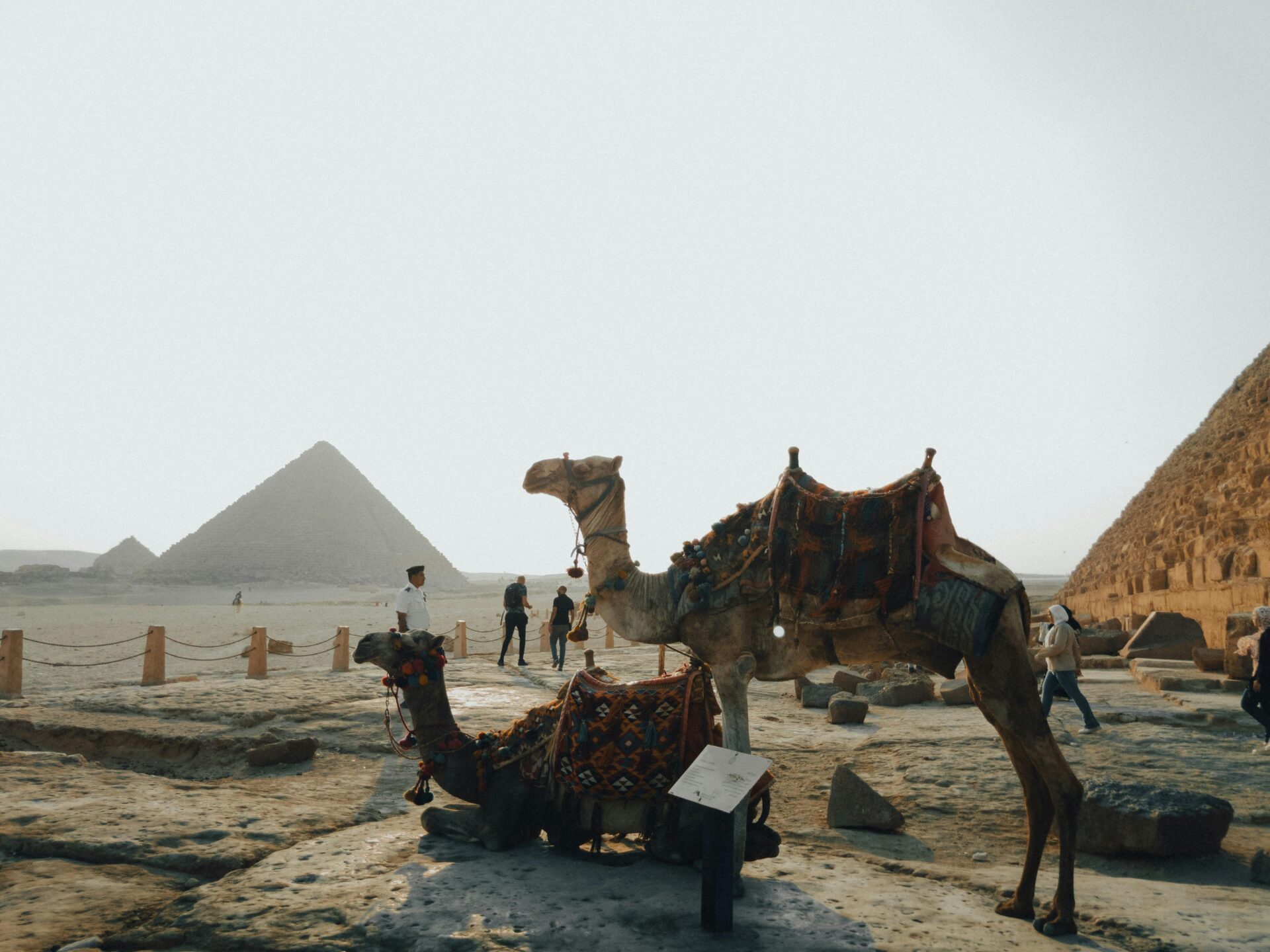
The Pyramids of Giza sit on a plateau southwest of Cairo, accessible by taxi (30 minutes from central Cairo, £8-12 negotiated in advance) or by metro and minibus (45 minutes, £0.70). They are visible from the Cairo highway as you approach — three triangular profiles above the desert horizon.
The experience at the pyramid plateau is different from any photograph of it because the photographs don’t show the city. Cairo extends to the edge of the pyramid complex on three sides. The suburban sprawl, the apartment blocks, the traffic — all visible from the Great Pyramid’s base. This is not a remote desert monument. It is the most famous landmark in a city of 21 million people.
The pyramids themselves don’t require explanation — they are as large, as old, and as extraordinary as every account suggests. Standing at the base of the Great Pyramid, the limestone blocks rising above you at a gradient that requires your head to tilt back significantly to see the summit, the scale simply doesn’t fit into normal human reference points for what a building is.
The Sphinx: Between the Pyramids of Chephren (the middle pyramid) and the valley below — carved from a single outcrop of limestone, 73 metres long and 20 metres high, the face weathered but the form intact. Best seen from the east (the viewing terrace in the Sphinx enclosure) and from the desert plateau above.
The Solar Boat Museum: Adjacent to the Great Pyramid, a museum containing the 4,500-year-old cedar boat discovered sealed in a pit beside the pyramid in 1954. The boat was assembled from 1,224 cedar planks without a single nail — wooden pegs and rope lashings only. The scale (43.4 metres long) and the state of preservation are extraordinary. Entry: £12. Worth 45 minutes.
The timing: Arrive at gate opening (8am). The site is large enough that even in peak season the first hours have manageable density. By 10am, the tour buses from Hurghada and Cairo’s major hotels have arrived. The plateau is genuinely crowded by noon. Go early, spend two hours, leave before midday.
What not to buy: Papyrus, alabaster figurines, or any souvenir from vendors on the plateau or at the taxi drop-off. These items are available in the same quality for one-fifth of the price in the Khan el-Khalili bazaar in Cairo. The pressure at the plateau is significant and persistent — the single most effective response is to keep walking.
The Egyptian Museum and the New Grand Egyptian Museum
The Egyptian Museum (Tahrir Square):
The original Egyptian Museum, opened in 1902, contains the most important collection of ancient Egyptian artefacts in the world. The Tutankhamun galleries (the death mask, the golden coffins, the canopic shrine) are the most visited rooms — arrive at opening and go there first. The Royal Mummy Room: eleven royal mummies from the New Kingdom including Ramesses II (who lived to approximately 90 years of age, died around 1213 BC, and is in extraordinary condition 3,200 years later). Entry to the mummy room: additional £5.
The museum building itself is as significant as the collection — a neoclassical structure from the early 20th century, the artefacts displayed in an arrangement that hasn’t fundamentally changed in decades, the labels sometimes in French only, the overall impression one of tremendous historical weight barely contained by the architecture.
Entry: £9.
The Grand Egyptian Museum (Giza):
Opened fully in 2024 after years of construction, the Grand Egyptian Museum (GEM) sits adjacent to the Giza plateau and is designed to eventually replace the Tahrir Square museum as the primary repository for Egypt’s antiquities. The scale: 490,000 square metres, the largest archaeological museum in the world.
The GEM’s centrepiece is the complete Tutankhamun collection — all 5,398 artefacts from the tomb, finally displayed together in dedicated galleries after being split across rooms at the Tahrir museum since 1923. This is the reason to visit the GEM specifically and is, by all accounts, one of the finest single archaeological displays in the world.
Entry: £22. Worth every pound for the Tutankhamun galleries alone.
The recommendation: visit both. The Tahrir museum for the history and atmosphere of the collection, the GEM for the Tutankhamun display and the state-of-the-art presentation.
The Nile Corridor — Luxor and Aswan
The Nile Valley from Cairo south to Abu Simbel is the spine of ancient Egypt — the narrow fertile strip between the desert on both sides where the civilisation that built the pyramids lived, farmed, and built for 3,000 years. The density of archaeological sites is extraordinary: every few kilometres, another temple, another tomb complex, another ancient city.
Getting there: domestic flight from Cairo to Luxor (1 hour, from £40 one way) or the overnight sleeper train (Cairo → Luxor, 10-12 hours, Abela Egypt sleeper train, from £30 for a 2-berth cabin — one of the finest overnight train experiences in the Middle East).
Luxor — The Valley of the Kings
Luxor sits on the site of ancient Thebes — the most important city in Egypt during the New Kingdom (1550-1077 BC). The city is bisected by the Nile: the East Bank (where Luxor and Karnak temples stand, where the living city operated — Egyptians built their temples on the east bank where the sun rose) and the West Bank (where the necropolis was — the Valley of the Kings, the Valley of the Queens, the workers’ village of Deir el-Medina, the mortuary temples, all on the west bank where the sun set).
Karnak Temple Complex:
The largest religious complex ever built. A UNESCO World Heritage site and the second-most visited site in Egypt after the Pyramids. The main approach: the Avenue of Ram-Headed Sphinxes (recently extended to connect Luxor Temple 2km south — the full ancient processional route is now walkable). The Precinct of Amun-Re (the main complex): the Sacred Lake, the Hypostyle Hall (134 columns, the tallest at 21 metres), the obelisks of Thutmose I and Hatshepsut, the inner sanctuaries.
Entry: £10. Arrive at 6am when the gates open — the Hypostyle Hall in the first morning light, the sun coming in low through the column forest, is the finest architectural experience in Egypt. By 9am, tour groups fill the hall.
Luxor Temple:
On the East Bank beside the Nile, a 3,400-year-old temple begun by Amenhotep III and completed by Ramesses II. The first courtyard: the colossus of Ramesses II flanking the entrance pylon. The Abu el-Haggag Mosque, built into the upper level of the temple in the 13th century (when the temple was buried under silt, the mosque at what was then ground level — as the temple was excavated the mosque remained, sitting improbably on the ancient walls). The Avenue of Sphinxes extending north toward Karnak.
Best at night: the temple is floodlit and the evening visit (from 6pm) gives the colossal scale in golden light without the midday heat. Entry: £10.
Valley of the Kings (West Bank):
The standard ticket covers three tombs of your choice (from approximately 25 currently open). The additional-charge tombs (Tutankhamun, Ay, Seti I) require separate tickets.
Seti I (additional £18): The finest tomb in the valley. 120 metres long, the deepest, the most completely decorated — every surface of every room and corridor covered in hieroglyphic texts and painted scenes from the Book of the Dead and the Amduat. The astronomical ceiling in the burial chamber is the finest surviving example of New Kingdom ceiling astronomy. This is the tomb you pay extra for.
Ramesses VI: Not an additional charge, included in the standard ticket, and the most complete painted ceiling in the valley — the Book of Caverns and Book of the Earth cover the ceiling in extraordinary detail.
Tutankhamun (additional £16): Deliberately not the most impressive tomb (the small scale is partly why it survived intact — not worth the robbers’ effort). The golden sarcophagus (the innermost of three nested coffins) still in situ in the burial chamber, Tutankhamun’s mummy inside it. The wall paintings — simpler than in the other tombs, hastily executed because the king died at 19 with minimal preparation. Worth visiting for the context, not for the decoration.
Hatshepsut’s Mortuary Temple (Deir el-Bahari): Adjacent to the Valley of the Kings, on the West Bank — a three-tiered temple built into a natural amphitheatre of cliffs. The only female pharaoh’s principal monument, and among the finest architectural compositions in Egypt. Entry included in the West Bank ticket combination.
The timing for the West Bank:
The Valley of the Kings opens at 6am. Take a taxi from Luxor centre to the West Bank ferry (£0.50) and a minibus on the far side — total time to the valley entrance, 30-40 minutes. Arrive at the valley gate by 6:15am. The hour between 6:15 and 7:15am before the first coaches is the version of the Valley of the Kings worth the early alarm.
Aswan — The Nile at Its Most Beautiful
Aswan is 220km south of Luxor — 3 hours by train, 1 hour by domestic flight. At 24°C in January and 40°C in August, the Aswan microclimate is warmer than Luxor (further south, closer to the Sahara).
Aswan is where the Nile becomes something different from the agricultural corridor of the north — the river widens, the banks are lined with palm trees and granite boulders, and the Elephantine Island sits in the middle of the current creating a landscape that has been painted, photographed, and described for centuries.
The Nubian Museum:
The finest museum in Upper Egypt, covering the Nubian civilisation from prehistory to the present. The collection includes artefacts rescued from the rising waters of Lake Nasser after the Aswan High Dam was completed in 1971 — the dam flooded a vast area of Nubia, displacing approximately 100,000 people and submerging hundreds of archaeological sites. The museum is partly a tribute to what was saved and partly a documentation of what was lost. Entry: £7.
The Unfinished Obelisk:
In a quarry on the southern edge of Aswan — an obelisk begun and abandoned in the reign of Hatshepsut (approximately 1460 BC), still lying in the bedrock where it was carved. It would have been 42 metres tall and 1,200 tonnes — the largest obelisk in history. The quarrymen discovered a crack in the stone and abandoned it.
The reason this is worth visiting: you see exactly how obelisks were made — the channels cut around the stone, the wooden wedges that would have been used to free it, the marks of the copper tools still visible in the rock. The mechanics of Egyptian quarrying are clearer here than anywhere. Entry: £4.
Elephantine Island:
The island in the middle of the Nile at Aswan, accessible by ferry (public ferry: £0.25, runs continuously). The Nubian villages on the island are the most authentic and intact in the Aswan area — painted houses (traditional Nubian colours: yellow, blue, green, orange), the community still navigating the balance between tourism and the daily life it was having before tourism arrived. The Aswan Museum on the island covers the archaeological history of Elephantine.
Abu Simbel — The 3am Departure That’s Worth It
Abu Simbel is 280km south of Aswan on the shore of Lake Nasser — the reservoir created by the Aswan High Dam. The two temples of Ramesses II (built approximately 1264 BC) were cut from the sandstone cliff by Ramesses as a monument to himself and to the gods, with the inner sanctuary of the main temple oriented so that the sun illuminates the four inner statues (Ramesses II, Amun-Ra, Ra-Horakhty, and Ptah) twice per year: February 22 and October 22 — believed to correspond to the dates of Ramesses’ birthday and coronation.
When the Aswan High Dam was constructed in the 1960s, both temples were going to be submerged by Lake Nasser. In one of the greatest feats of heritage rescue in history, UNESCO coordinated the cutting of both temples into 807 blocks (weighing up to 30 tonnes each), relocating them 64 metres higher and 200 metres back from the original position, and reconstructing them on an artificial cliff above the rising water. The project cost $80 million (1960s dollars) and took 4 years. The temple axes were maintained so the solar illumination phenomenon still occurs twice a year at the same dates. The scale of the relocation — and its success — is as impressive as the temples themselves.
Getting there:
Option 1: Convoys from Aswan (3.5-4 hours each way). The Aswan-Abu Simbel road runs through the eastern Sahara; the government requires foreign visitors to travel in convoy for security reasons. The convoy departs Aswan at 3am (arriving Abu Simbel at sunrise) or 11am. The 3am convoy is the non-negotiable choice: the temples at sunrise, before the day-trip coaches from Aswan, is the version that justifies the journey.
Option 2: Domestic flight from Aswan (45 minutes, from £70 one way). Faster, but removes the desert road context and arrives mid-morning after the first convoy.
Option 3: Stay overnight in Abu Simbel village. Two or three small hotels operate near the site — staying overnight allows the evening visit (when the tourist groups have returned to Aswan and the temples are almost empty) and the early morning entry before any convoy arrives. This is the finest version and requires advance booking of both accommodation and the site entry.
The temples:
The main temple of Ramesses II: four colossal statues of the seated pharaoh (21 metres each) flanking the entrance. Two of the original four are largely intact; one has lost its upper section in an ancient earthquake. The inner sanctuary: the four seated deities illuminated twice per year by the rising sun through a 65-metre corridor. The wall reliefs: the Battle of Kadesh (Ramesses’ claimed victory over the Hittites, depicted across an entire wall with a narrative specificity that no other battle scene in ancient Egypt matches).
The temple of Nefertari: the smaller temple adjacent, built by Ramesses II for his wife Nefertari — the only temple in ancient Egypt where a queen is depicted at the same scale as the pharaoh. Six statues on the facade alternating between Ramesses II and Nefertari. The interior: paintings of Nefertari in the presence of the gods, the finest painted reliefs in Upper Nubia.
Entry: £14 for both temples.
Cruising the Nile — The Felucca vs the Cruise Ship
The Felucca:
A traditional Nile sailboat — lateen-rigged, wooden, crewed by 2-4 people, accommodating 8-12 passengers on mattresses on deck under a canvas roof. The standard felucca trip runs from Aswan north toward Luxor over 2-3 days, stopping at villages on the riverbank, the island of Kom Ombo (where the crocodile temple of Sobek and Haroeris stands beside the river), and the valley landscapes of Upper Egypt.
Cost: £30-45/person/day, including meals cooked by the crew and mattress-and-sleeping-bag accommodation on deck. Not luxurious. Not the point. The Nile from the deck of a felucca — the banks drifting past at 3 knots, the sound of the sail, the palm trees and cliffs and occasional village, the captain navigating the wind — is one of the finest slow travel experiences in Africa.
The Cruise Ship:
Floating hotels between Luxor and Aswan: 3-4 night itineraries, guided excursions to all the major temples, comfortable cabin accommodation. Prices: £250-600/person for 3-4 nights all-inclusive. The cruise ship gives the temples with the context of a Nile journey; the felucca gives the Nile journey with access to the temples by day.
Both are valid and complementary. Budget: felucca. Comfort: cruise ship. Best experience: felucca for the river, specific guided excursions to temples arranged independently.
Dahab and the Sinai — The Diving and the Desert
Dahab is a small coastal town on the Gulf of Aqaba in the Sinai Peninsula — 3 hours north of Sharm el-Sheikh, a completely different kind of place. Where Sharm is a resort economy of large hotels and package tourists, Dahab is small, low-rise, relatively inexpensive, and built around diving and the specific kind of slow travel that happens when a place remains affordable long enough for a community to develop.
The diving: the Gulf of Aqaba has some of the finest coral reef diving in the world — visibility regularly exceeding 30 metres, water temperature 22-27°C year-round, reef ecosystems largely intact. The Blue Hole (a sinkhole on the reef north of Dahab) is one of the most famous dive sites in the world — a 300-metre-deep vertical shaft in the reef, the outer edge at 55 metres connecting to the open water through an arch. The Blue Hole has a significant fatality history among technical divers attempting the arch at depth; for recreational divers, the outer wall to 40 metres is extraordinary and entirely safe.
Dahab is one of the most affordable PADI training destinations in the world — Open Water certification available from £180, significantly cheaper than European dive schools.
Dahab for non-divers:
The Sinai interior: a landscape of pink granite mountains that looks like no other desert in the region. Mount Sinai (Jebel Musa, 2,285m) — the mountain where Moses received the Ten Commandments according to tradition — is 2 hours west of Dahab by minibus. The ascent (2 hours, by foot path or by camel to the final 750 steps, then foot only) reaches the summit monastery and the chapel at the peak. Climb at night (starting at midnight) to reach the summit for sunrise — the view over the Sinai and the Gulf is extraordinary and the experience of the dawn in this specific landscape, with the religious context present regardless of one’s own faith, is affecting in a way that is hard to explain.
Getting to Dahab:
Fly to Sharm el-Sheikh (direct flights from UK airports in summer from £150-200 return, fewer in winter). Bus from Sharm to Dahab: 1.5 hours, £4. Or fly to Cairo and take the bus across the Sinai (6 hours). The Sharm flight is the standard routing.
Siwa Oasis — The Oracle and the Desert Silence
Siwa is an oasis 560km west of Cairo, near the Libyan border, in the Great Sand Sea of the Egyptian Sahara. It has a population of 33,000 people, dates as its primary agricultural product, and the ruins of the Temple of Amun — the oracle Alexander the Great consulted in 331 BC when he came specifically to ask whether he was the son of a god.
The oracle confirmed that he was. Alexander’s army called him “Son of Zeus” from that moment. His visit to Siwa is the moment most historians identify as the beginning of his divine kingship narrative.
The journey from Cairo: 8-10 hours by overnight bus (£12-18), or a combination of bus and shared taxi. The distance and the time are part of the point — Siwa takes effort to reach, and the effort creates the separation from Cairo’s density that makes its character comprehensible.
The Oasis:
350,000 date palms. 200 springs, some cold, some warm, all fed by an underground aquifer. The old city of Shali — a mud-brick fortress that was occupied until heavy rains dissolved much of it in 1926, now a romantic ruin on the central hill. The Temple of Amun (Aghurmi) on a rock above the oasis — the actual oracle chamber, still identifiable.
Fatnas Island:
A palm grove on a salt lake west of the main oasis — accessible by bicycle (the standard transport in Siwa, hired from any hotel for £2/day). The water at the lake is 60-70% saline — even saltier than the Dead Sea, in the opposite direction from Jordan. Float in it at sunset with the palms above and the Sahara visible beyond the lake edge.
The Great Sand Sea excursions:
4WD trips into the sand dunes at the edge of the oasis — the same sand formations that defeated the British Long Range Desert Group in 1941 and that have changed remarkably little since. Overnight camping on the dunes, beneath a sky unobscured by any artificial light for hundreds of kilometres. Book through a Siwa operator (several operate from the central square) for £35-50/person for a full-day excursion.
The Western Desert — White Desert and the Black Desert
The route from Cairo south through the Western Desert passes through three distinct landscapes that look like no other desert terrain accessible from the UK.
Bahariyya Oasis: 370km southwest of Cairo — the gateway to the Western Desert circuit. The Golden Mummies — a cemetery of Greco-Roman period mummies discovered in 1996, now accessible in a small museum. The hot spring pools on the edge of town.
The Black Desert: Between Bahariyya and the White Desert — a volcanic landscape of black dolerite fragments covering the ground, the mountains capped with dark rock. The geological explanation (ancient lava fields) makes it no less visually striking.
The White Desert: Between Bahariyya and Farafra — a landscape of chalk and limestone formations eroded into surreal shapes: mushroom columns, giant chess pieces, abstract sculptures in brilliant white. The formations glow in the sunset and appear ghostly by moonlight. Camping overnight in the White Desert, with the formations surrounding the camp, is one of the most unusual sleeping environments available in Africa.
The circuit from Cairo: Bahariyya (3 hours), overnight camping in the White Desert, Siwa Oasis (3 hours from Bahariyya), return to Cairo (8 hours). A 4-day circuit that covers some of the most extraordinary desert landscape in the world.
Navigating the Tourist Scam Economy — The Honest Guide
Egypt has a developed and sophisticated tourist scam economy. This section exists because knowing what it looks like is more useful than discovering it in practice.
The most common approaches:
The “museum is closed” redirect: A well-dressed man at the entrance to a major site tells you it’s closed today (for a holiday, for repairs, for a VIP visit) and offers to take you to a papyrus factory or alabaster workshop instead. The site is not closed. Walk past him.
The free gift: A vendor places a headdress on your head, a stone figure in your hand, or drapes a scarf around your shoulders, announces it’s a gift, then demands money when you try to leave or return it. The gift is not free. Do not accept anything you didn’t ask for.
The “I remember you” friend: A man approaches and says he recognises you from the hotel, the restaurant, the tour. He does not. This is the opening of a conversation designed to end in a shop.
The carriage/horse redirect at the pyramids: Your agreed route is subtly changed to include a stop at a souvenir shop where the driver or guide receives a commission.
The false bakshish: At smaller sites, unofficial “guides” attach themselves without invitation and then demand payment at the end. The clearest prevention: hire official guides (clearly badged) from the site entrance or arrange in advance through your hotel.
The approach that works:
Walk with purpose. Say no clearly, once, without elaborating or engaging with the response. Do not feel rude — the exchange is designed to exploit the social discomfort of refusal. “La shukran” (No, thank you) said clearly and then ignoring the response is the most effective tool. Most travellers who have been to Egypt more than once report that the second visit is significantly less stressful than the first because they know what to expect and how to respond.
This section is not intended to create anxiety. The vast majority of interactions in Egypt are not scams. Cairo’s street life, the genuine warmth of the people, and the extraordinary food available from vendors who are simply selling food are all real alongside the tourist economy. The skill is distinguishing them — which comes quickly and makes the whole experience significantly more enjoyable.
What It Costs — Real Numbers
Egypt is mid-range for the region and excellent value for the historical density it delivers.
The Site Entry Reality
Egypt’s site entries are significant and should be budgeted explicitly:
| Site | Entry |
|---|---|
| Giza Pyramids | £8 |
| Solar Boat Museum | £12 |
| Grand Egyptian Museum | £22 |
| Egyptian Museum (Tahrir) | £9 |
| Valley of the Kings (3 tombs) | £9 |
| Seti I tomb (additional) | £18 |
| Tutankhamun tomb (additional) | £16 |
| Karnak Temple | £10 |
| Luxor Temple | £10 |
| Hatshepsut’s Temple | £7 |
| Abu Simbel (both temples) | £14 |
| Nubian Museum | £7 |
A comprehensive Nile circuit (Cairo, Luxor, Aswan, Abu Simbel): allow £130-160 for site entries alone.
Daily Budgets
Budget (£30-45/day excluding site entries)
- Accommodation: budget guesthouse or small hotel (£12-22/night)
- Food: local restaurants, koshary, street food (£5-8/day)
- Local transport: taxis negotiated, public transport, minibuses
Mid-range (£55-80/day)
- Accommodation: mid-range hotel (£28-50/night)
- Food: mix of local and better restaurants (£12-18/day)
- Guide for Valley of the Kings and Karnak (worth it for context)
Comfortable (£90-130/day)
- Accommodation: quality hotels and Nile cruise cabin (£55-90/night)
- Food: restaurant meals (£20-30/day)
- Private guide throughout
What 10 Days in Egypt Actually Costs from the UK
| Category | Budget | Mid-Range |
|---|---|---|
| Return flights (Cairo, 6 weeks ahead) | £200–350 | £280–450 |
| Site entries (comprehensive circuit) | £130–160 | £130–160 |
| 10 nights accommodation | £130–230 | £280–450 |
| Food (10 days) | £60–95 | £120–185 |
| Internal transport (trains, taxis, flights) | £70–120 | £100–160 |
| Guide fees (Valley of the Kings, Karnak) | £30–50 | £50–80 |
| Total | £620–1,005 | £960–1,485 |
Eating in Egypt — Koshary and Everything Else
Egyptian food is the least internationally profiled of the significant Middle Eastern cuisines and one of the most satisfying — a cuisine built on legumes, bread, and vegetables that has fed a population living at the margin of agricultural production for 5,000 years, producing dishes of extraordinary efficiency and flavour.
Koshary
The national dish and the finest cheap meal available in Egypt. A ceramic bowl of macaroni, rice, lentils, and chickpeas, topped with fried onions (the crispy kind, cooked until dark brown), tomato sauce, and garlic vinegar (all added to taste at the table). The combination sounds like it shouldn’t work and produces an intensely flavoured, completely satisfying bowl of food for £0.80-1.20 at any koshary shop in Egypt.
Koshary restaurants are identified by their name (Abu Tarek, Koshary el-Tahrir, and variations thereof) and by the enormous vats of each component visible through the front window. Order “koshary” and specify small, medium, or large (wasat for medium). Add the vinegar and the tomato sauce in stages until the balance is right.
Ful Medames
The Egyptian breakfast — slow-cooked fava beans with olive oil, lemon, and garlic, eaten with flatbread. The oldest continuously eaten dish in Egypt (fava beans have been found in Egyptian tombs dating to 2400 BC). Available from street carts and small cafes from 6am. Cost: £0.50-1 for a generous portion. The correct Egyptian breakfast, eaten before any archaeological site, is ful with fresh bread from the bakery adjacent.
Ta’ameya (Egyptian Falafel)
Unlike the chickpea-based falafel of Lebanon and Jordan, Egyptian ta’ameya uses fava beans — producing a brighter green interior, a slightly different flavour profile, and a crust that’s more intensely crunchy. Stuffed into a small flatbread with tomato, onion, and tahini: £0.40-0.60. Available from street vendors and small cafes from breakfast through mid-afternoon.
Hawawshi
Spiced minced meat (beef or lamb) baked inside a flatbread — the Egyptian version of a meat pie. The bread bakes crispy on the outside while the meat inside steams in its own fat. Available from street food vendors and bakeries throughout Cairo and Upper Egypt. £0.60-1.20.
Molokhia
A thick green soup made from jute leaves (molokhia means “king’s vegetable” — it was historically reserved for royalty), cooked with chicken or rabbit broth, garlic, and coriander, served over white rice or with flatbread. A distinctive, slightly mucilaginous texture that takes one encounter to normalise and then becomes something you specifically seek. At any local restaurant serving home-style Egyptian cooking.
Konafa (Kunafa)
A shredded wheat pastry — the strands of dough formed into a crispy shell, filled with fresh white cheese or cream, baked until the outside is golden, soaked in sugar syrup, and scattered with crushed pistachios. The Egyptian version is larger and simpler than the Lebanese or Palestinian equivalents. At any pastry shop from late morning through evening. £0.80-1.50 per piece.
Where to Eat in Cairo:
Local koshary and ful restaurants near Khan el-Khalili for breakfast and lunch. The fish restaurants along the Nile at Corniche el-Nil for grilled fish dinners. Abou El Sid (a Lebanese-Egyptian restaurant in Zamalek) for a proper dinner — the Egyptian meze, the slow-cooked meat dishes. The food court at the base of the Cairo Tower in Zamalek for a range of options at decent prices in a central location.
Practical Notes
Visa: UK passport holders can obtain an e-visa online (visa.gov.eg) — 30-day single entry, approximately £20. Processing: 2-3 working days. Also available on arrival at Cairo, Hurghada, and Sharm el-Sheikh airports (similar cost). Apply in advance to avoid queues.
Getting there: Direct flights from London Heathrow, Gatwick, Stansted, and several regional UK airports. EgyptAir direct to Cairo (4 hours). Also British Airways, Wizz Air, easyJet. Package holiday flights to Sharm el-Sheikh and Hurghada from many UK airports. Return flights to Cairo: £200-450 booked 6-10 weeks ahead; significantly cheaper on budget carriers if flexible on dates.
Currency: Egyptian Pound (EGP). £1 ≈ 78 EGP at time of writing (the rate has been volatile — verify before travel). ATMs widely available in Cairo, Luxor, and Aswan. Cash necessary for most tourist sites, market purchases, and local restaurants. Carry EGP rather than US dollars for daily spending — the exchange rate is better.
Getting around: Cairo metro (Line 1 and 2 cover the main tourist areas, from £0.10/journey). Taxis in Cairo: fix the price before getting in or use the Uber/Careem app. Trains between Cairo, Luxor, and Aswan: the Abela Egypt sleeper train is the correct option for the Cairo-Luxor and Luxor-Aswan overnight journeys (book through abela.com.eg, from £20-30 per berth). Local minibuses in Luxor and Aswan cover the West Bank and the sites.
Language: Arabic. English is widely spoken in tourist areas, hotels, and major sites. “Shukran” (thank you), “la shukran” (no thank you, the most useful phrase in Egypt), “bikam?” (how much?). The Arabic spoken in Egypt is a distinct dialect widely understood across the Arabic-speaking world due to Egypt’s film and television industry.
Health: Standard Middle East precautions. Tap water not safe to drink in Egypt — bottled water throughout. Hepatitis A and Typhoid vaccinations recommended. Sun protection is non-negotiable — the Egyptian sun is intense year-round, more so in summer.
Safety: Egypt is generally safe for UK tourists in the main tourist areas. The Sinai Peninsula (outside the tourist resort areas of Sharm el-Sheikh and Dahab) is subject to Foreign Office travel advice — check the current status of specific areas before visiting. Cairo, the Nile corridor, and the Red Sea resorts have strong security presence and good safety records.
Two Itineraries — Classic Nile and the Extended Circuit
7 Days — The Classic Nile Circuit
For the traveller who wants the essential Egypt: Cairo and the Pyramids, Luxor, Aswan, and Abu Simbel.
Day 1: Fly into Cairo. Giza Pyramids (arrive at gate opening). Solar Boat Museum. Grand Egyptian Museum (afternoon).
Day 2: Cairo. Islamic Cairo — Khan el-Khalili, Al-Azhar Mosque, the Citadel. Egyptian Museum at Tahrir (Tutankhamun galleries). Overnight sleeper train Cairo → Luxor.
Day 3: Arrive Luxor morning. West Bank: Valley of the Kings (Seti I + Ramesses VI + one standard). Hatshepsut’s Temple. Medinet Habu (Ramesses III mortuary temple, almost always quiet). Luxor Temple in the evening.
Day 4: Luxor. Karnak Temple at 6am opening. The Luxor Museum (best collection of New Kingdom artefacts in Luxor, quieter than Karnak). Afternoon train or flight to Aswan.
Day 5: Aswan. Unfinished Obelisk. Nubian Museum. Felucca to Elephantine Island. Aswan Botanical Garden on Kitchener’s Island (British era, exotic plants, a charming anomaly).
Day 6: 3am departure by convoy to Abu Simbel (arrive 6:30am). Both temples at sunrise. Return to Aswan by noon. Train or flight back toward Cairo.
Day 7: Cairo. Old Cairo (Hanging Church, Coptic Museum). Departure flight.
14 Days — The Extended Circuit (Adding Dahab and Siwa)
Days 1-7: As above.
Day 8: Aswan → Cairo (overnight train or morning flight). Check into hotel near Ramses station for early departure.
Day 9: Overnight bus to Siwa Oasis (departs Cairo 10pm, arrives 6am).
Day 10: Siwa Oasis. Fatnas Island by bicycle. Shali ruins at sunset. Overnight in Siwa.
Day 11: Siwa to Bahariyya by jeep (4 hours through the desert). White Desert camping overnight.
Day 12: White Desert morning. Return to Cairo by bus (3 hours from Bahariyya). Afternoon flight Cairo → Sharm el-Sheikh. Bus to Dahab.
Days 13-14: Dahab. Day 13: diving at the Blue Hole (beginner) or open water sites. Day 14: snorkelling or free dive morning. Afternoon bus to Sharm, evening flight home via Cairo.
Final Thought
I was in the Hypostyle Hall at Karnak at 6:15am on a November morning. The sun was coming in from the east at a low angle, the shafts of light catching the dust that the night winds had deposited on the columns. The columns are 16 metres in diameter at the base. From a human perspective at ground level, looking up, they are simply too large for the human scale of reference to settle on a number.
A man was sweeping the floor between the columns with a long-handled broom. He swept methodically, moving between the column bases, the broom making a specific sound on the stone floor that echoed faintly. He had been doing this at dawn for years. The columns had been there for 3,000 of them.
This is the specific gift that Egypt offers. The mundane and the monumental occupying the same space. A man with a broom in an architectural space that has received visitors continuously since before the birth of European civilisation.
You stand in the Hypostyle Hall and you are part of a queue of people who have stood in the Hypostyle Hall since 1300 BC.
That doesn’t make you small. It makes you part of something much larger than you arrived expecting.
Question about Egypt this guide doesn’t cover? Drop it in the comments.